



Missed the H-1B lottery? A cap-exempt visa lets certain employers sponsor you year-round — no quota, no deadline. Here’s exactly how it works, who qualifies, and what most guides dangerously get wrong.
There’s a specific kind of quiet that settles in the week after H-1B lottery results come out. You check your account. You refresh. You already know what it says, but you check again anyway. The job offer is real. Your employer wanted you. The work is there, waiting. And a random computer just said no.
That feeling — equal parts helplessness and frustration — is something hundreds of thousands of workers experience every single year. If that’s where you are right now, or you’re trying to build a strategy that doesn’t depend on lottery luck, this guide is written for you.
Some employers never enter the lottery. They don’t have to. They can file an H-1B petition on any Monday in March, any Thursday in October, any day the hiring decision gets made. No quota. No waiting until next April. No one-in-four odds standing between you and authorization to work.
This is the cap-exempt H-1B pathway. Understanding it completely — including the parts most guides misstate — could change your entire immigration strategy for 2025 and 2026.
What "Cap-Exempt" Actually Means — And What It Doesn't
The H-1B program has an annual ceiling. Congress set it at 65,000 new visas per fiscal year under the general category, plus an additional 20,000 reserved for workers who hold a master’s degree or higher from a U.S. institution. That combined 85,000 figure sounds like a lot until you realize demand typically exceeds it by four or five times. Because of that, U.S. Citizenship and Immigration Services runs a lottery to determine which petitions even get considered.
Cap-exempt petitions sit entirely outside that system. They don’t count against the quota. There’s no registration window, no selection odds, no October 1st start-date constraint tied to a fiscal year race.
What creates the exemption isn’t the worker’s credentials, nationality, or job title — it’s the nature of the employer. Certain categories of organizations are recognized under U.S. immigration law as operating sufficiently in the public interest that Congress built them a separate lane. That exception was written directly into the Immigration and Nationality Act and has survived multiple administrations, policy shifts, and reform efforts.
One thing worth clarifying immediately: a cap-exempt H-1B is not a different visa. The worker gets the same H-1B classification, the same work authorization rights, the same three-year initial period extendable to six years, and the same specialty occupation requirements. The exemption is procedural. It removes the lottery. Everything else stays identical.
The H-1B Lottery in Numbers: Why the Odds Have Become Untenable

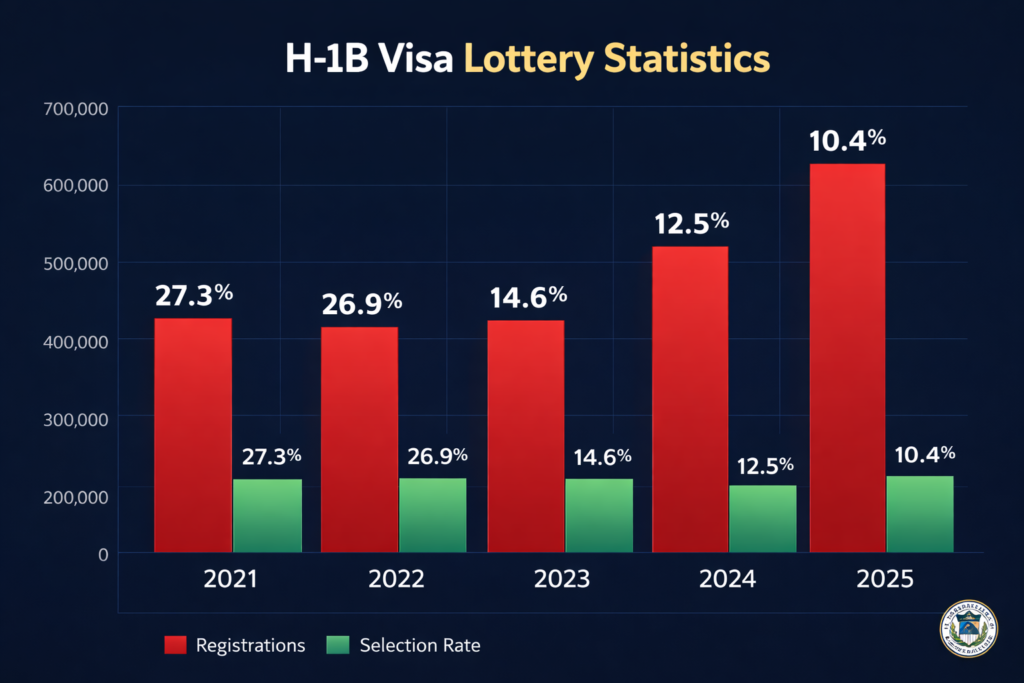
Before explaining how cap-exempt works, it helps to understand precisely how difficult the standard lottery has become. These figures come from official USCIS electronic registration data and announcements.
For a complete breakdown of how the lottery registration
process works, official costs, and what changed in 2025,
read our detailed guide on the
[H-1B lottery new rules, costs, and selection process](https://usaharmony.com/h1b-lottery-new-rules-costs-selection/).
H-1B Lottery Registration and Selection: FY2021–FY2025
| Fiscal Year | Eligible Registrations | Initial Selections | Key Context |
|---|---|---|---|
| FY2021 | ~274,000 | ~85,000 | Multiple employer registrations per beneficiary permitted |
| FY2022 | ~309,000 | ~85,000 | Same multi-employer structure; odds worsening |
| FY2023 | ~474,421 | Multiple rounds required | USCIS conducted multiple selection rounds; final totals not publicly released |
| FY2024 | ~758,994 | ~110,791 (initial) | Record registrations, partly driven by multi-employer gaming of the system |
| FY2025 | ~470,342 | 114,017 (initial) + 13,607 (second round) | First full cycle under beneficiary-centric rules — most accurate individual count |
(Sources: USCIS FY2025 Cap Season Announcement | Federal Register 89 FR 15602)
Two important caveats about this data. First, prior to FY2025, USCIS allowed multiple employers to register the same beneficiary, which artificially inflated raw registration numbers. The FY2024 figure of nearly 760,000 registrations does not represent 760,000 unique individuals. Starting FY2025, USCIS implemented a beneficiary-centric selection model under the March 2024 Final Rule — one registration per unique person — making FY2025 numbers the most accurate measure of actual individual demand.
Second, even with those reforms, the FY2025 data shows roughly 127,624 total selections against approximately 470,342 registrations. That’s a selection rate of around 27% — meaning nearly three in four individuals who registered were not chosen. For workers competing only in the general 65,000 cap pool without a U.S. advanced degree, odds are meaningfully lower. This is the environment in which cap-exempt status has become increasingly important.

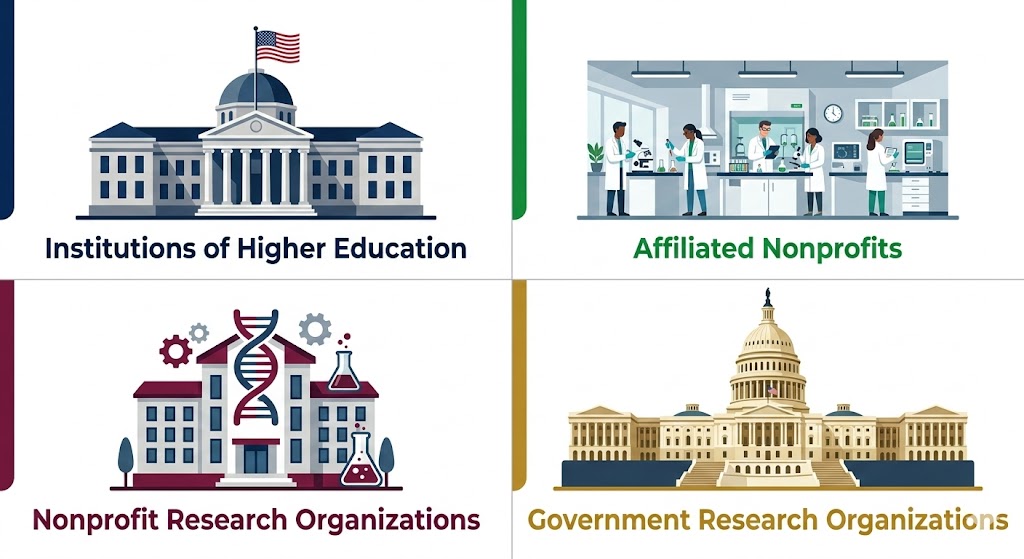
This is where the most dangerous misconceptions live. People hear “nonprofits can sponsor without the lottery” and assume any 501(c)(3) qualifies. That assumption sends people chasing the wrong jobs for months. The eligibility categories are specific and statutory.
Institutions of Higher Education
The clearest and least contested category. Accredited colleges and universities — from flagship research institutions to community colleges — qualify as cap-exempt employers. The definition comes directly from Section 101(a) of the Higher Education Act of 1965 (20 U.S.C. § 1001(a)), which requires the institution to be accredited by a recognized national agency, authorized by its state to operate, nonprofit or public in structure, and capable of conferring degrees or providing at least two years of credit toward a bachelor’s degree.
USCIS interprets this category broadly and consistently. Accreditation letters, state authorization records, tax documentation, and institutional websites are typically sufficient. Most established universities face no meaningful challenge establishing this status.
Nonprofits Affiliated With a Higher Education Institution
This category is where eligibility becomes nuanced and where petitions most frequently run into problems. A nonprofit hospital, research foundation, or professional training institute can qualify — but only if it has a formal, documented, active working relationship with a qualifying university.
“Affiliated” has a specific regulatory meaning under 8 C.F.R. § 214.2(h)(8)(ii)(F)(2). It means the nonprofit is connected to the university through shared ownership or governance, is operated by the university as a subsidiary or branch, or has entered into a formal written affiliation agreement establishing an active working relationship for research or educational purposes.
The December 2024 Final Rule, effective January 17, 2025, clarified that a nonprofit engaging in activities outside the scope of its affiliation agreement does not lose cap-exempt status as a result. The organization doesn’t have to do only university-related work — it just needs to have a genuine, ongoing, formally documented relationship with a qualifying institution, and a fundamental activity that contributes to that institution’s research or education mission.
A vague memorandum of understanding is not enough. A detailed cooperative agreement with joint faculty, shared research programs, or structured student training pipelines is. And that agreement must remain active for the entire petition period — not just at the time of filing.
Nonprofit Research Organizations
Nonprofits where research is a “fundamental activity” qualify independently, without any university connection required. This category was meaningfully changed by the DHS Final Rule published December 18, 2024 (89 FR 103054), effective January 17, 2025, which amended 8 C.F.R. § 214.2(h) to replace the former “primarily engaged in research” standard with the broader “fundamental activity” test.
Before the rule change, USCIS expected research to be the dominant, primary purpose of the organization. After the change, a nonprofit that conducts genuine research as a core part of its mission — even if it also provides patient care, public advocacy, education, or social services — has a legally stronger basis for cap-exempt status. The Federal Register gives the example of a nonprofit hospital that conducts medical research as a fundamental activity: it may qualify even though patient care is its primary operational function. (Federal Register 89 FR 103054)
This expanded the pool of qualifying nonprofits meaningfully. However — and this matters — expanded eligibility does not mean reduced scrutiny. USCIS adjudications remain evidence-based and discretionary. The agency still expects substantive documentation: Form 990 filings showing research expenditures, grant award records, publication histories, staff organizational charts showing research personnel, and annual reports that make research a visible, funded, staffed priority. The standard changed. The evidentiary burden did not.
Government Research Organizations
Federal, state, and local government entities whose fundamental purpose involves conducting or promoting basic or applied research qualify under the same framework. National laboratories, public health research agencies, and federally funded research and development centers are typical examples. Proving government status is generally straightforward through public records. The “fundamental activity” standard now applies here as well.
The Fifth Pathway: The “At” Model Most Guides Overlook
A private, for-profit company wants to hire a foreign worker. They’ve lost the H-1B lottery. But the worker would be placed full-time at a university research lab, doing work that directly supports that university’s research mission. Can the private company file a cap-exempt petition?
Yes — under specific conditions defined at 8 C.F.R. § 214.2(h)(8)(iii)(F)(4), effective January 17, 2025.
This is called the “at” exemption or third-party placement model. A cap-subject employer can file a cap-exempt petition if the worker will spend at least 50% of their working time performing duties that directly and predominantly advance the essential purpose, mission, objectives, or functions of a qualifying cap-exempt institution. The January 2025 rule codified that 50% threshold explicitly and clarified that “working at” the institution includes remote and telework arrangements — physical presence on campus is not strictly required as long as the work demonstrably serves the institution’s mission.
One point with significant downstream consequences: in the “at” model, the petitioning employer is still the private company. That matters directly for the $100,000 fee question, addressed below.
Once a cap-exempt employer secures H-1B approval for a worker, a second employer — even a fully cap-subject private company — can file a concurrent H-1B petition for that same individual without entering the lottery. The second petition rides on the existing cap-exempt approval.
Here’s how it works in practice. A worker holds a genuine part-time position at a qualifying nonprofit research organization. That employer files a cap-exempt H-1B petition and wins approval. Now the worker’s full-time private employer can file a concurrent H-1B petition for the primary role — no lottery, no registration window, no April deadline.
The dependency is real and important. The concurrent cap-subject petition’s validity is tied to the ongoing existence of the cap-exempt employment. If the worker leaves the nonprofit role, the concurrent status can be compromised. This is not a technicality you manage around later — it’s a structural constraint you plan for upfront. The cap-exempt job must be genuine, compensated, documented, and ongoing throughout both petition periods.
Three Real-World Paths: Composite Case Studies
Case Study 1: Dr. Priya and the Affiliated Nonprofit Pathway
Dr. Priya is a computational biology researcher from India. She finished her PhD at a U.S. university, was working on STEM OPT when her private biotech employer submitted her for the lottery — and lost. Twice. With OPT running out, she shifted her search toward nonprofit research institutes. She found a position at a 501(c)(3) medical research foundation that held a formal cooperative agreement with a nearby university — joint faculty appointments, shared laboratory space, co-authored federally funded grant applications. That agreement was the foundation of her cap-exempt petition, filed under 8 C.F.R. § 214.2(h)(8)(ii)(F)(2), alongside the IRS determination letter and extensive research documentation. With premium processing, approval came back in eleven days. She is now in her second year, with a PERM labor certification initiated.
The lesson: The affiliation agreement has to be substantive, current, and operationally active — not a loose MOU.
For Indian nationals navigating H-1B approvals specifically,
the stamping experience carries additional nuance.
Our [H-1B visa stamping guide specifically for Indian
professionals](https://usaharmony.com/h1b-visa-stamping-2026-guide-indian-professionals/)
covers the Hyderabad and Chennai consulate experience in detail.
The more thoroughly documented the working relationship between the nonprofit and the university, the stronger the petition holds up to scrutiny.
Case Study 2: Marcus and the Concurrent Employment Strategy
Marcus is a software engineer from Brazil working on STEM OPT. His primary employer — a mid-size healthcare technology company — had lost the H-1B lottery for him two years in a row. He connected with a university-affiliated nonprofit offering a genuine part-time advisory role — eight hours per week supporting a digital health research initiative. The nonprofit filed a cap-exempt H-1B petition for the part-time role. Once approved, his primary tech company filed a concurrent petition — no lottery required. Both H-1Bs are now active. His primary employer has since initiated the green card process.
The lesson: The part-time cap-exempt role must be real. Documented duties, actual compensation, genuine deliverables. USCIS is attentive to arrangements that exist primarily to generate immigration status. Paper employment creates petition risk for both the employer and the worker.
Case Study 3: Dr. Ahmed and the FQHC Pathway
Dr. Ahmed is a physician from Egypt who completed residency in the U.S. on a J-1 visa and obtained a waiver. When his employer submitted him for the H-1B lottery, he wasn’t selected. Through a medical staffing network, he found a federally qualified health center in rural Midwest — an institution that qualifies under the cap-exempt framework and has an established H-1B sponsorship pipeline for clinical professionals. The petition was filed in June. With premium processing, approval arrived within two weeks. His spouse received H-4 status, and green card sponsorship was negotiated into the initial contract.
The lesson: For clinical professionals willing to work in underserved areas, cap-exempt eligibility combined with persistent workforce shortages creates a genuinely accessible hiring environment. The compensation gap versus private practice is real, but so is the stability and the long-term immigration pathway.
Cap-Exempt vs. Cap-Subject: Direct Comparison
| Feature | Cap-Exempt H-1B | Cap-Subject H-1B |
|---|---|---|
| Annual numerical limit | None | 85,000 (65K general + 20K master’s) |
| Lottery required | No | Yes, when oversubscribed |
| Filing window | Any time, year-round | Registration opens approximately March annually |
| Employer types | Universities, qualifying nonprofits, government research orgs | Any U.S. employer |
| Premium processing available | Yes | Yes |
| Green card sponsorship possible | Yes | Yes |
| Specialty occupation required | Yes | Yes |
| Prevailing wage rules apply | Yes | Yes |
| Switching to cap-subject employer | Requires lottery unless concurrent or prior cap count | N/A |
| Status transfers with employer change | No — tied to specific petition | No — tied to specific petition |
| Concurrent employment enabled | Yes | Yes |
Processing Time: Standard vs. Premium
| Processing Type | Typical Timeline | USCIS Guarantee | Recommended For |
|---|---|---|---|
| Standard processing | 2–5 months | None | Workers with no urgent deadline |
| Premium processing | 3–15 business days | Adjudicative action within 15 business days | Workers on expiring OPT or STEM OPT |
| Premium with RFE issued | 15 days + response time | 15-day clock restarts after response received | Complex employer documentation cases |
Current premium processing fee for Form I-129 is $2,805 as of 2025 (USCIS Filing Fees). Note that USCIS guarantees an adjudicative action — meaning approval, RFE, or denial — within the 15-business-day window. An RFE pauses and restarts the clock. For workers with STEM OPT expiring within four months, standard processing does not provide meaningful assurance of continuous status. Premium processing in those cases is a necessity, not a convenience.
Once your petition receives approval, you will receive an
I-797 Notice of Action. Understanding your
[H-1B visa number and where to find it on your approval documents](https://usaharmony.com/h1b-visa-number-what-it-is-where-to-find-it/)
is an important step before your start date and any
future employer transfers.
What Getting the Job Actually Requires
The visa pathway exists. Getting hired is a separate challenge, and it deserves honest discussion.
Universities have their own credentialing expectations that operate entirely independently of immigration law. Research and faculty-adjacent roles routinely require a doctorate. Academic HR cycles are long — three to six months from posting to offer is normal — and most institutions don’t proactively communicate rejections. If you haven’t heard back within a few weeks of an application deadline, that silence is typically the answer.
For clinical and healthcare professionals, the market responds differently. Physicians, dentists, nurse practitioners, and other licensed clinicians at federally qualified health centers, university-affiliated hospital systems, and nonprofit community health organizations encounter genuine demand — particularly in rural and medically underserved areas where workforce shortages are persistent and real.
Technology and IT professionals find cap-exempt roles at universities and research institutions, but competition from local candidates is real. When given an equivalent choice, most institutions prefer someone who doesn’t require sponsorship. Prior relationships matter significantly — alumni networks, former internships, and professional collaborators who know your work open doors that cold applications rarely reach.
Applying from outside the United States reduces response rates across all these categories, independent of qualification level. Being inside the U.S. on any valid authorization — OPT, STEM OPT, J-1, or other status — positions you more favorably from an employer’s practical perspective.
What USCIS Actually Wants in the Documentation Package
Most cap-exempt petition denials and RFEs trace back to documentation problems — not eligibility problems. The employer genuinely qualifies. The petition just doesn’t prove it adequately.
Think of it this way: USCIS has never visited your employer’s campus or seen the research happening. The petition is the only thing they have. If it doesn’t tell a complete, specific, evidence-backed story, they send an RFE — which adds months and costs more money.
For universities: Accreditation documentation, state authorization records, degree program evidence. Straightforward for any established institution.
For affiliated nonprofits: IRS 501(c)(3) determination letter, the full affiliation agreement, evidence the agreement is currently active, and a specific explanation connecting the worker’s job duties to the university’s research or education mission. The connection must be explicit and documented — not assumed.
For nonprofit research organizations: IRS determination letter plus substantive evidence that research is a fundamental organizational activity. This means Form 990 analysis showing research expenditures, grant award records, publication histories, organizational charts showing research staff, and annual reports that reflect research as a visible funded priority. The January 2025 rule expanded who qualifies — it did not reduce what you have to show. (8 C.F.R. § 214.2(h) | USCIS Form I-129 Instructions)
For “at” placements: A contract or formal agreement between the private employer and the qualifying institution, a letter from the institution confirming and describing the placement, and a detailed duty description showing how the worker’s role serves that institution’s core mission.
If you receive an RFE, treat it as a second chance to complete the evidentiary record — not as a denial to fight. Many RFE responses result in approval when the missing documentation is properly submitted.
The $100,000 Fee: The Most Misreported Aspect of 2025 H-1B Policy
This section has been widely misunderstood — including in earlier versions of this very article. Here is the accurate, verified picture.
What happened: On September 19, 2025, President Trump signed a Presidential Proclamation titled “Restriction on Entry of Certain Nonimmigrant Workers,” invoking authority under INA §§ 212(f) and 215(a) (8 U.S.C. § 1182(f)). It took effect at 12:01 a.m. Eastern on September 21, 2025. USCIS published implementing guidance on October 20, 2025. (USCIS H-1B FAQ)
The trigger is the beneficiary’s location — not the employer’s tax status. This is the critical point that most summaries get wrong. The $100,000 payment is required when all three of these conditions are met simultaneously:
- A new H-1B petition is filed on or after September 21, 2025, AND
- The beneficiary is outside the United States at the time of filing, AND
- The petition will result in the beneficiary entering the U.S. in H-1B status via consular processing
Who is NOT subject to the $100,000 payment:
- Petitions filed before 12:01 a.m. Eastern on September 21, 2025
- Beneficiaries already inside the United States filing a change of status, extension of stay, or amendment — including F-1 students on OPT changing to H-1B, and workers changing employers while remaining in the U.S.
- Workers in valid H-1B status already
- Workers traveling abroad who reenter under a petition approved before the effective date
Once your cap-exempt H-1B petition is approved and you need
to travel internationally, understanding the stamping process
is your next critical step. See our complete guide to the
[H-1B visa stamping process for 2026](https://usaharmony.com/h1b-visa-stamping-2026-guide/)
before booking any international travel.
The key correction about cap-exempt employers: Universities, nonprofit research institutions, and affiliated nonprofits are not automatically exempt from the $100,000 payment. Cap-exempt status determines whether the petition counts against the 85,000 annual lottery cap. The $100,000 fee is an entirely separate legal framework triggered by entry from abroad. A university filing a new H-1B for a researcher currently living in India who has never held U.S. status must pay the fee — unless the narrow national interest exception applies.
That national interest exception requires demonstrating extraordinary circumstances: no American worker is available, the beneficiary does not pose a security risk, and requiring the payment would significantly undermine U.S. interests. USCIS has described this threshold as applying to rare situations. It is not a routine path.
Additional context: Multiple federal lawsuits, including one filed by the Chamber of Commerce and the Association of American Universities, were challenging the proclamation’s legality as exceeding presidential authority as of late 2025. The proclamation itself is set to expire 12 months from its September 21, 2025 effective date absent extension. Given active litigation and the time-limited nature of the order, anyone planning to file a new petition for a beneficiary currently abroad should consult both current USCIS guidance at uscis.gov and qualified legal counsel before proceeding. (White House Proclamation)
Salary and Wages: The Honest Version
There is no separate salary floor unique to cap-exempt positions. Every H-1B petition — regardless of employer type — requires a Department of Labor-certified Labor Condition Application confirming the offered wage meets or exceeds the prevailing wage for the specific occupation and geographic location. That standard applies equally to universities and private companies. (DOL LCA Requirements)
What is true: wages at universities and nonprofit research institutions are typically lower in absolute terms than equivalent private-sector roles. A data scientist at a university lab in Ohio will likely earn less than the same data scientist at a technology company in California. But both salaries might satisfy their respective prevailing wage standards, because those standards are occupation-specific and location-specific.
Don’t assume cap-exempt means a pay cut — and don’t assume it means competitive private-market compensation either. Ask the salary question directly. The LCA is a public record, so wage information is accessible regardless of whether the employer volunteers it.
One additional development worth noting: the same September 2025 Presidential Proclamation directed the Department of Labor to initiate rulemaking to raise prevailing wage levels for H-1B positions. That rulemaking was ongoing as of early 2026 and, if finalized, would affect minimum wage floors for all H-1B petitions — cap-exempt and cap-subject alike.
What Happens When You Want to Leave
This conversation rarely happens before accepting a cap-exempt offer — and then suddenly matters enormously when a private company makes an attractive offer two years later.
If you have only ever held a cap-exempt H-1B and have never been selected under the lottery in a prior year, moving to a standard private employer requires that employer to enter you in the H-1B lottery. You are not automatically portable. You’d need to register during the next available window, compete for selection, and potentially wait through multiple cycles.
The concurrent strategy is the main structured workaround. If you maintain genuine cap-exempt employment while a private employer files a concurrent cap-subject petition for your primary role, the lottery requirement may be avoided — because the concurrent petition rides on your existing cap-exempt approval. But that cap-exempt employment must remain active throughout the process. If it ends while the concurrent petition is still pending, your status may be in jeopardy.
A separate situation applies to workers who were previously selected under the cap in an earlier year — perhaps they worked for a cap-subject employer years ago, then moved to a university. Because they’ve already been “counted,” a new cap-subject employer can file for them without a new lottery selection. If you’re unsure whether your employment history gives you this prior-cap-count status, an immigration attorney can confirm it by reviewing your records. (INA § 214(g))
Five Common Mistakes That Derail Cap-Exempt Petitions
Mistake 1: Assuming Any Nonprofit Qualifies Being a 501(c)(3) does not create cap-exempt status. The nonprofit must fall into one of the defined categories — a qualifying educational institution, formally affiliated with one, or having research as a fundamental activity. Nonprofits providing advocacy, social services, housing assistance, or legal aid almost certainly do not qualify unless they independently satisfy one of those standards.
Mistake 2: Relying on a Weak or Expired Affiliation Agreement A one-page MOU that describes a loose collaboration won’t survive scrutiny. USCIS expects a formal, detailed, currently active written agreement establishing an ongoing working relationship for research or educational purposes. Ask about the agreement’s renewal status before building your petition around it.
Mistake 3: Job Duties That Don’t Connect to the Institution’s Mission The worker’s specific duties must directly and predominantly further the qualifying institution’s core purpose. A general administrative role at a university requires a specific and documented argument about how those duties advance educational or research functions — it won’t be assumed. The connection must be made explicitly in the petition. (8 C.F.R. § 214.2(h)(8)(iii)(F))
Mistake 4: Letting the Qualifying Status Lapse During the Petition Period If the affiliation agreement expires, the university changes its relationship with the nonprofit, or the organization ceases its research activities, the cap-exempt basis for the petition can be challenged at extension. Evaluate the durability of whatever creates your employer’s exemption before accepting an offer built around it.
Mistake 5: Treating Concurrent Employment as a Paper Arrangement The concurrent strategy works when the cap-exempt employment is genuine. It fails — and creates legal exposure for both employer and worker — when the part-time role exists only on paper to manufacture immigration eligibility. Real duties, real compensation, real documentation.
Frequently Asked Questions
Eligibility is determined by the employer’s type. Accredited universities, qualifying affiliated nonprofits, nonprofit research organizations with research as a fundamental activity, and government research entities can file outside the lottery. The worker’s role must still qualify as a specialty occupation requiring at least a bachelor’s degree in a specific field.
It depends on where the beneficiary is located — not on whether the employer is cap-exempt. If a qualifying nonprofit or university files a new H-1B petition on or after September 21, 2025 for a beneficiary currently outside the United States, the $100,000 requirement applies unless the narrow national interest exception is approved. Beneficiaries already inside the U.S. filing a change of status or extension are not subject to the fee. This proclamation is subject to active federal litigation and expires 12 months from its effective date absent renewal. Confirm current status at USCIS.gov.
Standard processing runs two to five months. With premium processing, USCIS commits to an adjudicative action — approval, RFE, or denial — within 15 business days. Most well-documented cap-exempt petitions with premium processing resolve in under two weeks. Current premium fee is $2,805 per USCIS Filing Fees.
No. There is no annual numerical ceiling on cap-exempt petitions. Any qualifying employer can sponsor as many workers as it has legitimate positions for.
If you’ve never been selected under the cap, you’d generally need to enter the lottery. The concurrent employment model may provide an alternative. If you were previously selected under the cap in an earlier year, a new cap-subject employer can file for you without a new lottery selection.
The employer must pay at or above the DOL prevailing wage for your occupation and location, as confirmed through the certified LCA. There is no separate or lower salary floor for cap-exempt positions. (DOL LCA Requirements)
Yes — under the “at” placement model — if the worker will spend at least 50% of their time on duties that directly advance the mission of a qualifying cap-exempt institution. Note the $100,000 fee may apply because the petitioning employer is a private company. (8 C.F.R. § 214.2(h)(8)(iii)(F)(4))
Yes. A qualifying employer can file an I-129 at any time — no lottery window, no April deadline. The January 2025 Final Rule also codified automatic cap-gap protection for F-1 students with pending cap-subject H-1B change-of-status petitions under 8 C.F.R. § 214.2(f)(5)(vi)(A). For workers with imminent STEM OPT expiration, file the I-129 with premium processing and start that process well before the expiration date. (USCIS OPT for F-1 Students)
Your spouse qualifies for H-4 status on the same basis as any H-1B holder’s dependent. H-4 status alone does not grant work authorization. However, if you have an approved I-140 immigrant petition and are in an H-1B extension period waiting on a priority date, your H-4 spouse may be eligible for an H-4 EAD — employment authorization tied to the green card process, not to cap-exempt status itself. (USCIS H-4 EAD)
If the employer closes, you have a 60-day grace period under current USCIS regulations to find a new employer and have a transfer petition filed. (USCIS Grace Periods) If the employer loses its cap-exempt status mid-petition — for example, because an affiliation agreement expires — the basis for your petition extension may be challenged. Before accepting a cap-exempt offer, understand what creates that employer’s exemption and how durable that foundation is.
LEGAL DISCLAIMER
This article is intended for general informational and
educational purposes only. It does not constitute legal advice,
immigration advice, or a substitute for consultation with a
licensed U.S. immigration attorney. U.S. immigration law,
USCIS policy, and related federal regulations are subject
to frequent change, including through executive action,
rulemaking, and federal court decisions.
The information presented in this article reflects the authors’
understanding of publicly available sources, official USCIS
guidance, and federal regulatory materials as of 2025–2026.
It may not reflect developments that occurred after the
article’s publication date.
No attorney-client relationship is created by reading,
sharing, or relying on this article. All readers are strongly
encouraged to consult a qualified immigration attorney
licensed to practice in the United States before making
any visa, petition, or employment decisions.
Specific situations — including cases involving the $100,000
Presidential Proclamation fee, pending federal litigation,
or complex concurrent employment arrangements — require
individualized legal analysis that this article cannot provide.
The author and publisher assume no liability for actions
taken based on the information contained herein.