

Russia has dramatically escalated the Ukraine war by launching a nuclear-capable ballistic missile toward western Ukraine, signaling a direct warning to Europe and the United States as peace negotiations gain momentum.
The Russian Defense Ministry confirmed on Friday that it fired an Oreshnik intermediate-range ballistic missile, capable of carrying nuclear warheads, toward western Ukraine—marking only the second known use of the weapon since the war began. The strike occurred near Ukraine’s western regions, uncomfortably close to Poland and NATO’s eastern flank, intensifying concerns across Europe.
Though the missile carried non-explosive or dummy warheads, military analysts and European officials agree the attack was symbolic rather than tactical, designed to project power and remind the West of Russia’s nuclear capabilities.
A Calculated Signal to Europe and NATO
The selection of western Ukraine as the target was no coincidence. Unlike previous missile strikes focused on eastern and southern regions, this launch placed the missile’s impact zone within proximity of European Union and NATO territory.
European diplomats described the move as an intentional escalation, aimed at influencing ongoing diplomatic efforts to end the war and deterring further Western military support for Kyiv.
“This was not about battlefield gains,” said one senior European official. “It was about intimidation.”
What Is the Oreshnik Missile?
The Oreshnik is an intermediate-range ballistic missile derived from Russia’s RS-26 Rubezh, a system originally designed for intercontinental nuclear missions. Though modified for shorter distances, the missile remains part of Russia’s strategic nuclear forces.
Key capabilities:
Can carry nuclear, conventional, or dummy warheads
Uses multiple independently separating warheads
Travels at hypersonic speeds
Cannot be intercepted by Ukraine’s current air defense systems
Its use is widely interpreted as a thinly veiled nuclear threat, even when no nuclear payload is present.
No Explosives, But Maximum Impact
Ukrainian intelligence assessments confirmed that no explosive material was found in the warheads used during Friday’s strike. Colonel Roman Kostenko, secretary of Ukraine’s parliamentary defense committee, said the findings strongly indicate the missile was used solely for political and psychological pressure.
Nevertheless, the message was received loud and clear.
EU foreign policy chief Kaja Kallas described the strike as “a deliberate escalation meant to warn Europe and the United States.”
Massive Overnight Assault Across Ukraine
The Oreshnik launch was part of a larger, coordinated Russian assault that included:
36 missiles
More than 240 attack drones
Strikes across multiple Ukrainian regions
Kyiv Hit Hardest
Ukraine’s capital endured the most devastating impact:
At least four civilians killed, including a medical worker
More than 20 injured
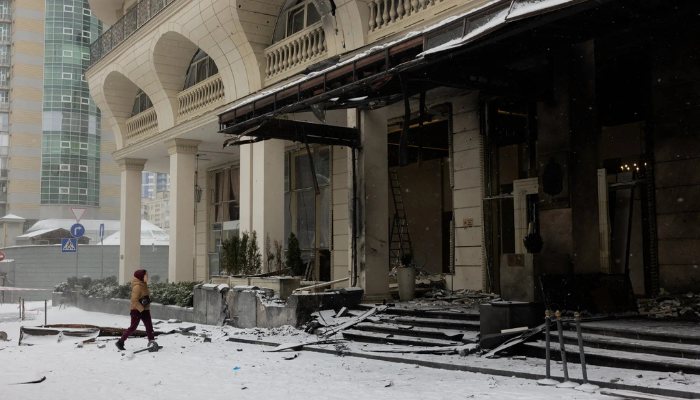
Several residential high-rise buildings struck
One apartment complex was hit twice in a “double-tap” strike, a tactic designed to target first responders arriving at the scene. Ukrainian emergency services reported injuries to rescue workers and medical staff.
“The most cynical attacks are against those who save lives,” Interior Minister Ihor Klymenko said.
Infrastructure Damage Amid Freezing Temperatures
Missile and drone strikes also hit critical infrastructure, causing:
Water supply disruptions
Heating outages affecting half of Kyiv’s apartments
With temperatures plunging to -8°C (17°F) and expected to drop further, Mayor Vitali Klitschko urged residents who could leave the city to seek warmth elsewhere.
Black Sea Attack on Civilian Vessels
Later on Friday, Ukraine reported that Russian drones struck two foreign-flagged civilian ships in the Black Sea.
According to Deputy Prime Minister Oleksii Kuleba:
One Syrian crew member was killed
Multiple others were injured
The attack raised further alarms about the safety of commercial shipping and the broader regional implications of Russia’s military campaign.
Russia’s Justification Disputed
Moscow claimed the Oreshnik launch was retaliation for an alleged Ukrainian attempt to attack one of President Vladimir Putin’s residences last month.
Ukraine categorically denied the accusation, calling it fabricated and intended to justify escalation. U.S. intelligence agencies have also stated they found no evidence supporting Russia’s claim.
Zelensky Calls for Global Response
Ukrainian President Volodymyr Zelensky demanded firm international action, particularly from Washington.
“Russia only understands strength,” Zelensky wrote. “Every time it chooses destruction over diplomacy, it must face consequences.”
He emphasized that the missile strike posed a direct threat to Europe, naming cities such as Warsaw, Bucharest, and Budapest as equally vulnerable.
A Treaty Broken, a Threat Revived
The Oreshnik missile falls under a category once banned by the Intermediate-Range Nuclear Forces (INF) Treaty, signed in 1987 to ease Cold War tensions.
The U.S. withdrew from the treaty in 2019, citing Russian violations
Russia later abandoned the agreement entirely
Missiles once prohibited are now actively used in Ukraine
Security experts warn this erosion of arms control increases the risk of strategic miscalculation.
Why This Strike Matters
While the Oreshnik caused limited physical damage, its strategic implications are enormous:
Signals Russia’s willingness to invoke nuclear symbolism
Raises pressure on European governments
Tests Western resolve during sensitive peace negotiations
Demonstrates weapons Ukraine cannot defend against
The strike underscores a dangerous reality: Russia is prepared to escalate rhetorically and militarily to influence diplomacy.
Conclusion: A Warning Shot Heard Across Europe
The launch of a nuclear-capable missile—dummy warheads or not—marks a critical turning point in the Ukraine war. It was not meant to destroy cities, but to shake capitals, from Kyiv to Brussels to Washington.
As diplomacy struggles to gain traction, Russia’s message is unmistakable:
Peace talks will proceed under the shadow of escalation.