


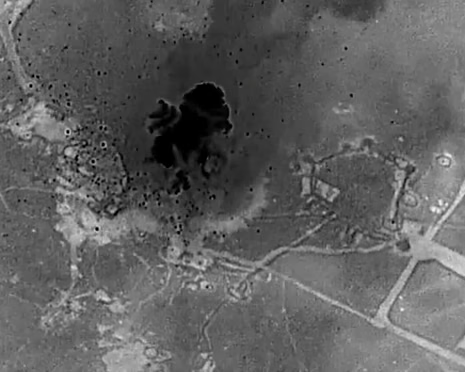
The United States, along with allied partner forces, has carried out an extensive series of airstrikes targeting Islamic State (IS) strongholds across Syria, according to a statement released by the US Central Command (CENTCOM). The military action marks one of the most significant operations against the extremist group in recent months and underscores Washington’s continued commitment to counterterrorism efforts in the Middle East.
The strikes, executed on Saturday, were ordered directly by US President Donald Trump and form part of Operation Hawkeye Strike, a campaign initiated in response to a deadly Islamic State attack on US forces earlier in December. That ambush, which occurred near the historic city of Palmyra in central Syria, resulted in the deaths of two American soldiers and a civilian interpreter supporting US operations.
Operation Hawkeye Strike: A Calculated Military Response
CENTCOM described the latest offensive as a “large-scale, precision-focused operation” designed to disrupt Islamic State networks, dismantle their operational capabilities, and prevent future attacks against US and allied forces. The operation is not intended to initiate a broader conflict but rather to send a clear deterrent message to extremist organizations operating in the region.
In a statement posted on social media platform X, CENTCOM emphasized that the United States would respond decisively to any threat against its personnel. “If you harm our warfighters, we will pursue you relentlessly,” the command stated, reaffirming its zero-tolerance stance on attacks against American forces.
Massive Firepower Deployed Across Multiple Targets
According to US defense officials speaking to CBS News, more than 90 precision-guided munitions were launched against over 35 Islamic State targets scattered across central Syria. The operation involved more than 20 aircraft, highlighting the scale and coordination of the mission.
A diverse array of military assets participated in the strikes, including F-15E Strike Eagles, A-10 Thunderbolt II aircraft, AC-130J gunships, MQ-9 Reaper drones, and Jordanian F-16 fighter jets. The involvement of Jordanian forces reflects continued regional cooperation in combating terrorism.
While the Pentagon has not yet disclosed specific locations of the targeted sites, officials confirmed that the strikes focused on known IS infrastructure, weapons depots, and operational hubs used to plan and coordinate attacks.
Casualty Figures Yet to Be Confirmed
At present, there is no verified information regarding the number of casualties resulting from the strikes. CENTCOM stated that battle damage assessments are ongoing, and further details will be released once intelligence reviews are completed.
US Defense Secretary Pete Hegseth echoed the administration’s hardline stance, posting on X that the United States would “never forget and never relent” when responding to attacks on its forces. His remarks reinforced the administration’s messaging that Operation Hawkeye Strike is a sustained effort, not a one-time response.
Background: The December Attack That Sparked the Operation
Operation Hawkeye Strike was first announced in December following a deadly Islamic State ambush near Palmyra. The attack underscored that despite years of military pressure, IS remnants remain capable of carrying out lethal operations, particularly in Syria’s vast desert regions.
When announcing the campaign last month, Secretary Hegseth described it as an act of retribution rather than the start of a new war. “This is not the beginning of a broader conflict,” he said at the time. “It is a declaration that the United States will defend its people without hesitation.”
Previous Missions Yield Significant Results
Before the latest wave of airstrikes, US and allied forces conducted 11 separate missions between 20 December and 29 December, during which nearly 25 Islamic State members were killed or captured, according to CENTCOM.
The first mission of Operation Hawkeye Strike, launched on 19 December, was particularly intense. US and Jordanian forces carried out coordinated attacks using fighter jets, attack helicopters, and artillery, striking more than 70 IS targets across central Syria. That operation alone involved the deployment of over 100 precision munitions.
CENTCOM noted that these early missions significantly degraded IS capabilities, destroying key weapons stockpiles, logistics routes, and command centers.
Syria’s Fragile Political Landscape
The renewed US military action comes at a time when Syria remains politically and militarily fragile. In December 2024, the long-standing regime of President Bashar al-Assad collapsed, effectively bringing an end to a brutal civil war that had devastated the country for over 13 years.
Following Assad’s removal, rebel leader Ahmed al-Sharaa, also known as Abu Mohammed al-Jolani, assumed the presidency after his faction consolidated control. While the change in leadership marked a historic turning point, it also created security vacuums in several regions—conditions that extremist groups like Islamic State have attempted to exploit.
Islamic State Still a Threat Despite Weakened Position
Although Islamic State no longer controls large swathes of territory as it once did, US intelligence assessments indicate that the group remains active and dangerous. In 2025, IS fighters have primarily targeted Kurdish-led forces in northeastern Syria, conducting ambushes, bombings, and targeted assassinations.
US officials warn that without sustained pressure, IS could regroup and reestablish operational networks, particularly in remote desert areas where government control is weak.
US Commitment to Counterterrorism in the Region
The Biden and Trump administrations alike have maintained that US military presence in Syria is focused on preventing the resurgence of Islamic State and ensuring regional stability. Operation Hawkeye Strike represents a continuation of that long-term counterterrorism strategy.
CENTCOM reiterated that the United States would continue working closely with regional partners to neutralize threats and protect both military personnel and civilian populations.
Conclusion
The latest US-led strikes against Islamic State targets in Syria signal a strong and deliberate response to terrorism and a clear warning to extremist groups operating in the region. Through Operation Hawkeye Strike, Washington aims to dismantle remaining IS networks, deter future attacks, and reinforce its commitment to defending its forces and allies.
As Syria navigates a precarious post-war transition, the battle against Islamic State is far from over. The United States has made it clear that it will remain vigilant—and ready to act—against any threat that endangers its people or undermines regional security.