
By [Emma Charlotte] | Geopolitics & Global Affairs Analysis
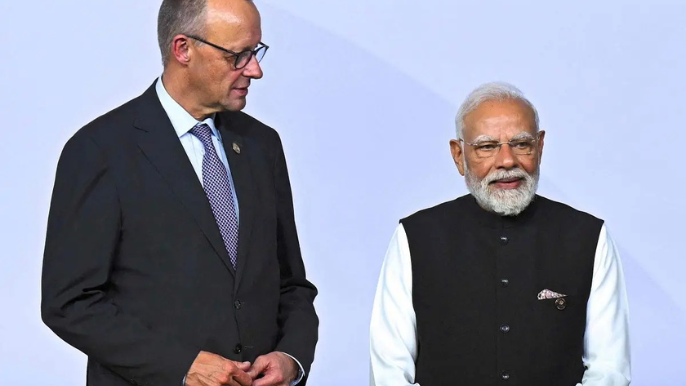
As the global order undergoes a profound transformation, German Chancellor Friedrich Merz’s first major Asia tour marks more than a diplomatic courtesy—it signals a strategic recalibration. His decision to begin the tour in India, before visiting China, carries deep geopolitical meaning. In an era shaped by shifting power balances, strained alliances, and growing uncertainty around the United States, India and Germany are quietly positioning each other as indispensable partners.
This visit reflects a broader reality: the old certainties of global politics are fading, and middle powers like India and Germany are increasingly shaping the future through pragmatic cooperation rather than ideological alignment.
A Partnership Moving Beyond Economics
For decades, India–Germany relations were largely defined by trade, engineering, and industrial collaboration. German companies such as Bosch, Siemens, Continental, and Mercedes-Benz have long viewed India as a high-growth market, while India has regarded Germany as a global benchmark for precision engineering and innovation.
However, the relationship is now evolving rapidly.
Today, defence, security, technology transfer, and geopolitics are emerging as new pillars of engagement. This shift reflects not only India’s rising strategic ambitions but also Germany’s changing worldview following Russia’s invasion of Ukraine and growing instability in transatlantic relations.
Defence Cooperation: A Strategic Breakthrough
One of the most consequential developments during Chancellor Merz’s visit is the advancement of negotiations on a €8 billion submarine co-production deal. Under the proposed agreement, German submarines would be built in India, involving extensive technology transfer and joint manufacturing.
Why This Matters for India
For New Delhi, the deal aligns perfectly with its “Make in India” and defence indigenization goals. India is seeking to modernize its navy amid rising tensions in the Indo-Pacific, particularly due to China’s expanding naval presence.
Equally important, the partnership helps India diversify away from its traditional dependence on Russian military equipment, a necessity in a world where sanctions, supply disruptions, and geopolitical pressure are increasing.
Why Germany Is Onboard
For Berlin, defence cooperation with India represents a major policy shift. Germany was historically cautious about arms exports, especially to countries with close ties to Russia. However, those restrictions have eased as Germany reassesses its security posture after the Ukraine war.
India is now seen as a trusted democratic partner, offering Germany access to one of the world’s fastest-growing defence markets while strengthening Europe’s strategic footprint in the Indo-Pacific.
Visiting India Before China: A Symbolic Signal
Chancellor Merz’s decision to visit India before China is highly symbolic.
China has long been Germany’s largest trading partner, but that relationship has become increasingly complicated. German companies face rising risks from China’s economic slowdown, regulatory uncertainty, and geopolitical assertiveness. At the same time, Europe’s trade deficits with China and concerns over unfair trade practices have intensified.
India, by contrast, is emerging as a key pillar of Germany’s “de-risking from China” strategy. With a vast consumer base, democratic institutions, and a rapidly expanding economy, India offers diversification without strategic vulnerability.
For New Delhi, this shift reinforces its growing status as a central player in Europe’s Indo-Pacific vision.
A Shared Unease About the United States
Another unspoken but powerful driver of closer India–Germany ties is uncertainty surrounding the United States, particularly under President Donald Trump’s second term.
From punitive tariffs to unpredictable foreign policy decisions, Washington is increasingly viewed as a less reliable partner. Both India and Germany continue to depend on U.S. economic and military power, but neither wants to place all its strategic bets on a volatile ally.
Recent U.S. actions—ranging from tariffs on Indian goods over Russian oil purchases to wavering commitments in global conflict zones—have pushed New Delhi and Berlin to seek greater strategic autonomy.
China: A Common Concern, Different Stakes
India and Germany share concerns over China’s growing assertiveness, especially in critical supply chains and the Indo-Pacific. Both advocate for a rules-based multilateral order, resisting a world dominated solely by Washington and Beijing.
Yet, their positions are not identical.
For India, China is a direct security threat, with an unresolved and heavily militarized border. For Germany, China remains an economic heavyweight—its largest trading partner—making Berlin’s approach more cautious and economically constrained.
Despite these differences, both countries recognize that unchecked Chinese dominance would destabilize global trade and security, making cooperation between India and Germany strategically valuable.
Mobility, Migration, and Talent Exchange
One of the most practical and mutually beneficial aspects of the relationship lies in workforce mobility.
Germany faces an aging population and acute shortages of skilled labor, particularly in engineering, healthcare, and IT. India, meanwhile, has a massive pool of technically skilled professionals and young talent.
The India–Germany Migration and Mobility Partnership Agreement, signed in 2022, reflects this complementarity. Germany has committed to issuing up to 90,000 visas for Indian workers, while Indian students already form the largest international student group in Germany.
As the United States tightens visa rules, Germany is poised to become an even more attractive destination for Indian students and professionals—creating a true win-win demographic partnership.
The EU–India Trade Deal: A Historic Moment Ahead
Chancellor Merz’s visit also sets the stage for a potentially historic development: the long-awaited EU–India Free Trade Agreement, nearly two decades in the making and expected to be finalized soon.
For Europe, the deal offers access to one of the world’s most dynamic markets at a time when relations with both the U.S. and China are strained. For India, it promises deeper integration into global value chains, increased investment, and enhanced strategic leverage.
Germany, as Europe’s economic engine, plays a pivotal role in driving this agreement forward.
India’s Geopolitical Balancing Act
India today occupies a unique position in global affairs. It maintains relations with Russia, the United States, Europe, and the Global South—often simultaneously and pragmatically.
Rather than choosing sides, New Delhi is leveraging its economic growth, strategic relevance, and diplomatic flexibility to act as a stabilizing force in a fragmented world.
Germany and the wider EU increasingly view India as a reliable, long-term partner capable of anchoring cooperation amid global uncertainty.
Conclusion: Partners by Necessity, Not Convenience
In today’s turbulent geopolitical landscape, the India–Germany relationship is no longer just about trade or diplomacy—it is about strategic survival and shared stability.
As old alliances weaken and global power centers shift, Berlin and New Delhi are discovering that they need each other more than ever. Not out of convenience, but out of necessity.
This evolving partnership—rooted in defence cooperation, economic diversification, talent mobility, and shared democratic values—may well become one of the defining strategic relationships of the 21st century.