



Let’s start with the honest version of this question — the one people actually type into Google at 11pm after their employer mentions attorney fees.
“Do I seriously need a lawyer for this? The USCIS website makes it look straightforward.”
That’s a fair observation. The H-1B registration portal is relatively simple. You fill in some fields, submit, and wait for the lottery. That part — a lot of people could probably handle themselves.
But here’s the thing most articles don’t tell you clearly: the registration is not the petition. The lottery selection is not the approval. And the approval is not automatic, no matter how qualified you are.
What happens after lottery selection is where cases are won and lost. That’s where the legal work actually lives. And that’s why the answer to “do I need a lawyer” is more nuanced than a simple yes or no.
The Moment Most People Realize They Should Have Hired an Attorney
There’s a pattern that plays out more often than people realize.
A small company decides to handle the H-1B petition themselves — maybe they’ve done it once before, maybe they just think it’s manageable. The registration goes through fine. The worker gets selected. Everyone feels good.
Then, about three to five months later, USCIS sends a Request for Evidence. It’s asking the employer to prove the position qualifies as a specialty occupation. Suddenly, the company needs to construct a legal argument — a documented case explaining the academic requirements of the role, the connection between the degree and the job duties, and organizational evidence that this is a genuine professional-level position.
They call an immigration attorney at this point. That attorney now has to respond to an RFE without having built the original filing. They’re working backwards. The response is harder, the timeline is compressed, and the outcome is less predictable.
The legal fee at this stage often exceeds what the original filing would have cost.
This isn’t a rare story. It’s one of the most common patterns in employment-based immigration.
What an H-1B Immigration Lawyer Actually Does
A lot of attorney service pages list their offerings in bullet points — LCA filing, I-129 preparation, RFE response, premium processing coordination. That’s technically accurate but doesn’t explain why it matters.
Here’s a more useful way to think about it.
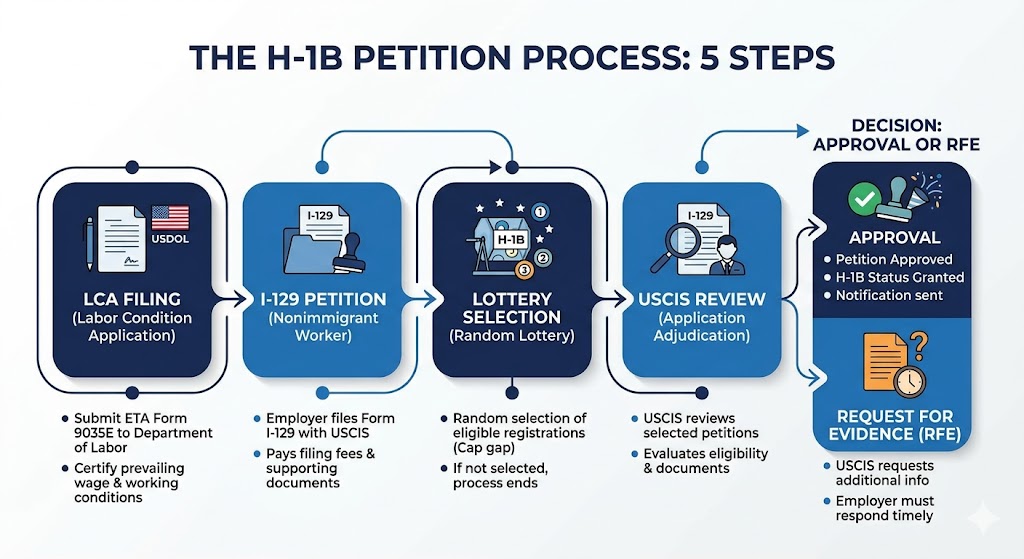
The LCA is the foundation. Before USCIS ever sees the petition, the employer must file a Labor Condition Application with the Department of Labor. This document commits the employer to paying the prevailing wage for the specific occupation in the specific geographic area. Get this wrong — wrong wage level, wrong occupational classification, wrong work location — and everything downstream is compromised. An attorney makes sure the LCA is both legally compliant and strategically sound.
The specialty occupation argument is the heart of the petition. USCIS doesn’t just take your word for it that a job requires a bachelor’s degree. For positions that aren’t obviously degree-dependent — certain IT roles, business analysts, consulting positions — the employer has to build an affirmative case. This involves job description drafting, educational requirement justification, sometimes industry standards documentation. This is legal argumentation, not form-filling.
The employer-employee relationship has to be verifiable. USCIS wants evidence that a genuine employment relationship exists — that the employer controls the work, sets the schedule, supervises the employee directly, and isn’t just acting as a placement intermediary. For consulting arrangements or third-party worksite situations, this is the area where scrutiny has intensified significantly since 2017.
Premium processing coordination matters more than it sounds. Choosing whether to file for premium processing — and whether that cost falls to the employer or the worker — involves actual regulatory rules, not just preference. An attorney ensures this decision is made correctly and documented properly.
And then there’s the RFE. If USCIS issues a Request for Evidence, the response window is typically 87 days. What goes into that response can determine whether a case is approved or denied. An attorney who built the original petition knows exactly where the vulnerability was and can respond with targeted, precise documentation. Someone without legal background responding to an RFE is essentially arguing a case they don’t fully understand.

Do You Legally Need a Lawyer?
No. There is no legal requirement for either an employer or a foreign national to use an immigration attorney for an H-1B filing. USCIS allows self-representation.
But “legal requirement” and “good idea” are different categories.
Think about it this way: you don’t legally need a doctor to remove a splinter, either. The question is whether the stakes justify getting a professional involved.
For H-1B specifically, the stakes are high in a way that’s easy to underestimate. A denial doesn’t just mean the worker has to try again next year. Depending on their current status, a denial can affect their ability to remain in the U.S. at all. An RFE that isn’t answered well often leads to a denial. And some denials create a documented record that complicates future petitions.
Most companies that have sponsored H-1B workers before use attorneys — not because they’re required to, but because they’ve learned what happens when they don’t.
Who Pays the Attorney Fees — and Who Is Legally Required To
This comes up more than it should, which suggests a lot of employers aren’t communicating it clearly.
The employer is responsible for the attorney fees and mandatory government filing costs associated with an H-1B petition. This isn’t optional or negotiable. Department of Labor regulations specifically prohibit employers from passing these costs to the H-1B worker in a way that would bring their effective wage below the required prevailing wage.
There is one carve-out: premium processing. If premium processing is requested for the worker’s personal benefit — say, they have a personal travel deadline — the worker can choose to cover that cost voluntarily. But if the employer needs the faster processing for business reasons, the employer pays.
If you’re a foreign national and your employer is asking you to pay any part of the filing fees, attorney fees, or USCIS fees, that arrangement warrants a closer look. At minimum, consult someone before agreeing to it.
The fee structure itself is layered. You have the base I-129 filing fee, the ACWIA training fee (which varies by employer size — companies with 25 or fewer full-time employees pay less), the fraud prevention and detection fee, and optionally the premium processing fee. To understand exactly what each component costs and who owes what, this complete H-1B fee breakdown for 2026 covers it in full detail.
The $100,000 Fee — What It Is, Who It Applies To, and Where Things Stand
If you’ve been reading about H-1B in 2025 or 2026, you’ve almost certainly seen this number. It deserves a direct explanation.
In September 2025, a Presidential Proclamation introduced a $100,000 per-petition fee for new H-1B cases requiring consular processing — meaning cases where the foreign national is outside the United States and needs a new visa stamp to enter. The fee is employer-paid.
A few important distinctions about what this fee does and doesn’t cover:
- It does not apply to Change of Status cases filed within the U.S. If a worker on F-1 OPT, B-2, or another valid status inside the country transitions to H-1B through a domestic COS petition, the $100,000 fee is not triggered.
- It does not apply to extensions, transfers, or amendments for workers already inside the U.S. Existing H-1B holders renewing or changing employers domestically are exempt.
- It does not apply to workers with a valid, unexpired H-1B stamp who are seeking a new petition from outside the country — though this area has seen inconsistent USCIS handling, and some cases have received RFEs incorrectly asking for the fee.
As of early 2026, multiple active lawsuits are challenging the fee’s legal foundation. The central argument is that a fee of this magnitude requires Congressional authorization, not executive action. No final ruling has come down yet, but courts have been receptive to the plaintiffs’ arguments.
For the most current update on this and other regulatory changes, the 2026 H-1B new rules guide is worth reading before making any filing decisions.
What Professions Actually Qualify for H-1B?
The technical answer from USCIS is: any position that normally requires a bachelor’s degree or higher in a specific field of study.
The word “specific” is doing a lot of work there.
A software engineer role requiring a computer science degree — that’s textbook qualifying. A physician position requiring an MD — qualifying. A licensed architect, a structural engineer, a financial analyst requiring an accounting or finance degree — generally yes.
The harder cases are roles where the degree requirement is less obvious. Business analysts, IT project managers, certain marketing or operations roles, management consultants — these positions face elevated scrutiny because USCIS has, over the years, issued guidance suggesting that positions requiring a degree “in any field” don’t meet the specialty occupation standard. The degree has to connect directly to the job functions, not just be a general educational baseline.
This is exactly why the specialty occupation argument in the petition matters so much. For roles on the clearer end of the spectrum, the argument is brief and well-supported. For roles in gray areas, it can be the deciding factor between approval and denial.
If you want to check your specific role against the full eligibility criteria, this H-1B requirements guide for 2026 walks through the specialty occupation standards and common qualifying scenarios in detail.
How Much Does an H-1B Attorney Actually Charge?
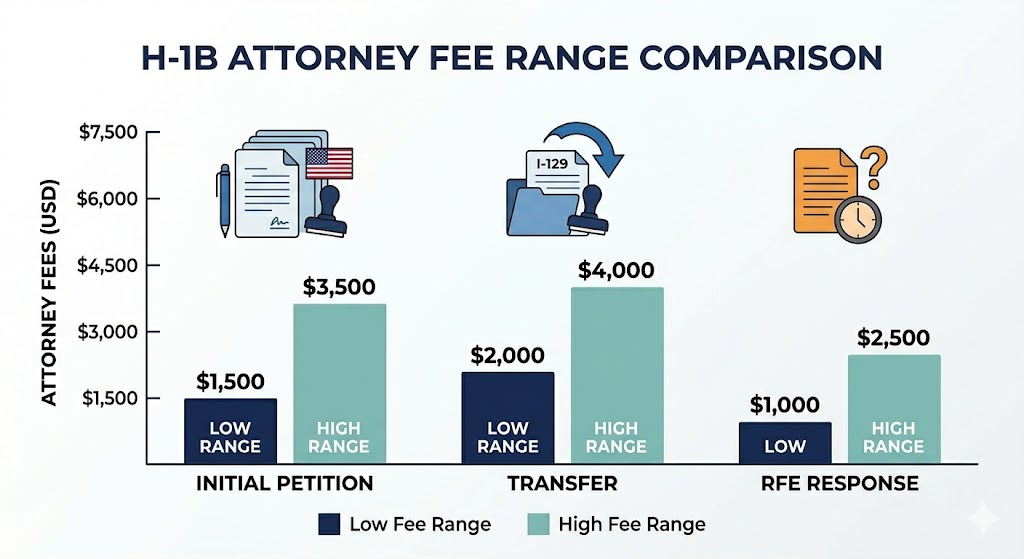
Attorney fees vary by firm size, geography, experience level, and case complexity. Here’s a realistic range based on what the market actually looks like.
Initial H-1B petition (new filing with lottery): $1,500–$4,000 in attorney fees, not including government costs. Boutique immigration firms in major cities tend toward the higher end; mid-size regional firms often come in lower.
H-1B transfer to a new employer: $1,000–$2,500. The core eligibility is already established, so there’s less legal heavy lifting required.
RFE response: This varies significantly depending on the RFE’s scope — a narrow documentation request might cost $500–$1,000 to respond to; a substantive specialty occupation challenge can run $2,000–$4,000 or more.
Premium processing fee (if applicable): $2,805 paid to USCIS directly, on top of attorney and other filing fees. This is a government fee, not attorney compensation.
The $2,500 attorney fee that often makes people nervous? That’s actually on the lower end of the market. When someone says an attorney is “too expensive” at $2,500, it’s often because they haven’t priced out what an RFE response or denial reversal costs — which frequently exceeds that amount many times over.
The OPT to H-1B Path — Does Having an Attorney Change Things?
If you’re currently on F-1 OPT, this is probably the most directly relevant section.
First, a clarification that saves a lot of confusion: OPT and H-1B are not the same thing, and “converting” from one to the other isn’t a seamless status upgrade — it’s a new visa petition process. OPT is an extension of your F-1 student status. H-1B is an entirely separate employer-sponsored classification. To move from one to the other, your employer files an H-1B petition on your behalf, and if you’re in the U.S. at the time, they typically request a Change of Status alongside it.
The good news for people in the U.S. on OPT: the $100,000 fee doesn’t apply to you if your petition is filed as a Change of Status domestically. USCIS guidance has confirmed that in-country COS filings are exempt.
The bad news: OPT workers face the same specialty occupation scrutiny as everyone else, plus the cap-gap period creates its own timing complexities. If your OPT expires before October 1st — when H-1B status officially begins — there’s a regulatory protection called cap-gap that allows you to stay and work. But that protection has specific conditions, and not everyone qualifies under it automatically.
An attorney helps here in ways that matter: ensuring the petition is filed before your OPT expires, coordinating the cap-gap correctly, and making sure there are no gaps in your authorized work period.
Worth noting: during a standard 12-month OPT period, you typically get one lottery cycle. With a 24-month STEM OPT extension, you may get two or three more opportunities — but each one is a separate registration, not an accumulated chance. The lottery doesn’t remember previous attempts.
When You’re Changing Employers Mid-H-1B
H-1B transfers are, in theory, more straightforward than new petitions. The worker’s eligibility is already established. The employer doesn’t need to go through the lottery. The petition can be filed and portability kicks in — meaning the worker can often start the new job once the transfer receipt is in hand, not after approval.
In practice, the “portability” piece requires conditions to be met. The transfer must be filed while the existing H-1B is valid. The new position must be in the same or a closely related occupational classification. And the worker must not have any status gaps between the old and new employment.
The highest-risk transfer scenario is one where the worker was laid off. The 60-day grace period after termination sounds generous, but it’s not. Sixty days to find a job, negotiate an offer, have the employer engage an attorney, prepare the petition, and file — that’s a genuinely tight window. Workers who treat it as “plenty of time” often discover they miscounted.
If you’ve recently been laid off and are working through H-1B options, this guide on what to do when your H-1B is cancelled or at risk is a practical starting point. There’s also a broader breakdown of the 240-day rule and grace period mechanics at this H-1B extension and grace period guide.
Foreign Lawyers and the H-1B: A Complicated Fit
One question that comes up often enough to address directly: can a lawyer trained outside the U.S. work here on an H-1B?
Yes — but with specific conditions.
The position has to require a law degree, and that degree has to be evaluated for U.S. equivalency. Most foreign LL.B. or LL.M. degrees, when evaluated by a recognized credential evaluation service, can meet the educational threshold.
But here’s the practical issue. Working as a licensed attorney in the U.S. requires passing a state bar exam. Most states won’t admit foreign-educated lawyers to the bar without additional steps — some require an American LL.M., some have their own foreign attorney track, and a handful simply don’t allow it. New York has traditionally been one of the more accessible states for foreign lawyers to sit for the bar.
Many foreign-trained legal professionals start their U.S. careers in adjacent roles — legal research positions, compliance roles, contract review functions — while they pursue bar admission. These positions can qualify for H-1B if the job genuinely requires a law degree to perform the duties.
Who Is Exempt from the H-1B Cap?
Not everyone needs to go through the lottery. This is one of the most valuable things to understand early, because it changes the entire strategy for certain employers and workers.
Employers that qualify as cap-exempt include:
- Institutions of higher education (accredited colleges and universities)
- Nonprofit organizations affiliated with or related to such institutions
- Nonprofit research organizations
- Government research organizations
Workers employed by cap-exempt entities can have H-1B petitions filed at any time of year, with no lottery, no April start date, and no annual cap limitation.
The important nuance: cap-exempt status belongs to the employer, not the worker. A researcher who holds an H-1B through a university and decides to move to a private tech company needs to enter the lottery — their existing cap-exempt status doesn’t transfer. Conversely, someone who has already been counted against the cap in a previous year can move to a new cap-subject employer without re-entering the lottery, as long as they’ve previously been selected and approved.
For a detailed breakdown of who qualifies and how the application works, this cap exemption guide covers it thoroughly.
The Wage-Weighted Lottery: What Changed and Why It Matters
The H-1B lottery has been reformed in a way that most general articles still aren’t explaining clearly.
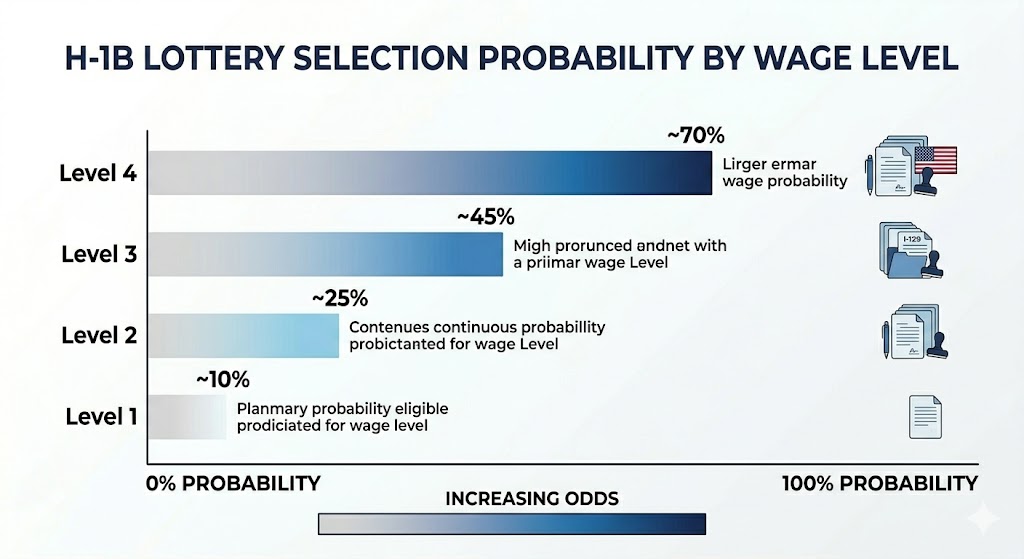
The old system was a straightforward random draw — every registered petition had roughly equal odds, with a separate pool for U.S. master’s degree holders. The newer approach assigns weighted odds based on the prevailing wage level of the position being registered.
Wage Level 4 positions — the highest tier — get the best lottery odds. Level 1 positions — entry-level, essentially — get the worst. The intent was to shift the pool toward higher-skilled, higher-compensated workers and reduce the volume of low-wage filings that characterized earlier lottery years.
For workers, this means that the wage level your employer selects at registration is no longer just a compliance question — it has a direct effect on your chances of selection. For employers, it means that underpaying or misclassifying a position isn’t just a legal risk; it also statistically hurts the worker’s lottery odds.
The H-1B lottery new rules and selection guide breaks down exactly how the weighted system works, including how wage levels are assigned and what the current selection odds look like.
What Happens to Your Spouse When You’re on H-1B
It’s easy to get so absorbed in the primary visa process that dependent status becomes an afterthought. But for couples where one partner holds H-1B status, the H-4 question comes up quickly.
An H-4 visa allows spouses and unmarried children under 21 to live in the U.S. with the primary H-1B holder. What it doesn’t automatically allow is work. H-4 holders can study, can travel, can accompany — but working requires a separate Employment Authorization Document.
The H-4 EAD is only available when the primary H-1B holder has an approved I-140 petition — which is the immigrant visa petition used in green card applications. Without that I-140 approval, an H-4 holder cannot apply for work authorization, full stop.
This connects to the green card timeline in a significant way. The faster an employer initiates the green card process, the earlier the I-140 can be approved, and the earlier an H-4 spouse can work. For couples where both partners want to work in the U.S., the timing of green card filing isn’t just a long-term planning question — it has immediate practical consequences.
The H-4 EAD guide for 2026 covers the eligibility rules, current processing times, and what the elimination of the automatic extension rule means for people whose EADs are expiring.
H-1B and the Green Card: Understanding What Comes After
Most people on H-1B aren’t planning to stay on H-1B forever. The long-term goal is permanent residence — a green card. Understanding how these two connect helps with planning.
H-1B is what’s called a “dual intent” visa. Unlike most nonimmigrant visas, it explicitly allows you to pursue permanent residence while maintaining your nonimmigrant status. You can file an I-140 (immigrant petition) with a pending H-1B, renew your H-1B while your green card application is in process, and generally move along both tracks simultaneously.
The standard employment-based path involves PERM labor certification, I-140 approval, and then adjustment of status (I-485). The entire process can take anywhere from two years to several decades, depending almost entirely on your country of birth. Workers born in countries with heavy demand — particularly India and China for EB-2 and EB-3 categories — face backlogs measured in decades.
An H-1B can be extended beyond the standard six years in one-year increments if your I-140 has been approved and a visa number isn’t yet available. This is one of the most important strategic reasons to start the green card process as early as possible.
For a detailed timeline and cost breakdown, particularly for Indian nationals where the backlog issue is most acute, this H-1B to green card guide lays out realistic projections and planning considerations.
Visa Stamping — The Step People Forget Until They Need to Travel
Your H-1B petition approval and your H-1B visa stamp are two separate things. The petition is what USCIS approves. The visa stamp is what a U.S. consulate puts in your passport to allow you to re-enter the country after international travel.
If you’ve never left the U.S. after getting your H-1B approved through Change of Status, you don’t have a stamp yet. You don’t need one to work or stay — your I-94 determines your authorized period of stay, not the stamp. But the moment you travel internationally, you’ll need to get stamped at a U.S. consulate before you can come back.
As of 2026, consular appointment availability — particularly in India — has been severely constrained, with some locations not showing available dates until 2027. This isn’t a minor administrative inconvenience; it’s a genuine barrier to international travel for H-1B holders who need stamping.
Before you book any international travel, understand your stamping situation fully. This H-1B visa stamping guide for 2026 covers dropbox eligibility, appointment strategies, and what’s changed under current consular processing conditions. And if you’re trying to navigate the interview waiver option, this guide on H-1B interview waiver and dropbox eligibility is specifically useful.
How to Actually Find a Good H-1B Attorney (Not Just a Busy One)
This is where most articles get vague. “Look for experience, check reviews, schedule a consultation.” Sure — but what does that actually mean in practice?
A few things that matter more than people realize:
Ask specifically about your case type. An attorney who primarily handles O-1 and EB-1A cases isn’t necessarily the right fit for a routine H-1B with an IT consulting employer. Immigration law has enough subspecialties that experience in employment-based immigration broadly isn’t the same as deep experience with the specific issues in your petition.
Find out who will actually work your case. Large immigration firms sometimes have senior partners who do consultations and junior staff who handle the actual filing. That’s not inherently bad, but you want to know the structure.
Ask what they do when an RFE comes. The answer tells you a lot. An attorney who explains their RFE response process with specificity — how they assess the issue, what documentation they request, how they construct the legal argument — is different from one who says “we handle those all the time, don’t worry.”
Be skeptical of guarantees. No immigration attorney can guarantee approval. USCIS makes the final decision, and the outcome depends on factors that can’t be fully controlled. An attorney who promises a specific outcome should make you pause.
“Free consultation” is common, but varies. Some firms use initial consultations to genuinely assess your case. Others use them primarily as sales calls. Pay attention to whether the attorney is asking questions about your specific situation or mostly talking about their firm.
If you’re in the job search stage and trying to understand which companies have strong H-1B sponsorship histories, the H-1B visa sponsors 2026 guide and the job search guide for H-1B sponsorship are useful starting points.
One Last Thing Worth Saying Plainly
The H-1B process isn’t designed to be navigated without expertise. It’s layered, it’s time-sensitive, and the consequences of errors don’t always show up immediately — sometimes they surface years later when you’re trying to extend, transfer, or start a green card process.
An immigration attorney doesn’t just fill out forms. A good one builds a defensible record. They think about not just this year’s petition but what happens at the extension stage, at the green card stage, and at the consulate if you ever need stamping.
That perspective — someone thinking two or three moves ahead — is what the fee is actually paying for.
If you’re still in the early stages of figuring out whether H-1B is even the right path for you, the full eligibility guide is worth reading before anything else. And once you’re ready to dig into the financial side of sponsorship, the 2026 complete fee breakdown lays out every cost layer in clear terms.
Frequently Asked Questions
You can hire an attorney to advise you personally, but they cannot file the petition on your behalf — the employer is the petitioner. What personal legal counsel can do is review documents before they’re submitted, flag problems, and advise you on your rights. Some workers in situations where the employer seems inexperienced find this genuinely worthwhile.
Unclear, but the legal challenges are substantive. Attorneys following the litigation are cautiously optimistic that the fee won’t survive long-term judicial review, but “long-term” doesn’t help if you’re making decisions today. Plan as if it applies, and adjust if it’s overturned.
Overall, historical approval rates have run between 85–95%. But that average covers a huge range of case types. Straightforward petitions from established employers in classic specialty occupation fields have very high approval rates. IT consulting arrangements, staffing situations, and positions where the specialty occupation argument is weaker have much higher RFE and denial rates. The strength of the petition matters more than the overall statistics.
This is one of the more nuanced areas. H-1B status is tied to the sponsoring employer. You can invest in a business, but you can’t work for it without the business sponsoring your H-1B — and self-employment (working for a company where you’re the controlling owner) generally doesn’t meet the employer-employee relationship requirement. There are structures that some attorneys have used to navigate this, but it requires careful legal setup and is fact-specific.
Disclaimer:This article is for informational purposes only and does not constitute legal advice. Immigration law is fact-specific and changes frequently. For guidance on your individual situation, consult a licensed immigration attorney.