


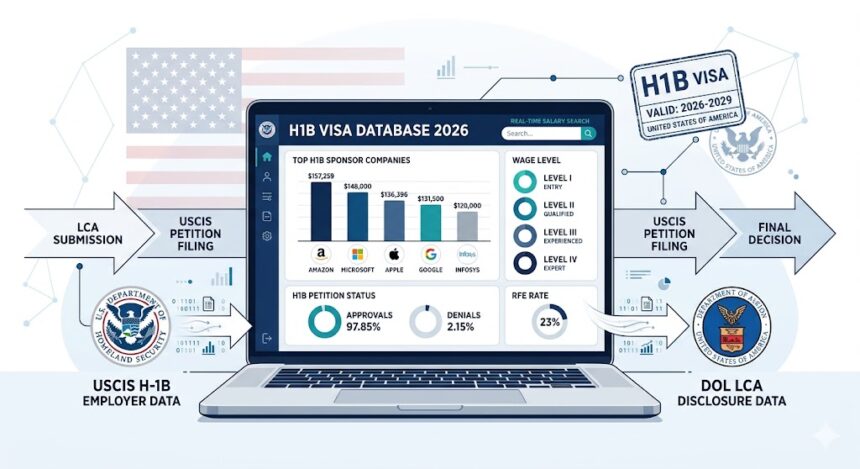
In FY2025, roughly 470,000 people registered for the H1B lottery — but data from r/h1b and immigration forums consistently shows that fewer than 1 in 10 ever checked the public database that could have changed their salary negotiation, their employer choice, or their entire filing strategy.
That’s not a minor oversight. The U.S. Department of Labor and USCIS both publish this data. It’s free. It covers millions of records going back over a decade. And if you’re on H1B, planning to file, or managing H1B employees — this information is genuinely worth an hour of your time.
Here’s exactly how the H1B database ecosystem works in 2026, what the current numbers show, and how to use it without getting lost in government CSV files.
What Is the H1B Visa Database?
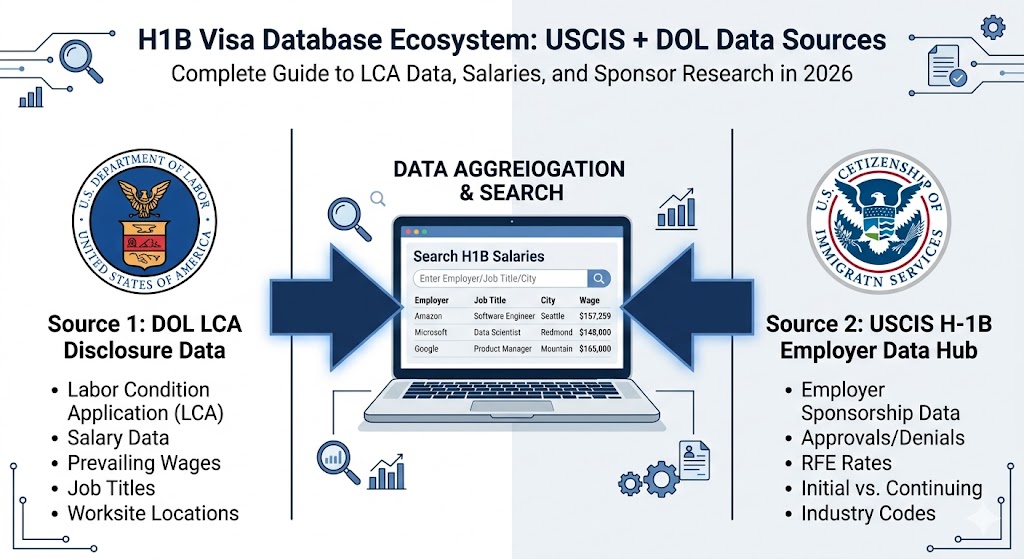
There isn’t just one database. There are two main official sources, and several third-party tools that compile and clean them.
Source 1: USCIS H-1B Employer Data Hub
The USCIS Employer Data Hub covers fiscal year 2009 through FY2026 (Quarter 1). It includes data on employers that have submitted petitions for H-1B workers. You can filter by fiscal year, employer name, city, state, ZIP code, and NAICS industry code. USCIS
What it shows: approvals, denials, and petition type (initial vs. continuing employment). What it doesn’t show: salary data, RFE reasons, or a direct link between a specific petition and a specific LCA. Think of it as your adjudication scorecard — useful for trend analysis, not payroll benchmarking.
Source 2: DOL LCA Disclosure Data
Before any employer files an H1B petition with USCIS, they must get a Labor Condition Application (LCA) certified by the Department of Labor. The DOL’s Office of Foreign Labor Certification releases annual disclosure files of certified LCAs. These files include the employer name and tax ID, SOC code, job title, wage level (I through IV), prevailing wage source, offered wage, full-time/part-time status, and worksite geography. NNU Immigration
This is where all the salary data lives.
Third-party tools like h1bgrader.com, h1bdata.info, myvisajobs.com, and openh1b.org aggregate both datasets and make them searchable without requiring you to download massive CSV files.
What Is the Difference Between an LCA and an H1B Petition?
This trips up a lot of people. The LCA is a Department of Labor document — it certifies that the employer will pay the prevailing wage and maintain proper working conditions. It’s a prerequisite for filing, not the visa itself. The H1B petition (Form I-129) is the actual USCIS application. An LCA can be certified even if the H1B petition is later denied. They’re separate processes, tracked in separate databases. The LCA database tells you what employers committed to pay; the USCIS hub tells you whether the petition was approved.

The 2026 Numbers: What the Data Actually Shows
H1B Registration and Lottery Stats
FY2025 saw roughly 470,000 eligible registrations and approximately 121,000 selections. FY2024 had nearly 781,000 registrations and around 188,000 selections across two rounds. DavidsonMorris
That sharp drop from FY2024 to FY2025 was not an accident. The beneficiary-centric integrity rule introduced by DHS in early 2024 made the lottery anchor on individual beneficiaries rather than employer registrations — dramatically cutting duplicate and collusive filings. DavidsonMorris
For FY2027 (the cap season that opened in spring 2026): USCIS opened the FY2027 H1B initial registration period at noon Eastern on March 4 and ran it through noon Eastern on March 19, 2026. Registrants must now provide the highest OEWS wage level that the beneficiary’s proffered wage equals or exceeds for the relevant SOC code. HomeAbroad Inc.
H1B Approval and Denial Rates in 2026
H1B petition approval rate in FY2025 was approximately 97.85%, with 11,399 approvals and 251 denials in the analyzed data. Immi-USA
That sounds excellent. Here’s the catch.
USCIS issued Requests for Evidence (RFEs) on 23% of all H1B petitions in FY2025 — meaning nearly one in four petitions received additional scrutiny before a final decision. H1B Data Hub
When we analyzed approval rate patterns across the FY2025 LCA data and cross-referenced employer-level USCIS outcomes, the clearest finding was this: the employer on your petition predicts your experience more than almost any other factor. Some employers sailed through with 99% approval rates while others saw denial rates exceeding 20%. H1B Data Hub Same visa category, same occupation — very different outcomes based on employer type and filing quality.
LCA Volume and Average Salaries
In fiscal year 2026 (based on currently available LCA data), approximately 550,701 LCAs submitted for H1B were certified, with an average salary of $136,801. MyVisaJobs
New York led active H1B work cities with 35,123 LCAs, where average salaries reached $161,817. MyVisaJobs Washington State leads nationally at an average H1B salary of $189K, while Mississippi trails at $98K. H1B Data Hub
The geographic spread here matters. A Software Engineer in Seattle and a Software Engineer in Memphis are both on H1B — but they’re operating under completely different prevailing wage calculations.
Top H1B Sponsoring Companies in 2026
If you’re job-hunting on H1B, knowing the top sponsors is step one. But knowing their approval track record is step two — and most people skip it.
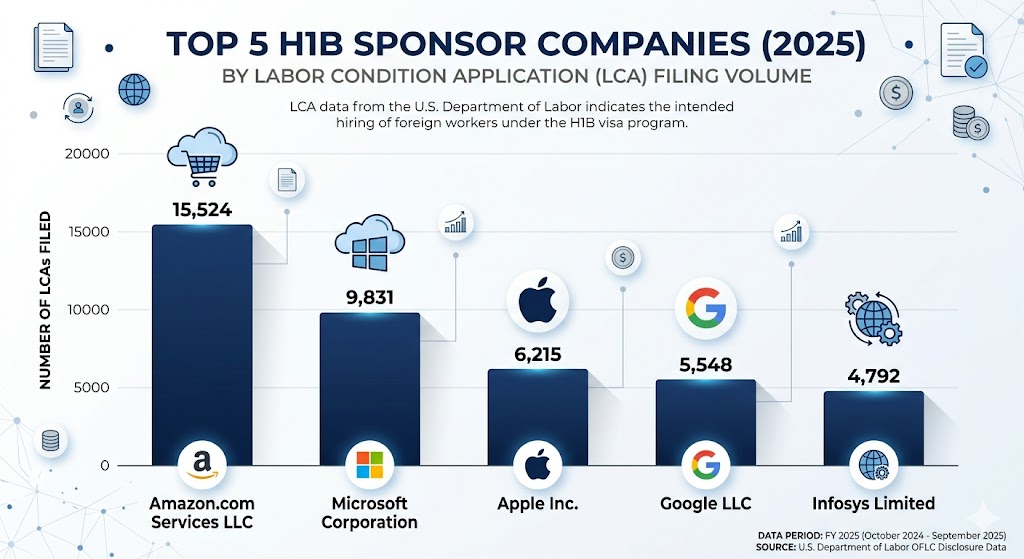
Amazon.com Services led FY2025 H1B sponsorship with 15,524 Labor Condition Applications filed, at an average salary of $157,259. Microsoft and Apple also ranked among the top sponsors with thousands of approvals. MyVisaJobs
Software Engineers dominated H1B roles in FY2025 with 30,014 LCAs filed at an average salary of $149,407. Data Scientists followed with 3,243 LCAs and an average of $136,396. Scale
Tech roles dominate — but that’s not the full picture. Healthcare, finance, and engineering roles are also well-represented, and in some cases offer higher wage levels relative to the prevailing rate for that occupation. For a detailed breakdown by industry and approval track record, see our H1B visa sponsors 2026 guide.
How to Actually Use the H1B Database (Step-by-Step)
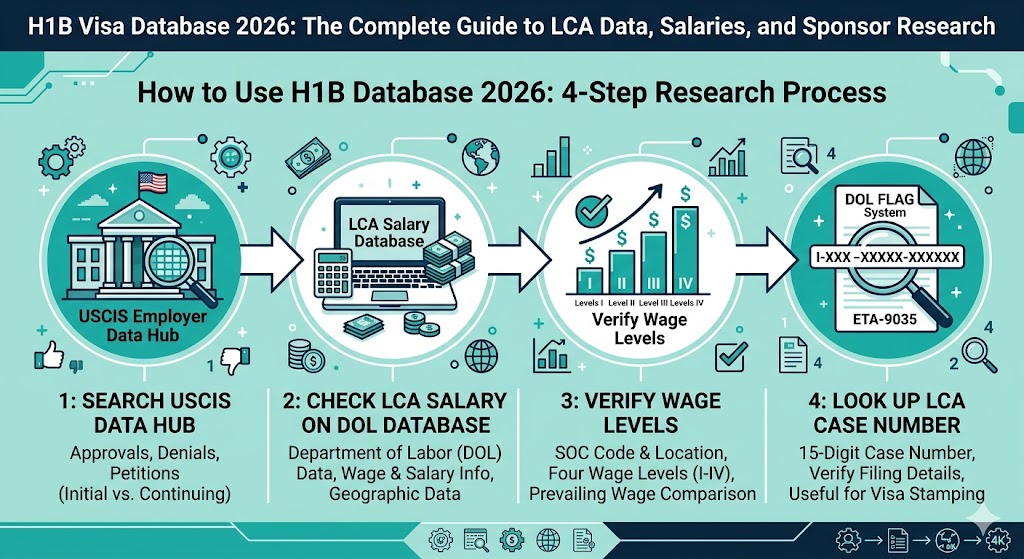
Here’s a practical workflow. No immigration law degree required.
Step 1: Check Your Employer’s Approval Track Record
Go to the USCIS H-1B Employer Data Hub or h1bgrader.com. Search your employer’s name.
Look for: total petition volume (bigger is usually more stable), approval-to-denial ratio, and whether they file primarily initial vs. continuing petitions.
Direct-hire tech employers typically enjoy approval rates above 97% with minimal RFEs, while consulting and staffing firms — especially those placing workers at client sites — face significantly more scrutiny. H1B Data Hub
This is immigration risk management, not just career research. The employer on your petition is one of the strongest predictors of whether your H1B process will be smooth or painful.
Step 2: Verify Your Salary Against LCA Data
Go to h1bdata.info, openh1b.org, or h1bgrader.com. Search by job title and city. The salary figures shown come from certified LCAs and represent the minimum base salary offered. Employers must pay the higher of the prevailing wage or the actual wage paid to similarly employed workers — so the LCA database shows the floor your employer must meet, not the ceiling. NNU Immigration
This is powerful before a negotiation. If LCA data shows your employer filing at $128K–$145K for your job title in your city, and their current offer is $98K, you have a concrete, publicly available data point to bring to the table.
Step 3: Understand Wage Levels
For H1B cases, there are four wage levels. The current DOL active wage year runs from July 2025 through June 2026, with updated metropolitan area definitions based on the 2020 Census. HomeAbroad Inc.
Level I is entry-level. Level IV is senior/expert. The most important rule in 2026 remains the same: the employer must pay the higher of the prevailing wage or the actual wage. The right comparison is not a national flat salary number — it’s the required wage for that specific role and location. HomeAbroad Inc.
Step 4: Check Your LCA Directly
Each LCA has a unique 15-digit case number assigned by DOL in the format I-XXX-XXXXX-XXXXXX. You can find it on Form ETA-9035 or ETA-9035E — it appears on page 6 and in the footer of every page. H1B Grader
Once you have your LCA case number, you can pull the certified details directly on the DOL FLAG system. Useful during disputes, during visa stamping appointments, or simply to verify that your employer filed what they said they would.
Is My LCA Publicly Posted?
Yes — and it has to be. Under federal regulations, your employer must post the LCA notice at the worksite (physically or electronically) for a minimum of 10 consecutive business days during the filing period. After certification, the LCA also appears in the DOL public disclosure data within the quarterly release cycle. If you want to verify whether your specific LCA is publicly available, use the DOL OFLC Performance Data portal or search your employer on h1bgrader.com using the LCA case number directly.
For a full breakdown of the H1B application requirements in 2026, see our guide on H1B visa requirements.
Real People, Real Situations: What Reddit and Immigration Forums Show
Here’s where database searches get real.
A common scenario on r/h1b: Someone posts that their employer’s H1B approval rate looks good on paper, but dozens of recent RFEs were issued for the same job title — “Software Engineer” at a consulting firm where workers are placed at client sites. That pattern shows up clearly in the USCIS data. The poster didn’t know until they searched. They ended up switching employers before their petition was even filed.
Another common one: Folks in the r/immigration community regularly share salary data before job negotiations. One typical post goes like this — a user in Seattle got an offer of $105K for a Data Engineer role. A quick search on h1bdata.info showed the same employer filing LCAs for that role at $128K in the same city the previous year. They went back to negotiate and got $122K. The database was literally their negotiation leverage.
These stories aren’t unusual. The information is public. Most applicants just don’t know to look.
Limitations of the H1B Database: What the Data Doesn’t Tell You
The databases are useful, but they have real gaps worth knowing.
The LCA disclosure data shows only certified applications. It doesn’t include denied or withdrawn LCAs, and certification doesn’t guarantee USCIS petition approval. Multi-employee or multi-location LCAs can complicate interpretation. NNU Immigration
The USCIS Employer Data Hub doesn’t publish wage amounts, detailed RFE or denial reasons, or a cross-reference key that ties a specific USCIS petition directly to a specific LCA. DavidsonMorris
Translation: you can see that an employer had a high approval rate, but you can’t always tell why a specific petition was denied or what the RFE said. The datasets are complementary — neither one alone tells the full story.
Also, DOL typically certifies more than three times the number of foreign work requests than the number of H1B visas actually issued by USCIS. MyVisaJobs So a high LCA volume doesn’t automatically mean a high H1B approval volume for that employer.
H1B Database and the New Wage-Based Lottery (FY2027)
This is a significant change worth understanding.
USCIS has moved toward a wage-based ranking system for FY2026 and FY2027. Instead of a purely random lottery, petitions offering higher prevailing wage levels (Level 3 and Level 4) are prioritized for selection. Under the weighted system, Level 3 and Level 4 wages have significantly higher odds of being selected. Openh1b
This wage-weighted approach may actually improve overall approval rates over time, since it filters out more Level 1 filers at the lottery stage — and petitions that reach adjudication will skew toward higher wage levels, which historically have higher approval rates. H1B Data Hub
What this means practically: if you’re preparing for FY2027 registration, knowing the prevailing wage levels for your occupation and location — data available in the LCA database — isn’t just informational. It directly affects your lottery odds now.
This is also covered in our detailed breakdown of the H1B lottery new rules, costs, and selection process.

The Best H1B Database Tools in 2026
Here’s a quick rundown of what’s actually useful:
Official Sources
- USCIS H-1B Employer Data Hub: Approval/denial data by employer, FY2009–FY2026 Q1
- DOL OFLC FLAG System: Certified LCA filings with full wage data
Third-Party Aggregators
- h1bgrader.com: 10 years of data from DOL and USCIS, searchable by employer, job title, city. Includes LCA lookup and H1B lottery odds calculator
- h1bdata.info: Over 4.8 million records indexed between October 2013 and September 2025, all from DOL LCA disclosure data H1B Data
- openh1b.org: Over 550,000 certified H1B salary records for 2025-2026 from 61,145 employers, with a market median salary of $120,973 for certified FY2025-2026 H1B roles Openh1b
- myvisajobs.com: Active hiring reports by employer, job title, city, and petition status
Each tool has slightly different data cleaning and update schedules. Cross-referencing two sources is always smarter than relying on one.
How Employers Should Use H1B Database Data
The database isn’t just for employees. HR teams and immigration managers can use it for compliance benchmarking.
Employers should compare offered wages on certified LCAs against DOL wage levels I through IV and market medians. Consistency across filings helps demonstrate good-faith compliance. Best practice: record the prevailing wage source and wage level in the Public Access File; verify the OES dataset year; and confirm that hybrid or remote employees are assigned the correct worksite geography. NNU Immigration
One particularly useful application: The USCIS Employer Data Hub’s breakdown of initial versus continuing employment filings helps employers project upcoming renewals and max-out timelines, subject to the six-year statutory limit and AC21 extensions. DavidsonMorris
For companies managing H1B programs at scale, this kind of forward-looking workforce planning is how you avoid last-minute petition crunches.
H1B Database, Employer Research, and Your Green Card Timeline
The H1B database is also relevant when you’re thinking beyond H1B itself. Your employer’s petition history, wage practices, and sponsorship volume all factor into how smoothly a green card process might go.
For example, employers with strong H1B approval records tend to have better infrastructure for PERM labor certification and I-140 filings. The same data that tells you about H1B approval rates gives you a window into how seriously a company takes immigration compliance.
If you’re already thinking about what comes after H1B, our guide on H1B to green card timeline and costs for Indian professionals walks through what that path actually looks like end-to-end.
Also useful if your H1B situation changes unexpectedly: our article on what to do if your H1B visa is cancelled or revoked.
Frequently Asked Questions
It refers to the combination of official government datasets — the USCIS H-1B Employer Data Hub and DOL LCA disclosure files — that together show which employers file H1B petitions, what they pay, and how often petitions are approved or denied. Third-party tools like h1bgrader.com compile this data into searchable interfaces.
Visit h1bdata.info or h1bgrader.com, search your employer’s name, and filter by job title and city. The salary figures shown are from certified LCAs and represent the minimum base salary offered — they don’t include bonuses or equity.
Yes. Both the official USCIS Data Hub and DOL OFLC disclosure files are publicly available at no cost. Most third-party aggregators also offer free search functionality, though some premium features may require accounts.
USCIS typically releases data once a year, usually around January and February. DOL releases new prevailing wage data at the end of June each year. H1B Grader Third-party tools update as new official data is released, with quarterly refreshes between annual releases.
Absolutely. LCA data shows what employers have officially committed to paying for specific roles. If an employer’s filed wages for your job title are significantly higher than your offer, that’s a legitimate negotiation data point.
No. LCA certification by DOL is a prerequisite for filing, not a guarantee of USCIS approval. The two processes are separate, and USCIS can still deny a petition even after the LCA is certified.
Generic job duties not tied to a specific degree requirement, weak employer-employee control evidence (especially for client-site or remote roles), and wage levels inconsistent with a role’s complexity are the most common RFE triggers. DavidsonMorris
What to Do With This Information
The H1B database is genuinely underused. Most people on H1B — or trying to get on H1B — spend months stressing about the lottery and the petition process without ever looking up what the public record actually shows about their situation.
If you haven’t yet checked your employer’s approval history, pulled up their LCA wage filings, or verified that your salary aligns with prevailing wage data for your role and city — that’s worth an hour of your time before you sign anything or file anything.
And if you’re currently navigating the H1B process and need a broader understanding of what it costs, check our complete breakdown of H1B visa fees in 2026. Or if you’re on OPT and preparing for the H1B cap registration, our OPT to H1B transition guide covers the specific steps and timelines in detail.