

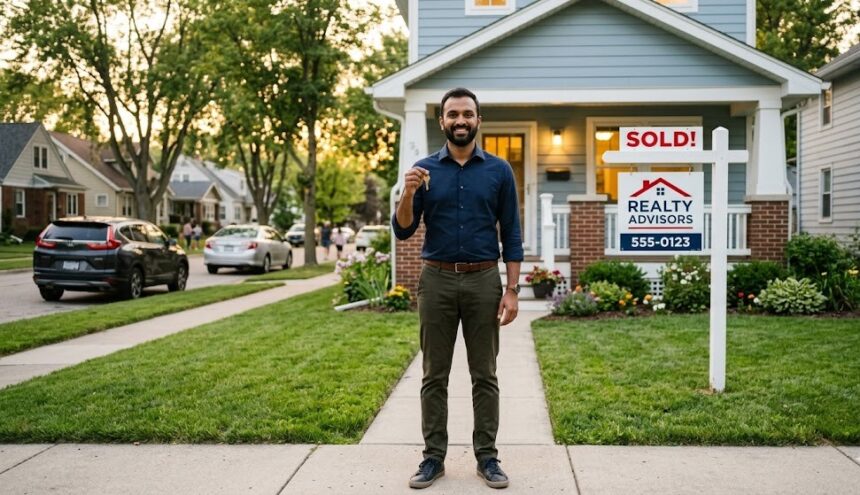
Here’s what changed in May 2025 that every H1B homebuyer needs to know: FHA loans — for years the most accessible mortgage option for non-citizens — are no longer available to H1B visa holders. HUD issued Mortgagee Letter 2025-09 and closed that door entirely.
If you’ve been researching mortgages using older guides, you may be preparing for a loan that no longer exists for you.
This guide is different. It covers the 2026 landscape specifically — what’s still available after the FHA ban, what lenders actually look at on an H1B file, and how to position yourself for the best shot at approval. You’ll leave with a clear path forward, not just a list of loan types.
Can H1B Visa Holders Get a Mortgage in 2026?
Yes — and this remains true despite the 2025 policy changes. U.S. law doesn’t prevent non-citizens from owning property or taking out a mortgage. What lenders care about is your ability to repay, not your citizenship.
That said, being on a temporary work visa adds complexity. Lenders have to assess not just your income and credit, but whether that income is likely to continue. An H1B has an expiration date, which means a lender issuing a 30-year mortgage has to make a judgment call about your long-term residency.
The foundation is solid: both Fannie Mae and Freddie Mac — the two government-sponsored enterprises backing the majority of U.S. mortgages — explicitly allow lending to non-permanent residents on valid work visas, including H1B. Their guidelines don’t treat you differently from a U.S. citizen, as long as you meet the same financial standards. (Source: Fannie Mae Selling Guide B2-2-02)
The Big Change: FHA Loans Are Gone for H1B Holders (May 2025)
On May 25, 2025, HUD issued Mortgagee Letter 2025-09, triggered by President Trump’s February 2025 executive order titled “Ending Taxpayer Subsidization of Open Borders.” H1B visa holders can no longer apply for FHA-insured mortgages.
Previously, FHA loans were the go-to option for H1B holders — 3.5% down payment, credit scores accepted as low as 580. That option is now closed to anyone on a temporary work visa.
The rule applies to any FHA case number assigned on or after May 25, 2025. If you were mid-process before that date, your existing loan may still be valid. New applications are not. (Source: HUD Mortgagee Letter 2025-09)
Industry data suggests FHA loans to non-permanent residents had already dropped significantly before the formal rule change — the policy only confirmed a trend lenders had seen coming. The options that remain are real. You just need to understand them clearly.

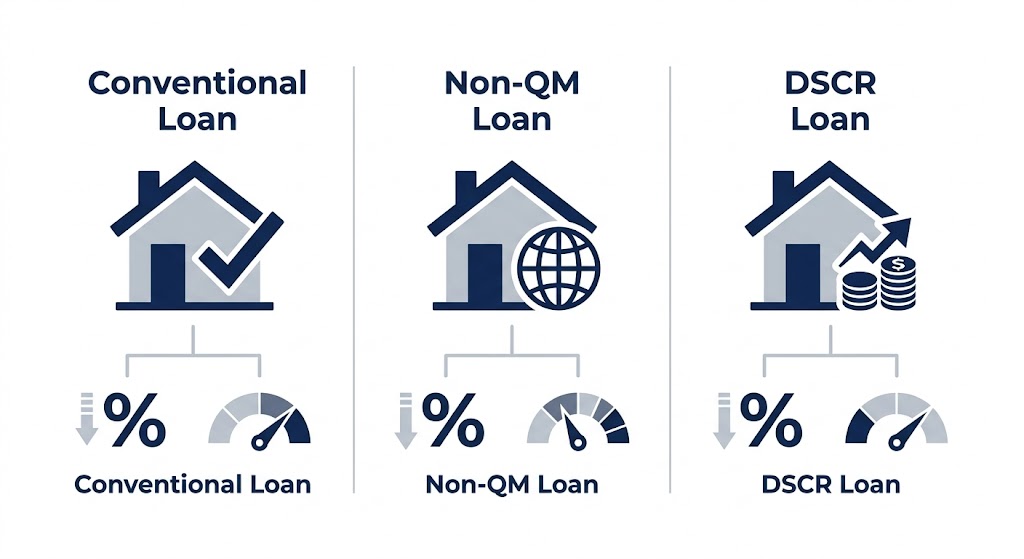
Mortgage Options for H1B Visa Holders in 2026
1. Conventional Loans (Fannie Mae / Freddie Mac) — The Primary Path
Conventional loans are now the main route for most H1B homebuyers, and Fannie Mae and Freddie Mac guidelines explicitly permit non-permanent residents.
What you need:
- Valid H1B visa with at least 1–2 years remaining at closing
- Social Security Number (SSN)
- U.S. credit score of 620 or higher (700+ gets significantly better rates)
- 2 years of U.S. employment history — or combined U.S. + foreign employment with the same organization
- Debt-to-income (DTI) ratio under 43%
- Down payment of 3–5% minimum (20% improves approval odds and eliminates PMI)
The I-140 advantage: An approved I-140 (Immigrant Petition for Alien Workers) changes the lender’s risk calculation entirely. In a lender’s eyes, you shift from “temporary worker” to “future permanent resident.” Approval odds increase, and rates often improve. This is one of the most underused levers H1B buyers have. (Source: Law Offices of Peter D. Chu, immigration law perspective)
If you’re working toward your green card, our guide on H1B to green card timeline and cost explains where you may stand in that process — and how to frame it for a lender.
On rates: A strong financial profile — good credit, stable income, 20% down, approved I-140 — can get you the same rate as a U.S. citizen. The visa itself doesn’t automatically trigger a rate penalty.
2. Non-QM and Foreign National Loans — For Newcomers Without U.S. Credit
Non-QM loans serve H1B holders who arrived recently and don’t yet have 2 years of U.S. credit history.
These programs evaluate borrowers differently. Some accept international credit reports from your home country, 12–24 months of foreign bank statements, employment letters confirming multi-year income, or international assets as proof of financial strength.
The trade-offs are real: down payments typically run 20–30%, and interest rates run 1–2% above conventional. On a $500,000 home, that’s a meaningful monthly difference. But for a recently arrived H1B professional who wants to stop renting, they’re a legitimate option. (Source: Scotsman Guide)
If you’re still building your credit profile, our article on how to build a credit score in the U.S. and getting your first credit card as an Indian immigrant can compress the timeline. Even 12 solid months of U.S. credit history opens doors that Non-QM routes can’t match on price.
3. DSCR Loans — For Investment Properties
DSCR (Debt Service Coverage Ratio) loans qualify you based on the property’s rental income, not your personal income — no W-2 or U.S. tax returns needed.
This works well for H1B professionals who want to invest in U.S. real estate while still renting their own residence, or who want to build equity without waiting years for conventional eligibility. Down payments typically start at 20–25%. (Source: HomeAbroad H1B Mortgage Guide)
4. Portfolio and Bank Statement Loans
Some regional banks and credit unions hold their own loans rather than selling them to Fannie or Freddie. These portfolio lenders set their own rules and can be more flexible with non-standard borrower profiles.
Rates and terms vary significantly. H1B homebuyers on immigration forums consistently recommend getting at least three quotes — a large national bank, a local credit union, and an online broker — because variation between lenders on H1B files is substantial, not just in rate, but in willingness to approve at all.
Eligibility Requirements: What Lenders Actually Check
Credit Score and History
The 620 floor for conventional loans is a minimum, not a target. Below 680, expect higher rates. Above 720, the best products open up. U.S. credit history of at least 2 years is standard — though foreign credit history from countries with similar reporting systems can sometimes be combined.
Our guide on how credit scores work in the U.S. and best tradelines to boost your credit are worth reading before you apply.
Visa Validity
Most lenders want at least 12 months remaining on your H1B at closing. Many prefer 2+ years. If your visa is expiring within a year, get your extension filed and approved before applying — an approved extension is far stronger than a pending one.
See our guide on H1B extension and the 240-day rule for renewal timelines.
Employment Stability
Frequent employer changes are a yellow flag. If you’ve recently changed employers, our H1B visa transfer guide explains how that affects your employment record from a lender’s perspective.
Income Continuity
Fannie Mae requires evidence that income will continue for at least 3 years from the mortgage application date. An employer letter confirming your role, salary, and expected continued employment directly addresses this requirement.
For current salary benchmarks, our H1B salary requirements guide has prevailing wage data by occupation and location.
DTI (Debt-to-Income Ratio)
Keep this under 43%. That means all monthly debt payments — student loans, car payments, credit card minimums — should not exceed 43% of gross monthly income. Paying down existing debt before applying is one of the fastest ways to improve approval odds.
Our strategies to pay off credit card debt guide can help if high-interest debt is a current barrier.
Down Payment Source
You can use gifted funds from family overseas. You’ll need a formal gift letter stating the money is not a loan, plus documentation of the transfer. Overseas funds generally need to sit in your U.S. bank account for 60+ days before a lender will accept them.

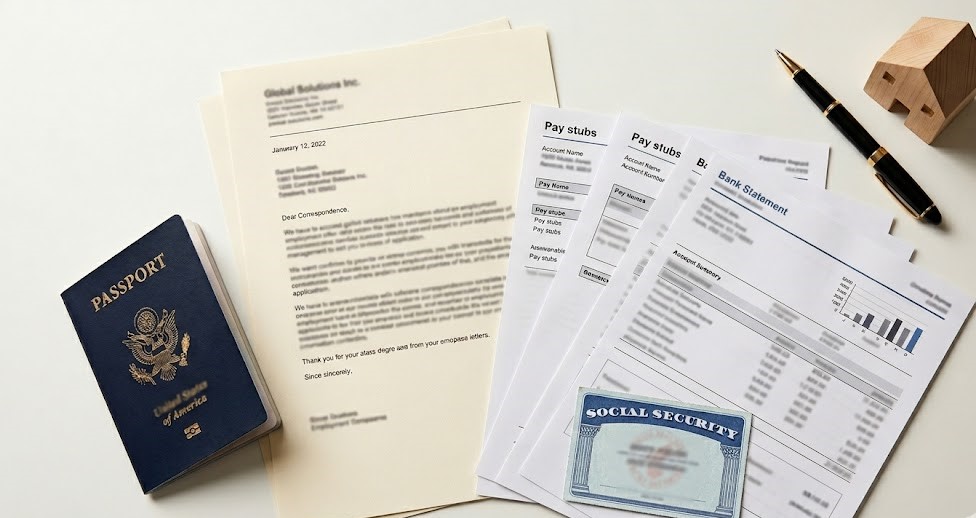
Documents Required for an H1B Mortgage Application
Identity & Immigration Status
- Valid H1B visa
- I-797 approval notice
- Passport (current and any relevant previous pages)
- SSN
Employment & Income
- Recent pay stubs (last 2–3 months)
- W-2 forms (last 2 years)
- Federal tax returns (last 2 years)
- Employment verification letter confirming your role, salary, and expected continued employment
- If visa expires within 12 months: employer letter confirming intent to extend
Assets
- Bank statements (last 2–3 months, all accounts)
- Investment account statements
- If using international funds: documentation of origin and transfer
Property
- Purchase agreement (once under contract)
- Property appraisal (ordered by lender)
Keep your visa documentation current throughout the process. One missed renewal can pause everything. Our H1B visa extension complete guide covers exactly what to do and when.
Real Experiences: What H1B Buyers Are Saying
H1B homebuyers on immigration forums point to the same pattern consistently: income stability and credit history matter more to lenders than the visa itself. Several buyers have reported getting approved for conventional loans with less than 14 months remaining on their H1B — as long as the rest of the file was clean.
The most repeated advice from H1B borrowers who’ve successfully closed: find a loan officer who has specifically worked with non-citizen files. A loan officer who rarely handles H1B applications will ask for things that aren’t required, misread your file, or simply decline because they’re unfamiliar with how Fannie Mae guidelines apply to non-permanent residents. The lender you choose matters as much as the loan type.
According to H1B homebuyers on immigration forums, shopping multiple lenders isn’t just about finding a lower rate — it’s about finding someone who actually knows how to get your file through underwriting.
The H4 Spouse Co-Borrower Strategy
If your spouse holds a valid H4 EAD, their income can be included in the mortgage application. Many couples don’t realize this, and it can substantially improve the qualifying loan amount.
Without an EAD, your spouse can still be listed on the property title — they just can’t be a qualifying co-borrower. Our guide on H4 EAD work authorization in 2026 explains the current authorization process and timelines.
What Happens to Your Mortgage If Your Visa Expires?
Your mortgage obligation doesn’t change if your visa expires. There is no clause in standard U.S. mortgage contracts that requires you to maintain a particular immigration status. What changes is your practical situation.
If your H1B isn’t renewed, you still own the property. You can rent it out, continue paying the mortgage from abroad, or sell it. The lender does not call the loan due based on your immigration status.
The real risk is income disruption. If your visa isn’t renewed and you lose your job, payments become harder to sustain. This is exactly why lenders care about visa validity and income continuity upfront — they’re pricing in that risk before they approve you.
Having an approved I-140 mitigates this concern substantially. Our H1B to green card timeline guide explains where you may stand in that process. If your H1B has been cancelled or revoked, our guide on what to do if your H1B is cancelled covers your options clearly.
The I-140 Factor: How Green Card Progress Affects Mortgage Approval
An approved I-140 is one of the most powerful things you can bring to a mortgage application — and most articles don’t give it enough attention.
An approved I-140 means USCIS has recognized that you qualify for a green card and your employer is sponsoring you for permanent residence. A lender reads this as: this borrower is in the process of becoming a permanent resident. The perceived risk drops sharply. Borrowers with approved I-140s consistently report better rates, less documentation friction, and fewer conditions on approval. (Source: Law Offices of Peter D. Chu, immigration law perspective)
If your employer hasn’t started sponsorship yet, our guide on H1B visa sponsors in 2026 covers how to have that conversation.

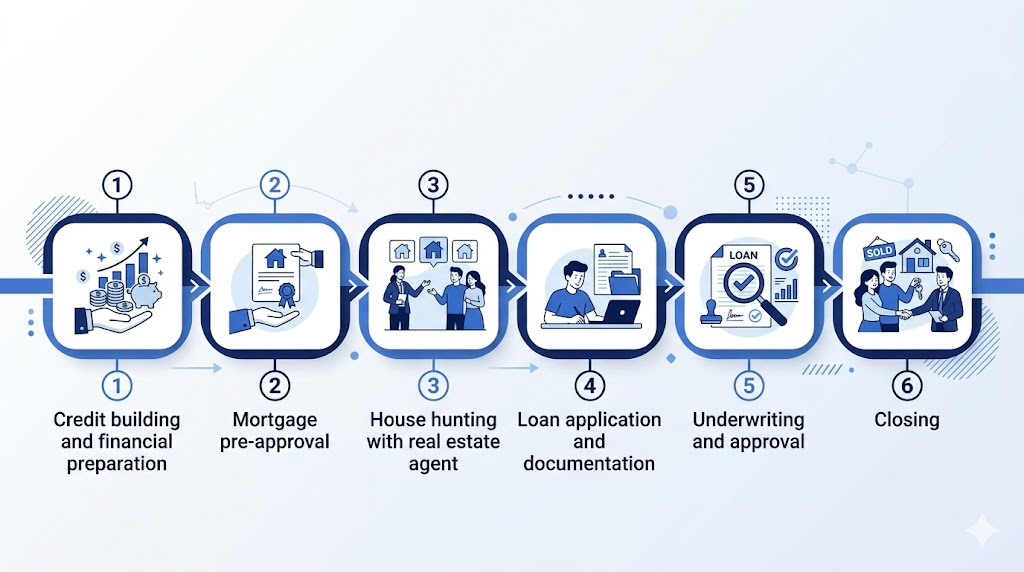
Step-by-Step: Getting a Mortgage on an H1B Visa in 2026
Step 1: Build your financial foundation first Get your credit score above 700 if possible. Pay down existing debt. Open a U.S. bank account if you haven’t already — our guide to opening a U.S. bank account covers the setup process. Don’t apply for new credit cards in the 6–12 months before a mortgage application.
Step 2: Check your visa timeline Make sure you have at least 12–18 months remaining on your H1B before starting the mortgage process. If you’re close to expiry, renew first. Our H1B new rules 2026 guide covers current requirements and recent policy changes.
Step 3: Calculate your budget realistically Run a DTI calculation before you start house hunting. Add up all your monthly debt payments and divide by gross monthly income. Above 43% — pay down debt or save for a larger down payment before applying.
Step 4: Get pre-approved from the right lender Find lenders who specifically mention experience with H1B or non-permanent resident borrowers. Ask them directly: “How many H1B mortgages have you closed in the last year?” Their answer tells you everything about how your file will be handled.
Step 5: Gather every document in advance Don’t wait for the lender to ask. Have your visa paperwork, I-797, pay stubs, tax returns, W-2s, bank statements, and employer letter ready before you apply. Document delays are the most common reason H1B mortgage applications stall.
Step 6: Submit and communicate proactively Respond to every lender request the same day if possible. Underwriting on non-citizen borrower files tends to involve more back-and-forth than for U.S. citizens. Staying on top of it prevents the process from stalling before your closing date.
Tax Benefits of Owning a Home on an H1B Visa
H1B visa holders are taxed as U.S. residents, which means you access the same homeowner tax deductions as citizens:
- Mortgage interest deduction: Deduct interest on up to $750,000 of mortgage debt, reducing your taxable income.
- Property tax deduction: State and local property taxes are deductible up to $10,000 annually under current IRS rules.
- Capital gains exclusion: Sell your primary residence after living there 2 of the last 5 years and exclude up to $250,000 in capital gains ($500,000 if married filing jointly).
For accurate filing, our guide on best tax software for H1B visa holders covers how to handle the return correctly.
Common Mistakes H1B Buyers Make
1. Applying while visa is too close to expiry A visa with less than a year remaining is a serious obstacle. Many lenders will flatly decline. Renew before you apply.
2. Not shopping enough lenders Variation between lenders on H1B files is significant — not just in rates, but in willingness to approve at all. Get at least three quotes before committing.
3. Large unexplained deposits before closing Any transfer above 1% of the loan amount may trigger documentation requirements. Move overseas funds to your U.S. account at least 60 days before closing.
4. Changing jobs mid-process A job change during the mortgage process can pause or kill your application. If you’re considering a move, close the mortgage first.
5. Not mentioning your I-140 Many H1B holders have a pending or approved I-140 and never bring it up with their lender. Always raise it — it changes your risk profile materially.
Conclusion: Three Things to Take Away
First, the FHA option is gone — but the conventional loan path via Fannie Mae and Freddie Mac remains fully open to H1B holders, and it’s the right path for most borrowers with an established U.S. credit history. Non-QM and DSCR products fill the gap for newer arrivals and investors.
Second, your immigration profile matters almost as much as your financial one. Visa validity, I-140 status, and employer letter quality directly affect what lenders will offer you. Come to the application with all of that documented and current.
Third, lender selection is not a small decision on an H1B file. Find someone who has closed H1B mortgages specifically — not someone learning on your application.
Get pre-approved with an H1B-specialist lender before you start house hunting seriously. It takes the guesswork out of your budget and gives you leverage in a competitive market.
If you’re still working through visa timeline questions before applying, our H1B Extension Guide and H1B Salary Requirements pages are good next reads.
Frequently Asked Questions
Yes. See Mortgage Options for H1B Visa Holders above for full details. A green card is not required — what you need is a valid H1B, SSN, credit history, and provable income.
Not automatically. A strong profile — good credit, stable income, approved I-140, 20% down — can qualify you for the same rate as a U.S. citizen. See Eligibility Requirements above for what drives the lender’s decision.
Yes, if they have a valid H4 EAD. Without one, they can be on the title but not as a qualifying co-borrower. See the H4 Spouse Co-Borrower Strategy section above.
Your mortgage stays in place. You still own the property. See What Happens to Your Mortgage If Your Visa Expires above for a full breakdown, and our H1B visa cancelled guide for what to do next.
Yes, with a gift letter and full documentation of the transfer. Funds should be in your U.S. account for 60+ days before closing. See Eligibility Requirements — Down Payment Source above.
620 is the technical floor for conventional loans. 700+ is where you see competitive rates. 740+ unlocks the best products. See our credit score guide and how credit scoring works for how to get there.
Yes — a pending I-140 still helps your application. Lenders view it as evidence that you’re in the green card process, which reduces their concern about long-term residency uncertainty. The difference between pending and approved is meaningful, though: an approved I-140 closes the lender’s biggest risk question almost entirely, while a pending one only partially addresses it. If your I-140 is filed but not yet approved, bring the receipt notice to your lender and make sure your employer letter reinforces your employment continuity.
If you plan to stay in the same city for 4–5 years, buying typically builds more wealth than renting. Fixed mortgage payments don’t increase the way rent does. If your location or employment situation is uncertain, renting gives you flexibility. Run your own numbers — there’s no universal answer.

Disclaimer: This article is for informational purposes only and does not constitute legal, financial, or mortgage advice. Consult a licensed mortgage professional before making any homebuying decisions.