

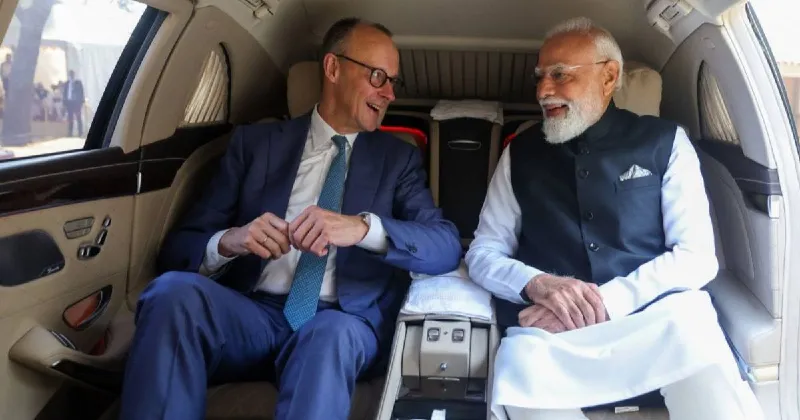
Prime Minister Narendra Modi’s recent style of hosting world leaders with informal and friendly gestures continued during German Chancellor Friedrich Merz’s first official visit to India. After similar moments with Russian President Vladimir Putin and British Prime Minister Keir Starmer, Modi shared a car ride with Merz, signaling warmth and trust in India’s global partnerships.
Chancellor Merz arrived in India on January 12 for a two-day visit, marking his first Asia trip after becoming Germany’s chancellor. Beyond formal talks, the visit had strong cultural symbolism. Modi and Merz flew kites and visited Sabarmati Ashram in Ahmedabad, highlighting the personal and historical connect between the two nations.
Speaking to the media in Gandhinagar, Merz described India as a “desired partner” and a “partner of choice” for Germany. He said Germany is committed to taking India-Germany ties to a higher strategic level, especially at a time of global economic uncertainty.
A major focus of the talks was the India–European Union Free Trade Agreement (FTA). Merz stressed that concluding the FTA is urgent to unlock the full potential of trade and investment. He said several European leaders are expected to visit India soon with the aim of finalising the deal, which would help both sides face global trade challenges.
Defence cooperation emerged as a key pillar of the visit. India and Germany signed a Memorandum of Understanding (MoU) to deepen collaboration in defence development, production, innovation and global supply chains. Merz said this has strategic importance, as both countries want to avoid dependence on limited supply chains.
Merz also warned about the rise of protectionism worldwide, but said India and Germany strongly support open, diversified and resilient trade systems. As two large democracies with growing economies, closer cooperation between them is natural, he added.
Later, at the India–Germany CEOs’ Forum, Prime Minister Modi announced a major step forward. He said India and Germany have decided to turn their economic relationship into a “limitless” partnership, expanding cooperation beyond traditional sectors into strategic areas like defence and technology.
Modi said Merz choosing India as his first Asian destination reflects Germany’s trust in India and India’s importance in Germany’s global diversification plans. He confirmed that a Joint Declaration of Intent in the defence sector was exchanged.
Both leaders also backed the India–Middle East–Europe Economic Corridor (IMEC), which aims to boost connectivity and trade. The first IMEC ministerial meeting is expected soon.
According to the joint statement, both sides welcomed the Defence Industrial Cooperation Roadmap, which will promote long-term industry-level collaboration, including joint development and production of defence equipment. India also welcomed Germany’s move to speed up defence export clearances.
The two countries agreed to continue cooperation in submarines, helicopter safety systems and counter-drone technologies, combining India’s skilled workforce and cost advantage with Germany’s advanced technology and investment strength.
Germany announced it will deploy a Liaison Officer to the Information Fusion Centre–Indian Ocean Region (IFC-IOR), strengthening maritime security cooperation. Both sides also decided to set up a new Track 1.5 Foreign Policy and Security Dialogue.
Foreign Secretary Vikram Misri said the visit shows a growing convergence between India and Germany. He confirmed that Prime Minister Modi will visit Germany later this year for the next round of Inter-Governmental Consultations (IGC). He also noted that Germany has eased defence export procedures for India.
The visit comes as India and Germany mark 25 years of strategic partnership and 75 years of diplomatic ties. The talks resulted in at least 27 outcomes, including cooperation in semiconductors, artificial intelligence and a visa-free transit facility for Indians passing through Germany.
Economic ties continue to grow strongly. Bilateral trade reached $51.23 billion in 2024–25, making Germany India’s largest EU trading partner. Services trade rose 12.5 per cent to $16.65 billion.
Germany is India’s ninth-largest foreign investor, with $15.4 billion in FDI since 2000. Over 2,000 German companies operate in India, while more than 215 Indian firms are active in Germany, especially in AI, semiconductors and digital technologies.
Energy and climate cooperation remains strong under the Green and Sustainable Development Partnership, with Germany committing €10 billion by 2030 for clean energy, green transport and urban projects in India.
People-to-people ties are also deepening. Nearly 60,000 Indian students study in Germany, making them the largest international group in STEM fields. Around 300,000 people of Indian origin live in Germany, including students, professionals and business owners.
Overall, Chancellor Merz’s visit highlights the growing closeness between India and Germany, as both countries work together to build a strong, balanced and future-ready partnership amid global uncertainty.