


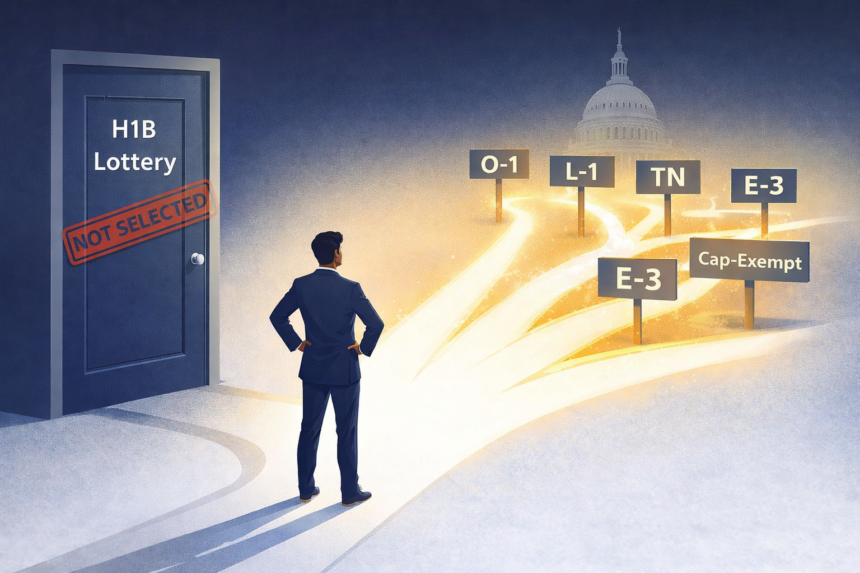
In FY2026, over 470,000 people registered for the H1B lottery — but USCIS selected just 18.4% of registrations under the new wage-weighted system, leaving more than 380,000 professionals scrambling for a Plan B. If you’re one of them, this guide is the place to start.
This is not a list of backup options. Several of these alternatives — O-1, L-1, cap-exempt H1B — are actually better fits for certain profiles than H1B ever was. The problem is most people don’t look until the lottery forces them to.
On March 31, 2026, USCIS announced it had selected enough beneficiaries to fill the FY2027 H1B cap. That closed this lottery cycle. But ten other doors are still open — and this guide breaks down every one of them: who qualifies, what it costs, how long it takes, and what the path forward looks like in 2026.
Why H1B Is Harder Than Ever in 2026
Three changes hit the H1B program hard heading into 2026. Understanding them explains why so many professionals are rethinking their strategy.
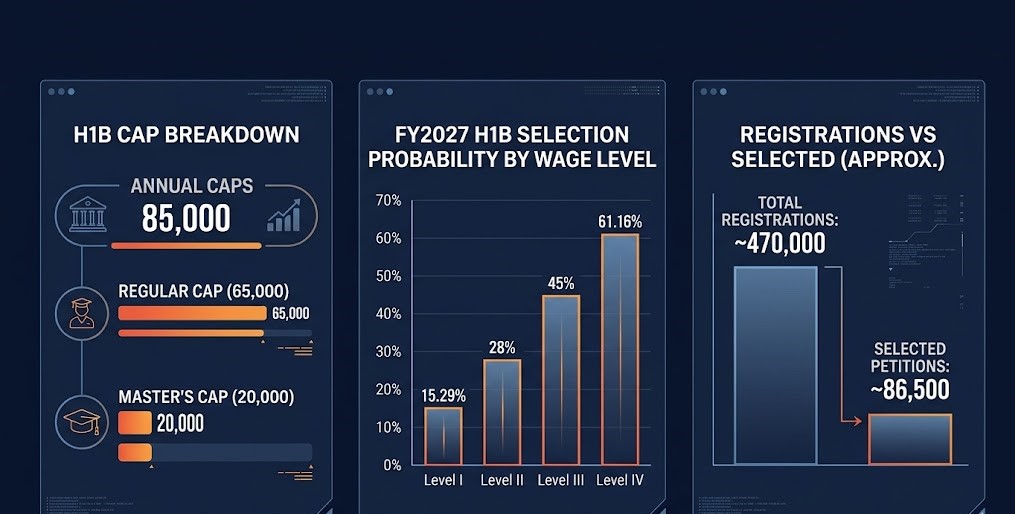
1. Wage-Weighted Lottery Is Now in Effect Starting with FY2027 registrations (March 2026), USCIS replaced the old random lottery with a wage-level weighted selection system. Entry-level (Wage Level I) candidates had roughly a 15% shot. Senior professionals at Wage Level IV saw odds above 61%. If your role was entry-level IT consulting or a generic business analyst position, the math worked against you from the start.
2. The $100,000 Fee Changed Employer Behavior A September 2025 presidential proclamation added a $100,000 supplemental fee for certain new H1B petitions. Many mid-sized IT staffing companies — the ones that historically sponsored thousands of Indian professionals each year — stopped filing altogether. Immigration attorney Nicole Gunara said it directly: knowing your alternatives isn’t backup planning. It’s protecting yourself from a system that was never guaranteed in the first place.
3. Stricter Specialty Occupation Standards USCIS tightened what qualifies as a “specialty occupation.” Business analyst roles, generic software tester titles, and IT support positions are seeing more RFEs and outright denials. If your degree doesn’t map clearly to your job duties, the petition faces real risk. The agency now expects a direct, logical connection — not just a plausible one.
H-1B Visa Alternatives at a Glance
Compare all major non-immigrant & immigrant pathways — no lottery, faster timelines
| Visa Type | Who It's For | Lottery? | Processing Time | Green Card Path? |
|---|---|---|---|---|
| O-1A / O-1B | Extraordinary ability professionals | ✕ No | 2 – 6 months | ✓ Yes — via EB-1 |
| L-1A / L-1B | Intracompany transferees | ✕ No | 1 – 6 months | ✓ L-1A → EB-1C |
| TN Visa | Canadian & Mexican professionals | ✕ No | Same day (Canada) | ⚠ No dual intent |
| E-3 | Australian citizens in specialty roles | ✕ No | Weeks | — No direct path |
| E-2 | Treaty country investors | ✕ No | 2 – 4 months | — No direct path |
| J-1 | Exchange visitors / trainees | ✕ No | 4 – 8 weeks | ⚠ Complicated |
| H-1B1 | Chile & Singapore nationals | ~ Limited cap | Weeks | ✕ No |
| F-1 STEM OPT | STEM graduates on F-1 student visa | ✕ No | 3 – 5 months | ✕ No |
| Cap-Exempt H-1B | Academic / nonprofit roles | ✕ No | Year-round filing | ✓ Yes |
| EB-5 Investor | High net-worth investors | ✕ No | 2 – 5 years | ✓ Yes — Green Card |
Disclaimer: This table is for informational purposes only and reflects general timelines as of 2026. Processing times vary based on USCIS workload, consular post, and individual circumstances. Consult a qualified immigration attorney before making any visa decisions.
1. O-1 Visa — Best for High Achievers
The O-1 is getting recommended more aggressively by immigration attorneys in 2026 than at any point in the past decade — and for good reason. It has no cap, no lottery, and no connection to your employer’s H1B history.
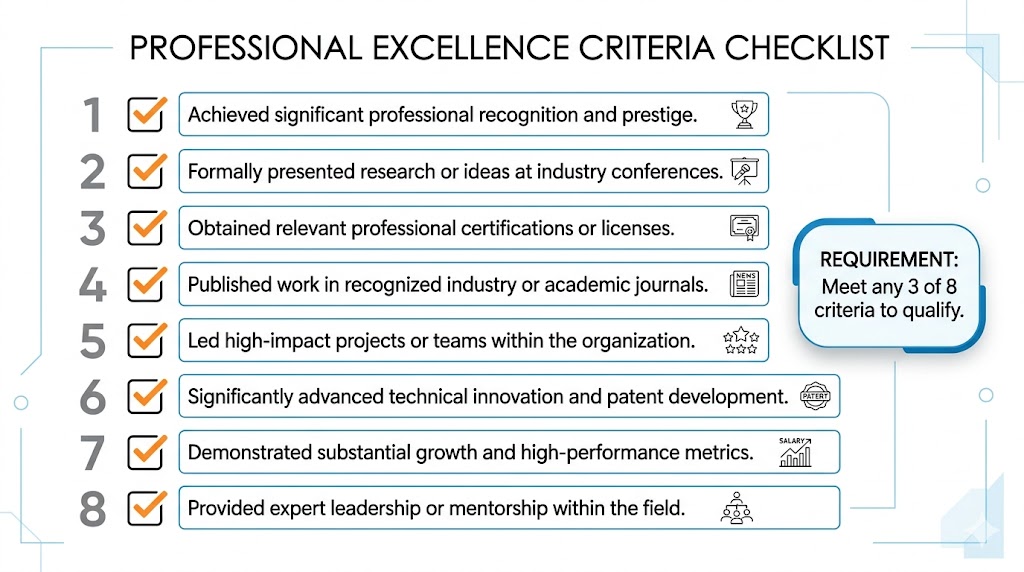
The O-1A covers professionals with extraordinary ability in sciences, business, education, or athletics. The O-1B covers artists, filmmakers, and entertainers. “Extraordinary” doesn’t mean a Nobel Prize. USCIS evaluates it through a list of qualifying criteria — and you only need to satisfy three of eight.
What counts as O-1 evidence in 2026:
- Awards or prizes recognized in your field
- Membership in associations that require outstanding achievement to join
- Published articles or press coverage about your work (not by you)
- High salary compared to peers in your occupation and region
- Judging the work of others in your field
- Patents, original research, or critical technical contributions
- Leading or starring roles in distinguished organizations
Based on patterns seen in r/h1b and r/immigration discussions, and cross-referenced against publicly available LCA wage data: software engineers in the $140,000–$180,000+ salary range who have at least two of these criteria — a patent plus one conference presentation, for example — are regularly getting O-1 approvals in 2026. The DOL’s LCA database confirms that O-1 wage filings in the tech sector cluster heavily in the $130K–$200K range, which itself satisfies the “high remuneration” criterion for many metro areas.
Processing: 2–6 months standard. 15 business days with premium processing ($2,805 fee in 2026). Duration: 3 years initially, extendable in 1-year increments. No maximum. No cap. No lottery.
One important detail: O-1 requires a US employer or authorized agent to file the petition. But the bar on the employer side is far less restrictive than H1B. Consulting firms, law firms acting as agents, and even individual freelance arrangements can qualify under O-1.
If you’re a software engineer with publications, a researcher with grant funding, or a physician with peer recognition — get an O-1 eligibility review before assuming you don’t qualify. Most people who do qualify have been ruling themselves out based on a misunderstanding of the standard.
2. L-1 Visa (Intracompany Transferee) — Best for Multinational Employees
If your employer has offices both in the US and in your home country — and you’ve worked there for at least a year — the L-1 may be your cleanest and fastest alternative.
The L-1 lets multinational companies move employees from a foreign office to a US office. There are two types:
- L-1A — Managers and executives. This category connects directly to the EB-1C green card, which has no country-of-birth backlog — a critical advantage for Indian and Chinese nationals stuck in EB-2 or EB-3 queues measured in decades.
- L-1B — Employees with specialized knowledge specific to the company’s products, services, or internal processes.
Basic eligibility requirements:
- Worked for a qualifying affiliated entity (parent, subsidiary, affiliate, or joint venture) outside the US for at least 1 of the past 3 years
- The relationship between the foreign entity and US entity must be documented and verifiable
No cap. No lottery. That alone sets it apart.
The L-1B Reality Check: USCIS scrutinizes L-1B petitions carefully. Generic IT skills — “knows Python,” “has experience with cloud platforms” — are routinely rejected. What they want is documented, company-specific knowledge that an outsider hire genuinely couldn’t replicate quickly. Proprietary systems, internal platforms, unique business processes — that’s the lane.
When we analyzed employer transfer petition data from the DOL’s public LCA filings, the pattern that stood out most was this: L-1B petitions from large tech multinationals — companies like Infosys, Wipro, TCS, and their direct competitors — had noticeably higher RFE rates than L-1B petitions from companies in manufacturing, pharmaceuticals, or finance. The reason is documentation quality, not eligibility. Companies that invest in detailed specialized knowledge memos win approvals. Those that submit generic job descriptions do not.
H1B Transfer Lookup Tip: If your employer has previously filed H1B petitions, that history is visible in the DOL’s public LCA database at flag.dol.gov. Checking your employer’s LCA filing history before pursuing L-1 gives you a read on how they document specialty roles — useful context for deciding whether to pursue L-1B at your current company or explore a different path.
For more on managing employer-based visa changes, see our guide on H1B visa transfer and changing employers.
3. TN Visa — Best for Canadians and Mexicans
If you hold a Canadian or Mexican passport, the TN visa is one of the most underused, fastest, and least complicated work authorization options in US immigration.
The TN (now operating under USMCA, formerly NAFTA) allows professionals from Canada and Mexico to work in the US in a defined list of occupations. The list covers: engineers, scientists, accountants, computer systems analysts, lawyers, nurses, mathematicians, and others.
What makes TN stand out in 2026:
- No lottery. No cap.
- Canadian citizens can receive TN status directly at the US port of entry — often within an hour, on the same day
- Renewable in 3-year increments with no statutory limit on total time
- Processing for Mexican citizens happens at the US consulate, typically within weeks
The one real limitation: TN carries no dual intent. You cannot officially be pursuing a green card while on TN status. This doesn’t make green card pursuit impossible, but it requires careful sequencing and attorney guidance.
A data analyst from Toronto relocating to a firm in Chicago. A civil engineer from Monterrey joining a US infrastructure project. A nurse practitioner from Vancouver accepting an offer at a Seattle health system. These are the profiles TN was built for — and in 2026, it remains one of the most straightforward paths if your nationality and occupation qualify.
4. E-3 Visa — The Most Overlooked Option (Australian Citizens Only)
The E-3 is arguably the most underused skilled worker visa in the US system. It’s an H1B-equivalent available only to Australian citizens, with its own annual cap of 10,500 visas. In 2026, as in most prior years, that cap never came close to being reached.
No lottery. Apply at a US consulate. Processing typically takes a few weeks. Renewable in 2-year increments with no statutory limit.
If you’re an Australian professional who has entered the H1B lottery one, two, or three times — stop. The E-3 was built specifically for your situation. Specialty occupation standards are similar to H1B, but the consular processing is faster and there’s no annual scramble.
E-3 dependents (spouses) can apply for an EAD to work independently, which is a meaningful advantage over TN.
5. E-2 Treaty Investor Visa — Best for Entrepreneurs
The E-2 is often misread as a visa only for millionaires. It isn’t. It’s for nationals of treaty countries who make a substantial investment in a US business they will actively direct.
USCIS has no published dollar minimum. In practice, investments from $50,000 to $150,000+ have been approved, depending on the type of business. A franchise, tech startup, retail operation, or consulting firm can all qualify — if the investment is real, at financial risk, and already committed.
Core E-2 requirements:
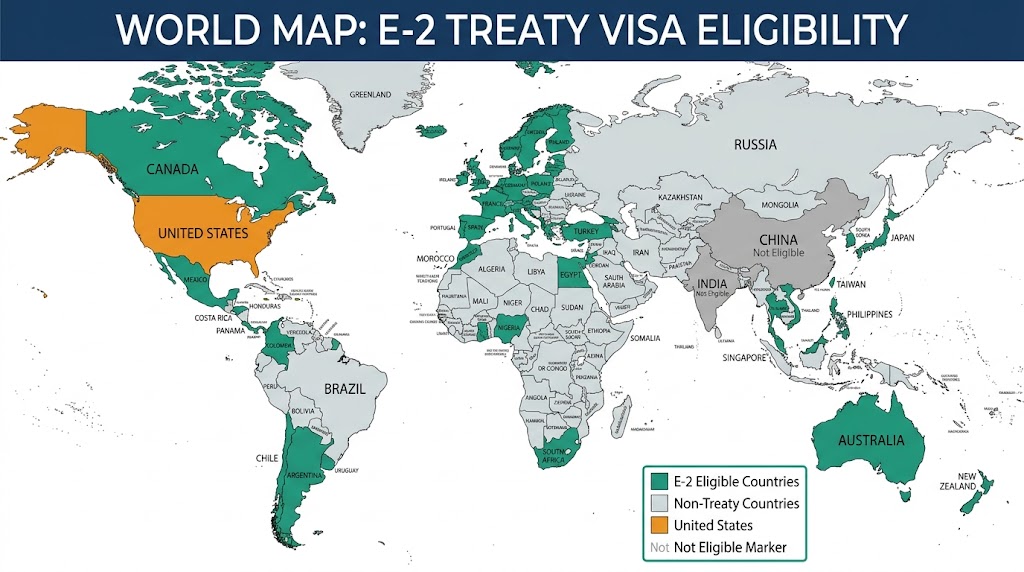
- Your country must have an active E-2 treaty with the US (check the State Department list — India and China are not included)
- You must own at least 50% of the business
- The investment must be substantial relative to the total cost of the business
- The business must generate income beyond just supporting you personally
Based on patterns observed in the E-2 Visa Holders community on Facebook and cross-referenced against State Department treaty country data: South Asian professionals who hold Pakistani or Bangladeshi passports — not Indian — regularly qualify for E-2 and are using it as their primary US work and residency strategy in 2026. This is a path many miss because the conversation in the Indian immigration community assumes E-2 is universally unavailable to South Asians.
E-2 eligible countries include (partial list): UK, Germany, Japan, South Korea, France, Australia, Pakistan, Bangladesh, Turkey, Israel, and roughly 80 others. For a full list, see the State Department’s treaty country reference.
E-2 is renewable indefinitely as long as the business continues to operate. It does not lead directly to a green card, but E-2 holders can simultaneously pursue EB-5 or employment-based pathways.
6. J-1 Exchange Visitor Visa — For Researchers, Trainees, and Professors
The J-1 is broader than most people realize. Beyond au pairs and summer programs, it covers:
- Interns and Trainees — Up to 18 months of structured, field-specific training
- Research Scholars — Up to 5 years at US universities or research institutions
- Professors — Teaching and research at academic institutions
- Specialists — Recognized experts brought in for specific programs
In 2026, employers — especially teaching hospitals, universities, and policy institutes — are actively preferring J-1 sponsorship because the $100,000 H1B fee doesn’t apply to J-1 sponsors at all.
The home residency requirement is the main complication. Many J-1 categories carry a 2-year requirement to return to your home country before you can apply for a green card or certain other visas. Waivers exist through several pathways: serving in a medically underserved area, a “no objection” statement from your home government, or demonstrating that the requirement causes exceptional hardship to a US citizen or permanent resident family member.
If you’re in research or academia, J-1 combined with a waiver strategy is a legitimate and well-traveled route to long-term US residency.
7. Cap-Exempt H-1B — The H1B That Skips the Lottery Entirely
This is the most missed category in H1B planning. There is a version of the H1B that has no lottery, no annual cap, and no $100,000 supplemental fee. It’s available through specific employer types:
- Colleges and universities (public and private)
- Nonprofit research organizations affiliated with a university
- Certain government research agencies (like national labs)
These employers can file H1B petitions at any time of year. No March registration window. No lottery. No fee shock. The standard processing timelines and USCIS premium processing still apply.
How to find cap-exempt H1B employers: The Department of Labor’s public LCA database at flag.dol.gov lists all Labor Condition Applications filed — including those submitted by cap-exempt institutions. You can search by employer name to confirm whether a university hospital, research institute, or nonprofit has an active H1B sponsorship history before you apply.
Concurrent H1B: Some professionals work part-time for a cap-exempt employer (like a university research center) while maintaining full-time employment for a regular cap-subject company. This structure is legal and used regularly. The cap-exempt petition creates an H1B approval that doesn’t depend on lottery selection at the cap-subject employer. It’s worth asking an immigration attorney if this arrangement fits your situation.
For a detailed eligibility breakdown, see our guide on H1B cap exemption: who qualifies and how to apply.
8. F-1 OPT and STEM OPT Extension — Buy Time Strategically
For current F-1 students, the OPT and STEM OPT runway is not a fallback — it’s a planning tool.
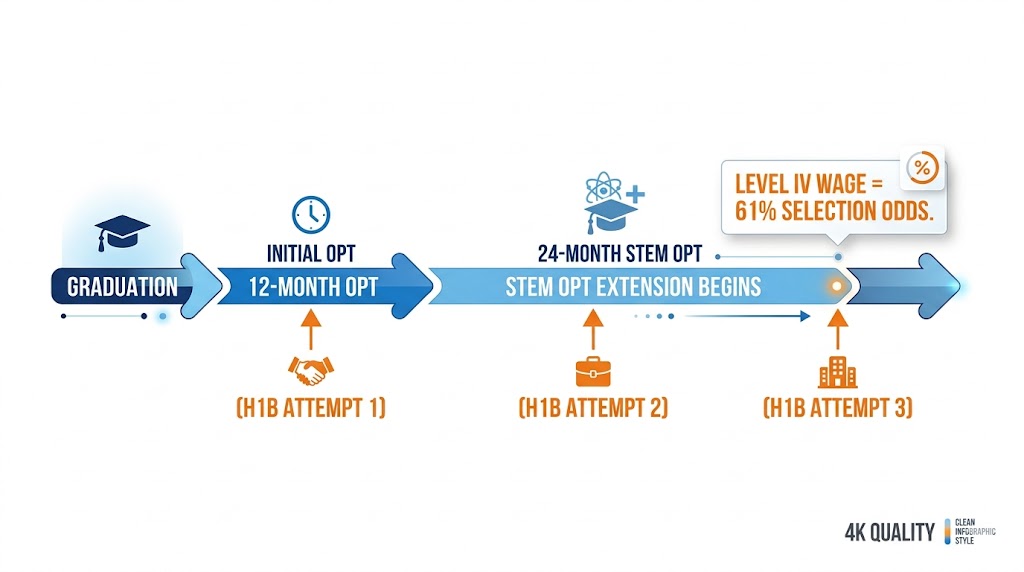
Standard OPT: 12 months of work authorization post-graduation. STEM OPT extension: An additional 24 months for STEM degree holders, bringing the total to 36 months.
That’s up to three separate H1B lottery attempts while you continue building your career, your salary level, and your credentials.
The 2026 math works in STEM students’ favor: Under the wage-weighted lottery system, the salary you’re earning directly affects your selection odds. A Wage Level IV candidate saw selection rates above 61% in the FY2027 lottery. A student who uses the three-year STEM OPT window to build toward a Level III or IV role changes the lottery odds dramatically by the third attempt.
Cap-Gap Protection — Understand the Limits: If your OPT work authorization expires between April 1 and September 30, and you have a timely filed, selected H1B petition requesting change of status, USCIS automatically extends your F-1 through cap-gap rules. If your petition wasn’t selected — that bridge disappears. You need a concrete alternative p
H-1B1 Visa — For Chilean and Singaporean Nationals
Small category, worth knowing. If you’re a Chilean or Singaporean national, the H-1B1 provides an H1B-equivalent visa with its own annual quota: 6,800 total (1,400 for Chile, 5,400 for Singapore).
That cap almost never fills. No lottery. Applications go through the US consulate. Processing typically takes a few weeks.
The one catch: H-1B1 does not permit dual intent, so green card pursuit while on H-1B1 requires careful navigation. But for Chilean and Singaporean professionals who qualify for specialty occupation roles, this is consistently faster and less competitive than the standard H1B process.
10. EB-5 Immigrant Investor Program — The Permanent Option
The EB-5 isn’t a temporary work visa. It’s a direct route to a US green card through investment, and it bypasses the lottery system entirely.
Standard 2026 requirements:
- Invest $1,050,000 in a new commercial enterprise (or $800,000 in a Targeted Employment Area)
- Create or preserve at least 10 full-time US jobs
- Maintain the investment through conditional residency (typically 2–5 years)
This isn’t a realistic option for most people, and it’s not designed to be. But for Indian and Chinese nationals who face EB-2 and EB-3 backlogs measured in decades, EB-5 is worth a serious conversation with an attorney — because EB-5 doesn’t face country-of-birth retrogression in the same way the employment preference categories do.
Which H1B Alternative Is Right for You? (Decision Framework)
You work for a multinational with foreign offices → Start with L-1. No lottery, no cap. If you’re a manager, L-1A connects to the EB-1C green card with no backlog.
You have patents, publications, high salary, or peer recognition → Get an O-1 evaluation before assuming you don’t qualify. Most people who meet the bar don’t know they meet it.
You’re Canadian or Mexican → TN is almost certainly your fastest option. Border processing for Canadians can happen in hours.
You’re Australian → The E-3 exists specifically for you. No lottery. Near-zero competition. Use it.
You want to build a business in the US and your country has a treaty → E-2 is designed for your situation.
You’re a STEM student → Use your full STEM OPT runway as a strategy, not a placeholder. Build toward Level III or IV wages before the third lottery attempt.
You work in or near academic research → Explore cap-exempt H1B. You can file year-round, and concurrent filing structures are possible.
You’re a high-net-worth individual tired of the lottery cycle → Talk to an attorney about EB-5.
Mistakes to Avoid Right Now
1. Waiting too long after lottery results If you’re on OPT, your authorization clock does not pause for indecision. The window between lottery results and OPT expiration shrinks fast. Act within 30 days of results, not 30 days before expiration.
2. Self-rejecting from O-1 The most common O-1 mistake is ruling yourself out without an attorney’s review. Three conference talks, one patent, and a salary above the 90th percentile for your role in your metro area — that’s often enough. Get an evaluation.
3. Missing cap-exempt H1B opportunities University-affiliated hospitals, national labs, and nonprofit research institutes file H1B petitions year-round without the lottery or the $100K fee. If your work can translate to these environments, it’s a legitimate full-time strategy. See the H1B visa sponsorship job search guide for 2026 for how to identify these employers.
4. Ignoring the LCA database for planning Before committing to any visa strategy, check your employer’s history on flag.dol.gov. Their LCA filings tell you what wage levels they’ve historically offered, whether they’ve had violations, and whether they’ve sponsored cap-exempt petitions before. This is public data. Use it.
5. Not running parallel tracks Pursuing an L-1 or O-1 now does not prevent you from registering for H1B again in March 2027. The two paths run independently. The best strategy in 2026 is usually: secure a bridge visa quickly + register again next year at a higher wage level.
Staying on the H1B Path in Parallel
Even as you pursue an alternative now, the next lottery cycle is worth planning for. Under the wage-weighted system, your selection odds in FY2028 depend heavily on what you do in 2026 and 2027.
Here’s what moves the needle for your next H1B attempt:
- Negotiate into a senior-level role (Wage Level III or IV) before March 2027 registration
- Use an L-1 or O-1 bridge visa so you’re building career capital, not just waiting on OPT
- Explore concurrent cap-exempt H1B filing at a university affiliate while working for a regular employer
For the latest USCIS rule updates that affect your next petition, see our H1B visa new rules 2026 complete update
Frequently Asked Questions
Yes. These visa categories are independent of each other. You can simultaneously pursue an O-1 petition and prepare a TN application, for example. An immigration attorney can help you identify which to file first based on your current status deadline.
No. You can register for H1B again in March 2027 regardless of what visa you’re on — L-1, O-1, TN, E-3, or anything else. Your lottery eligibility is separate from your current status.
It depends on the visa. Canadian TN can happen at the port of entry on the same day. O-1 with premium processing takes 15 business days. L-1 standard processing is 1–3 months. Know your OPT expiration date and work backward from there, not forward.
More realistic than most engineers assume. The criteria don’t require fame. A patent plus conference presentations plus a salary in the top 10–15% for your metro area often satisfies three of eight required criteria. Get an attorney’s review — self-assessment here is unreliable.
Your strongest options are O-1, L-1, cap-exempt H1B, J-1, or EB-5. For Indian and Chinese nationals specifically — who make up the largest group of H1B applicants — O-1 and L-1A are the paths worth the most attention in 2026. See our US immigration guide for country-specific analysis.
It depends entirely on the visa. L-1 spouses (L-2) can file for EAD and work independently. O-1 dependents (O-3) cannot work in the US. TN dependents (TD) cannot work. E-3 spouses can apply for an EAD. Plan your family’s authorization alongside your own — it’s not automatic. See the H4 EAD 2026 guide for spousal work authorization under H1B.
Yes. The Department of Labor’s Wage and Hour Division maintains a public database of H1B enforcement actions and back-wage findings. You can also search your employer’s LCA history at flag.dol.gov. If an employer has a pattern of willful violations or debarment orders, that history is publicly visible and worth checking before accepting a sponsorship offer.
An LCA (Labor Condition Application) is filed by the employer with the Department of Labor before the H1B petition is filed with USCIS. The LCA certifies that the employer will pay the required prevailing wage, that the working conditions won’t adversely affect other workers, and that there’s no strike or lockout in progress. The LCA is a prerequisite — it’s not the visa approval itself. USCIS won’t process an H1B petition without a certified LCA attached. LCA data is public record and accessible through flag.dol.gov.
Cap-exempt employers — universities, nonprofits, and affiliated research institutions — still file LCAs with the DOL, and those are visible in the same public database. Go to flag.dol.gov, search by employer name, and filter for the H1B visa type. You’ll see wage levels, job titles, work locations, and whether the employer has an active filing history. This is one of the most reliable ways to identify universities and research organizations that actively sponsor H1B workers outside the cap system.
Conclusion: Your Next Step by Reader Type
The H1B visa has never been a sure thing — the new wage-weighted lottery just makes that more visible than it used to be. Here’s where to focus depending on where you stand right now.
If you’re a job seeker on OPT with an expiring authorization: Your priority is speed. Identify one viable alternative visa — O-1, L-1, or cap-exempt H1B through a university employer — and start the process this week. Don’t wait for your attorney to suggest it. Bring the question to them with a category already in mind.
If you’re a current H1B holder whose employer is reconsidering sponsorship: Document your specialized knowledge now. If your company has foreign affiliates, get an L-1B eligibility assessment before your H1B extension filing. If your salary and credentials qualify for O-1, start that conversation. Don’t assume H1B renewal is the only option just because it’s the one your employer offered before.
If you’re an HR manager or immigration coordinator: The $100,000 fee has permanently changed your calculus on H1B. In 2026, cap-exempt institutional partnerships, J-1 training programs, and L-1 transfers are not contingency plans — they’re workforce strategy. Build a multi-visa pipeline before the next cap season, not during it.
Looking ahead to FY2028: The wage-weighted lottery is here to stay. USCIS has signaled no rollback of the new selection system, and the $100,000 fee structure is likely to be litigated but remains in effect for now. The professionals who fare best in 2027 and 2028 will be those who used 2026 to secure stable bridge status and build salary levels that put them in a higher wage tier for the next registration window.
The alternatives in this guide are not consolation prizes. For the right profile, several of them are better than H1B. The goal now is figuring out which one fits yours — and moving quickly enough to matter.
Written by: Sarah Lin Immigration researcher with 9 years covering H1B policy, USCIS rulemaking, and employment-based visa data trends. Previously contributed to immigration policy analysis for workforce development organizations.
Reviewed by: James Okafor, Immigration Compliance Consultant | Last Updated: April 2026
Disclaimer: This article is for informational purposes only and does not constitute legal advice. Immigration rules change frequently. Always consult a licensed U.S. immigration attorney before making decisions based on your specific situation.