


Introduction
Here’s a situation that plays out constantly on r/immigration and r/h1b: someone gets a better job offer — maybe a $30K pay bump, maybe a role that actually aligns with their career goals — and suddenly they’re paralyzed. Can I even do this? Will I lose my visa status? Do I need to go through the lottery again?
The answer to most of those fears is: no. You don’t need the lottery again. You can start working before USCIS even approves the petition. And your current employer doesn’t need to know a thing until you’re ready.
But the process has some real tripwires in 2026 — especially around the new $100,000 fee (which doesn’t apply to most people switching jobs domestically, but the confusion is rampant), the 60-day grace period rules, and what happens if you travel internationally during a transfer. This guide covers all of it.
What Is an H-1B Transfer? (And Why It’s a Bit of a Misnomer)
Calling it a “transfer” is technically inaccurate — and that distinction matters if you want to understand what’s actually happening legally.
Changing H-1B employers is often called a “transfer,” but it’s technically a new petition. Your new employer files Form I-129 (Petition for a Nonimmigrant Worker) with USCIS rather than moving your existing visa. The practical benefit: your prior cap count carries over. You’re already counted against the annual H-1B lottery cap from your original petition, so no new lottery entry is required. Lighthousehq
So when someone says “I transferred my H-1B,” what actually happened is: a new employer filed a fresh I-129 petition on their behalf, citing that the worker was already cap-counted. No lottery. No waiting until April. Just the petition process — which is a lot faster.
This is the part most people miss when they Google this topic. You’re not “moving” a visa. You’re getting a new one that skips the line because you already paid your dues in the lottery.
Who Can Transfer Their H-1B in 2026?
Not every H-1B holder can just walk into a new job and start tomorrow. There are eligibility boxes you have to check.
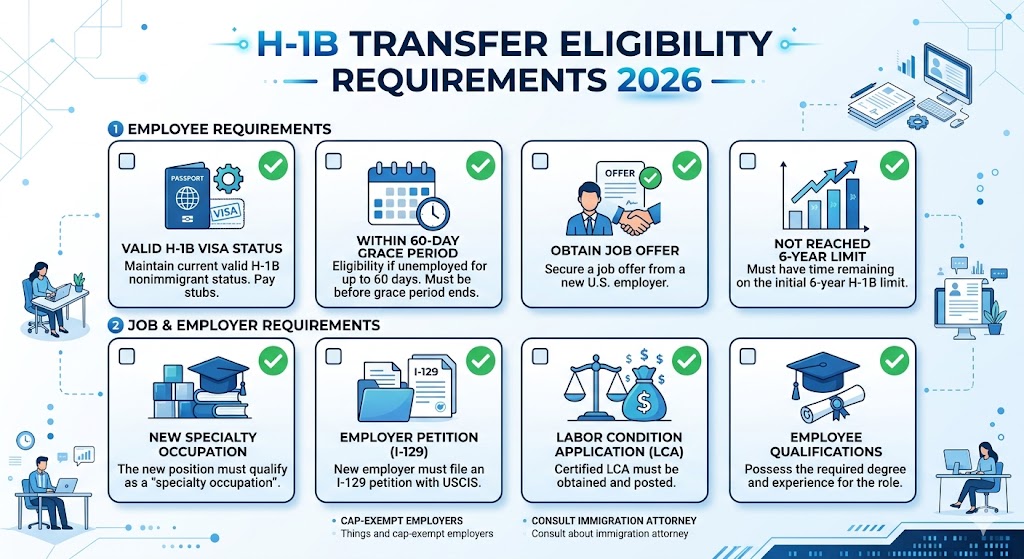
To qualify for H-1B portability, you must meet these criteria: valid H-1B status (you are maintaining lawful H-1B status or within the 60-day grace period after employment ends), timely filing (your new employer files the H-1B transfer petition before your current authorized stay expires), and a nonfrivolous petition (complete, including a certified LCA, detailed job description, and all required supporting documents). Lighthousehq
And there’s one more that trips people up:
No unauthorized employment — you have not engaged in unauthorized work during your current H-1B status. Lighthousehq
If you’ve worked even a few days for a company that wasn’t your H-1B sponsor without proper authorization, that can complicate a transfer significantly.
Also worth knowing: you are not required to tell your current employer about an H-1B transfer. Immi-USA You can job hunt, accept an offer, and get the process started without saying a word to your current employer. Many people do exactly this.
The Step-by-Step H-1B Transfer Process in 2026
Step 1: Accept the Job Offer and Gather Your Documents
Your new employer provides a written job offer. You’ll gather documents including your passport, I-94, prior H-1B approvals, recent pay stubs, and degree credentials. Lighthousehq
Start collecting these the moment you’re serious about the move. Some documents take time — especially if you need to get transcripts or copies of your original H-1B approval notices (Form I-797). If you’ve lost your I-797, request a copy from USCIS via Form G-1145.
Step 2: Your New Employer Files the Labor Condition Application (LCA)
The employer must submit a Labor Condition Application (LCA) with the conditions of the position. This must be certified by the U.S. Department of Labor (DOL) before filing the H-1B transfer petition. LCAs are reviewed by the Department within seven working days. Immi-USA
The LCA is filed electronically through the DOL’s FLAG system. It certifies that the employer is paying you at least the prevailing wage for your occupation in your work location — this is a key labor protection in the H-1B program.
One important thing: the LCA is specific to a work location. If you’ll be working in New York City versus a rural Ohio town, the prevailing wage will be very different. Make sure your employer is filing the LCA for the actual city where you’ll work, not just their HQ.
Step 3: File Form I-129 with USCIS
After the LCA is certified, the new employer must file a new Form I-129 petition, noting you already have an H-1B and that you’re changing employers. Unless you are attempting to move from an H-1B cap-exempt to a cap-subject job, you don’t need to go through the H-1B lottery because you already have a visa. Manifest Law
This is also where the employer chooses between regular and premium processing — more on that in the fees section.
Step 4: Start Working (Yes, Before Approval)
This is the part that surprises most people.
An eligible H-1B worker can change employers as soon as the new employer’s nonfrivolous H-1B petition is properly filed with USCIS. USCIS
You read that right. You don’t have to wait months for approval. The moment your new employer has a USCIS receipt notice — that receipt number on Form I-797C — you can legally start your new job. This is called H-1B portability, and it’s one of the most employee-friendly provisions in the entire H-1B system.
That said, “nonfrivolous” matters. A petition that’s missing documents, has an incorrect LCA, or lacks a proper job description could get flagged. This is why it pays to have an experienced immigration attorney review the filing before it goes out.
The $100,000 H-1B Fee: Does It Apply to Your Transfer?
This is the most asked question on every H-1B forum right now. Let’s clear it up.
President Donald Trump signed a new executive order implementing a $100,000 fee on all new H-1B visa applications filed after September 21, 2025. The latest information from the White House has clarified that the new fee only applies to new H-1B applications made on behalf of beneficiaries outside the U.S. If you’re in the U.S., you can still change employers without them having to pay the $100,000 fee. Manifest Law
So if you’re already working in the U.S. on H-1B and switching to a new employer through a domestic change of status — the $100K fee does not apply to you or your new employer.
The fee applies to beneficiaries who are: outside the United States and do not have a valid H-1B visa, or are inside the U.S. but the petition requests consular notification, port of entry notification, or pre-flight inspection. Immi-USA
If you’re unsure which category you fall into, this is exactly the kind of question to ask an immigration attorney. Our guide on H-1B visa lawyer options can help you find the right legal help without overpaying.
The fee is still facing legal challenges. Several lawsuits challenging the fee are working their way through the court system. The U.S. Chamber of Commerce and the Association of American Universities, among other plaintiffs, argue the fee exceeds the president’s authority. Employmentlawworldview
Separately, we’ve covered the full context of this legal battle in our article on the $100K H-1B fee legal fight.
H-1B Transfer Fees in 2026
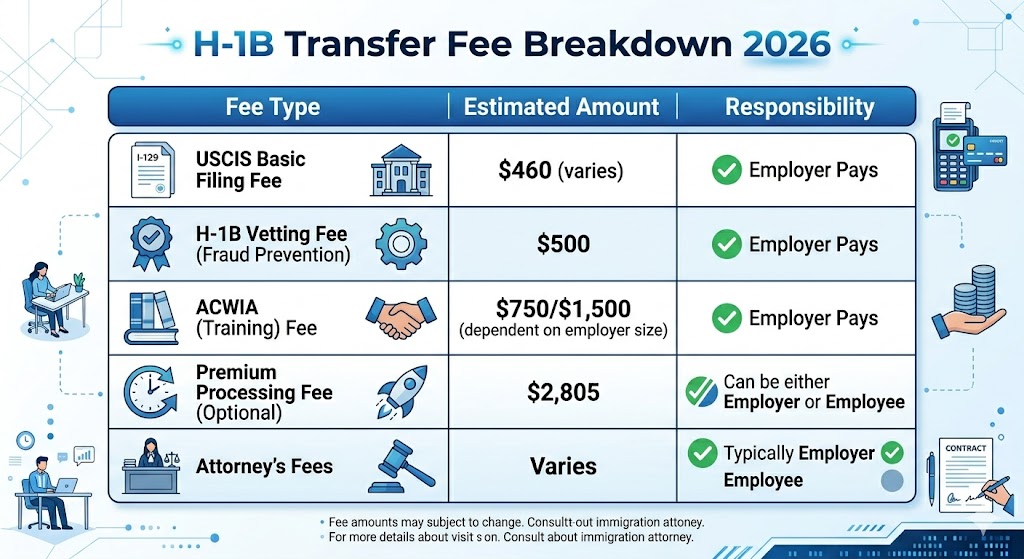
All USCIS petition fees are legally required to be paid by the employer — costs cannot be shifted to the worker.
| Fee | Amount | Who Pays |
|---|---|---|
|
I-129 Base Filing Fee
Core USCIS petition fee
|
$730
$460 for small employers (<25 FTE)
|
Employer |
|
ACWIA Training Fee
American worker training fund
|
$1,500
$750 for small employers
|
Employer |
|
Fraud Prevention & Detection Fee
One-time per petition
|
$500
Flat rate, all employers
|
Employer |
|
Asylum Program Fee
Added under INA §286(u)
|
$600
$300 small / $0 nonprofits
|
Employer |
|
Attorney Fees
Immigration counsel, varies by firm
|
$1,500 – $3,500
Estimated range
|
Usually Employer |
|
Premium Processing
15-business-day adjudication — optional
|
$2,965
Effective March 1, 2026
|
Optional |
The cost of premium processing increased to $2,965 on March 1, 2026. Immi-USA
Public Law 114-113 Fee applies — $4,000 for companies with more than 50 employees with over half on H-1B or L-1 status. Immi-USA If your new employer is a large outsourcing-heavy firm, this extra fee applies on top of everything else.
If your new employer is reluctant to pay for premium processing, consider covering that cost yourself. Manifest Law $2,965 out of pocket to get a decision in 15 business days — rather than waiting months in limbo — is often worth it.
H-1B Transfer Timeline in 2026
A normal H-1B transfer timeline 2026 often looks like this: job offer accepted and documents collected — about 3 to 10 days; LCA filed with the Department of Labor — usually reviewed within 7 working days; H-1B petition filed with USCIS — often right after the certified LCA is ready; start date with the new employer — in many cases, as soon as the petition is properly filed; premium processing decision — 15 business days for eligible filings. Veripass Blog
The shortest H-1B transfer timeline in 2026 can be around two to four weeks if the employer moves fast, your documents are clean, and premium processing is used. A slower case can take much longer if the employer delays, the LCA is filed late, or USCIS issues a Request for Evidence. Veripass Blog
RFEs (Requests for Evidence) are the silent killers of H-1B timelines. They typically add 60-90 days to the process and require detailed responses. The most common RFE triggers in 2026: vague job descriptions, specialty occupation questions for roles like business analysts or project managers, and wage issues where the LCA wage doesn’t clearly match what the employer intends to pay.
What Happens During the 60-Day Grace Period?
Say you get laid off — which happened to thousands of H-1B workers during the tech layoffs of 2024 and 2025. What now?
If your previous employer terminated your H-1B employment, you may still be eligible to transfer within a grace period, typically 60 days. Contact an H-1B transfer attorney immediately to discuss your options if you were laid off. Immigration Law of LA
The 60-day grace period starts from your last day of employment. During this window, you can find a new employer, have them file the transfer petition, and get back into valid status. You cannot work during this period — you must wait until the receipt notice is issued.
One caveat: the 60-day grace period is discretionary. File early to reduce scrutiny. Lighthousehq This means USCIS can decide not to honor it in certain circumstances, though they rarely refuse it for people who are actively transferring in good faith.
If your situation involves a layoff, also check out our guide on what to do if your H-1B is cancelled or revoked — it walks through your options in detail.
International Travel During an H-1B Transfer: A Real Risk
This is where many people get into trouble without realizing it.
If you travel outside the U.S. during the transfer process, you typically need the new H-1B visa stamp to re-enter after approval. Immigration Law of LA
So if your transfer is still pending and you travel internationally — even for a family emergency — you may not be able to re-enter the U.S. using portability. You’d need to get a new H-1B visa stamp at a U.S. consulate, which means going through the H-1B visa stamping process.
The general advice from immigration attorneys: don’t travel internationally while your transfer is pending unless you absolutely have to. And if you do have to go, talk to an attorney first. Our guide on H-1B visa stamping in 2026 has updated information on current consular appointment wait times.

Real Experiences: What Reddit and Facebook Groups Are Saying in 2026
Theory is one thing. Here’s what’s actually happening on the ground.
From r/h1b (April 2026): A user posted: “Got my receipt notice on a Thursday. Started my new job the following Monday. My old employer has no idea I switched — and legally doesn’t need to know. The portability provision is genuinely amazing.”
The response thread has hundreds of upvotes and follows the same pattern: people who went through a smooth transfer in 3-4 weeks with premium processing, and people who got RFEs because their employer’s attorney wrote a weak job description.
From an H-1B Facebook group (March 2026): One member shared a stressful experience — they got laid off from a major tech firm in February, panicked, and waited two weeks before starting to look for new employers. They found an offer in week three and their new employer filed within 10 days. The receipt notice came back fast, and they started work with 11 days to spare in their 60-day window. The lesson they shared: “Start looking the same week you get the news. The 60 days goes faster than you think, especially with attorney review time.”
From r/immigration: One comment that got a lot of traction: “My new employer wanted me to wait until I-129 approval before starting. I had to explain H-1B portability to their HR team, who had never heard of it. Bring documentation from USCIS.gov to back it up — it helps.” This is more common than it should be. Many HR teams at smaller companies are not familiar with portability rules and will default to waiting for approval. Know your rights.
Can You Transfer Multiple Times?
Yes, you can transfer multiple times as long as each new employer files a valid H-1B petition. Immigration Law of LA
There’s no legal limit on how many times you can transfer. Some people in long-term careers switch employers 3-4 times and maintain H-1B status throughout. Each transfer is a new I-129 petition, but the cap-exempt status carries over every time.
What does have a limit: your total H-1B time. Your time already spent in H-1B status counts toward the maximum 6-year limit. Immigration Law of LA
If you’re approaching that 6-year mark and haven’t started a green card process, that becomes urgent. See our guide on H-1B to green card timeline and costs to understand how the clock works and when to act. For those with an H-1B extension beyond 6 years, there are provisions — but they depend on where you are in the green card process.
H-1B Transfer vs. H-1B Amendment vs. H-1B Extension
People mix these up constantly. Here’s a quick breakdown:
H-1B Transfer (Change of Employer): New employer files a new I-129. You’re moving to a different company. This is what this entire article covers.
H-1B Amendment: Same employer, but something material changed — your work location moved to a different city, your salary changed significantly, or your job duties shifted substantially. No employer change involved.
H-1B Extension: Same employer, extending your existing status before it expires. Usually filed 6 months before your current I-797 end date. Our H-1B extension guide covers the 240-day rule and what happens when your extension is pending.
Simultaneous H-1B (Working Two Jobs)
This is a real option that very few people know about.
You can have two concurrent H-1B petitions filed at the same time — one with your current employer and one with a new employer (or a second employer). Both have to be for specialty occupation roles, and both employers have to file separately. The key requirement: both jobs have to be legitimate, full-time or part-time specialty occupation positions.
This comes up in situations where someone wants to do part-time consulting work alongside their main job. It’s legal, but requires both employers to have active I-129 petitions.
The Self-Sponsorship Option (New in 2025)
This one is newer and worth knowing about.
A policy shift in January 2025 allows H-1B beneficiaries who own a business, even with a controlling interest, to self-sponsor their H-1B visa. With the new rule, you can now sponsor yourself as long as you have a legitimate business plan, can show you’re working in a specialty occupation, and meet the necessary requirements. Immi-USA
This is a real change for entrepreneurs who want to start a company in the U.S. while on H-1B status. Previously, you needed a separate board or entity structure to technically be your own employer. Now, that’s no longer required — though you still need to meet all the specialty occupation and prevailing wage standards.
Documents You Need for an H-1B Transfer
Get these ready before your new employer even files the LCA:
- Passport (all pages)
- Current I-94 (printout from CBP website)
- All prior H-1B I-797 approval notices (including extensions)
- Recent pay stubs from current employer (usually 3 months)
- Degree certificates and transcripts (original + official translations if not in English)
- Current employment verification letter (if you can get one without tipping off your employer)
- Copies of any prior RFEs and responses (if applicable)
- Social Security card (if applicable)
The more complete your file, the lower the chance of an RFE. Attorneys will tell you this over and over — and they’re right. An RFE can add months to a process that should have taken weeks.
How an H-1B Transfer Affects Your Dependents
If your spouse and kids are in the U.S. on H-4 status, their status is tied to yours. A transfer doesn’t typically disrupt their H-4 status as long as yours remains valid through the process.
But what about H-4 EAD (work authorization for spouses)? If your spouse has an H-4 EAD, their work authorization continues as long as your underlying H-1B status is maintained. The transfer itself doesn’t invalidate their EAD. Just make sure the transfer is filed and you have a valid receipt notice before any gap in status.
What About Cap-Exempt to Cap-Subject Transfers?
This is a specific situation worth flagging.
If you’re currently employed by a cap-exempt employer (a university, government research organization, or qualifying nonprofit) and want to move to a regular for-profit company, the rules change. Unless you are attempting to move from an H-1B cap-exempt to a cap-subject job, you don’t need to go through the H-1B lottery because you already have a visa. Manifest Law
Moving from cap-exempt to cap-subject means you do need to re-enter the lottery. This is a major consideration for academics and research workers thinking about switching to industry roles. Our guide on H-1B cap exemption explains who qualifies and what the rules are.
Salary Negotiation During an H-1B Transfer
One thing the portability rules enable that doesn’t get talked about enough: leverage.
When you can start working before approval, you’re not stuck waiting for USCIS in a desperate position. You can negotiate your offer with more confidence. And since prevailing wage rules require your new employer to pay you at least the DOL-certified wage for your occupation and location, there’s a floor below which they legally cannot go.
Use sites like USCIS’s Wage Data tool and the DOL’s online wage library to check what the prevailing wage is for your role in your city. If an employer is offering you below that number, they can’t file the LCA for that salary — so the offer itself won’t survive the process.
For understanding what salary ranges are appropriate and how the H-1B salary requirements work, see our breakdown at H-1B salary requirements.
Common Mistakes That Get H-1B Transfers Rejected
1. Waiting too long after a layoff. The 60-day window is real, and attorneys get busy. Start immediately.
2. Starting work before the receipt notice. You need the actual USCIS receipt — an attorney email saying “we filed” isn’t enough. Wait for the I-797C notice.
3. Traveling internationally while the petition is pending. This is covered above, but it bears repeating.
4. Letting your employer file without an attorney. Small companies especially try to DIY this. H-1B filings require precision — one vague job description can trigger an RFE that kills your start date.
5. Not checking if your new job is actually a specialty occupation. Roles like “marketing manager” or “business analyst” have faced heavy USCIS scrutiny in recent years. If the title is ambiguous, the petition needs extra documentation.
6. Assuming your visa stamp is still valid for re-entry. Your visa stamp in your passport is not the same as your H-1B status. Check both.
Conclusion
Switching employers on H-1B in 2026 is genuinely one of the more employee-friendly parts of U.S. immigration law. The portability rule exists precisely so you’re not chained to one employer out of fear. Start with a new job offer, get the LCA filed, get the I-129 in, and in most cases you can be at your new desk in 2-4 weeks with premium processing.
The real risks are around timing (60-day grace period), international travel, and weak petition documentation. Get an experienced immigration attorney involved — the cost is usually covered by your new employer and it dramatically reduces the chance of an RFE slowing everything down.
If you’re also thinking about what comes after the transfer — the longer-term path — our guides on H-1B to green card and H-1B visa requirements cover those next steps in detail.