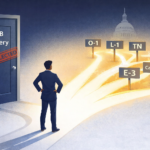



Quick Summary: To qualify for H-1B sponsorship in 2026, both the employer and the employee must meet specific requirements — and the bar for what counts as a qualifying job has gotten harder to clear in the current enforcement environment. This guide covers every eligibility requirement, what changed, and how to assess your situation before you start the application process.
ContentsThe Two-Part Test Nobody Explains ClearlyWhat Makes a Job a “Specialty Occupation”What the Applicant Needs — Degree and Credential RequirementsWhat the Employer Needs to DoCap-Subject vs Cap-Exempt — Which Track Are You On?Common Situations That Are More Complicated Than They LookWhat Happens After You Qualify — The Process FlowFrequently Asked QuestionsDisclaimer
The H-1B visa doesn’t have one eligibility requirement. It has several — stacked on top of each other — and all of them have to be satisfied at the same time.
The job has to qualify. Your degree has to match the job. Your employer has to be eligible to sponsor. The salary has to meet the prevailing wage. And since 2025, the enforcement environment around all of these has tightened in ways that are catching people who assumed their situation was fine.
This guide goes through each requirement clearly. Not in the vague way that most eligibility summaries do it — where you read three paragraphs and still don’t know if your specific situation qualifies — but specifically enough that you can actually assess where you stand.
Before we get into eligibility, a note on context: understanding the requirements is step one, but the lottery, fees, and recent rule changes are separate layers that affect whether meeting the requirements actually results in an approved visa. USAHarmony’s H-1B new rules 2026 guide covers all of that in one place if you need the full picture alongside this.
The Two-Part Test Nobody Explains Clearly
Most eligibility guides treat the H-1B as if there’s one question: does this person qualify? There are actually two questions, and both have to be answered yes.
Question 1: Does the job qualify as a specialty occupation? Question 2: Does the applicant qualify for that specialty occupation?
USCIS evaluates both independently. A job can be a legitimate specialty occupation and still be denied if the applicant’s credentials don’t match it. An applicant can have an excellent degree and still be denied if the job description doesn’t meet the specialty occupation standard.
The two-part structure matters because the most common H-1B denials and RFEs in 2025 and 2026 come from a failure on one side of this test — either the job was described too broadly, or the degree was in a field that doesn’t have a clear connection to the role. Understanding which side of the test you’re on tells you what you actually need to fix.
What Makes a Job a “Specialty Occupation”
This is the requirement that generates the most confusion and the most RFEs.
Under INA §214(i)(1), a specialty occupation must require at least a bachelor’s degree — or its equivalent — in a specific field of study as a minimum entry requirement for the position. The word “specific” is doing real work in that sentence. A job that requires “a degree in a related field” or “any technical degree” is not a specialty occupation as USCIS reads it.
The four ways to establish specialty occupation status, per USCIS policy:
1. The degree is normally the minimum for the position in the industry. If most people doing this job at comparable companies have a bachelor’s in the same specific field, that’s evidence. USCIS looks at Department of Labor occupational data, industry surveys, and job postings from similar employers.
2. The degree requirement is common for the occupation. The OOH (Occupational Outlook Handbook) and DOL’s SOC data are the primary reference points here. If DOL data shows that the occupation typically requires a specific degree, that helps.
3. The employer normally requires a specific degree. This one is company-specific — if you always hire people with a particular degree for this role, USCIS may accept that as evidence. But it has to be consistent, not invented for the petition.
4. The job is so complex or unique that only someone with a specific degree could do it. This is the hardest one to establish and usually comes up in specialized research or senior technical roles.
(Source: USCIS Policy Manual — Volume 2, Part B, Chapter 4)
Why this matters more in 2026: USCIS has been issuing RFEs at higher rates on petitions where the specialty occupation connection isn’t clearly documented. Broad job titles like “Software Engineer,” “Business Analyst,” or “Project Manager” are getting more scrutiny than they did in 2021 or 2022, because the connection between the title and a specific degree isn’t self-evident. If your job title is common and your petition doesn’t specifically explain why a particular degree is required for the specific duties listed, expect pushback.
This connects directly to the wage level issue. USAHarmony’s guide to H-1B fees explains the LCA wage level structure in detail, but the short version relevant here: Level I wage designations on petitions that describe highly specialized work create a credibility problem. If the job is truly a specialty occupation requiring expert knowledge, the wage level should reflect that.

What the Applicant Needs — Degree and Credential Requirements
If the job qualifies as a specialty occupation, the next question is whether you — specifically — qualify to fill it.
The Degree Requirement
You need at least a U.S. bachelor’s degree, or a foreign equivalent, in the specific field required by the position. Three things matter here: the level (bachelor’s or higher), the field (must match the job), and the source (U.S. degree or credential evaluation).
Foreign degrees: A degree from an Indian, UK, Canadian, or other non-U.S. institution is acceptable — but it has to be evaluated by a NACES-member credential evaluation service to establish U.S. equivalency. Most petitions include a credential evaluation as a standard document. If yours doesn’t have one, the petition is incomplete.
Three-year degrees: This comes up constantly with Indian applicants. A three-year bachelor’s degree from an Indian university — B.Com, B.Sc., B.A. — is generally not accepted as equivalent to a U.S. four-year bachelor’s degree on its own. Some credential evaluators will find equivalency when combined with a master’s degree or additional coursework. Others won’t. This is one of the most important things to check before your employer files the petition, because a three-year degree issue discovered during USCIS adjudication is expensive and time-consuming to fix.
Degree field must match the job: Having a bachelor’s degree in any field is not sufficient. The degree has to be in the field required by the specialty occupation. A computer science degree for a software engineering role — clear match. A business administration degree for a software engineering role — USCIS will question it. A mechanical engineering degree for a data science role — needs a strong explanation.
If your degree field doesn’t perfectly match the job title, it doesn’t automatically disqualify you — but your attorney needs to build a specific argument about why your education prepared you for the specialty occupation. Vague connections don’t hold up under scrutiny.
The “Equivalent” Path — When There’s No Degree
USCIS recognizes that not everyone with a qualifying skill set has a formal degree. The equivalent path is:
- Three years of specialized experience equals one year of college education
- Progressive work experience — meaning experience that demonstrates increasing complexity and responsibility — can be used to establish equivalency
The math: to substitute for a four-year bachelor’s degree, you’d need 12 years of qualifying progressive work experience. This is a high bar and most petitions don’t rely on it. But it exists, and for people who have built deep expertise without the formal degree path, it’s worth discussing with an immigration attorney.
(Source: INA §214(i)(2))
What the Employer Needs to Do
The H-1B isn’t just about the employee. The employer carries significant obligations and has to meet specific requirements to be eligible to sponsor at all.
IRS Registration and Business Operations
The sponsoring employer must be a legitimate U.S. business entity — registered with the IRS, actively operating, and capable of demonstrating a genuine need for the position being filled. An employer who has gone through name changes, mergers, or acquisitions needs to have the corporate history clearly documented in the petition.
USCIS’s Fraud Detection and National Security division conducts unannounced site visits to verify that employers are operating as described. If a site visit reveals a company that doesn’t match its petition representation — wrong address, no actual operations, employees working on-site at a different location — a Notice of Intent to Revoke can follow. This is happening more frequently in 2025 and 2026 than it was before.
The Labor Condition Application
Before filing an H-1B petition with USCIS, the employer must file a Labor Condition Application with the Department of Labor. The LCA certifies several things:
- The wage being paid is at least the prevailing wage for the occupation in the area of intended employment
- Hiring the H-1B worker won’t adversely affect working conditions for U.S. workers in similar positions
- There is no active strike or lockout at the worksite
- The employer will provide the required wage even if the employee is in a nonproductive status through no fault of their own
The LCA designates a specific work location. This matters because if an employee works from a different location — including extended remote work from another country — the employer may be in violation of the LCA terms. Under current enforcement, LCA location violations are being caught at ports of entry at higher rates than before. If you’ve been working remotely from India or another country for an extended period, this is something to discuss with your attorney before your next international trip. USAHarmony’s H-1B revocation guide covers what happens when LCA compliance issues surface — it’s not a theoretical risk in 2026.
(Source: DOL LCA Requirements — FLAG System)
The Wage Requirement — And Why It Changed
The H-1B wage must meet or exceed the prevailing wage for the occupation in the geographic area of employment, as determined by DOL’s Occupational Employment and Wage Statistics data.
As of 2026, this matters in a new way. The wage-weighted lottery system introduced February 27, 2026 means that the wage level on the LCA doesn’t just determine compliance — it determines lottery odds. Level IV gets four entries, Level III gets three, Level II gets two, Level I gets one. And if multiple employers register the same beneficiary, the lowest wage level among all registrations controls the entry count.
This creates a direct connection between wage compliance and selection probability that didn’t exist before. USAHarmony’s H-1B new rules 2026 guide covers the wage-weighted lottery in full detail, including the specific way multiple registrations interact.
Cap-Subject vs Cap-Exempt — Which Track Are You On?
Not every H-1B goes through the lottery. This distinction matters enormously for planning.
Cap-Subject Petitions
Most H-1B petitions are subject to the annual cap of 85,000 — 65,000 in the regular pool and 20,000 for the advanced degree exemption. These petitions go through the lottery, which now uses wage-weighted selection. Registration typically opens in early March for employment starting October 1 of the same year.
If you’re a candidate at a private tech company, financial firm, healthcare company, or most other private sector employers, you’re almost certainly on the cap-subject track.
Cap-Exempt Petitions
Certain employers are not subject to the cap and don’t go through the lottery at all:
- Institutions of higher education
- Nonprofit organizations affiliated with or related to institutions of higher education
- Nonprofit research organizations
- Government research organizations
For these employers, H-1B petitions can be filed year-round, in any volume, without waiting for a registration window. This is a meaningful advantage in 2026 — no lottery risk, no wage-weighting pressure, no March deadline.
USAHarmony’s cap exemption guide covers the specific qualifying criteria and how to pursue this path if your field allows for it.
(Source: USCIS H-1B Cap Exemptions)
Already on H-1B — The Transfer Scenario
If you’re already working in the U.S. on H-1B status and changing employers, you’re not subject to the cap. H-1B transfers — formally called petitions for a change of employer — go directly to USCIS without going through the lottery, regardless of the time of year.
Under H-1B portability rules in INA §204(j), you can start working for the new employer the day the transfer petition is filed — not when USCIS approves it. The approval can take months, but the work authorization starts at filing, provided you’ve been in lawful H-1B status and the new petition is non-frivolous.
This is the most commonly misunderstood part of the transfer process. If you’re changing jobs and your attorney tells you to wait for USCIS approval before starting the new job, ask specifically about portability and whether it applies to your situation.

Common Situations That Are More Complicated Than They Look
“I have a three-year bachelor’s from India.”
This is the most common credential issue Indian applicants face. A three-year B.Sc., B.Com, or B.A. is typically not treated as equivalent to a U.S. four-year bachelor’s degree on its own. The usual path is:
- Three-year bachelor’s + two-year master’s = U.S. bachelor’s equivalent, or
- Three-year bachelor’s + specific additional coursework that a credential evaluator can use to establish equivalency
The credential evaluation matters enormously here. Different NACES-member organizations take different approaches to three-year degrees. Your attorney should specify which evaluator to use based on how they handle your particular degree and institution. Submitting a credential evaluation that doesn’t specifically address the three-year issue is a common mistake.
“My job title is Software Engineer but my degree is in Electronics.”
This comes up frequently with engineers who crossed into software roles early in their careers. It’s not automatically disqualifying — but your petition needs to specifically document why an electronics engineering background qualifies you for the software role as described. The argument usually runs through overlapping technical foundations and specific coursework. A vague statement that “the fields are related” won’t hold up.
“My employer wants to put me at a Level I wage.”
In 2025 and 2026 this creates two problems simultaneously. First, a Level I wage on a petition describing senior or specialized work is an LCA consistency issue — if the job is complex enough to be a specialty occupation, the wage should reflect that. Second, under the new wage-weighted lottery, a Level I registration gives you the minimum number of lottery entries. If any other employer registers you at Level I, that single low-wage registration controls the entry count for everyone. USAHarmony’s H-1B new rules guide covers the weighted lottery mechanics in detail.
“I’m a consultant placed at a client site.”
IT consulting petitions face more scrutiny than direct-hire positions. The core issues are: does the petition describe the actual work at the client site, is the work location accurate on the LCA, and is the employer-employee relationship real? If you’re placed at a client and your employer can’t demonstrate actual supervisory control over your work, the specialty occupation claim gets harder to sustain. If the client is a separate company, the petition needs to specifically address the third-party placement situation.
What Happens After You Qualify — The Process Flow
Meeting eligibility requirements doesn’t end the work. It starts a specific process.
For cap-subject applicants: Your employer registers you during the March window. If selected in the lottery, they file the full petition between April and June, typically for an October 1 start date. If you’re currently outside the U.S., you’ll need a visa stamp from a U.S. consulate before you can enter. Given the current appointment backlog in India — no H-1B slots through end of 2026 at all five Indian consulates — this stamping step deserves planning well ahead of any anticipated start date. The full process for Indian professionals is covered in USAHarmony’s H-1B stamping guide.
For cap-exempt applicants: No lottery. File when ready, year-round. Processing times still apply, but there’s no selection risk.
For transfers: File the transfer petition with a new employer. Under portability rules, start working the day the petition is filed. Keep your receipt notice as proof of pending status.
If you need to understand your visa number and documents: The I-797 approval notice, your visa stamp, and your I-94 all contain different numbers that serve different purposes. USAHarmony’s guide to the H-1B visa number explains each one and where to find it — this is one of those documents questions that sounds basic but causes real confusion when it matters.
For H-4 spouses: If your spouse will be accompanying you or joining you on H-4 status, work authorization for them depends on whether your employer has filed an approved I-140 petition. USAHarmony’s H-4 EAD guide covers the eligibility and process for H-4 work authorization, including the October 2025 rule change that eliminated the automatic renewal extension.

Frequently Asked Questions
A U.S. bachelor’s degree or foreign equivalent in a specific field related to the specialty occupation. The degree level alone isn’t sufficient — the field must match the job. Foreign degrees require a credential evaluation from a NACES-member service to establish U.S. equivalency. (Source: INA §214(i))
Not on its own, in most cases. A three-year bachelor’s from India is generally not treated as equivalent to a U.S. four-year bachelor’s degree. Combined with a master’s degree or specific additional coursework, equivalency may be established through credential evaluation. This is one of the most important things to confirm with an immigration attorney and credential evaluator before your employer files.
The mandatory government fees — I-129 base fee, ACWIA training fee, fraud prevention fee, and asylum program fee — are legally the employer’s obligation and cannot be passed to you. Premium processing can be charged to the employee if the employee is requesting it. For the full fee breakdown including the $100,000 supplemental fee that applies to new petitions for beneficiaries outside the U.S., USAHarmony’s H-1B fees guide covers everything.
Yes — through an H-1B transfer petition filed by the new employer. Under H-1B portability rules, you can start working for the new employer the day the transfer petition is filed, not when it’s approved. The transfer is cap-exempt — it doesn’t go through the lottery. Your current status must be valid at the time of filing.
The annual cap is 85,000 petitions — 65,000 regular plus 20,000 for advanced degree holders. It applies to most private sector employers. Universities, nonprofit research organizations, and affiliated institutions are cap-exempt and don’t go through the lottery at all. USAHarmony’s cap exemption guide covers which employers qualify.
A Request for Evidence means USCIS needs more documentation before making a decision. It’s not a denial. You typically have 87 days to respond. The response should be prepared by your employer’s immigration attorney, not drafted on your own. The most common RFE categories in 2025–2026 involve specialty occupation documentation and degree-to-job field connections.
Up to 60 consecutive calendar days — the grace period under 8 CFR 214.1(l). During this window, you remain in valid immigration status but cannot work in any capacity. The clock starts on your termination date, not when severance ends. USAHarmony’s 60-day grace period guide covers the specific rules and the mistakes that silently shorten this window.
Yes. USCIS can revoke via a Notice of Intent to Revoke if employer compliance issues surface. The Department of State can prudentially revoke a visa stamp — including based on prior arrests, social media content, or policy-driven enforcement sweeps. Employer withdrawal also ends the petition. USAHarmony’s H-1B revocation guide explains each type and what your options are.
No. H-4 status by itself doesn’t include work authorization. An H-4 EAD is a separate application that requires your employer to have an approved I-140 petition on file. The process and October 2025 rule changes are covered in USAHarmony’s H-4 EAD guide.
Disclaimer
This article is published by USAHarmony.com for informational and educational purposes only. It does not constitute legal advice and does not create an attorney-client relationship. Immigration law is highly specific to individual circumstances. The information reflects publicly available USCIS guidance and policy as of March 2026. Regulations, processing times, fees, and enforcement priorities can and do change. Always consult a licensed U.S. immigration attorney before making any decisions related to your visa status, employment, or petition filing. USAHarmony.com does not provide legal representation or immigration services.