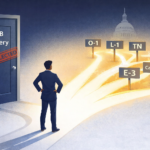



Quick Summary: Most H-1B sponsorship guides tell you what the process is. This one tells you how to navigate it — from the employer’s side of the table, through the salary conversation that now affects your lottery odds, to what happens if things go wrong.
There’s a version of this search that goes like this: three rounds of interviews, a final round that went well, and then — somewhere between the handshake and the offer — the visa question comes up and the conversation changes.
What this guide does:
- Tells you what employers are actually calculating when sponsorship comes up in 2026 — and why costs changed
- Shows you when to raise the visa question and exactly how to frame it
- Walks through three real scenarios: OPT holder, candidate in India, existing H-1B transfer
- Covers what happens if things go wrong — the grace period, layoffs, and what 60 days actually gives you
The candidates who navigate this well aren’t the ones with the most impressive resumes. They’re the ones who understand the employer’s side of the equation before they start the conversation.
What Employers Are Actually Thinking — And Why It Changed
Put yourself on the other side of the table for a moment.
You’re an engineering manager. A strong candidate makes it through your entire interview loop. Final round goes well. Then HR flags that this person needs H-1B sponsorship.
In 2021, that conversation was: “Okay, we’ll file the paperwork, it’ll cost us a few thousand dollars, and they can start in October.” Inconvenient, but manageable.
In 2026, that conversation is significantly more complicated.
If the candidate is currently outside the U.S. — in India, waiting for their first H-1B — the employer now has to factor in a $100,000 supplemental fee that took effect September 21, 2025. That’s before attorney fees. Before filing fees. Before premium processing. The total cost of sponsoring someone from outside the U.S. can now exceed $105,000 in government fees alone.
If the candidate is already in the U.S. on OPT, the $100,000 fee doesn’t apply — but the employer still has to file before the March registration window, navigate the wage-weighted lottery that started February 27, 2026, and plan for an October 1 start date.
None of this makes you less worth hiring. But it means the conversation you’re walking into is more financially loaded than it used to be. Knowing that going in changes how you approach it.
USAHarmony’s H-1B new rules 2026 guide covers every policy change in detail. The short version for this conversation: costs went up, enforcement tightened, and the lottery now rewards higher-wage candidates with better selection odds.
The Lottery Math — Why Your Salary Negotiation Is Now Also Your Visa Strategy
This one is new and most candidates don’t know it yet.
Since February 27, 2026, the H-1B lottery is wage-weighted. Each registration gets a number of entries based on the wage level of the offered position:
- Level IV (fully competent, highest wage): 4 entries
- Level III (experienced): 3 entries
- Level II (qualified): 2 entries
- Level I (entry-level): 1 entry
A candidate registered at Level IV has four times the selection odds of one registered at Level I.
Here’s what this means for your job search: the salary you negotiate doesn’t just affect your paycheck. It affects whether you get selected in the lottery at all.
There’s also a critical detail about multiple registrations. If more than one employer registers you — say a direct employer at Level III and a staffing firm at Level I — the lowest wage level among all your registrations controls your entry count. One Level I registration from anywhere cancels out a Level IV registration from a big tech company. You’d get one entry instead of four.
So if a staffing firm is registering you alongside a direct employer, find out the wage levels on both. If the staffing firm is filing at Level I, having them withdraw that registration may actually improve your odds.
This is a mechanical reality most candidates and even some recruiters aren’t aware of yet. The full breakdown is in USAHarmony’s H-1B new rules guide.

The Conversation — When to Bring It Up and How
This is the part candidates stress about most. And honestly, most of the stress comes from waiting too long.
The wrong time to bring up sponsorship: After three rounds of interviews, when the employer has already invested 15 hours in your candidacy and the offer is being drafted.
The right time: Before the first technical interview, or during the initial recruiter screen. You don’t need to make it the headline of your application. But raising it early means both sides know the parameters before anyone wastes time.
The framing matters. There’s a difference between:
“I should let you know I’ll need H-1B sponsorship.”
and
“I’m currently on OPT and would need H-1B sponsorship — wanted to flag that early so we can figure out if the timeline works for both sides.”
The second version shows you understand the process, signals that you’ve thought about their side of it, and opens a practical conversation instead of dropping a requirement.
What to Ask Before You Say Yes
Before you accept an offer from any employer, there are five things worth knowing:
1. Have they sponsored H-1B before, and how recently? A company that filed 20 petitions in FY2024 has an established process. A company filing for the first time while also figuring out the wage-weighted lottery is a different situation. Neither is a dealbreaker — but you should know which one you’re walking into.
2. Do they have immigration counsel? Companies without an experienced immigration attorney often underestimate how specific H-1B documentation requirements are. This is how petitions get RFEs for things that could have been addressed upfront.
3. What wage level will they use for the LCA? Under the new lottery system, this is now a legitimate negotiating point alongside salary. A Level III filing at the same dollar amount as a Level I filing isn’t the same offer — it’s three times the lottery odds.
4. What’s their policy on the $100,000 fee if you’re currently outside the U.S.? Some companies will absorb it for strong candidates. Others have quietly stopped sponsoring anyone currently abroad. Better to know before you turn down other offers.
5. What happens if you don’t get selected in the lottery? Some companies will hold the role and try again next year. Others can’t. A candid conversation about this now is much less painful than finding out in April when lottery results come out.
Employers Who Sponsor — and How to Find Them
Not all companies approach H-1B sponsorship the same way. And in 2026, the category of “sponsors reliably” has gotten narrower in some areas and wider in others.
Large tech, finance, and healthcare companies sponsor at volume and have established processes. Under the wage-weighted lottery, they’re actually more valuable to candidates than before — they tend to file at Level III and IV, which means 3–4x better lottery odds than a staffing firm filing at Level I.
Mid-size companies with 15–30 prior petitions are often underrated. They’ve been through the process enough to know how it works, they’re not scrambling on every filing, and there’s often less competition than at large employers.
Cap-exempt employers — universities, nonprofit research institutions — don’t go through the lottery at all. If your field includes research, academic, or nonprofit roles, this is worth serious consideration. There’s no March deadline, no selection risk, and fees are lower. USAHarmony’s cap exemption guide covers who qualifies.
Staffing firms sponsor significant volume. The work situation is different from direct hire — you may be placed at a client site, your LCA needs to reflect that location, and the employer of record is the staffing firm, not the client. This has specific compliance implications worth understanding before you sign.
For the actual research workflow — how to use USCIS Employer Data Hub and the DOL LCA system to find companies actively sponsoring right now, not just historically — USAHarmony’s H-1B sponsor database guide walks through the complete process.
Three Scenarios — How This Actually Plays Out
Scenario 1: You’re on STEM OPT, Job Offer in Hand
This is the most common situation for recent graduates. Your OPT is running, you have an offer, and the employer needs to file before the March registration window for an October 1 start.
The key things to confirm: Has the employer filed the LCA already or are they waiting? Is the wage level consistent with the role they described? Are they using premium processing?
If your OPT expires before October 1 and your H-1B isn’t approved yet, you need a clear plan — either premium processing that delivers an answer before your OPT runs out, or a cap-gap discussion with an immigration attorney about your specific timeline.
The filing fee structure for your employer is covered in USAHarmony’s H-1B fees guide — worth reviewing so you understand what they’re committing to and can have an informed conversation.
Scenario 2: You’re in India, Looking for Your First U.S. Role
The $100,000 supplemental fee is the first conversation. Some employers who sponsored freely before will now decline upfront. Others will say yes if you’re the right candidate for a role they can’t fill domestically.
Be honest about your situation early. Lead with your skills and what makes you specifically qualified for this role. The visa question is real — but you want to be evaluated as a candidate first.
If you get an offer and the employer is proceeding, you’ll also need a visa stamp before you can enter the U.S. — and the current appointment situation at Indian consulates means no H-1B slots are available through the end of 2026. USAHarmony’s H-1B stamping guide for Indian professionals covers the current backlog and what to expect.
Scenario 3: You’re Already on H-1B, Considering a Change
You don’t go through the lottery. You’re transferring — and under H-1B portability rules, you can start working for the new employer the day the transfer petition is filed.
The things worth checking: is your current H-1B petition still valid, does the new role meet specialty occupation requirements, and what’s the new employer’s timeline for filing? The transfer can happen any time of year, but a gap in status between employers creates problems. Your status, your visa number, and what each of your documents means are covered in USAHarmony’s H-1B visa number guide.

What Happens to Your H-4 Spouse During This Process
If your spouse is coming with you on H-4 status, their situation is connected to yours in ways that need planning upfront.
H-4 status by itself doesn’t include work authorization. The H-4 EAD — which does give work authorization — requires your employer to have an approved I-140 petition as part of a green card process. If you’re a new H-1B holder without an I-140, your spouse won’t be eligible for work authorization initially.
If you’re an existing H-1B holder transferring to a new employer and you have an approved I-140, your spouse’s H-4 EAD eligibility is maintained — but there’s a catch. The automatic renewal extension for H-4 EADs was eliminated in October 2025. Your spouse’s work authorization ends on the expiration date of their EAD card, even if a renewal is pending. Filing early — 6 to 8 months before expiration — is now non-negotiable.
USAHarmony’s H-4 EAD 2026 guide covers the full eligibility picture and what the October 2025 rule change means for renewal timing.
If It Doesn’t Work Out — What the Grace Period Actually Gives You
If your H-1B employment ends — layoff, termination, company closure — you have up to 60 consecutive calendar days to act. Here’s what to do.
First, get your termination date in writing. The clock starts on that date. Not your last paycheck. Not the end of your severance. The termination date. This single detail is the one that catches the most people off guard.
What the 60 days gives you:
- You remain in valid immigration status
- You can interview, negotiate, and have a new employer file a transfer petition
- Under H-1B portability rules, you can start working for the new employer the day the transfer petition is filed — not when USCIS approves it
What it doesn’t give you:
- Work authorization — you cannot work for anyone during the grace period
- Flexibility on the deadline — 60 days is the hard limit
- Multiple grace periods — you can’t stack them within the same visa validity
The 60 days sounds manageable. It goes faster than expected when you’re also interviewing, negotiating offers, and trying to get a new employer to move quickly enough to file before the window closes. Starting that process on day one — not day thirty — is the difference between having real options and running out of time.
USAHarmony’s 60-day grace period guide is worth reading now, before you need it. And if your visa is revoked rather than just your employment ending, USAHarmony’s H-1B revocation guide covers what each type of revocation means and what your options are.

Frequently Asked Questions
During the initial recruiter screen — not after final round interviews. Early disclosure gives both sides time to assess whether the timeline and cost work. It also signals that you understand the process, which most employers find reassuring. Late disclosure after significant interview investment creates frustration regardless of how good a candidate you are.
Yes — and in 2026, you should. The wage-weighted lottery means a higher wage level directly increases your selection probability. A Level III registration has three times the odds of a Level I registration. This is a legitimate factor to raise in salary discussions, particularly if an employer is wavering between wage levels.
You can be registered again in the next cycle. If you’re on OPT or STEM OPT, your existing work authorization continues while you wait. Cap-exempt employers — universities, nonprofits, research institutions — are an option year-round regardless of lottery results. If you’re currently on H-1B through a different employer, a transfer doesn’t go through the lottery at all. (Source: USCIS H-1B Cap)
Mechanically, yes — it’s the same USCIS petition process. Practically, it’s different. The staffing firm is your employer of record even if you work at a client site. The LCA needs to reflect the actual work location. Your assignment can change. And under the wage-weighted lottery, staffing firm petitions often come in at lower wage levels — which affects selection odds as described above.
Company closure or bankruptcy ends the employer-employee relationship, triggering the 60-day grace period. An acquisition is different — if the new entity assumes the obligations of the original petition, your status may be preserved. This is fact-specific and requires a conversation with an immigration attorney immediately. Don’t assume continuity; confirm it in writing.
Training repayment agreements are a legally complex area for H-1B workers. The mandatory filing fees cannot be charged to the employee in any form, including through a repayment agreement. If your employer is presenting a repayment agreement covering any immigration fees, review it with an independent attorney before signing. (Source: DOL Fact Sheet 62H)
The H-1B itself is not a green card pathway — it’s a work visa. The green card process runs separately and is typically initiated by the employer through PERM labor certification and I-140 petition filing. Having an approved I-140 matters for your H-4 spouse’s EAD eligibility and for extensions beyond the six-year H-1B limit. For Indian nationals, the green card backlog means the I-140 milestone is worth pursuing early even if a green card is many years away.
Waiting too long to verify whether a company actually sponsors — and specifically, whether they sponsor for the type of role and the candidate profile you represent. One direct question asked in the first conversation saves weeks of effort.
Disclaimer
This article is published by USAHarmony.com for informational and educational purposes only. It does not constitute legal advice and does not create an attorney-client relationship. Immigration law is highly specific to individual circumstances. The information reflects publicly available USCIS guidance and policy as of March 2026. Regulations, fees, and enforcement priorities change. Always consult a licensed U.S. immigration attorney before making any decisions related to your visa status, employment, or petition filing. USAHarmony.com does not provide legal representation or immigration services.