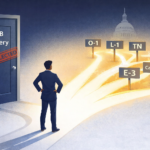



Before we begin: This isn’t a process overview. Those exist everywhere and they all say the same things. This is about the decisions that actually matter — the ones that determine whether your green card takes 3 years or 30, whether your priority date is worth anything, and whether the path you’re on right now is actually getting you somewhere.
Let’s start with the number nobody leads with.
If you’re an Indian national — born in India, regardless of where you’ve lived or worked since — and you’re in the EB-2 or EB-3 employment-based green card category, the current wait for a visa number is measured in decades. Not years. Decades.
The Department of State’s April 2026 Visa Bulletin shows the EB-2 India Final Action Date at July 15, 2014. EB-3 India sits at November 15, 2013. That means people who filed their PERM applications in mid-2013 are only now approaching the front of the line. People who started back then are now in their mid-careers. Some had kids who were in diapers — those kids are teenagers now.
One more thing specific to April 2026 that matters immediately: USCIS has announced that for April 2026, all employment-based applicants must use the Dates for Filing chart (Chart A) — not the Final Action Dates chart. The Chart A cutoff for EB-2 India is January 15, 2015. For EB-3 India, it’s also January 15, 2015. If your priority date falls before those cutoffs, you may be able to file your I-485 right now. We’ll get into exactly what that means and why it matters below.
This is the context in which everything else about the H-1B to green card path has to be understood. The process itself isn’t that complicated. The wait is.
And the people who navigate this well aren’t the ones who give up or leave. They’re the ones who understand exactly what the process involves, start it as early as possible, and make every single decision along the way with the long timeline in mind. That’s what this guide is for.
Why the Green Card Process and Your H-1B Are Two Separate Things Running in Parallel
This is the first thing most people get wrong, and it matters more than almost anything else.
Your H-1B visa is not a path to a green card. It’s a temporary work visa that allows you to stay in the U.S. while your employer sponsors you for permanent residence — which is a completely separate process, run by different agencies, on a completely different timeline.
The H-1B is the vehicle. The green card is the destination. Your employer has to drive both at the same time, and each requires different paperwork, different fees, and different waiting periods.
Getting your H-1B extended is not progress toward a green card. It’s keeping the vehicle running while you wait for the destination to become reachable. The two things happen in parallel but they’re not the same thing — and treating them as the same thing is the single biggest misunderstanding I see people walk around with for years.
Understanding this changes how you think about your employer. An employer who sponsors your H-1B but never starts the green card process isn’t sponsoring your future in the U.S. — they’re sponsoring your ability to keep working for them temporarily. That is not the same commitment. Not even close.
If you want to understand the full mechanics of how the H-1B itself works before diving into green card territory, USAHarmony’s H-1B new rules 2026 guide covers the complete 2025–2026 policy picture.
The Three Stages — And Which One Actually Determines Your Wait
Every employment-based green card goes through three stages. They happen in order. You can’t skip any of them. And the stage that determines your actual wait time is the last one — not the first two.

Stage 1: PERM Labor Certification
Who files it: Your employer, with the Department of Labor.
What it is: A formal certification that your employer tried to recruit U.S. workers for your position and couldn’t fill it with a qualified American candidate.
How long it takes: Currently 12 to 18 months for standard processing. Audited cases take significantly longer.
What it costs your employer: $3,000–$7,000+ in attorney fees. There is no government filing fee for PERM itself.
PERM is the employer’s burden entirely. They write the job description, run the recruitment process, document the results, and file the application. Your role during this stage is to provide your credentials and stay employed.
One thing that often gets glossed over: the job description in the PERM application has to match your actual position — both now and the future role they’re sponsoring you for. A title change alone usually isn’t a problem. But a promotion that significantly changes your actual job duties can affect your PERM. If your responsibilities have shifted meaningfully since the PERM was filed, talk to an immigration attorney before your employer files anything new.
The PERM also establishes something absolutely critical: your priority date. This is the date the Department of Labor receives your employer’s application. It is the single most important number in your entire green card process — because everything else is just waiting for your priority date to become “current,” meaning the government is now ready to process your application.
For Indian nationals, the gap between when a priority date is established and when it becomes current is measured in years to decades. For most other countries, it’s typically months. This disparity exists because Congress set per-country annual caps on employment-based green cards, and India generates far more applications than that cap allows — year after year, without relief.
Source: DOL PERM Processing Times
Stage 2: I-140 Immigrant Petition
Who files it: Your employer, with USCIS.
What it is: The formal petition that says — specifically you, not just the role — are the person this employer wants to sponsor for permanent residence.
How long it takes: 6–12 months standard. 15 business days with premium processing.
What it costs: $715 government filing fee + $2,965 for premium processing (optional, but you should push for it).
USCIS reviews three things during I-140: that your employer is a legitimate U.S. business capable of paying the offered wage, that the position qualifies for the immigration category being filed under, and that you personally have the qualifications for the role.
The most important thing about the I-140 that most people don’t know:
An approved I-140 survives a job change.
Under AC21 portability rules, if your I-140 has been approved for at least 180 days and you change employers to a similar occupational category, your priority date stays with you. The I-140 from your former employer remains valid even though you’ve moved on.
This is genuinely significant. The I-140 approval date — not your employment date, not your H-1B approval date — is the milestone you want to reach as early as possible. An approved I-140 gives you the flexibility to change jobs without starting over. Without one, you’re tied to your current employer for the entire wait.
Push for premium processing on the I-140. It costs $2,965 and cuts the wait from six to twelve months down to fifteen business days. For a process that could take thirty years total, the math is obvious. For a full breakdown of what employers typically pay versus what employees pay, USAHarmony’s H-1B fees 2026 guide has current numbers.
Source: USCIS Form I-140
Stage 3: Adjustment of Status (or Consular Processing)
Who files it: You, with USCIS — or at a U.S. consulate abroad if you’re outside the country.
What it is: The actual green card application — converting your temporary status to permanent residence.
How long it can take: Months if your priority date is current. Decades if it isn’t.
This is the stage that Indian nationals wait for. The I-485 (Application to Register Permanent Residence) cannot be filed until a visa number is available for your priority date and category. If you’re EB-2 India and your priority date is after July 15, 2014, you cannot file under the Final Action date — though as noted, for April 2026, USCIS is using the Dates for Filing chart, which gives a slightly earlier window.
During the wait, you maintain H-1B status. Your employer extends it. You live your life. And you watch the Visa Bulletin every single month.
The Visa Bulletin — How to Actually Read It
The Department of State publishes the Visa Bulletin every month. It shows which priority dates are currently eligible for visa numbers across all categories and countries of birth.
There are actually two charts in the Visa Bulletin, and most people only know one of them:
Chart A — Dates for Filing: The earlier, more lenient date. If USCIS allows it (which they announce separately each month), you can file your I-485 using this date even though your priority date isn’t fully current yet. Filing earlier doesn’t get you a green card faster — but it protects your place in line and starts the clock on certain benefits you actually care about.
Chart B — Final Action Dates: The actual date. This is when your priority date is fully current and a visa number will actually be allocated to you.
April 2026 Visa Bulletin — India Priority Dates at a Glance
| Category | Final Action Date (Chart B) | Dates for Filing (Chart A) |
|---|---|---|
| EB-1 India | Current | Current |
| EB-2 India | July 15, 2014 | January 15, 2015 |
| EB-3 India | November 15, 2013 | January 15, 2015 |
| EB-2 (All Other Countries) | Current | Current |
| EB-3 (All Other Countries) | Current | Current |
Most people only track Chart B. People who actually know what they’re doing also track Chart A and file I-485 as soon as USCIS allows it — because filing early unlocks things that matter while you wait: work authorization through an EAD, travel authorization through Advance Parole, and protection if your employer’s situation changes.
The practical implication for April 2026: USCIS has confirmed that Chart A dates apply this month for employment-based cases. If your priority date is before January 15, 2015 and you’re in EB-2 or EB-3 India — you may be able to file your I-485 right now. The window can close the following month. Don’t sit on it.
Source: DOS Visa Bulletin — Current Issue
💡 Pro Tip: Bookmark the Visa Bulletin page and set a recurring calendar reminder for the first of every month. When USCIS announces Chart A dates apply and your priority date qualifies, you often have just a few weeks to file. Miss the window and you may wait months for another opportunity — or watch the dates retrogress.
The EB Categories — Which One You Should Actually Be In
Not every H-1B holder goes through the same green card category. Which category your employer files under — and whether you can pursue a self-petition option — affects your wait time, your eligibility criteria, and your flexibility if things change.
EB-1A — Extraordinary Ability
No employer sponsor required. You file for yourself.
The standard is genuinely high: you need to demonstrate extraordinary ability in your field through a sustained track record of major achievements — nationally or internationally recognized awards, published work with high citation counts, membership in selective professional organizations that require outstanding achievement for entry, serving as a judge of others’ work in your field, or evidence of a critical role at a distinguished organization.
If you meet this standard, the EB-1A wait is dramatically shorter than EB-2 or EB-3 for Indian nationals. That’s because EB-1 has more favorable allocation dynamics — it draws from a different pool than EB-2 and EB-3, and the India-specific backlog is far less severe in EB-1.
Many Indian nationals in senior research, academic, and highly specialized technical roles who qualify for EB-1A don’t pursue it — either because they don’t know they qualify, or because their employer steers them toward EB-2 by default. That’s a mistake that costs years.
The bar is high. But it’s worth evaluating honestly before defaulting.
Source: USCIS EB-1A
EB-1B — Outstanding Researchers and Professors
Requires employer sponsorship, but — critically — no PERM. That alone saves 12 to 18 months right at the start.
The standard is somewhat lower than EB-1A. Your employer has to demonstrate you’re outstanding in your academic field by showing you meet at least two of a defined list of criteria: receiving recognized prizes or awards for outstanding achievement, membership in associations that require outstanding achievement, published material about your work in professional publications, participating as a judge of others’ work in your field, making original scientific or scholarly contributions of major significance, or authoring scholarly articles in journals with international circulation.
Universities, research hospitals, and R&D-heavy companies are the typical sponsors. If you work in any research-adjacent role and you have a publication record, a decent citation count, or have reviewed papers for any conference or journal, you may be closer to EB-1B eligibility than you think.
No PERM. Shorter processing. Better allocation dynamics for Indian nationals than EB-2. If your employer qualifies and your research record supports the petition, EB-1B deserves serious consideration over EB-2.
Source: USCIS EB-1B
EB-2 — Advanced Degree or Exceptional Ability
The most common category for H-1B holders. You qualify if you have a master’s degree or higher — or a bachelor’s plus five years of progressive experience in your field — or if you can demonstrate exceptional ability in sciences, arts, or business.
Requires PERM in most cases, which adds 12 to 18 months before your I-140 even gets filed and before your priority date starts counting.
The National Interest Waiver (EB-2 NIW): This subset of EB-2 waives the PERM requirement entirely. You file for yourself — no employer sponsorship needed — arguing that your work is in the national interest of the United States. The standard was significantly clarified in the Matter of Dhanasar USCIS precedent decision in 2016, and it’s become far more accessible than it used to be, particularly for:
- STEM researchers with published work
- Healthcare professionals, including physicians in underserved areas
- Engineers working on infrastructure or defense-adjacent projects
- Entrepreneurs with a clear economic value proposition
If you qualify for EB-2 NIW, you’re not dependent on any one employer for the early stages. You control the timeline. That’s meaningful flexibility — especially for anyone who might want to change companies, do consulting work, or eventually build something of their own.
Source: USCIS EB-2 NIW
EB-3 — Skilled Workers and Professionals
Lower degree bar than EB-2. Requires at least a bachelor’s degree for professionals, or two years of training and experience for skilled workers. Requires PERM.
The April 2026 Final Action Date for EB-3 India (November 15, 2013) is slightly behind EB-2 India, though the gap fluctuates. Some Indian nationals who qualify for both EB-2 and EB-3 file both — a “downgrade strategy” — and advance whichever category moves faster. This requires separate PERM and I-140 filings and costs more in attorney fees. But for someone staring at a 20+ year wait, having optionality between two categories that might diverge significantly over time has real value. Ask an attorney whether dual-filing makes sense in your specific situation.
A Brief Word on EB-5
EB-5 is worth mentioning for completeness, though it’s a different world entirely. The program provides green cards to investors who commit capital — currently $1.05 million, or $800,000 in targeted employment areas — into a U.S. business that creates at least 10 full-time jobs for U.S. workers.
For most H-1B holders, EB-5 isn’t a realistic path. But for those with access to significant capital or family wealth, it sidesteps the India backlog entirely. If this is potentially relevant to your situation, this is a specialist attorney conversation — not something to navigate with a general guide.

What “Priority Date” Actually Means for Your Real Life
This section isn’t about immigration procedure. It’s about what a decades-long wait actually means for real decisions you have to make.
Your H-1B extensions: Once your I-140 is approved, your employer can extend your H-1B in three-year increments indefinitely — regardless of the standard six-year cap. This is established under AC21. The practical implication: you can remain in the U.S. on H-1B while waiting for your priority date to become current, as long as your employer keeps sponsoring extensions and your job and status stay valid. The H-1B extension and 240-day rule guide on USAHarmony covers the mechanics of what happens at each renewal stage.
Your H-4 spouse: If you have an approved I-140, your spouse on H-4 status may be eligible for work authorization through an H-4 EAD. This isn’t automatic — eligibility requirements and timing matter significantly. The H-4 EAD 2026 guide on USAHarmony covers current eligibility and what recent rule changes mean for renewal timing.
Your children: Children listed on your green card application as derivative beneficiaries must be under 21 when the visa number is finally issued. The Child Status Protection Act (CSPA) provides some protection by calculating a “CSPA age” that can be lower than the actual age — but it doesn’t eliminate the problem entirely. Children who were infants when you started this process may be approaching adulthood by the time your priority date becomes current. This is a real consideration for long-range planning, and most people don’t think about it until the clock is already running down.
Changing jobs: With an approved I-140 that’s been pending for at least 180 days, you can change employers under AC21 portability — provided the new job is in the same or similar occupational classification. Your priority date stays with you. The I-140 from your former employer is generally not revoked after the 180-day mark. If you’re thinking about switching companies and you have an approved I-140, check your timeline carefully before you do anything. USAHarmony’s H-1B sponsorship and job search guide walks through how to navigate a job change without jeopardizing your green card progress.
Leaving the U.S.: If you’ve filed your I-485 and received Advance Parole (Form I-131), you can travel internationally and return without needing your H-1B visa stamp. This matters considerably because H-1B visa stamping at Indian consulates has faced significant backlogs. USAHarmony’s H-1B stamping 2026 guide for Indian professionals covers the current situation in detail. Advance Parole is an alternative travel document — but you must have it in hand before you leave the U.S., or your pending I-485 could be considered abandoned.
The Real Cost Nobody Talks About Clearly
Let’s put actual numbers on this. The green card process is expensive — not just in government fees, but in total cost across the entire timeline.
Complete Green Card Cost Breakdown — 2026
| Stage | Who Pays | Govt. Filing Fee | Typical Attorney Fee | Notes |
|---|---|---|---|---|
| PERM Labor Certification | Employer | $0 | $3,000–$7,000 | Employer required by law to pay |
| I-140 Petition | Employer | $715 | Included above | Cannot be passed to employee |
| I-140 Premium Processing | Employer/Negotiable | $2,965 | — | Strongly recommended |
| I-485 (Adult applicant) | Employee | $1,440 | $1,500–$3,000 | Includes biometrics |
| I-485 (Child under 14) | Employee | $950 | Varies | Different fee structure |
| Biometrics | Employee | Bundled with I-485 | — | Scheduled by USCIS |
| Medical Exam (Form I-693) | Employee | $200–$500 | — | Civil surgeon fee varies widely |
| EAD (Form I-765) | Employee | Bundled with I-485 | — | Verify at time of filing |
| Advance Parole (Form I-131) | Employee | Bundled with I-485 | — | Verify at time of filing |
| H-1B Extension (per cycle) | Employer | $2,880–$4,000+ | $1,500–$2,500 | Every 3 years after cap hit |
Important legal note: DOL regulations prohibit employers from passing PERM and I-140 filing costs to employees. The I-485, medical exam, and personal filing fees are typically the employee’s responsibility. Before the process starts, get clear in writing on exactly what your employer covers.
Sources: DOL Fact Sheet 62H, USCIS Filing Fees G-1055
The Long-Game Math
Over a 20+ year wait, a family of three can realistically spend:
- Multiple H-1B extensions: $15,000–$25,000+
- Multiple EAD renewals after I-485 filing: $3,000–$5,000+
- Multiple medical exams (they expire): $1,500–$3,000+
- Attorney fees across multiple employers: $5,000–$15,000+
- I-485 and all associated filings: $6,000–$10,000+
Total over the full timeline: $30,000–$60,000+ for a family of three. Before accounting for the opportunity cost of career decisions made to preserve employer sponsorship, or the general financial and emotional cost of having your life in bureaucratic limbo for decades.
This is exactly why building a strong financial foundation early matters so much. The flexibility to change employers, weather a layoff, or absorb unexpected costs depends on savings and financial stability that H-1B holders sometimes underinvest in during their early years in the U.S. If you’re still establishing U.S. credit history, USAHarmony’s guide on building credit on an H-1B visa covers the specific paths available on a work visa. And if you haven’t sorted out a U.S. bank account yet, the guide to opening a bank account as an immigrant is worth a read.
💡 Pro Tip: Ask your employer’s immigration attorney for a copy of every single filing they submit on your behalf — PERM, I-140 approval notice, all H-1B approvals. Create a dedicated folder, physical and digital, and back it up. Immigration firms change. Employers change. You do not want to be reconstructing your immigration history from scratch years down the line when something critical is missing.
What to Do Right Now — Regardless of Where You Are in the Process
If Your Employer Hasn’t Started the Green Card Process
Ask. Directly. “Has the company initiated my PERM labor certification?”
If the answer is no — and you’ve been on H-1B for two or more years — this is worth a real conversation. Not a confrontational one. Just an honest one. The green card sponsorship commitment is entirely separate from the H-1B sponsorship, and not all employers offer it. But you should know where you stand.
If your employer won’t sponsor you for a green card and you’re committed to staying in the U.S. long-term, that changes your calculus about whether this is the right employer for your situation. Better to know now than to find out after four more years.
If PERM Is Filed But I-140 Isn’t Yet
Push your employer or their attorney to file the I-140 as soon as the PERM is approved, and push for premium processing. Every day the I-140 sits without being filed is a day you’re not building toward the 180-day AC21 portability threshold. The sooner the I-140 is approved, the sooner you have real flexibility.
If Your I-140 Is Approved But I-485 Isn’t Filed
Check the Visa Bulletin every month at travel.state.gov. Know your priority date. Know your category. When USCIS announces that Chart A dates apply and your date falls under the cutoff, file your I-485 immediately. Verify the current fee at uscis.gov/g-1055 before filing. This filing starts the clock on your EAD and Advance Parole — both of which give you meaningful options while waiting.
If You’ve Filed I-485 and Are Waiting
Your focus during this period is maintaining valid continuous status. Keep your H-1B current. Renew your EAD well before it expires — don’t assume automatic extensions apply; verify the rules at the time of renewal. Renew Advance Parole before it expires if you plan to travel internationally.
Also: file your taxes correctly every single year. USCIS will review your tax records during I-485 adjudication. A year of unfiled taxes or a public charge concern can create complications at your adjustment interview. The resident alien versus nonresident alien filing distinction matters more than most people realize, and getting it wrong creates problems that are annoying and expensive to fix later.
Real Situations That Change the Picture
“My employer is being acquired.”
Corporate restructurings — mergers, acquisitions, spinoffs — affect pending green card petitions in ways that depend entirely on what kind of succession is happening. A successor-in-interest acquisition where the new entity assumes all obligations may allow petitions to continue without interruption. Other restructurings require completely new filings. The moment any restructuring is announced, have a conversation with an immigration attorney. Don’t wait to see how it plays out.
“I’m being laid off.”
If your I-140 has been approved for at least 180 days and you can find a new employer in a similar occupational category within your grace period, AC21 portability may give you significantly more protection than you think. The H-1B 60-day grace period guide on USAHarmony covers exactly what that window gives you and what you need to do within it. If your visa is also being revoked, the H-1B cancelled or revoked guide covers the additional layer you need to navigate simultaneously. The 60-day clock is not forgiving. Don’t wait on anything.
“I want to start my own company.”
H-1B holders cannot be self-employed under H-1B status. But once you’ve filed your I-485 and received your EAD, you can work for your own company while your green card is pending. Many Indian founders in the U.S. built their companies exactly this way — maintaining H-1B with an employer, filing I-485 when eligible, getting their EAD, and using it to start building what they actually wanted to build while the wait continued. EB-2 NIW is also worth evaluating if you’re an entrepreneur, since it removes the employer dependency entirely from the PERM stage onward.
“I’ve been waiting so long I’ve lost track of where my case stands.”
File a FOIA request with USCIS to get your complete immigration record. Check your I-140 status at egov.uscis.gov using your receipt number. Check your priority date against the current Visa Bulletin at travel.state.gov. If you’ve had changes in employer, status, or personal circumstances that you haven’t discussed with an attorney in the past two years, book a consultation. Things that seemed minor at the time can have compounding consequences over a long timeline.

Frequently Asked Questions
It depends almost entirely on your country of birth and your EB category. For nationals of most countries in EB-2 or EB-3, it’s typically 1–3 years from PERM filing to green card approval. For Indian nationals in EB-2, the April 2026 Final Action Date is July 15, 2014. People who start the process today are looking at estimated waits of 50+ years under current allocation rates — though these estimates vary and policy changes could affect them over time. Source: National Foundation for American Policy — Employment-Based Backlog Analysis
Yes, under specific conditions. Once your I-140 has been approved for at least 180 days and your I-485 has been pending for 180+ days, you can change employers under AC21 portability — provided the new job is in the same or similar occupational classification. Your priority date stays with you, and your former employer’s I-140 generally cannot be revoked after the 180-day mark. Source: INA §204(j) — AC21 Portability
The PERM and I-140 are the employer’s costs — by law, they cannot be passed to the employee. The I-485, medical exam, biometrics, and associated personal filing fees are typically the employee’s responsibility. Attorney fees vary depending on what the employer covers. Clarify this in writing before the process begins. Source: DOL Fact Sheet 62H
Once your I-140 is approved, your employer can extend your H-1B in three-year increments beyond the standard six-year cap — indefinitely, as long as the I-140 remains approved and your employer keeps filing extensions. This is the mechanism that allows people to remain on H-1B for 15–20+ years while waiting for priority dates. Source: INA §214(g)(4) — AC21 H-1B Extension
AC21 portability allows you to change employers without losing your green card queue position, once your I-140 has been approved for 180+ days and your I-485 has been pending for 180+ days. It’s not automatic — you assert it when joining a new employer, and the new job must be in the same or similar occupational classification. Sometimes this requires a legal argument about what “similar” means. Source: USCIS AC21 Policy Manual
Yes — unmarried children under 21 can be included as derivative beneficiaries. The Child Status Protection Act provides some protection against aging out, but it doesn’t eliminate the risk for children who were very young when the process started and face 20+ year waits. For families with young children starting the process now, this is worth a specific conversation with an immigration attorney. The CSPA calculation is fact-specific. Source: Child Status Protection Act — INA §203(h)
If your I-140 has been approved for at least 180 days, AC21 portability gives you protection — you can transfer to a new employer in a similar role and your priority date stays with you. If the I-140 hasn’t been approved for 180 days, the employer’s closure may affect the petition. Get to an immigration attorney immediately. The 60-day grace period clock starts at termination.
Structurally, no — the per-country limits are set by Congress. Practically, a few things help at the margins: filing PERM as early as possible, premium processing the I-140, filing I-485 as soon as USCIS allows Chart A dates, and honestly evaluating whether EB-1A or EB-1B are viable (they have dramatically shorter effective waits for Indian nationals). Some people also maintain both EB-2 and EB-3 petitions simultaneously for optionality. None of these fix the fundamental backlog, but they maximize your position within it.
Most guides don’t say this plainly, so here it is:
They wait too long to ask their employer to start PERM. The earlier you establish your priority date, the better. Even a few months earlier can matter enormously over a 20-year timeline.
They don’t push for premium processing on the I-140. Compressing the I-140 stage from 6–12 months to 15 business days costs $2,965. In the context of a 20+ year wait, that’s obvious math.
They don’t track the Visa Bulletin monthly. The window to file I-485 using Chart A dates can open and close within a single month. People miss it and wait another year — or watch the dates retrogress.
They don’t honestly evaluate EB-1A or EB-1B. A lot of Indian nationals who could qualify for EB-1 default to EB-2 because it’s more familiar. EB-1 has dramatically shorter effective waits.
They forget about their kids aging out. If your child is under 10 right now and your priority date is 2020, do the math. CSPA helps but doesn’t solve everything.
They don’t know what AC21 portability actually gives them. The 180-day I-140 milestone is one of the most valuable milestones in employment immigration. A lot of people don’t know it exists until they’re about to change jobs in a panic.
| Stage | Filed by | Agency | Est. time | Key milestone |
|---|---|---|---|---|
1 PERM Labor Certification Recruitment & DOL audit | Employer | DOL | 12–18 months | Priority date established |
2 I-140 Immigrant Petition EB-2 or EB-3 category | Employer | USCIS | 15 bus. days Premium processing | AC21 clock starts |
⏳ Wait for Priority Date Visa Bulletin — monthly check | — | — | Months–decades India EB-2/3: very long | Country + category dependent |
3 I-485 Adjustment of Status File when date becomes current | Employee | USCIS | When eligible | EAD + Advance Parole unlocked |
4 Biometrics Appointment Fingerprints + photo | USCIS | ASC | Scheduled by USCIS | Required for processing |
5 Medical Exam (I-693) Before or during I-485 | Employee | Civil Surgeon | Before I-485 filing | USCIS-designated surgeon only |
6 Interview (if required) Not always scheduled | USCIS | Local field office | Scheduled by USCIS | Not always required |
✓ Green Card Issued Permanent residence granted | USCIS | Mailed | After final approval | Permanent residence granted |
Disclaimer
This article is published by USAHarmony.com for informational and educational purposes only. It does not constitute legal advice and does not create an attorney-client relationship. Immigration law is highly specific to individual circumstances — including country of birth, visa history, employer situation, and current priority dates. Information reflects publicly available USCIS, DOL, and DOS guidance as of April 2026. Priority dates, processing times, and regulations change frequently — sometimes month to month. Always consult a licensed U.S. immigration attorney before making any decisions related to your green card process. USAHarmony.com does not provide legal representation or immigration services.