

If you’ve ever tried to Google “H1B transfer cost,” you’ve probably landed on articles that either give you one confusing number or bury the real answer under 15 paragraphs of disclaimers.
So here’s the short version before we go deep: an H1B transfer costs an employer anywhere from $2,380 to $10,000+ depending on company size, whether you add premium processing, and what your attorney charges. And no — if you’re already inside the U.S. on a valid H1B, the controversial $100,000 fee does not apply to you.
That last point alone has saved a lot of people from unnecessary panic.
This guide covers every cost involved in an H1B transfer in 2026 — what’s mandatory, what’s optional, who pays for what, what happens if you’re transferring from India, and what real people on Reddit and immigration forums are actually spending.
What Is an H1B Transfer, and Why Does the Cost Structure Matter?
An H1B transfer — officially called a “portability filing” or “change of employer petition” — lets you move from one U.S. employer to another without losing your H1B status. You don’t go back into the lottery. You don’t start from scratch. Your new employer files a fresh I-129 petition with USCIS, and as long as it’s filed while you’re in a valid period of authorized stay, you can legally start working for the new company the moment the petition is filed — not when it’s approved.
That’s a huge deal. It means a lot of the anxiety around “what if it gets rejected?” doesn’t mean you’re suddenly out of a job. You were working legally when it was filed; you continue working legally until USCIS decides.
Now, costs. The reason they’re confusing is because there’s no single H1B transfer fee. There are five to seven separate government fees, and which ones apply to your specific situation depends on:
- How many full-time equivalent (FTE) employees your new employer has
- Whether your employer is a nonprofit, university, or government research entity
- Whether you want expedited processing
- Whether you need consular processing (big cost variable in 2026 — more on this below)
- Whether you use an immigration attorney
Let’s go through each fee one by one.
Form I-129 — Base Filing Fee
Required for every H-1B transfer petition, regardless of employer size
| Employer Type | Filing Fee |
|---|---|
| 🏠 Small Employer Fewer than 25 full-time equivalent employees |
$460
Standard Rate
|
| 🏢 Large Employer 25 or more full-time equivalent employees |
$780
Higher Rate
|
| 🏭 Nonprofit / Higher Education / Govt. Research Cap-exempt organizations qualify for reduced fee |
$460
Reduced Rate
|
Note: This is only the USCIS base fee. Additional fees (ACWIA, Fraud Prevention, Premium Processing) may apply depending on your employer and petition type.
The fee structure changed on April 1, 2024, when USCIS implemented its major fee rule update. Before that, everyone paid $460 regardless of size. Large employers now pay $780.
Important: This fee does NOT apply to the second and subsequent extensions at the same employer. For a transfer, it typically applies as a fresh petition.
4. Anti-Fraud Fee
$500 — but only for new cap-subject petitions. For transfers, this fee does not apply if it was already paid when the original H1B was approved.
If you’re transferring and it’s NOT a new cap-subject petition (which it almost never is for a transfer), you won’t pay this.
5. Premium Processing Fee (Optional but Popular)
$2,965 as of 2026. This was increased by $160 from the previous $2,805 rate.
Premium processing guarantees USCIS will respond within 15 business days — not calendar days. In practice, many people see decisions faster than that, but 15 business days is the commitment.
This fee is optional. A lot of workers choose it because waiting months for a standard processing decision adds anxiety and uncertainty, especially when changing jobs involves notice periods, start dates, and relocation planning.
Is premium processing worth it? See our dedicated guide: H1B Premium Processing: Is It Worth the Fee in 2026?
6. The $100,000 Fee — Who Actually Has to Pay This?
In September 2025, the Trump administration issued a proclamation introducing a $100,000 fee for certain H1B petitions. This caused significant confusion and panic across immigration forums.
Here’s the clear answer: if you are already inside the United States on a valid H1B and your transfer petition is filed as a change of employer (not consular processing), you do not owe the $100,000 fee.
USCIS clarified in October 2025 that the fee applies specifically to petitions involving:
- Beneficiaries currently outside the United States
- Petitions requesting consular processing, port of entry notification, or pre-flight inspection
- Petitions where the beneficiary needs a new visa stamp to enter the country
Workers changing employers through a standard portability filing while physically present in the U.S. are excluded. F-1 students changing to H1B status through change of status are also excluded.
The fee is legally contested as of April 2026, with three active court challenges. It’s worth tracking H1B New Rules 2026 for the latest legal developments.
Exceptions can be requested through DHS at [email protected] if you believe your case qualifies for a national interest waiver, though defined criteria for these exceptions remain narrow.
Source: Employment Law Worldview — $100K Fee Update, November 2025
7. Attorney Fees
This isn’t a government fee, but it’s real money. Immigration attorneys typically charge between $1,500 and $5,000 for an H1B transfer petition, depending on the complexity of the case, attorney experience, and location.
Some large employers have in-house legal teams or preferred immigration law firm relationships that reduce per-petition costs. Smaller employers hiring an H1B worker for the first time often pay on the higher end.
The DOL requires that employers cover attorney fees as part of the H1B sponsorship cost. An employer cannot legally deduct these costs from the employee’s salary or require repayment.
2. Asylum Program Fee
Added alongside the April 2024 USCIS fee increase — paid on top of the base I-129 fee
| Employer Type | Asylum Fee |
|---|---|
| 🏠 Small Employer Fewer than 25 full-time equivalent employees |
$300
Standard Rate
|
| 🏢 Large Employer 25 or more full-time equivalent employees |
$600
Higher Rate
|
| 🏭 Qualifying Nonprofit IRS 501(c)(3) orgs, universities & govt. research institutions |
$0
✓ Fully Exempt
|
Exemption detail: Nonprofits qualifying under IRS section 501(c)(3), universities, and government research organizations are fully exempt from this fee.
Source: USCIS Final Fee Rule 2024
3. ACWIA Training Fee
Funds workforce training programs under the American Competitiveness and Workforce Improvement Act — applies to most H-1B transfers
| Employer Size | ACWIA Fee |
|---|---|
| 🏠 Small Employer 1 – 25 full-time equivalent employees |
$750
Standard Rate
|
| 🏢 Large Employer 26 or more full-time equivalent employees |
$1,500
Higher Rate
|
| 🏭 Exempt Organizations Nonprofits, universities & government research institutions |
$0
✓ Exempt
|
Note: The ACWIA fee is charged per petition. If your employer is filing an amended petition, confirm with your immigration attorney whether this fee applies in your specific case.
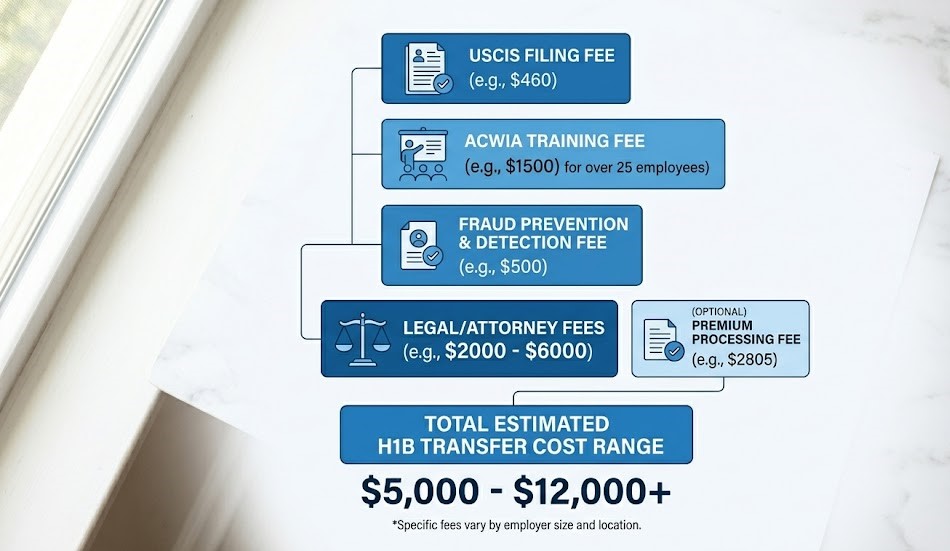
H-1B Transfer Fee Breakdown — 2026
Small employer (<25 FTE) · No premium · No attorney
| I-129 Base Filing Fee | $460 |
| Asylum Program Fee | $300 |
| ACWIA Training Fee | $750 |
| Total | $1,510 |
Large employer (25+ FTE) · No premium · No attorney
| I-129 Base Filing Fee | $780 |
| Asylum Program Fee | $600 |
| ACWIA Training Fee | $1,500 |
| Total | $2,880 |
Large employer + premium processing + attorney
| I-129 Base Filing Fee | $780 |
| Asylum Program Fee | $600 |
| ACWIA Training Fee | $1,500 |
| Premium Processing | $2,965 |
| Attorney Fees (est.) | $2,000–$4,000 |
| Total range | $7,845–$9,845 |
Nonprofit / university employer
| I-129 Base Filing Fee | $460 |
| Asylum Program Fee exempt | $0 |
| ACWIA Training Fee exempt | $0 |
| Total | $460 |
Who Pays for the H1B Transfer — Employer or Employee?
Short answer: the employer pays.
The Department of Labor has been clear on this for years. Fees that are required by law or regulation for H1B sponsorship cannot be passed to the employee. That includes the I-129 base fee, the ACWIA training fee, the asylum program fee, and attorney fees for the petition itself.
If an employer asks you to cover any part of these costs — or sign a “training agreement” that requires you to repay fees if you leave within a certain period — that raises serious compliance concerns. DOL regulations explicitly prohibit fee deductions that would bring a worker’s wage below the required prevailing wage level.
The only fee a worker typically pays is the DS-160 visa application fee ($185) when renewing a visa stamp at a U.S. consulate abroad. That’s a personal travel document expense, separate from the petition.
For more on how H1B salary requirements interact with fee obligations, see: H1B Salary Requirements 2026

Real-World Examples: What People Are Actually Spending
You can read fee schedules all day, but sometimes you want to know what it looks like in the real world. Here’s what workers and HR professionals have shared on immigration forums and subreddits over the past year.
From r/h1b (2024 thread on transfer costs):
One user described changing employers from a mid-size consulting firm to a large tech company. Their new employer’s legal team handled everything. Total cost to the employer came to roughly $6,800 — that included premium processing because the start date was firm, attorney fees through the company’s in-house immigration vendor, and all USCIS fees. The worker paid nothing out of pocket.
Another commenter in the same thread noted their small startup (around 30 employees) spent closer to $4,200 for a straightforward transfer without premium processing. The attorney they used charged $2,200 for the petition preparation.
From an H1B immigration forum (early 2025):
A user transferring from a staffing company to a direct employer described confusion about whether the $100,000 fee applied to them. They were inside the U.S. Their attorney confirmed it didn’t apply since they were doing a change of employer with change of status, not consular processing. Total petition cost: $3,380 (large employer, no premium processing, attorney charged $1,800 flat fee for the transfer).
A common Reddit observation worth noting:
Several H1B workers on r/immigration and r/h1b have flagged that smaller employers sometimes ask workers to “share” attorney costs informally — sometimes framed as a “training investment.” Immigration attorneys responding in those threads consistently point out this is illegal under DOL wage rules if it brings the worker below prevailing wage, and workers are encouraged to document these conversations.
The general range people report on forums for a standard employer-funded transfer: $3,000–$7,000 all-in. Add premium processing and you’re looking at $5,500–$10,000+. That aligns with the fee math above.
Source pattern references: r/h1b on Reddit, H1B transfer cost discussion threads (2024–2025)
H1B Transfer from India: Special Considerations
If you’re currently in India and trying to transfer your H1B to a U.S. employer — or if you’ve been approved but need to re-enter the U.S. after the transfer — the cost picture changes.
The $100,000 Fee Applies Here
Workers outside the U.S. who require consular processing are subject to the $100,000 proclamation fee. This is a real and significant cost. At current INR exchange rates (approximately ₹84–85 per dollar), that’s roughly ₹84–85 lakh.
Before your employer assumes this cost, they need to confirm:
- Is the beneficiary currently abroad?
- Does the petition require consular notification or visa issuance?
If yes to both, the $100,000 fee applies as of current USCIS guidance (subject to pending legal challenges).
Visa Stamp Renewal After Transfer
If you’re in India and your existing H1B visa stamp is still valid, you typically do not need a new stamp to return to the U.S. — the stamp is for entry, not for employer-specific authorization.
However, as of September 6, 2025, the U.S. Department of State has eliminated third-country visa processing. H1B holders must now renew their visa stamps in their home country (India, for Indian nationals). Appointment availability at U.S. consulates in India has been severely constrained, causing real delays.
If you need a new stamp after a transfer, be prepared for a wait of several months. Immigration attorneys are advising clients to book appointments well in advance and avoid unnecessary international travel until the stamp situation is clarified.
For a full guide on this: H1B Visa Stamping 2026: Complete Guide for Indian Professionals
INR Conversion Reference — 2026 (₹84/$)
| Scenario | USD | INR (approx.) |
|---|---|---|
| Scenario ASmall employer · no premium processing | $1,510 | ₹1,26,840 |
| Scenario BLarge employer · no premium processing | $2,880 | ₹2,41,920 |
| Scenario CLarge employer + premium processing + attorney | $7,845 | ₹6,58,980 |
| Consular processingConsular processing fee | $1,00,000 | ₹8,40,00,000 |
⚠ Exchange rates fluctuate — verify current rates before financial planning.
Does an H1B Transfer Count as a New Petition?
It’s a new filing — but NOT a new cap-subject petition. This distinction matters a lot.
Your new employer files a fresh I-129 with USCIS. That means new paperwork, a new LCA, and new fees. But you’re not re-entering the lottery. You’re using the cap space already allocated to your existing H1B approval.
This also means:
- Your H1B validity period doesn’t reset — the new petition typically covers the remaining validity of your current status, or can request an extension
- You don’t need to be selected again in the lottery
- The anti-fraud fee ($500) is not charged again since it was already paid in your original filing
For workers who came through OPT and transitioned to H1B, this distinction is particularly relevant. See: OPT to H1B Transition Guide
How Many Times Can You Transfer an H1B?
There’s no legal limit. You can transfer as many times as USCIS approves petitions from legitimate employers. Each transfer is a new petition with its own fees.
Practically speaking, very frequent transfers within short time frames can raise compliance questions during an RFE or audit, but the law doesn’t cap the count.
H1B Transfer Processing Times in 2026
Standard processing has historically ranged from a few weeks to 4–6 months depending on USCIS workload. As of early 2026, standard processing for H1B transfers typically runs 3–4 months.
Premium processing commits USCIS to a response within 15 business days from receipt. That’s not 15 calendar days — weekends and federal holidays don’t count. In practice, many cases get decided in 7–10 business days under premium.
If you need to start by a specific date — especially if you’re leaving a job with a firm last day — premium processing is often the practical choice, not a luxury.
What Documents Does the New Employer Need?
Filing an H1B transfer requires assembling a petition package. The core components are:
Government forms and filings:
- Form I-129 (Petition for Nonimmigrant Worker) — the centerpiece
- Labor Condition Application (LCA) — filed and certified by the Department of Labor before the I-129 is submitted. LCA filing itself is free.
- Form I-907 if premium processing is requested
Supporting employer documents:
- Offer letter or employment contract detailing position, salary, and duties
- Evidence that the position qualifies as a “specialty occupation” (typically a degree requirement)
- Documentation of the employer’s legitimacy (tax records, financial statements if a newer or smaller company)
Supporting employee documents:
- Copy of current passport
- Copies of all prior H1B approval notices (I-797)
- Academic credentials and transcripts
- Copy of most recent I-94
- Prior pay stubs (to demonstrate maintenance of status)
If the case is straightforward, an experienced attorney can prepare this package in 1–2 weeks. More complex cases — if there’s any gap in status, if the specialty occupation claim is non-standard, or if the employer is small and newer — can take longer to prepare.
If your current H1B was ever cancelled or revoked, the transfer process becomes more complicated. See: What to Do If Your H1B Is Cancelled or Revoked
Do You Need a New Visa Stamp After Changing Employers?
No — not immediately. The visa stamp in your passport is tied to the H1B visa category, not to your specific employer. It’s your authorization to enter the U.S. as an H1B worker.
As long as your stamp is still valid and you’re not traveling internationally, you don’t need to do anything about the stamp after a transfer.
You’ll need a new stamp only when:
- Your current stamp expires AND you plan to travel abroad
- You leave the U.S. and need to re-enter
Once your transfer is approved and your stamp later expires, you’d apply for a new stamp at a U.S. consulate — and at that point, your updated I-797 approval notice from the new employer is the supporting document you use.
Full stamping guide: H1B Visa Stamping 2026
What Happens to Your H4 Spouse During a Transfer?
Good news here. H4 dependents don’t need separate action during an H1B transfer. Their H4 status remains valid as long as the primary H1B worker maintains valid status.
If your spouse has an H4 EAD and is working, their EAD remains valid during and after the transfer — it doesn’t need to be re-filed just because you changed employers.
For the full picture on H4 EAD rules in 2026: H4 EAD 2026: Work Authorization for H1B Spouses
H1B Transfer and Your Green Card Timeline
One thing workers often overlook when evaluating a transfer: what happens to your green card progress?
If your current employer has started a PERM labor certification or filed an I-140 on your behalf, a transfer doesn’t automatically end that process. Under AC21 portability rules, if your I-140 has been approved for 180+ days and your green card application has been pending for at least 180 days, you can transfer to a same or similar job without losing your priority date.
This is a critical planning point. Before transferring, understand where you are in the green card process and whether portability rules protect your timeline.
Detailed guide: H1B to Green Card Timeline: What Indian Professionals Need to Know
Frequently Asked Questions
Yes — this is one of the most important protections in H1B portability law. Once the petition is properly filed (and you receive a receipt notice), you can begin working for the new employer immediately, provided you were in valid H1B status when filing occurred. You do not need to wait for approval.
If USCIS denies the transfer petition and you already started working for the new employer under portability rules, your status becomes complicated. You’d need to return to your original employer’s status (if still valid) or consult an attorney about your options. This is rare in clean cases but possible if the petition had errors or the position didn’t qualify as a specialty occupation.
Yes, company size doesn’t affect eligibility to sponsor an H1B transfer — it only affects which fees apply. A startup with 10 employees can transfer your H1B. The caveat is that USCIS may scrutinize smaller employers more carefully regarding their ability to pay the required wage and the legitimacy of the specialty occupation role.
You can file for both a transfer and an extension in the same I-129 petition. This is common — the new employer files a transfer petition that also extends your status for the standard 3-year period. See: H1B Visa Extension: Complete Guide
The 240-day rule typically applies to extensions filed before status expiration — it allows you to continue working for the same employer for up to 240 days while an extension is pending. Transfers operate differently under portability. For clarity on how these rules interact: H1B 240 Day Rule and Grace Period Explained
At April 2026 exchange rates of approximately ₹84–85 per dollar, a standard large-employer transfer with premium processing and attorney fees ($7,845–$9,845) translates to roughly ₹6.6–₹8.3 lakh. The $100,000 consular processing fee, if it applies, is approximately ₹84 lakh.
Nonprofits, universities, and qualifying government research organizations are exempt from the ACWIA training fee and the asylum program fee. Their total USCIS fees for a transfer are typically just the $460 base I-129 filing fee. This makes transferring to a university or nonprofit dramatically cheaper — even if the salary offer is lower.
Conclusion: Three Things Worth Keeping in Mind
H1B transfer costs aren’t as mysterious as they seem once you understand the structure. Before you or your employer starts planning, keep these three points front of mind:
1. Your location at the time of filing determines your biggest cost variable. If you’re inside the U.S., the $100,000 fee doesn’t apply to a standard change-of-employer transfer. If you’re abroad or need consular processing, the cost picture changes dramatically.
2. Employer size matters more than most workers realize. The difference between a large employer and a nonprofit in total government fees can be $2,000 or more. Factor this into negotiations, especially if you’re weighing a startup offer against a university or hospital role.
3. Premium processing isn’t optional for time-sensitive situations. At $2,965, it’s real money. But when your start date is firm and you can’t afford a 4-month wait, it’s the only reliable way to control your timeline.
If you’re actively exploring a transfer, start by reviewing what your current H1B status requires and whether your new employer qualifies for any fee exemptions. Then get an attorney involved early — even a single consultation before the petition is filed can prevent expensive mistakes.
About the Author Priya Mehta has covered U.S. immigration policy and visa processes for over six years, with a focus on employment-based immigration for Indian and South Asian professionals. Her work has been cited by immigration law firms and used by HR departments at U.S. technology companies.
About the Reviewer Daniel Okafor is a licensed immigration attorney practicing in New York and New Jersey, with 12 years of experience in employment-based immigration including H1B sponsorship, transfers, and green card processing.
Disclaimer:This article is for general informational purposes only and does not constitute legal advice. Immigration law changes frequently. Before making decisions about your H1B transfer, consult a licensed immigration attorney who can review the specific facts of your case.