

Most people who get an H-1B RFE — or worse, a denial — weren’t missing a random document. They failed a prerequisite check that should have happened months before anyone touched Form I-129.
That’s the thing about the H-1B that immigration guides often skip over. The visa isn’t primarily a paperwork exercise. It’s an eligibility exercise first. The forms, the fees, the lottery — those come later. Before any of that, there’s a specific set of conditions that must be true about the job, the worker, and the employer. If any one of them fails, no amount of premium processing or attorney skill will fix it.
This guide walks through every prerequisite — what it means, what USCIS actually scrutinizes, what trips people up in 2026, and what you need to have confirmed before your employer files anything.
What Is H1B Premium Processing, Exactly?
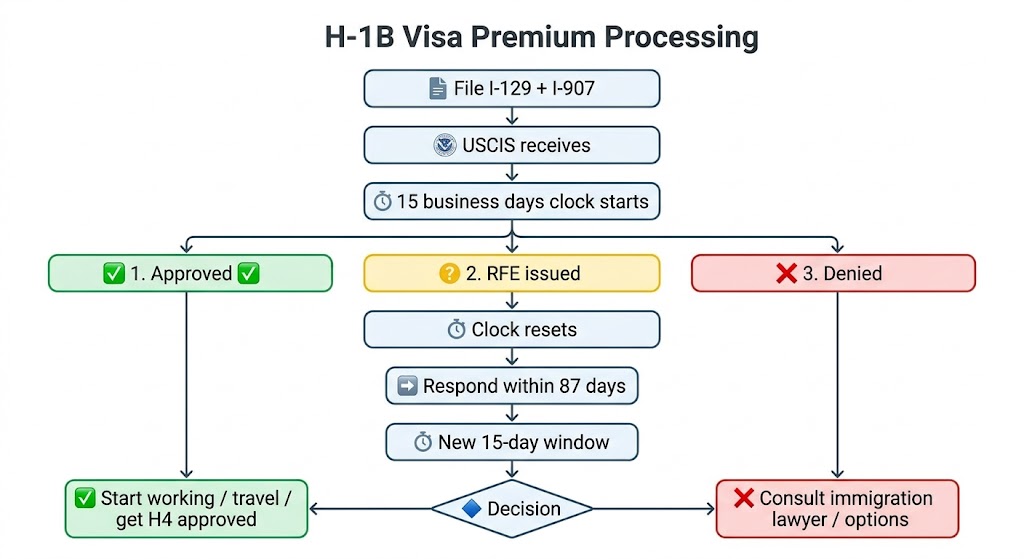
Premium processing is an optional service offered by U.S. Citizenship and Immigration Services (USCIS) that speeds up adjudication of your H1B petition (Form I-129). When your employer pays the premium processing fee and files Form I-907, USCIS commits to issuing a response within 15 business days. That response can be:
- An approval (best case)
- A Request for Evidence (RFE) asking for more documentation
- A denial
- A Notice of Intent to Deny (NOID)
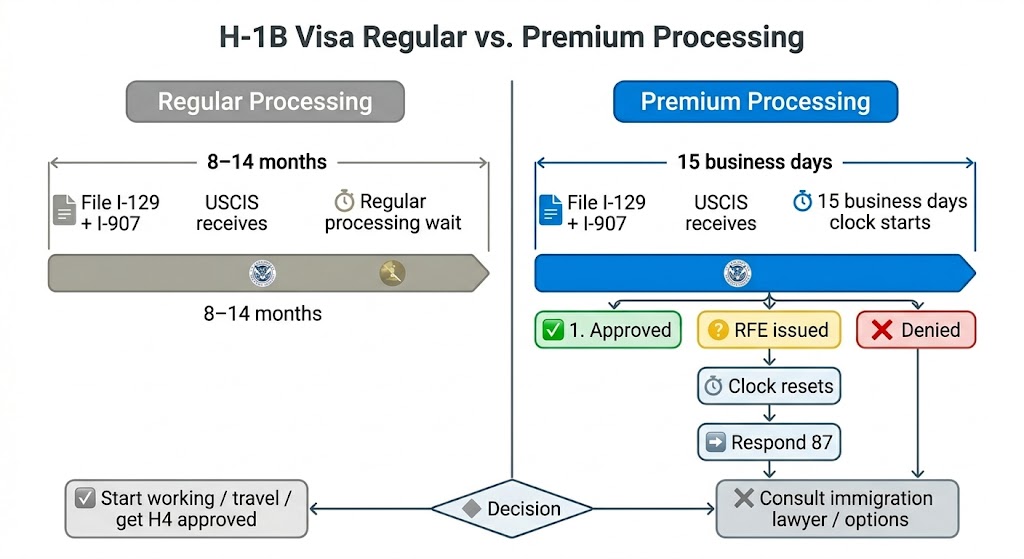
Important thing to understand: premium processing guarantees a response, not a specific outcome. USCIS won’t approve a weak petition faster just because you paid extra. But if your petition is solid, you’ll know within three calendar weeks instead of waiting 8–14 months.
2026 H1B Premium Processing Fee: What Changed on March 1st
This is the number most people search for first, so let’s be direct.
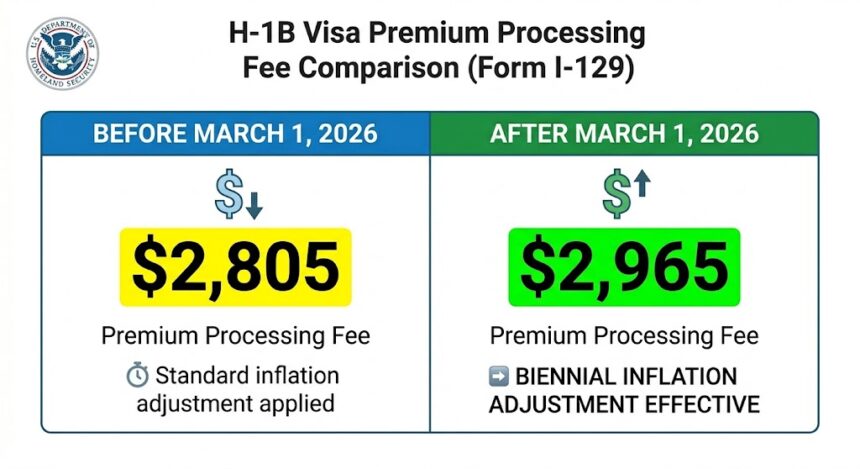
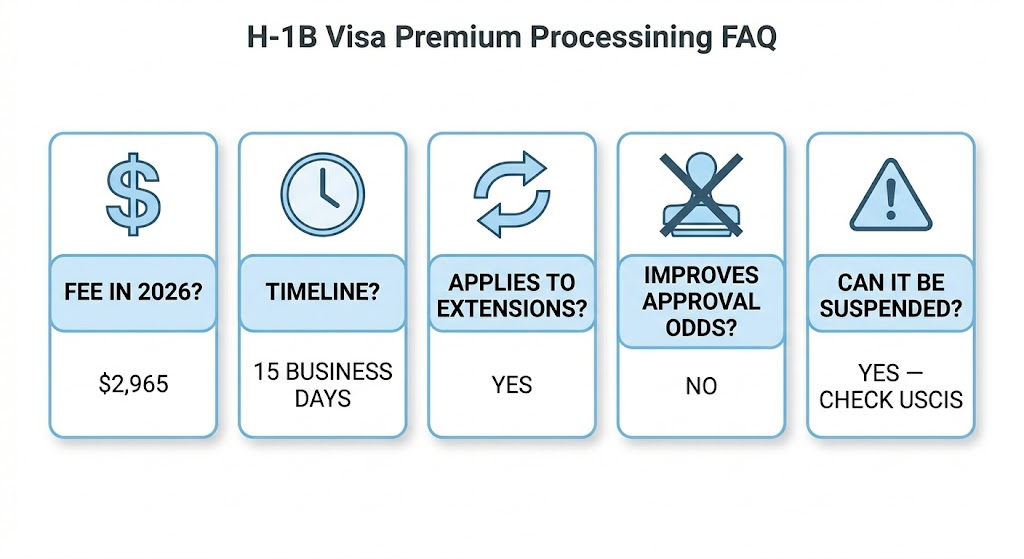
As of March 1, 2026, the premium processing fee for H-1B petitions is $2,965. Manifest Law
That’s up from $2,805, which was the fee before March 1st. This rule became effective on March 1, 2026. If you submitted a premium processing request postmarked on or after that date with the old fee amount, USCIS rejected Form I-907 and returned the filing fee. USCIS
Why the increase? DHS adjusted premium processing fees using inflation data from June 2023 through June 2025, based on the Consumer Price Index for All Urban Consumers — exactly as authorized under the USCIS Stabilization Act. Federal Register
So this isn’t arbitrary. It’s a scheduled, inflation-linked adjustment that happens every two years.
The full 2026 premium processing fee table:
| Form | Visa Types Covered | New Fee (March 1, 2026) |
|---|---|---|
| I-129 | H-1B, H-3, E-1, E-2, E-3, L-1A, L-1B, O-1, O-2, TN, Q-1 | $2,965 |
| I-140 | EB categories (EB-1, EB-2, EB-3) | $2,965 |
| I-539 | F-1, F-2, J-1, J-2 change of status | $2,075 |
| I-765 | OPT/STEM OPT work authorization | $1,780 |
Source: USCIS official announcement & Federal Register, Jan 12, 2026
How Long Does Premium Processing Actually Take?
USCIS commits to taking action on the case within 15 business days when premium processing is selected. This action can be an approval, a denial, or a Request for Evidence (RFE). Manifest Law
In practice? For FY 2025 (until May 31st, 2025), the current premium processing time average was about 0.4 months — roughly 12 days. RedBus2US So most applicants were hearing back even before the 15-day window closed.
Compare that to regular processing. USCIS currently lists an average processing time of approximately 4.5 months for change-of-status petitions, but actual adjudications are taking 8 months or longer. International Center
Eight months. Premium processing gives you an answer in under two weeks. That gap is the entire value proposition.
One thing to watch for: If USCIS issues a Request for Evidence (RFE), the 15-day clock resets. Once you submit your response, a new 15-business-day window begins. Manifest Law
And if they miss the deadline? USCIS refunds the premium processing fee and continues to process the H1B petition in expedited processing. Based on past data, they only refunded 0.073% of H1B petitions filed under premium processing over the past three years. RedBus2US So it almost never happens, but the guarantee is real.
Who Can Use H1B Premium Processing?
Premium processing isn’t available for every immigration filing, but for H1B specifically it’s quite broad. It’s available for most H1B cases, including new petitions, extensions, and employer transfers. Manifest Law
In concrete terms, your employer can request premium processing for:
- New H1B cap-subject petitions (post-lottery selection)
- H1B extensions with the same employer
- H1B amendments (if your job duties or location changed significantly)
- H1B transfers (changing employers)
- Cap-exempt H1B filings (universities, nonprofits, certain research organizations — see our H1B cap exemption guide)
One thing premium processing does NOT do: it plays no role in the lottery registration stage. Premium processing speeds up the review within 15 business days but does not improve your odds of approval and does not apply to the lottery registration stage. Manifest Law
When Does Premium Processing Actually Make Sense?
Paying $2,965 out of pocket — or convincing your employer to — requires a clear reason. Here are situations where it genuinely makes sense:
1. You’re Starting a New Job and Have a Hard Start Date
This is the most common scenario on r/h1b and r/immigration. You’ve resigned from your current position, or you’ve accepted an offer with a specific start date your future employer is holding firm on. Premium processing lets you confirm your start date quickly so you can resign from your current job without losing your visa status. Manifest Law
A lot of people in the Indian professional community in the US have dealt with exactly this situation — you’re at an Amazon, Microsoft, or mid-size tech company and a startup offers you a role that starts in 6 weeks. Regular processing is 8 months. You need premium.
2. Your OPT or Current Status Is About to Expire
This applies especially to F-1 students transitioning on the OPT-to-H1B path. If your current visa or Optional Practical Training is about to end, the 15-day guarantee helps you avoid a gap when you’re legally unable to work. Manifest Law
We’ve covered the OPT-to-H1B transition in detail at USAHarmony — OPT to H1B Transition Guide. That gap between OPT expiry and H1B approval is one of the most stressful periods for Indian students in the US, and premium processing is the main tool to manage it.
3. You Need to Travel Internationally
If you have a family function in India, a work trip abroad, or any international travel planned — and you need a valid H1B approval notice in hand to get your visa stamp at the consulate — premium processing is often the only realistic option.
Your ability to leave and re-enter the U.S. depends on having a valid visa, so premium processing lets you secure your status and book international travel faster. Manifest Law
Check our H1B visa stamping guide for Indian professionals if you’re going through consular processing after approval.
4. H4-EAD Is Tied to Your Approval
This one doesn’t get talked about enough. If your spouse is on H4 status and waiting for work authorization, H-4 can’t be approved until after the H-1B is approved. Faster approvals for you lead to quicker processing for H-4 dependents — which helps plan for school enrollment and move-in dates. Manifest Law
This is a real quality-of-life issue for families. Your spouse may be sitting at home, unable to work, while the petition drags for months. Premium processing cuts that wait dramatically. More on this at H4 EAD 2026 Work Authorization Guide.
5. H1B Extension and Your Current Status Expires Soon
If your H1B is expiring and you’re filing for an extension, regular processing might not finish before your authorized stay ends. Employees who already hold H1B status and are beneficiaries of an extension, amendment, or change of employer petition may generally continue working based on the pending petition International Center — this is the 240-day rule — but it adds legal ambiguity you’d rather avoid. Premium processing removes that uncertainty cleanly.
Read more about the H1B extension 240-day rule and grace period if you’re in this situation.
When to Skip Premium Processing
Not everyone needs it, and $2,965 is real money. Skip it if:
- Your start date is flexible and no urgent travel is planned
- Your employer’s HR says they always file premium anyway (some large companies do this as standard practice — confirm before paying extra)
- Your case is relatively straightforward and you’re comfortable waiting
- You’re at a nonprofit or university that files cap-exempt and generally has a smoother process
How to Actually File: Step-by-Step
Here’s the process for requesting premium processing, whether you’re filing fresh or upgrading an existing petition.
Step 1: Your Employer Files Form I-129 (or Already Has)
The H1B petition itself is Form I-129. If you’re filing new, both forms go together. If your petition is already pending, you can upgrade to premium processing later.
Step 2: File Form I-907
Form I-907 is the form used to request premium processing. You must fill it out with information that matches your H1B petition exactly — mismatches could lead to RFEs or other delays. Manifest Law
Step 3: Pay the Fee Separately
The premium processing fee must be paid separately from other filing fees. You can pay $2,965 through credit, debit, prepaid card, or electronic funds transfer. Manifest Law
Step 4: Mail to the Correct USCIS Service Center
You cannot file an H1B premium processing request online. You must mail the form and payment to the USCIS service center that’s processing your I-129. Manifest Law
This is an important detail. Check the specific service center your I-129 is assigned to, and send I-907 there. Sending it to the wrong center causes delays.
Step 5: Track Your Case
Once USCIS receives your I-907, they’ll issue a separate receipt. Your 15-business-day clock starts from the date USCIS receives the form — not the postmark date. Track your case status at uscis.gov/case-status using your I-797 receipt number.
Who Pays — Employer or Employee?
Generally, the employer pays. Employers are legally responsible for the majority of costs associated with the registration and petition. The only exceptions where the beneficiary can pay for fees are premium processing fees and visa fees for consular processing. Premium processing is an optional fee. Immi-USA
So the base H1B filing fees? Employer must pay. Premium processing? Legally, either party can pay because it’s optional.
In practice at most companies, if you’re joining a new employer and request premium processing for personal reasons (urgent travel, lease start date), you might need to pay it yourself or negotiate. If your employer is requesting it for their business planning purposes, they typically pay.
Check H1B visa fees complete breakdown 2026 to understand the full cost picture including base filing fees, ACWIA fees, anti-fraud fees, and the asylum program fee.
The RFE Question: Does Premium Processing Increase Chances of Getting One?
This comes up constantly in Reddit threads and Quora discussions, and the honest answer is: nobody’s sure, but the concern is real.
As one immigration lawyer noted, there are instances where cases under premium processing seemingly encountered a more pronounced likelihood of RFE issuance due to the time constraints placed on immigration officers. Given the substantial amount of material to evaluate within a limited time, there is a possibility, albeit unofficial, that the chances of receiving an RFE could increase. Ashoori Law
However, premium processing does not increase your chances of an RFE per se, but it may accelerate an RFE that was already likely to occur. Avvo
Think about it this way: a weak petition is going to get an RFE regardless of whether you pay for premium or not. Premium processing just makes you find out sooner rather than later. After you respond to the RFE, the case remains in the premium processing track until it’s approved or denied. USCIS normally issues a final decision within 15 business days of receiving your RFE response. Murthy Law Firm
One Quora commenter — a practicing immigration attorney — put it clearly: “I have seen quite a number of cases where cookie-cutter H-1Bs filed via premium processing where the position is clearly a specialty occupation, the candidate is well qualified, get an RFE.” Quora
The takeaway: if your petition is solid and well-prepared, premium processing is fine. If you’re filing with weak specialty occupation documentation or a mismatched degree, premium processing will surface that problem faster — but the problem was already there.
Real Scenarios: What People Are Actually Doing
These aren’t cherry-picked success stories. They’re patterns that show up repeatedly in r/h1b, r/immigration, and Trackitt forums — real situations that people navigate every year.
Scenario 1 — The New Job Offer An Indian software engineer at a mid-tier company gets poached by a fintech startup offering a 40% raise. The startup says the start date is non-negotiable — they need him in 8 weeks. His current H1B is valid, so this is a transfer. His employer agrees to pay for premium processing because getting him started fast is worth more than $2,965 to them. He gets approval in 11 days.
Scenario 2 — OPT Running Out An MS student from IIT Bombay is on STEM OPT extension, 4 months remaining. She’s selected in the H1B lottery. Regular processing could take until October or later — potentially past her OPT expiry. Her employer files with premium processing. She gets her approval in 13 days. No gap. No panic.
Scenario 3 — The RFE Situation A data analyst files with premium processing. Day 9, he gets an RFE asking for more evidence that his role qualifies as a specialty occupation. The clock resets. His lawyer responds within 30 days. He gets approval 12 days after response submission. Total time from initial filing to approval: about 52 days. Still faster than regular processing by months.
Scenario 4 — Spouse Can’t Work An H1B holder’s wife is on H4 and her EAD expired. They’re waiting on his H1B extension to file her H4 EAD renewal. Premium processing on his extension gets approved in 9 days. She files for H4 EAD immediately after. Without premium processing, she would have been unauthorized to work for 8+ months. See H4 EAD 2026 guide for more on this.
Premium Processing for H1B Extensions and Transfers
A lot of people think premium processing only applies to new cap-subject H1B petitions. It doesn’t. Premium processing is available for most H1B cases, including new petitions, extensions, and employer transfers. Manifest Law The fee is the same $2,965 regardless.
For H1B transfers specifically, this matters a lot. If you’re switching employers and your new employer wants you to start quickly, a pending transfer under regular processing creates uncertainty. Premium processing eliminates that. Our H1B visa transfer guide covers the full transfer process in detail.
For extensions, check H1B extension complete guide — but the short version is that if your current status is expiring within 6 months and you can’t afford to rely on the 240-day cap, premium processing on your extension is worth serious consideration.
H1B Approval Rates in 2026: Context for What You’re Paying For
One thing worth knowing before spending $2,965: H1B approval rates are genuinely high right now. According to USCIS data, the H1B visa approval rate for the full fiscal year 2025 is 97.9%. USCIS adjudicated 415,275 H1B petitions over the full year, approving 406,349 and denying 8,926. Manifest Law
H1B petitions for current visa holders who changed employers were approved at a rate of 98% in FY 2025. Manifest Law
So premium processing is not buying you a higher chance of approval. What it’s buying is certainty, speed, and the ability to plan your life around a known outcome date rather than a vague 8-month window.
Can Premium Processing Be Suspended?
Yes, historically USCIS has suspended premium processing during high-volume periods. USCIS did not suspend premium processing for the H1B FY 2026 season, so premium processing was available for FY 2026 season petitions. RedBus2US
But this can change. In previous years (2017–2019), USCIS suspended H1B premium processing for weeks or months during peak filing periods. Always confirm availability before planning around it.
Watch USCIS’s official page at uscis.gov/i-907 for real-time suspension notices.
Frequently Asked Questions
Yes. You can request H1B premium processing when you first file your visa petition or any time while your case is still waiting for a decision. Manifest Law You’ll need your I-797 receipt notice to upgrade a pending case.
No. The lottery is a separate step that happens before the petition. Premium processing only kicks in after the petition (Form I-129) is filed.
If USCIS fails to adjudicate within the above timeframes, USCIS must refund the premium processing fee. Kolkocasey They still continue processing your case as a priority even after refunding.
Yes. Cap-exempt employers (universities, nonprofits, government research organizations) can use premium processing for H1B petitions. See H1B cap exemption guide for eligibility details.
No. The approval notice you get through premium processing is the same I-797 as regular processing. It works exactly the same for visa stamping abroad. See H1B visa stamping 2026 guide for what you’ll need at the consulate.
That’s a different issue — if your current H1B gets revoked during the process, read H1B visa cancelled/revoked — what to do for your options.
Yes — use your receipt number from the I-797C notice at USCIS’s case status portal. If you’re not sure how to read your H1B number, check what the H1B visa number is and where to find it.
The Bottom Line: Is Premium Processing Worth $2,965?
It depends on your situation, which sounds like a non-answer but it’s genuinely true.
If you have a fixed start date, expiring OPT, international travel planned, or a spouse waiting on H4 EAD — yes, $2,965 is probably worth it. The alternative is months of uncertainty that affects every major life decision you make: where to live, whether to sign a lease, whether your spouse can look for work, whether you can fly home for a wedding.
If you have a flexible situation and no time pressure — maybe you don’t need it. Regular processing is free beyond the base fees, and with an approval rate above 97%, most straightforward cases get through without drama.
What premium processing is not: a guarantee of approval, a shield against RFEs, or a replacement for filing a well-prepared petition. The $2,965 buys you speed. The strength of your petition is what buys you the approval.
Disclaimer: This article is for informational purposes only and does not constitute legal advice. Immigration laws and USCIS policies change frequently. Consult a licensed immigration attorney for advice specific to your situation.