

There’s a specific kind of dread that H-1B holders know well. It’s not the lottery anxiety — though that’s bad enough. It’s the waiting that comes after. You filed the petition. The receipt notice arrived. And now you’re watching the USCIS case status page like a hawk, refreshing it every morning, wondering if your employer can even confirm your start date before something falls apart.
That’s the problem premium processing is designed to solve.
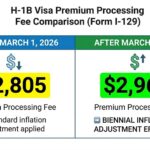
For $2,965 — the price as of March 1, 2026 — USCIS promises to make a decision on your H-1B petition within 15 business days. Not months. Not a vague “processing time varies.” Fifteen days.
But is that worth nearly three thousand dollars? The answer depends entirely on your situation. For some people, it’s the single best immigration decision they make. For others, it buys them nothing except a lighter bank account.
This guide breaks it down honestly.
1. What Is H-1B Premium Processing?
Premium processing is an optional service from U.S. Citizenship and Immigration Services (USCIS) that speeds up the adjudication of your H-1B petition. When your employer pays for it, USCIS commits to issuing a decision within 15 business days of receiving the request. That decision can be an approval, a denial, or a Request for Evidence (RFE) — but you’ll get something within those 15 days instead of waiting in a queue that can stretch to 8 months or longer.
The request is made using Form I-907, filed alongside (or separately from) the main H-1B petition on Form I-129.
Premium processing is available for most H-1B situations:
- New H-1B cap-subject petitions (post-lottery)
- H-1B extensions
- H-1B transfers (changing employers)
- Cap-exempt H-1B petitions
- Amendments
It does not change your legal eligibility. It does not improve your chances of approval. USCIS evaluates the exact same case — just faster.
Source: USCIS Form I-907 — Request for Premium Processing Service
2. The Fee Just Went Up — Here's What You're Paying in 2026
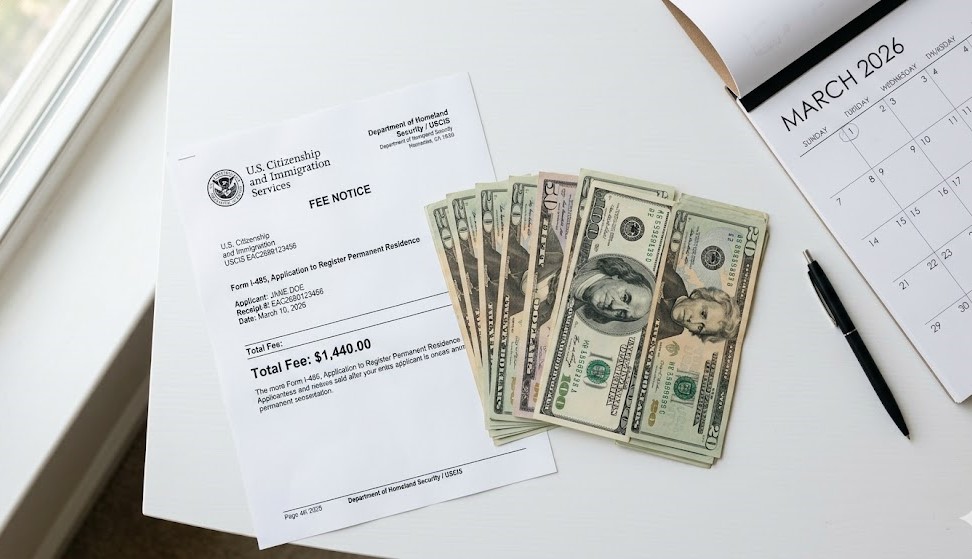
As of March 1, 2026, the H-1B premium processing fee is $2,965.
That’s a $160 jump from the previous fee of $2,805, which had been in effect since February 2024. The increase is authorized under the USCIS Stabilization Act, which requires DHS to adjust premium processing fees every two years to keep pace with inflation — specifically, the Consumer Price Index from June 2023 through June 2025.
Any Form I-907 postmarked on or after March 1, 2026 must include the new fee. USCIS is not accepting the old amount — petitions submitted with $2,805 on or after March 1 are being rejected outright and returned.
Fee history:
| Date | Premium Processing Fee |
|---|---|
| Before Feb 2024 | $2,500 |
| Feb 26, 2024 – Feb 28, 2026 | $2,805 |
| March 1, 2026 onward | $2,965 |
This is separate from — and in addition to — all other H-1B filing fees. The total employer cost for an H-1B petition with premium processing at a mid-size company now typically runs between $9,000 and $12,000+ when you add the I-129 base fee ($460), ACWIA fee ($1,500 for employers with 26+ employees), fraud prevention fee ($500), asylum program fee ($600 for large employers), attorney fees, and the optional $2,965 premium.
Sources:
3. What Does “15 Business Days” Actually Mean?
This is where a lot of people get caught off-guard, so let’s be precise.
15 business days means weekdays only — weekends and federal holidays don’t count. In practice, 15 business days works out to about 3 calendar weeks, sometimes a little more depending on when you file.
The clock starts the day USCIS physically receives your Form I-907 and fee — not the day you mail it. If you send it overnight and USCIS receives it on a Monday, day 1 is that Monday.
The RFE problem: If USCIS issues a Request for Evidence during those 15 days, the clock pauses. Once you respond to the RFE, a brand new 15-business-day window begins. So if an RFE comes on day 12 and takes you three weeks to respond to, you’re now looking at another 3 weeks after that. Premium processing doesn’t make RFEs disappear — it just means you get the RFE faster.
Historical data: According to USCIS processing time records through May 2025, the average premium processing approval actually came through in about 12 calendar days — slightly faster than the 15-business-day maximum. For regular processing in 2025, the Texas Service Center was running at roughly 8 months.
That gap — 12 days vs. 8 months — is the core of the premium processing value proposition.
Source: Redbus2US: H1B Visa Processing Times Premium vs. Regular (Updated Aug 2025)
4. When Premium Processing Is Absolutely Worth It
This is the section that actually matters. Premium processing isn’t for everyone — but for certain situations, skipping it would be a serious mistake.
Scenario A: You’re Transferring to a New Employer
This is probably the most common case where premium processing pays for itself many times over.
When you’re changing jobs, you can legally start working at your new employer as soon as USCIS receives the transfer petition — you don’t need full approval first. But your new employer still needs certainty about your status before they can book you on client projects, submit you for clearances, or finalize your start date. And you need to time your resignation carefully.
With premium processing, you know within 3 weeks whether the petition was approved, denied, or requires more documents. That’s a resignation conversation you can have with confidence. Without it, you’re handing in your notice while a 6-8 month timeline hangs over your head.
For a deeper look at the transfer process itself, the H-1B Visa Transfer: How to Change Employers Without Losing Your Status guide covers the portability rules and what happens if something goes wrong mid-transfer.
Scenario B: Your Current Status Is About to Expire
If your H-1B or I-94 expires in the next 60-90 days and your extension is pending, you’re in a race. Regular processing could leave you in a gray zone where you’re technically authorized to work under the 240-day rule — but traveling internationally becomes extremely risky, your employer may freeze certain work assignments, and any lapse creates problems down the road.
Premium processing eliminates that uncertainty before it becomes a real problem. If you want to understand the 240-day rule in detail, see H-1B Extension and the 240-Day Rule: What You Can and Can’t Do.
Scenario C: You’re on OPT and It’s About to Expire
F-1 OPT runs out. For many recent graduates, the transition from OPT to H-1B is the most stressful immigration moment of their early career. If your OPT expires before your H-1B petition is processed, you can’t work — period.
Premium processing gives you a decision before that window closes. It’s not optional in this scenario — it’s essential. The OPT to H-1B 2026: Complete Transition Guide breaks down the full timeline of what needs to happen and when.
Scenario D: You Were Just Laid Off
If you were laid off, you have a 60-day grace period to find a new employer and file a transfer petition. Sixty days sounds like a lot. It isn’t — especially when you factor in the time to find a job, negotiate an offer, and get the legal work started.
Once the transfer petition is filed, regular processing could leave you waiting for months without a clear answer. Premium processing means you know within 15 business days whether your new petition was accepted or if you need to pivot. That clarity matters enormously when you’re counting down a 60-day clock.
If your H-1B was cancelled or revoked and you’re navigating that situation, the H-1B Visa Cancelled or Revoked: Exactly What To Do article covers what steps to take and how much time you actually have.
Scenario E: You Have a Hard Business Deadline
Some situations are just time-sensitive from the employer’s side. A client contract starts October 1. A product launch needs a specific team assembled by a date. A relocation is scheduled. In these cases, the employer often drives the premium processing decision — and rightfully so. The cost of delay exceeds $2,965 by a significant margin.
5. When Premium Processing Is NOT Worth Your Money
Premium processing is a well-designed product. But there are real situations where it does nothing for you.
New Cap-Subject Petitions Filed in April-June
Here’s the one people don’t think about enough: if you just won the H-1B lottery and your employer files a fresh petition in April 2026, premium processing will get you an approval notice in 15 days. But you still cannot start working before October 1, 2026 — that’s when the federal fiscal year begins and cap-subject H-1B status takes effect.
So the approval comes in May. You still wait until October. What exactly did the $2,965 buy you? Peace of mind, sure — but no actual time savings.
The one exception: if you’re still on OPT that expires before October 1 and you need to confirm your H-1B was approved to maintain your status. In that case, premium processing matters.
For everything else in a new cap petition? The urgency argument is weak.
Source: VisaNation: H-1B Visa Processing Time
Situations With Zero Hard Deadlines
If your current H-1B doesn’t expire for another year, your OPT isn’t running out, you’re not changing jobs, and there’s no travel deadline — regular processing is probably fine. Standard processing times have ranged from 3.5 to 8 months in recent years, but if none of that timeline creates a real problem for you, paying $2,965 for speed you don’t need doesn’t make sense.
When Your Employer Simply Won’t Pay
Legally, your employer is required to pay most H-1B filing fees. Premium processing is technically optional — so some employers won’t cover it. Others will if you ask, especially if you can make a clear business case. But if the answer is no and the cost would fall on you, weigh it carefully against your actual situation.
6. Real Talk: What People on r/h1b Actually Say
The H-1B forums on Reddit — particularly r/h1b and r/immigration — have thousands of threads about premium processing. The patterns are pretty consistent.
One user going through an employer transfer described the experience this way in a thread on r/h1b:
“Filed transfer in premium. Got approval on day 11. That’s the only reason I could give my current employer two weeks’ notice without everything being up in the air. Would pay it again without thinking twice.”
Another comment from a user who had an extension pending while their I-94 was approaching its expiration:
“My status was expiring in 45 days when we filed. Attorney strongly recommended premium. Approved in 9 business days. Without it I would have been in the 240-day work authorization limbo thing and couldn’t travel home for my sister’s wedding.”
The skeptics exist too. A common sentiment from people who paid for premium on a new cap petition:
“Paid $2,805 last year for premium on my initial H-1B. Got the approval in 8 days. Still couldn’t start until October 1 anyway. My company paid for it but I honestly felt like they wasted money.”
This tracks with what immigration attorneys and experienced filers consistently say: the value of premium processing is almost entirely situational. The people who benefit most are those with real, hard deadlines — expiring statuses, job changes, 60-day grace periods. The people who get the least out of it are those who just want a faster approval on a petition where the outcome date is already fixed.
7. Who Pays — You or Your Employer?
This is a question that creates more confusion than it should.
By regulation, certain H-1B filing fees cannot be passed to the employee. The base filing fee (Form I-129), the ACWIA training fee, the fraud prevention and detection fee, and the asylum program fee must be paid by the employer. If your employer deducts these from your wages, that’s a violation.
Premium processing sits in a slightly different category. It’s technically an optional service, not a mandatory fee. USCIS and Department of Labor guidance doesn’t explicitly prohibit the employer from asking the employee to pay for premium processing — but it’s uncommon, and many immigration attorneys advise that cost-shifting premium processing fees to the employee risks pushing the worker’s effective wage below the required prevailing wage.
In practice, the large majority of employers pay for premium processing when they elect to use it. If your employer is asking you to pay for it yourself on a petition your employer is filing, it’s worth asking your HR department to clarify the policy — and optionally consulting an H-1B immigration attorney.
8. How to Request Premium Processing (Step-by-Step)

Premium processing is entirely managed by your employer and/or immigration attorney. Here’s how it works:
Step 1: Decide at filing or upgrade later You can request premium processing at the same time as the initial I-129 filing, or upgrade a pending petition to premium processing after you’ve already received the I-797 receipt notice. Both options are available.
Step 2: Complete Form I-907 Your employer (or their attorney) fills out Form I-907, Request for Premium Processing Service. The current version must be used — older versions are rejected.
Step 3: Pay the $2,965 fee Payment can be made by:
- Credit or debit card (use Form G-1450 for card payments)
- Electronic funds transfer / ACH (use Form G-1650)
Personal checks are not accepted. Payment must be in a separate remittance from any other filing fees.
Step 4: Mail to the correct USCIS Service Center The I-907 must be mailed to the USCIS service center handling the underlying I-129 petition. You cannot file premium processing online. Use tracked overnight shipping — your USCIS receipt date is the physical delivery date, and that’s when the 15-day clock starts.
Step 5: Monitor your case Your attorney will receive notices, but you can also check your case status online at USCIS Case Status using the receipt number from your I-797.
9. What Happens If USCIS Misses the 15-Day Deadline?
USCIS has a service level agreement (SLA) on premium processing — if they don’t issue a decision within 15 business days, they refund the $2,965 fee. Your case doesn’t get dropped; they continue processing it at expedited speed, you just get your money back.
This doesn’t happen often, but it has happened during surge periods. If you’re in this situation, your attorney will typically request the refund automatically once the SLA is missed.
Two important clarifications:
- The SLA applies to issuing any action — approval, denial, or RFE. An RFE counts as meeting the deadline.
- If an RFE is issued, the 15-day clock stops. The SLA refund provision only applies to the original 15-day window, not to the post-RFE response period.
Premium Processing vs. Regular Processing
Side-by-side comparison — H-1B / Employment-based petitions (2026)
| Feature | Regular Processing | ⚡ Premium Processing |
|---|---|---|
| Cost | $0 No additional fee |
$2,965 As of March 1, 2026 |
| Processing Time (2026) | 3.5 – 8 months | ~12–15 business days |
| Decision Guarantee | ✗None | ✓15 business days or full fee refund |
| Best For | No urgent deadlines | Transfers, expiring status, OPT, layoffs |
| Cap-subject New Petition | ✓Fine for most cases | ⚠Limited benefit unless OPT expiring |
| RFE Impact | ⚠Extends timeline significantly | ✓Resets 15-day clock; still faster overall |
| Who Pays | Employer | Employer (in most cases) |
| Online Filing Available? | ✓Yes (in most cases) | ✗No — mail only via Form I-907 |
Source: USCIS — Premium Processing guidelines 2026 | Consult an immigration attorney for case-specific advice.
11. Frequently Asked Questions
No. It guarantees a decision within 15 business days. That decision could be an approval, a denial, or an RFE. USCIS evaluates the merits of your case exactly the same way — just on a faster timeline. A strong petition still matters.
Yes — and this is one of the best use cases for it, especially if your current status is expiring within the next 90 days. Your H-1B extension is eligible for premium processing under Form I-907.
Yes. If your petition is already pending with USCIS and you have a receipt notice (I-797C), your employer can upgrade to premium processing at any point before the case is decided.
An RFE means USCIS needs more documentation before they can decide your case. The 15-day clock stops when the RFE is issued and starts fresh once you respond. Your attorney will typically have 87 days to respond. For complex RFE situations — especially those involving specialty occupation questions — consider consulting an H-1B attorney rather than navigating it alone.
H-4 EAD (Form I-765) has a separate premium processing option, now at $1,780 under the March 2026 fee schedule. However, H-4 EADs cannot be premium processed at the same time as the underlying H-1B — the I-765 must be filed separately. For everything about H-4 EAD work authorization, see H-4 EAD 2026: How H-1B Spouses Can Get Work Authorization.
Under the USCIS Stabilization Act, DHS adjusts premium processing fees biennially based on CPI inflation. The next scheduled adjustment would be around early 2028.
Not directly. H-1B premium processing applies only to the I-129 petition. The green card process involves different forms and timelines — but if you’re already planning that path, the H-1B to Green Card 2026: Real Timeline and Real Cost guide is a solid starting point for understanding what comes next.
The FY 2026-27 cycle introduced wage-weighted lottery selection and several policy changes that affect how petitions are evaluated. If you haven’t caught up on those, the H-1B Visa New Rules 2026: Complete Update breaks everything down.

The Bottom Line
Premium processing at $2,965 is not for everyone. But for anyone dealing with a job change, an expiring status, OPT running out, or a layoff countdown — it’s not really a luxury. It’s the cost of certainty in a process that has very little of it.
The fee went up $160 in March 2026. That’s annoying but not surprising — it was an inflation adjustment, not a policy decision. And relative to what’s at stake — your legal status to work in the United States — $2,965 is a reasonable price for knowing the answer in 15 business days instead of waiting through an 8-month processing queue.
If you’re navigating other parts of the H-1B process alongside this decision — understanding your salary requirements, thinking through your sponsorship strategy, or researching which employers actually sponsor — those pieces connect more than people realize. Premium processing is one decision inside a much larger picture.
Disclaimer :This article is for informational purposes only and does not constitute legal advice. Immigration situations are fact-specific — consult a licensed immigration attorney for guidance on your particular case.