


You landed your H-1B. You did the lottery, survived the wait, started the job. And then — six months in, maybe a year — a recruiter calls. Or a friend refers you. Or you just realize the role you’re in isn’t the one you actually want.
The first thought most people have is: will switching jobs cost me my visa?
The short answer is no. But the longer answer matters a lot more, because the way you do this — the timing, the paperwork, the portability window — determines whether the transition is clean or chaotic. People make mistakes here. Some of them don’t find out until months later, when USCIS asks uncomfortable questions about a gap in their pay stubs.
This guide covers what actually happens when you change employers on an H-1B, not the sanitized version.
The “H-1B Transfer” Is Actually a New Petition — Here’s What That Means
There’s no such thing as a real H-1B transfer. The word gets used everywhere — by recruiters, by HR departments, sometimes even by immigration attorneys as shorthand — but USCIS doesn’t use it, and more importantly, nothing literally moves between companies.
When an individual is already in H-1B status and plans to change employers, what technically gets filed with USCIS is a new H-1B petition, reflecting a change in employment. There is not an abbreviated “transfer” filing that is approved more easily than an initial H-1B filing. Murthy Law Firm
That last part is the one people tend to miss. Your new employer can’t cut corners by calling it “just a transfer.” The job still has to be a specialty occupation, the offered wage must meet or exceed the required wage, and your new employer must obtain a certified Labor Condition Application that covers the new worksite. Pollakimmigration
So yes, it’s a full petition. The upside is that you don’t go back into the lottery, and you don’t start your H-1B clock over.
How H-1B Portability (AC21 Rule) Lets You Change Jobs Without a Gap
Here’s where it gets better. When it comes to H-1B transfers, you don’t have to wait until the petition is approved to start working. You can begin your new job on whichever date is later: the date your employer files a non-frivolous I-129 petition on your behalf, or the requested start date on the petition. Manifest Law
This is the AC21 portability rule, and it’s the reason H-1B holders can actually change jobs without taking a gap in employment and income. The moment USCIS receives your new employer’s petition — not when it’s approved, just received — you can legally start working there.
To use portability, the nonimmigrant must have been previously issued an H-1B visa or otherwise provided H-1B nonimmigrant status; must have been lawfully admitted into the United States as a nonimmigrant; must not have engaged in employment without authorization since that admission; and must be the beneficiary of a non-frivolous I-129 petition filed with USCIS before the expiration of the period of stay authorized. Temple
If you’ve had any gaps in authorized employment — periods where you weren’t being paid, or worked outside your H-1B terms — portability becomes risky territory. Talk to an attorney before you do anything.
Step-by-Step: What the Process Actually Looks Like
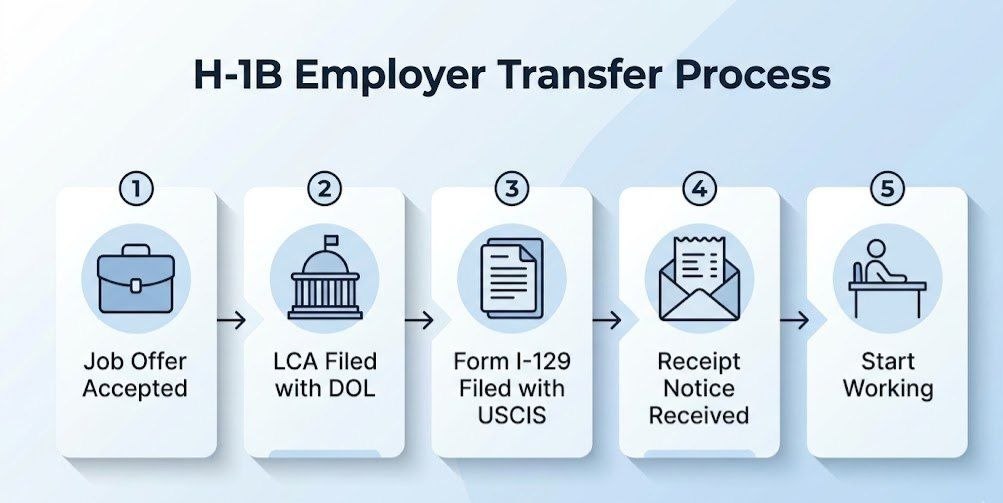
Step 1 — Get the offer in writing. Your new employer needs a formal offer in place before any immigration work starts. The position has to be a specialty occupation that aligns with your education and qualifications. You can’t port an H-1B from software engineering into a role that doesn’t require a degree — USCIS will notice.
Step 2 — New employer files the Labor Condition Application (LCA). This goes to the Department of Labor, not USCIS. Your new employer uses the LCA to argue for your specialized H-1B status, and it must confirm the offered wage meets prevailing wage requirements. Manifest Law LCA certification typically takes around 7 business days.
Step 3 — Form I-129 gets filed with USCIS. Once the LCA is certified, the employer files the I-129 petition. This is when the clock starts for portability. You don’t need to inform your current employer that you’ve filed a petition for an H-1B job change. Prodigy Finance You can apply for a role — and your new employer can file the petition — without telling anyone at your current job. That’s the law.
Step 4 — Receipt notice arrives. USCIS sends an I-797 receipt notice confirming they received the filing. Once this receipt number is received, the employee can begin working for the new employer. VisaGuide.World
Step 5 — Approval (or an RFE). Most clean filings get approved. But USCIS can also issue a Request for Evidence (RFE) asking for more documentation about the specialty occupation or the employer-employee relationship. If this happens, respond quickly and completely — dragging it out creates unnecessary uncertainty while you’re working under portability.
What USCIS Actually Looks for When Reviewing a Change-of-Employer Petition
Most people treat the H-1B employer transfer as paperwork — file it, wait, move on. USCIS doesn’t see it that way. Every change-of-employer petition gets reviewed on its own merits, and there are specific things an officer is looking for.
The first is specialty occupation. USCIS wants evidence that the role genuinely requires a bachelor’s degree or higher in a specific field. A job title of “software engineer” alone won’t cut it anymore. The petition needs to include a detailed description of actual job duties, and those duties need to map clearly to your degree. If your degree is in mechanical engineering and the new job is in finance, expect scrutiny.
The second is the employer-employee relationship. This became a bigger issue after USCIS started questioning consulting and staffing arrangements more aggressively. The agency wants to see that the new employer controls your day-to-day work — assigns tasks, evaluates performance, sets your schedule. If you’re being placed at a third-party client site, the petition needs to document that relationship carefully. Contracts, client letters, and work orders all matter here.
The third is the employer’s ability to pay. USCIS checks whether the new employer can actually afford the offered salary. For startups and smaller companies, this means submitting financials — tax returns, audited statements, or payroll records — to prove the wage is real and sustainable. A verbal commitment to pay you $150K means nothing if the company can’t back it up on paper.
Clean petitions anticipate all three of these areas and address them up front. Ones that don’t tend to generate RFEs.
H-1B Transfer Fees in 2026: Who Pays What
All mandatory fees must be paid by the employer. Only premium processing is optional.
| Fee Type | Large Employer 25+ employees |
Small / Nonprofit <25 employees |
|---|---|---|
| Form I-129 Filing Fee | $780 | $460 |
| ACWIA Training Fee | $1,500 | $750 |
| Fraud Prevention & Detection Fee | $500 | $500 |
| Premium Processing Optional | $2,965 | $2,965 |
| Total (without premium) | $2,780 | $1,710 |
| Total (with premium) | $5,745 | $4,675 |
* Premium processing guarantees a USCIS decision within 15 business days. Employer must pay all mandatory fees; employee may voluntarily cover premium processing.
If premium processing is offered — which brings the decision timeline down to 15 business days — it’s worth considering seriously. Standard processing can take several months, and that’s months of working under portability with no final approval.
For a deeper breakdown of every government fee involved in the H-1B process, the complete H-1B visa fee breakdown for 2026 is worth reading before you start a negotiation with your new employer.
One thing worth knowing: if your new employer is unwilling to pay for premium processing, consider covering that cost yourself. Manifest Law A few thousand dollars to avoid months of uncertainty about your authorization to work is usually money well spent.
H-1B Employer Transfer After a Layoff: The 60-Day Grace Period Explained
This comes up constantly, and with reason — layoffs in tech and finance hit H-1B holders hard because the immigration clock doesn’t pause.
If your previous employer terminated your H-1B employment, you may still be eligible to transfer within a grace period, typically 60 days. Immigration Law of LA That’s not 60 days from the day you find out — it starts the day your employment actually ends. And if your I-94 expires before 60 days, that date takes priority. Whichever comes first is your real deadline.
Filing near the end of the sixty days can increase scrutiny, so you and your new employer should move quickly when an offer is finalized. Pollakimmigration This isn’t bureaucratic caution — USCIS has issued Notices to Appear in recent years to people who cut it close or filed just outside the window.
The full breakdown of how this grace period works — and where people misread the rules — is covered in the H-1B 60-day grace period and 240-day rule guide. Read it before you assume you have more time than you do.
What to Do If Your New Employer Is Slow to File After You’ve Already Resigned
This is one of the most stressful situations H-1B holders face, and it doesn’t get covered enough. You resigned in good faith. The offer was solid. You gave notice, wrapped things up, maybe even started your first week — and then the new employer’s immigration process stalls. HR is waiting on legal. Legal is waiting on documents. Weeks pass.
Here’s the problem: your grace period starts counting from the day your old employment ended. If you’re in the 60-day window after a layoff, every day of delay is a day closer to an out-of-status situation. And if you’re relying on portability to work at the new employer, you legally can’t start until that receipt notice is in hand.
The first thing to do is escalate — politely but firmly. Ask HR for a specific date by which the I-129 will be filed. If they can’t give you one, ask whether premium processing is being used, because a pending LCA plus a premium I-129 can get you a receipt notice in under two weeks.
If the employer is genuinely stalling with no clear explanation, that’s a warning sign about how they handle immigration in general. In that case, contact an independent immigration attorney immediately. They can sometimes work with the employer’s counsel to move things forward, and they can advise you on whether any bridge options exist — such as a short-term status extension or a concurrent position — to keep you in lawful status while the filing gets sorted.
Never assume the employer’s immigration attorney is looking out for your interests. They represent the company. You need someone in your corner.
H-1B Transfer Travel Risks: What Nobody Tells You Before You Book That Flight
Travel during an H-1B transfer requires careful planning. A pending change of employer petition can interact with travel in ways that affect status and may shift you from a change of status path to consular processing. If you leave the United States while a combined change of employer and change of status petition is pending, USCIS may treat the change of status portion as abandoned. Pollakimmigration
If your current H-1B visa stamp is still valid, you can re-enter the U.S. after travel using it — you just need to also carry the I-797 receipt notice for the new employer’s pending petition. An H-1B worker who has changed employers and has a valid visa annotated for the previous employer may re-enter the United States using that visa, provided they present a valid H-1B approval notice for the new employer upon re-entry. Temple
If your visa stamp has expired, you’ll need to get it re-stamped before traveling internationally. That process has its own timeline and appointment bottlenecks — the H-1B visa stamping process and appointment guide explains the current situation at consulates in detail.
The $100,000 Fee: What It Actually Means for H-1B Employer Transfers
A lot of H-1B holders panicked when executive orders announced a $100,000 fee on new H-1B applications. The relevant detail for transfers: the latest information from the White House clarified that the new fee only applies to new H-1B applications made on behalf of beneficiaries outside the U.S. If you’re in the U.S., you can still change employers without them having to pay the $100,000 fee. Manifest Law
So if you’re currently employed and working in the U.S. on a valid H-1B, a standard change of employer is unaffected by the $100K fee. That said, the policy landscape has been shifting — the H-1B new rules and policy update for 2026 tracks what’s changed and what’s still pending.
The $100,000 Fee: What It Actually Means for H-1B Employer Transfers
A lot of H-1B holders panicked when executive orders announced a $100,000 fee on new H-1B applications. The relevant detail for transfers: the latest information from the White House clarified that the new fee only applies to new H-1B applications made on behalf of beneficiaries outside the U.S. If you’re in the U.S., you can still change employers without them having to pay the $100,000 fee. Manifest Law
So if you’re currently employed and working in the U.S. on a valid H-1B, a standard change of employer is unaffected by the $100K fee. That said, the policy landscape has been shifting — the H-1B new rules and policy update for 2026 tracks what’s changed and what’s still pending.
What Happens If the H-1B Transfer Gets Denied
This is the risk nobody wants to talk about, but it’s real. If the new petition is denied, “portability” work authorization is automatically terminated. Temple If you already started working at the new employer under portability, you have to stop immediately.
You’re not automatically deported, but you are out of status at that employer. Options at that point typically include filing an appeal, returning to your previous employer (if they’ll still have you and the prior H-1B is still valid), or working with an attorney on a status change.
The H-1B visa cancelled or revoked guide covers what your actual options look like in this scenario. Getting an RFE is not a denial — it’s USCIS asking for more documentation. The mistake people make is responding slowly or incompletely.
Most Common RFE Reasons for H-1B Transfers and How to Avoid Them
An RFE on a change-of-employer petition isn’t random. USCIS issues them when specific elements of the filing are weak or missing, and the same categories come up again and again.
The most frequent is specialty occupation. Officers increasingly challenge whether a role “normally” or “always” requires a specialized degree. If the job description is vague, or uses language that could apply to a general business role, expect USCIS to push back. The fix is a tightly written job duties letter from the employer, ideally supported by industry data showing that similar roles at comparable companies require the same degree.
The second most common RFE involves third-party placement. If you’ll be working at a client site — common in consulting and IT staffing — USCIS wants end-client letters confirming the work assignment and its duration. Without them, officers question whether the employer-employee relationship is real. These letters should be specific: project name, duration, supervisor name, work location.
Maintenance of status is the third trigger. If your pay stubs show any gaps, if your W-2s don’t match your approved salary, or if there’s a period where your employment situation is unclear, USCIS will ask about it. The best defense is providing clean, continuous pay documentation going back to the start of your current H-1B period.
One practical note: attorneys who specialize in H-1B filings build petitions that anticipate these RFE triggers. If your new employer is using general business counsel rather than a dedicated immigration attorney, that’s worth raising before the petition is filed, not after. The H-1B visa lawyer guide covers when independent counsel genuinely changes outcomes.
What H-1B Transfer Experiences Actually Look Like: Real Patterns From r/immigration
The r/immigration and r/h1b communities surface consistent patterns from people who’ve been through the H-1B transfer process — both the clean exits and the messy ones.
The people who had the smoothest H-1B employer transfers were the ones who started the process before giving notice. They accepted the offer, confirmed their new employer was ready to file, waited for the receipt notice, and then put in their resignation. Understanding H-1B portability rules correctly — specifically that you can start working the day USCIS receives the petition, not after approval — let them walk into the new job without any gap and without tipping off their current employer prematurely.
The people who ran into problems fell into a few clear patterns. They resigned before the change of employer petition was even filed, creating a status gap. They traveled internationally while their old visa stamp was expired and the new petition was still pending. Or they took a role at a company that wasn’t ready to file quickly — sometimes HR teams at startups seriously underestimate what H-1B filings actually involve, and the employee pays the price.
One recurring piece of advice from the community: don’t rely solely on your new employer’s immigration counsel. They represent the company, not you. If there’s any ambiguity in your status history — gaps in pay, early departures, periods where your situation was unclear — get independent advice before filing. The H-1B visa eligibility requirements for 2026 is a good starting point for checking your own situation before you move.
For 2026 specifically, the one takeaway that matters most: don’t wait until you have a signed offer letter to ask your new employer about their H-1B filing process. Ask during the interview stage. How quickly can they file after you accept? Do they use premium processing as a default? Do they have dedicated immigration counsel? The answers tell you a lot about whether the transition will be clean — and they’re questions you’re fully entitled to ask.
Planning Ahead: H-1B Transfer, Then Green Card
One thing people sometimes don’t factor in: if you’re in the middle of a green card process, changing employers isn’t automatically a problem — but it requires attention. Under AC21, if your I-140 has been approved for more than 180 days and you’re moving to a same or similar occupation, you can port your green card priority date to the new employer. That’s a separate process from the H-1B transfer, and timing matters.
If you’re thinking this far ahead, the H-1B to green card timeline, cost, and process guide has a realistic picture of how that process unfolds, including what changes if you switch employers mid-process.

Frequently Asked Questions
No. You don’t need to inform your current employer that you’ve filed a petition for an H-1B job change. Prodigy Finance There’s no legal requirement. That said, your employment contract may have notice period clauses — that’s a separate matter governed by employment law, not immigration law.
The H-1B transfer time ranges from 4 to 8 weeks once your application has been submitted, although you can streamline the process for an additional fee. Prodigy Finance With premium processing, USCIS commits to a decision within 15 business days.
Yes, you can transfer multiple times as long as each new employer files a valid H-1B petition. Immigration Law of LA There’s no limit on the number of employers you can work for during your H-1B period.
No. Your time already spent in H-1B status counts toward the maximum 6-year limit. Immigration Law of LA Changing employers doesn’t give you fresh time.
The employer can file while you are abroad, but you typically must obtain a new visa stamp before re-entry. Immigration Law of LA Portability doesn’t apply when you’re outside the U.S.
Your new employer will typically ask for your passport, current I-797 approval notice, I-94 record, recent pay stubs (usually last 3 months), your educational credentials and transcripts, and your resume or CV. Pay stubs are particularly important — they’re the primary evidence that you’ve maintained lawful H-1B status.
Startups can sponsor H-1B transfers, but USCIS scrutinizes them more carefully — specifically around financial stability and the legitimacy of the employer-employee relationship. Your new employer needs to show they can actually pay your salary. Thin documentation from a startup is one of the more common reasons for RFEs in change-of-employer petitions.
If your I-140 has been approved for 180+ days and the new role is in the same or similar occupation category, it can often be ported. This is separate from the H-1B transfer and should be handled carefully. Your priority date — the date your labor certification was filed — stays with you regardless of employer.
About the Author
Abhinav Kumar is an immigration content specialist who has covered U.S. visa policy, USCIS procedural changes, and H-1B regulations for more than five years. Before publishing, he consults with practicing U.S. immigration attorneys to verify accuracy and ensure every article reflects current policy. He has written extensively for Indian-American professionals navigating the U.S. immigration system. This article was reviewed by a licensed U.S. immigration attorney.
Disclaimer: This article is for informational purposes only and does not constitute legal advice. Immigration rules change frequently and individual circumstances vary. Consult a qualified U.S. immigration attorney before making any decisions about your visa status.