


Quick Summary: If your H-1B visa was cancelled or revoked, you are not necessarily being deported — but your next 60 days will define everything. This guide explains what type of revocation you’re actually dealing with, what your real options are, and the specific mistakes that turn a recoverable situation into a permanent one.
You found out today, or you’re trying to understand this before it happens to you. Either way, the same thing is true: most of the fear around H-1B revocations comes from not understanding what actually happened legally — and that confusion leads people to make decisions in the first 48 hours that cost them dearly for years.
A cancelled visa stamp is not the same as being deportable. A USCIS notice is not the same as a removal order. And “prudentially revoked” — a phrase thousands of H-1B holders saw in their email in 2025 — does not mean your life in the United States is over.
What it does mean is that your clock is running. And the people who navigate this well are the ones who understand exactly which clock, exactly when it started, and exactly what they’re allowed to do while it’s ticking.
That’s what this article is for.
What “Revoked” Actually Means — And Why It’s Not All the Same
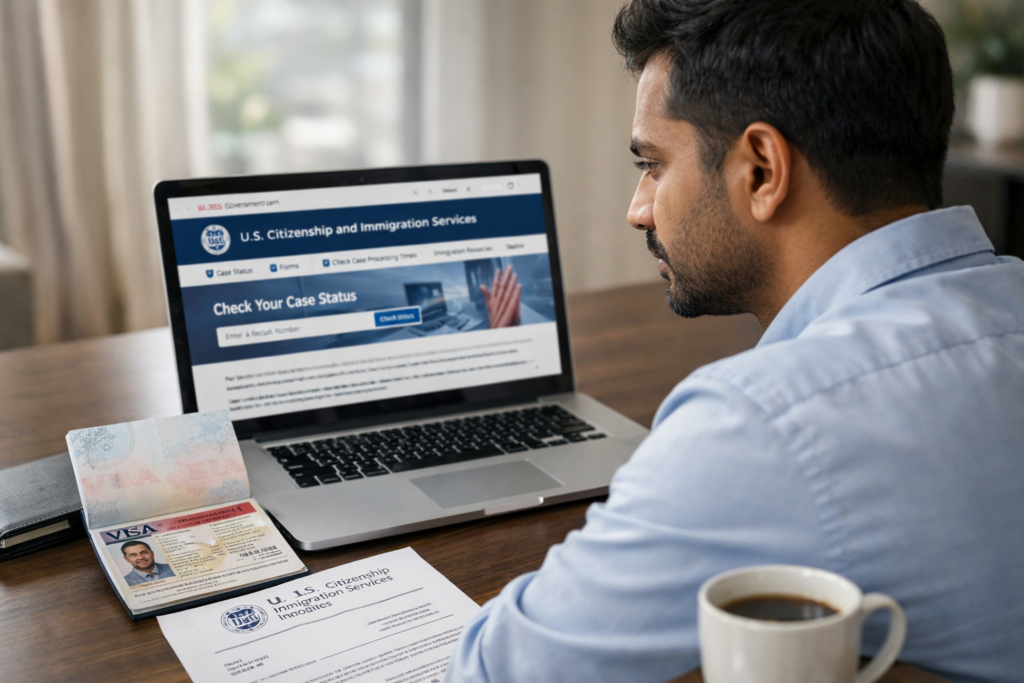
Most people hear “visa revoked” and assume one thing happened. It didn’t. There are three completely different mechanisms that can cancel or revoke an H-1B, and your next move depends entirely on which one you’re dealing with. Getting this wrong in the first week is how people end up making a bad situation significantly worse.
Type 1: Employer Withdrawal
Your employer decided to stop sponsoring you. This happens when you’re laid off, the company goes under, or the business relationship ends for any reason. The employer files a withdrawal request with USCIS — and once that’s processed, your approved I-129 petition is revoked. This is the most common type and, in most cases, the most manageable — because federal regulation has a built-in protection for exactly this situation.
Who starts it: Your employer What it kills: Your authorization to work for that specific employer What it doesn’t do: Immediately strip your status or trigger removal
Type 2: USCIS-Initiated Revocation via NOIR
USCIS sends you a Notice of Intent to Revoke (NOIR) directly. This happens when USCIS believes there’s been fraud, misrepresentation, a material change in job duties not reported, or employer non-compliance. The NOIR gives you a limited window — typically 30 days — to respond with evidence. This is not optional, and it is not something to handle without an attorney.
Who starts it: USCIS What it affects: Your I-129 petition AND your status Critical difference from Type 1: You have a response window. Use it immediately.
Type 3: Prudential Revocation by the Department of State
This is the type that became dramatically more common starting in early 2025 — and the one that confuses people most. The Department of State, under INA §221(i), has the authority to revoke a visa stamp at any time if it suspects — not proves — that you may no longer qualify. No court. No hearing. No advance warning required. (Source: 9 FAM 403.11-5(B), U.S. Department of State Foreign Affairs Manual)
Who starts it: Department of State (DOS) What it affects: Your visa stamp — NOT necessarily your U.S. status The thing most people don’t know: If you are already inside the United States when a prudential revocation happens and your I-94 is still valid, your immigration status is NOT automatically cancelled. You can continue living and working here — as long as you don’t leave the country.
That last point is so important it deserves its own section.
Visa vs. Status — The Distinction That Changes Everything
Understanding this difference is the single most valuable thing in this entire article. Confusing these two concepts is what sends people into unnecessary panic — or, worse, into making decisions that actually create a problem where one didn’t exist.
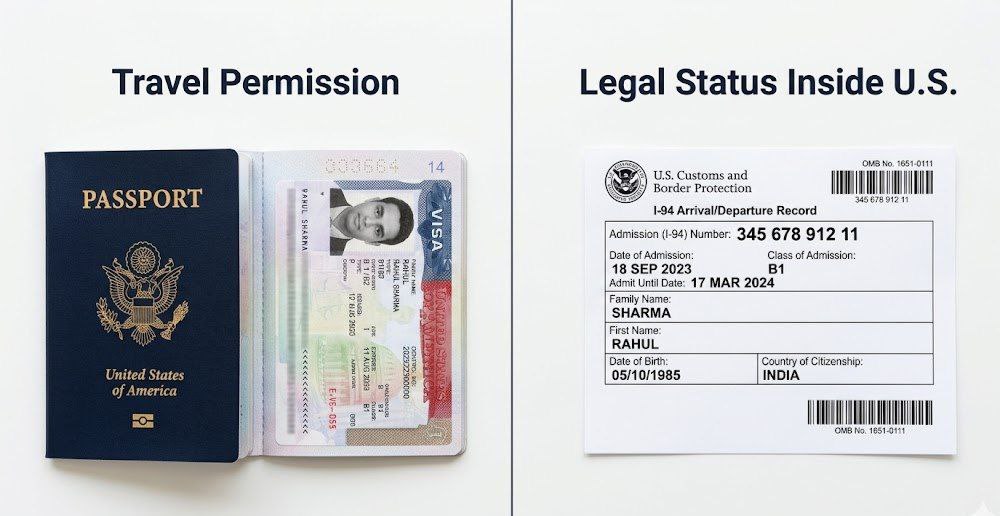
A visa stamp is your travel document. It’s what allows you to approach a U.S. port of entry and request admission. It’s the ticket to the border. Once you’re inside the country, it’s done its job.
Your immigration status — recorded in your I-94 — is what governs your legal presence inside the United States. It determines how long you can stay, what you can do, and whether you’re here lawfully. Your I-94, not your passport stamp, is what matters once you’ve crossed the border.
This means three things that matter right now:
- You can have a valid status and an expired or revoked visa stamp simultaneously. Millions of H-1B holders are in this exact position and are here completely lawfully.
- A prudential revocation of your visa stamp does not cancel your I-94 status.
- If you’re physically inside the U.S. with a valid I-94 and your stamp was prudentially revoked, you are not being deported. Stop traveling internationally immediately — but you do not need to leave.
What you cannot do: leave the U.S. and re-enter without a valid visa stamp. If you travel and your stamp is cancelled, you will need to apply for a new one at a U.S. consulate before returning. That process has its own timeline right now — the H-1B visa stamping guide for 2026 covers what that actually looks like under current conditions, including appointment availability and what consular officers are focusing on.
Why H-1B Visas Are Being Revoked at Record Rates Right Now
This is not routine enforcement. Something shifted significantly in 2025, and if you’re dealing with a revocation right now — or worried about one — understanding the enforcement environment helps you respond smarter.
From January 2025 through late 2025, more than 80,000 U.S. visas were revoked across all categories. More than half were not tied to serious security or criminal concerns — they were triggered by lower-level incidents, social media posts, policy-driven database sweeps, and employer compliance issues. (Source: Data compiled from reporting by immigration legal practitioners citing Department of State enforcement records. NOTE: Exact figure of 80,000 is widely cited in immigration legal commentary — readers should verify against current DOS reporting at state.gov)
Here’s what’s actually driving revocations in 2025–2026:
1. Criminal Arrests — Even Dismissed Cases The single biggest driver. A DUI, disorderly conduct, shoplifting, public intoxication — any arrest can trigger a prudential revocation within 24–48 hours of DOS receiving a law enforcement notification. The charge doesn’t need to be a conviction. Even if it was dismissed, expunged, or reduced, the underlying fingerprint record stays in federal databases and immigration agencies treat the arrest as sufficient grounds. (Source: 9 FAM 403.11-5(B))
2. Social Media and Political Speech Under current policy, content characterized as anti-American, certain political affiliations, or associations with specific organizations can trigger enhanced vetting. DOS has broad authority under INA §212(a)(3)(C) for foreign policy grounds. (Source: INA §212(a)(3)(C))
3. LCA Location Violations Working from a location not listed on your Labor Condition Application — including remote work from your home country for extended periods — has been used as grounds for visa cancellation at ports of entry. (Source: DOL Fact Sheet 62J)
4. Association With Blacklisted Employers Past employment through staffing agencies on USCIS’s debarment list can flag future applications — even when your current employer is completely legitimate.
5. Employer Non-Compliance Found in Site Visits USCIS’s Fraud Detection and National Security division conducts unannounced site visits. If actual job duties, worksite, or pay don’t match the petition, a NOIR can follow. (Source: USCIS FDNS Program)
6. Third-Party Accusations DOS can act on information from former employers, business partners, or personal acquaintances — often called “poison pen” communications — and revoke prudentially while investigating. (Source: 9 FAM 403.11)
7. Policy-Driven Mass Database Sweeps In early 2025, approximately 4,700 student visas were revoked in a single database cross-referencing sweep. Similar targeted sweeps have affected H-1B holders. Some people received revocation notices with no individual reason given — just a statute number. (Source: Immigration legal reporting; individual case details confirmed in federal court filings — readers should verify current enforcement patterns directly at uscis.gov)
The 60-Day Grace Period — What It Gives You and What It Doesn’t
If your H-1B ended because of an employer withdrawal — a layoff, termination, or company closure — federal regulation gives you a 60-consecutive-day grace period. During this time, you remain in valid immigration status, which means you can search for a new employer, file an H-1B transfer, apply for a change of status, or make an organized departure. What you cannot do is work — not freelance, not consulting, not anything paid — and you cannot extend this window or use it more than once within the same visa validity period. (Source: 8 CFR 214.1(l), DHS Final Rule)
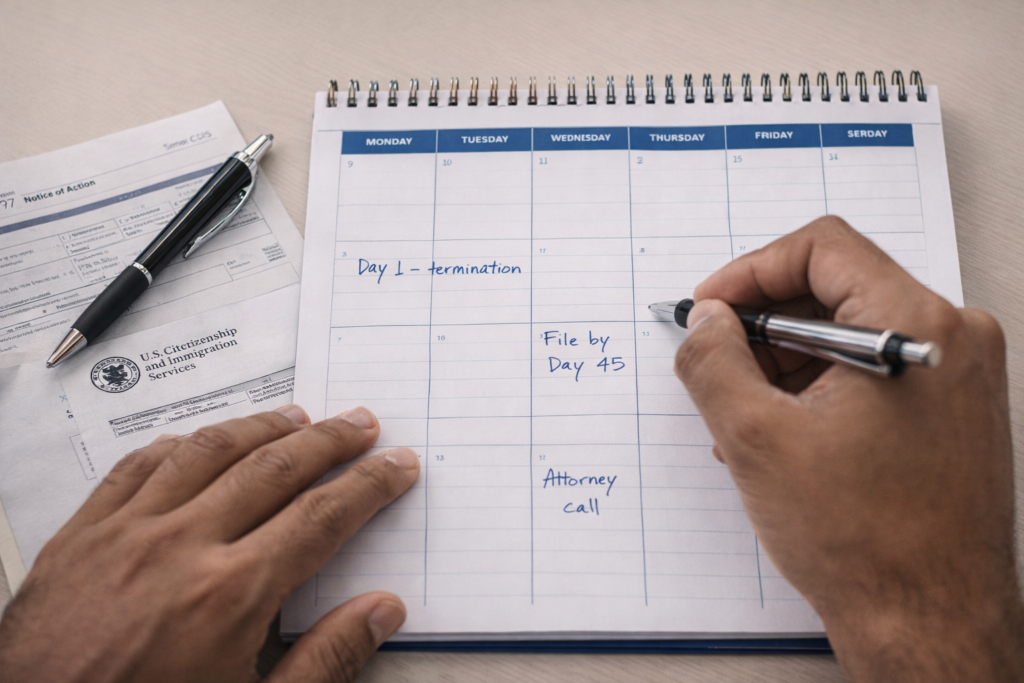
One thing that trips people up constantly: the clock starts on your employment termination date — not when your last paycheck arrives, not when severance ends, not when HR sends the confirmation email. The termination date. Get that date in writing today if you don’t have it already.
For a complete breakdown — including how Day 1 is counted, how severance interacts with the timeline, what the 240-day rule overlap looks like, and the specific mistakes that silently cut people’s time short — read the full dedicated guide: H-1B 60-Day Grace Period After Layoff: What Nobody Tells You.
The 240-Day Rule — For Those With an Extension Pending
There’s a related but entirely different protection worth understanding here. If your employer filed your H-1B extension petition before your I-94 expired, you’re allowed to keep working for the same employer for up to 240 days while USCIS takes its time processing that petition. This is the 240-day rule, and it’s commonly confused with the 60-day grace period — but they address completely different situations. (Source: 8 CFR 274a.12(b)(20))
The 240-day rule does not allow international travel and re-entry on an expired stamp, does not apply if the extension was filed late, and ends immediately if the employer withdraws the petition. If you were laid off while an extension petition was already pending, the interaction between these two rules gets complicated quickly — the H-1B extension and 240-day rule guide walks through those overlap scenarios in detail.
How to Check If Your H-1B Is Actually Revoked Right Now
Before taking any action — including contacting an attorney, calling your employer, or making any travel decisions — you need to know your actual legal status across three separate layers. Skipping this step is how people end up responding to the wrong problem.
Step 1: Check your visa stamp status Go to ceac.state.gov. Enter your visa application number from your passport stamp. “Revoked” or “Cancelled” means your stamp is no longer valid for travel or re-entry.
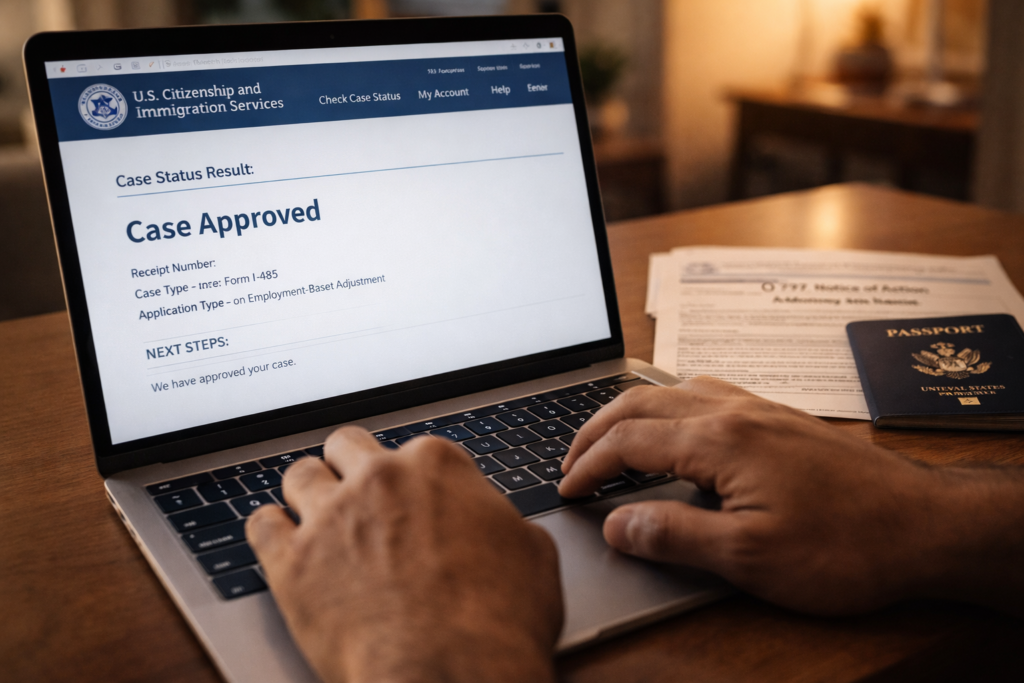
Step 2: Check your I-129 petition status Go to egov.uscis.gov. Enter your receipt number from your I-797 approval notice. If you need help locating that number, this guide explains exactly where your H-1B visa number appears in your documents.
Step 3: Check your I-94 record Go to i94.cbp.dhs.gov. This shows your authorized period of stay and current admission status.
Step 4: Read all three together
| What You See | What It Actually Means |
|---|---|
| Visa stamp revoked, I-94 still valid | Stay in U.S. — do NOT travel internationally |
| I-129 petition revoked by employer | 60-day grace period is active from termination date |
| NOIR received from USCIS | 30-day response window — attorney this week, not next |
| I-94 expired, no pending petition | Unlawful presence accruing — attorney today |
| Port of entry cancellation stamp in passport | Possible bar — FOIA request + attorney immediately |
Your Real Options — Honestly Assessed
Now that you know what happened and what your current status actually is, here are your realistic options. These aren’t all equivalent — some are clearly better than others depending on your situation — and the honest version of this conversation requires saying that clearly.
Option 1: H-1B Transfer to a New Employer
This is the best outcome if you can make it work within your timeline. Under H-1B portability rules, you can start working for a new employer the day the transfer petition is filed — not when USCIS approves it. The approval can take months. You’re still protected from the filing date forward.
The challenge is finding an employer who can move fast enough. Some companies can file in two to three weeks. Others take months just to finalize a job offer. Be upfront about your deadline from the first conversation. If you’re exploring cap-exempt employers — universities, nonprofit research institutions — the H-1B cap exemption guide explains who qualifies and how to pursue that path without waiting for a lottery cycle.
Option 2: Change of Status
If a transfer isn’t happening within your window, a change of status keeps you in lawful presence while you figure out the next step.
H-4 dependent: If your spouse has an active H-1B, you can switch to H-4. If their employer also has an approved I-140, you may qualify for H-4 EAD (work authorization), though processing takes time. B-1/B-2 visitor: Buys time but no work authorization — not a solution, just a bridge. F-1 student: Legitimate if you’re enrolling in school, but has its own processing requirements.
File the I-539 before day 60, not after.
Option 3: Voluntary Departure — The Hardest but Cleanest Option
If you reach week seven or eight and nothing has been filed, leaving voluntarily before unlawful presence begins keeps your record clean and your future options open. 180+ days of unlawful presence creates a 3-year re-entry bar. Over 365 days creates a 10-year bar. Leaving before day 60 resets none of that. (Source: INA §212(a)(9)(B))
Option 4: Responding to a NOIR
If USCIS sent a Notice of Intent to Revoke, you have approximately 30 days to respond with evidence. The employer typically leads this response, not the employee. This requires an immigration attorney experienced in USCIS litigation — not someone you find on day 28. (Source: 8 CFR 214.2(h)(11))

Comparison Table: The Three Types of H-1B Revocation
| Employer Withdrawal | USCIS Revocation (NOIR) | Prudential Revocation (DOS) | |
|---|---|---|---|
| Who initiates | Employer | USCIS | Department of State |
| Primary trigger | Layoff / termination / closure | Fraud, violation, non-compliance | Arrest, security concern, policy sweep |
| Affects visa stamp? | Not directly | Yes | Yes — often immediately |
| Affects I-94 status? | Yes (when processed) | Yes | Not automatically if inside U.S. |
| Grace period? | 60 days from termination | No automatic grace period | Status intact until I-94 expires |
| Can you work? | No (after termination) | No | Yes (if I-94 valid + inside U.S.) |
| International travel? | Risky without valid stamp | No | No — cannot re-enter without new stamp |
| Response window? | None | 30 days (NOIR response) | None — DOS acts unilaterally |
| Attorney required? | Strongly recommended | Mandatory | Strongly recommended |
| Most common 2025–26? | Always the most common | Increasing with site visits | Dramatically increased |
Real Situations We’ve Seen
These are based on patterns observed across actual cases — details anonymized. Each one illustrates a mistake or misunderstanding that cost someone real time and real options.
Situation 1 — The expungement that didn’t protect anyone.
Someone had a DUI in 2022. It was handled through the state court system, expunged, and they moved on. They’d traveled internationally afterward with no issues. Then came one more return trip — visa cancelled at the airport. The state expungement was irrelevant to immigration authorities. The federal fingerprint database still showed the arrest. Entry was denied.
What it teaches you: State expungements clear your state record. They do not erase the federal arrest record that immigration agencies access. Any arrest — dismissed, reduced, expunged — still exists for DOS and USCIS purposes. If you’ve had any arrest and are planning international travel, speak to an immigration attorney before you book the flight. Not after.
Situation 2 — Three months of severance, two weeks of actual time.
Someone received a generous three-month severance package after being laid off. They assumed the 60-day clock started when severance ended. It didn’t. Forty-seven days in, they finally looked into it carefully and realized the clock had been running since their termination date. With thirteen days remaining, filing a transfer petition in time became nearly impossible.
What it teaches you: Severance is money. It has no bearing on your immigration timeline. Your clock started the day your employment ended — full stop. Get the termination date in writing and treat it as Day 1.
Situation 3 — Nine months later, out of nowhere.
Someone disclosed a prior alcohol-related incident during their consulate interview, submitted the required medical documentation, and received their H-1B visa. Case closed, they thought. Nine months later, working in the U.S. with a valid I-94, they received a consulate email: visa revoked. No explanation beyond a statute citation. No interview. No warning.
Their status was still valid and they could continue working — but they couldn’t travel internationally until a new visa was issued, and that process had become more complicated with a prior revocation on their record.
What it teaches you: A visa being approved doesn’t mean the underlying concern was permanently resolved. Government databases are continuously cross-referenced. A revocation can come months or years after the original event.
Situation 4 — Honest answer, wrong airport.
Someone spent two months in their home country and worked remotely for their U.S. employer the entire time. Their company had informally approved it. At a preclearance facility on the way back, an officer asked directly if they had worked while abroad. They answered honestly — yes.
Visa cancelled. Their LCA listed a specific U.S. worksite. Two months of remote work from another country was a compliance violation. “My company approved it” was not a defense.
What it teaches you: LCA compliance is law, not policy. If your LCA lists a U.S. work location, that’s where you’re authorized to work. Company approval doesn’t override USCIS and DOL regulations.
Situation 5 — No paperwork, verbal ban, no idea what to fight.
Someone arrived at a U.S. airport with a valid stamp and an approved I-797. Secondary inspection. Hours of questioning. The officer verbally stated a five-year bar and sent them home the same day. No Form I-860 was provided. No written explanation of findings.
They returned home with a cancelled stamp and no documentation of what was officially recorded.
What it teaches you: If this happens, the first step is a FOIA request to CBP to get your inspection record. Without knowing what’s officially in the system, you can’t challenge anything. Don’t attempt to re-enter or reapply for any visa until you’ve reviewed that record with an attorney.
Situation 6 — A social media post from two years ago.
Someone had posted political commentary on a public social media account in 2023 — content that was later flagged under current administration vetting criteria. They had no criminal history, no employer violations, no other issues. One day they received a DOS email citing INA §212(a)(3)(C) — the foreign policy ground — with no specific post identified. Visa prudentially revoked.
They were inside the U.S., I-94 still valid, and continued working. But they were effectively grounded from any international travel until a new visa could be obtained and the underlying concern addressed.
What it teaches you: Social media is being actively reviewed during vetting. Posts from years ago can trigger action today. If you have any public-facing content that could be characterized as politically sensitive under current criteria, a proactive review with an immigration attorney before international travel is a reasonable precaution — not paranoia.
Situation 7 — The blacklisted employer they never knew about.
Someone had worked for a staffing agency five years prior — legitimately employed, filed all taxes, never had any compliance issues. That agency was later placed on USCIS’s debarment list for fraudulent practices by other employees. When this person applied for a new H-1B through a completely different, legitimate employer, the prior affiliation flagged in USCIS’s system. The new employer’s petition received an RFE citing the prior agency relationship.
What it teaches you: You can be caught up in an employer’s past fraud even if you personally did nothing wrong. If you’ve ever worked through a staffing agency or consultant shop — especially smaller ones — it’s worth checking whether that entity has appeared on USCIS’s debarment or fraud lists before making any new immigration filings or travel plans.
The Financial Reality Nobody Talks About
An H-1B revocation isn’t only an immigration problem. It lands at exactly the same moment that income stops — and unlike the immigration timeline, which has defined deadlines you can plan around, the financial pressure starts compounding immediately.
If you’ve spent several years building a life in the U.S. on H-1B, you’ve likely developed credit history, bank accounts, and ongoing financial obligations. Here’s what actually matters during this period:
Credit card balances don’t pause because your employment ended. If you’re carrying balances and your income just stopped, those accounts will compound faster than the 60-day timeline. The debt payoff guide walks through which approaches work specifically under reduced-income conditions — avalanche, snowball, consolidation — and how to prioritize when cash is limited.
Your bank accounts need to work independently of your employer’s payroll system. This sounds obvious, but some workers discover during a transition that their primary banking access was tied to employer-sponsored infrastructure. If you don’t have a standalone personal account with its own login and access, the guide to opening a U.S. bank account covers what’s needed and what to expect.
Your credit profile will matter during your job search. Apartment applications, employer background checks, and lease agreements all touch your credit report — often at exactly the moment you’re trying to move fast on housing or new employment. Knowing your actual credit score and what’s influencing it gives you one less unknown to manage.
With those practical considerations noted, let’s now look at what happens to any green card progress you may have started.
What Happens to Your Green Card If Your H-1B Is Revoked?
This depends entirely on where you are in the process — and the answers range from “this is manageable” to “you may need to restart.”
Your I-140 is already approved: An approved I-140 generally survives a layoff, job change, or even a revocation — provided you transition to a similar occupational category and find a new employer willing to continue sponsorship. Your priority date typically stays with you. That date is often the most valuable immigration asset you have, and it doesn’t disappear easily. (Source: INA §204(j) — H-1B Portability)
PERM filed but I-140 not yet approved: The PERM is tied to the sponsoring employer. If that employment relationship ends before I-140 approval, the PERM generally needs to be refiled with a new employer.
PERM hasn’t been filed yet: You’re starting from scratch with any new employer — new PERM, new I-140, new priority date. That’s a significant setback for nationals of countries with long backlogs.
The green card path from H-1B is a long one under any circumstances. A revocation doesn’t automatically end it, but it does require moving quickly to preserve what’s already been built. Talk to your attorney specifically about I-140 portability in the first week.
Week-by-Week Action Plan
This is not a general checklist. It’s a sequenced plan based on what actually needs to happen in what order.
Week 1 — The Week That Determines Everything
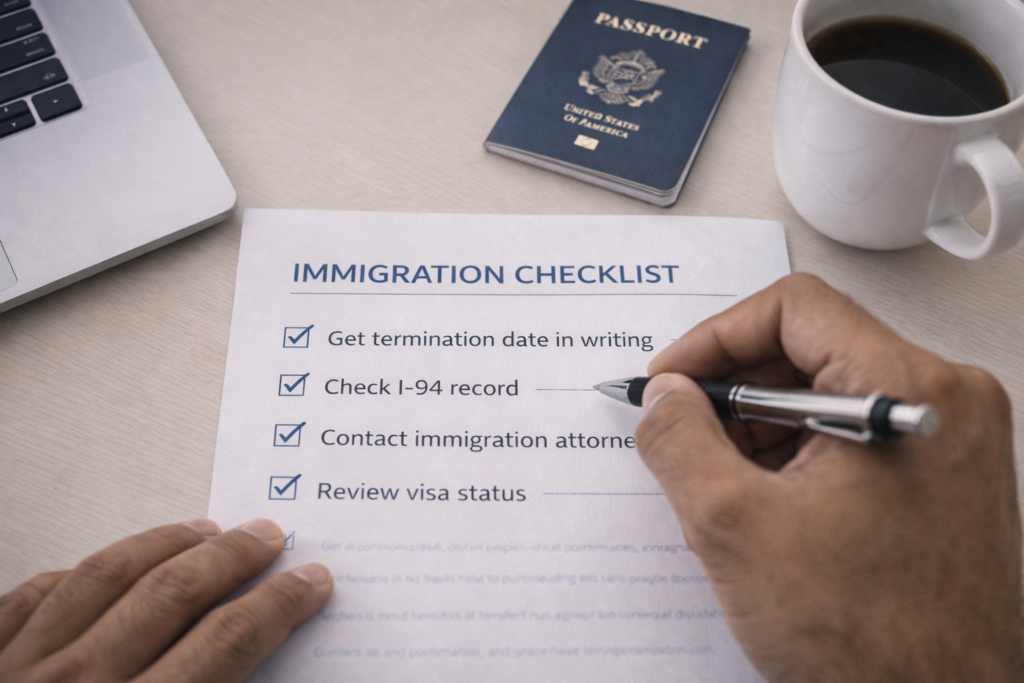
- Get your exact termination or revocation date in writing — today
- Check CEAC, USCIS case status, and I-94 (all three — not just one)
- Contact an immigration attorney — not next week
- Stop all work immediately if employment has ended
- Cancel any international travel plans
- Document everything: termination letter, consulate emails, USCIS notices
Week 2 — Assess Options Honestly
- Determine whether H-1B transfer is realistic given your actual job search timeline
- If spouse has H-1B, evaluate H-4 change of status as a bridge option
- Discuss I-140 portability with attorney if green card process was in progress
- Start applying to new employers — disclose your timeline upfront
- Review financial runway: balances, monthly obligations, accessible cash
Weeks 3–4 — File, Don’t Wait
- New employer committed? Petition should be filed immediately, not “when they have time”
- Change of status (I-539) must be filed before day 60 — not on day 59
- If voluntary departure looks likely, begin planning in parallel now
Weeks 5–6 — Confirm and Follow Up
- Confirm USCIS received your filing (look for receipt notice)
- Follow up with any employers who have outstanding offers
- Ensure all bank accounts and financial access are independent of former employer
Weeks 7–8 — Hard Deadline
- If nothing has been filed and no petition is pending, voluntary departure before day 60 is the cleanest outcome
- Every day after day 60 without valid status or a pending petition is unlawful presence
- Do not guess at this point — call your attorney
How to Get a New Visa After Revocation — Is It Possible?
Yes — in most cases. But the difficulty depends heavily on why the revocation happened, and it’s worth being clear-eyed about each scenario.
After employer withdrawal: The most straightforward path. New employer files new petition. Cap-subject employers require the next lottery cycle if you don’t qualify for cap exemption. The revocation itself doesn’t create a bar to future visas.
After prudential revocation: You must disclose the revocation on your new visa application. The consular officer will focus on whatever triggered it. Arrest-related revocations typically require documentation of case disposition and sometimes a medical evaluation. It’s not automatic approval, but it’s also not a permanent bar for most people.
After USCIS fraud finding: The most serious category. A finding of fraud or willful misrepresentation under INA §212(a)(6)(C) can create a permanent inadmissibility bar. This requires immigration litigation, not a standard reapplication. (Source: INA §212(a)(6)(C))
After port of entry cancellation with a bar: An I-212 waiver is required before any new visa application can proceed. Start with a FOIA request to CBP to understand exactly what finding is in the system before doing anything else.
FAQ — Questions People Are Actually Asking
It depends on which part of your immigration was revoked. If only the visa stamp was prudentially revoked by DOS and you’re inside the U.S. with a valid I-94, you can stay and continue working — your status is unaffected. If your I-129 petition was revoked through an employer withdrawal or USCIS action, your employment authorization ends and the 60-day grace period begins. In that grace period, you remain in lawful status but cannot work in any capacity. The answer is almost always “check your I-94 first.”
Not automatically — and this is the most important thing to understand clearly. Deportation, formally called removal, requires a separate proceeding before an immigration judge. A visa revocation alone does not trigger removal in most circumstances. The exception is a port of entry cancellation where a CBP officer invokes expedited removal authority under INA §235(b)(1). If you received a verbal bar at a port of entry, get a FOIA request in immediately to determine what’s actually in the record. (Source: INA §235(b)(1))
Employer withdrawal and termination of employment are two separate actions that don’t always happen together. In staffing agency and contract scenarios, a company may withdraw the petition due to a contract ending or internal restructuring — without formally terminating the worker. Get your actual employment status and official termination date confirmed in writing from HR. Your 60-day grace period clock starts from the last day of actual employment — not from when the petition was withdrawn in USCIS’s system. (Source: 8 CFR 214.1(l))
It means the Department of State cancelled your visa stamp on a precautionary basis — pending investigation of a potential eligibility concern — not as a final determination that you’re inadmissible. The stamp can no longer be used to travel to the U.S. or re-enter. However, your immigration status inside the U.S. (your I-94) may still be completely valid — check it separately at i94.cbp.dhs.gov. A prudential revocation is a pause-and-review mechanism, not a final ban. (Source: 9 FAM 403.11-5(B))
Yes — DOS has no legal obligation to provide detailed justification for a prudential revocation. You may receive nothing more than a citation to INA §221(i) and an email from the consulate. You can submit an inquiry through official channels or work through an attorney to seek additional information, but DOS has broad unilateral discretion here and is not required to explain the specific reason before acting. Document everything you receive and consult an attorney before responding to any government communication. (Source: INA §221(i))
No — and this arrangement causes real harm to workers who agree to it. USCIS only recognizes a worker as “in status” when they are actively employed and actually paid. If you later file for an extension, a change of employer, or any adjustment of status, USCIS will look at pay stubs and bank deposit records. An unpaid retention arrangement will not satisfy that standard and can create the appearance of a status gap. Never accept an unpaid arrangement as a substitute for proper status maintenance. (Source: USCIS H-1B Policy Manual, Chapter 5)
The $100,000 fee established via Presidential Proclamation applies to new H-1B petitions filed by cap-subject employers — not to extensions of currently approved petitions. If you’re filing a brand-new petition after a revocation with a cap-subject employer, this fee is potentially relevant to your employer’s decision-making. The rule is facing active legal challenges as of early 2026 — check uscis.gov for the current enforcement status before your employer commits to any filing timeline. (Source: Presidential Proclamation — NOTE: Check current legal challenge status at uscis.gov as rule may have been modified or enjoined)
H-4 status is derivative — it follows the primary H-1B holder directly. If your underlying H-1B status ends and is not replaced with a new valid status in time, your spouse’s H-4 status is also affected. Any H-4 EAD your spouse holds is tied to your valid H-1B status as well. If you’re filing for a change of status for yourself, file for your dependents simultaneously — not afterward. (Source: 8 CFR 214.2(h)(9)(iv))
For a DOS prudential revocation, there is no formal appeal process. Your practical remedy is to apply for a new visa and address the underlying issue at the consular interview. For a USCIS NOIR, your 30-day response functions as an appeal — respond with evidence through an attorney. For a port of entry cancellation, a FOIA request to CBP is the necessary first step, followed by legal review of whether the findings recorded can be challenged or corrected. (Source: 22 CFR 41.122)
Checklist: What To Do Right Now Based on Your Situation
If You Were Just Laid Off or Your Employer Withdrew Your Petition:
- Get your exact termination date in writing — today
- Confirm that date is your Day 1 of the 60-day grace window
- Stop all work immediately — no freelance, no consulting, nothing
- Check USCIS case status at egov.uscis.gov
- Check your I-94 at i94.cbp.dhs.gov
- Contact an immigration attorney in Week 1, not Week 3
- Assess H-1B transfer, H-4 change of status, or B-2 as bridge options
- Review financial position: credit balances, savings, monthly obligations
- Confirm all bank accounts are accessible independently of former employer payroll
If You Received a Prudential Revocation Notice:
- Check CEAC portal to confirm visa stamp status
- Check I-94 to confirm your status inside U.S. is still valid and active
- Cancel any upcoming international travel plans immediately
- Contact an immigration attorney before making any other decisions
- Do not leave the U.S. until you understand the re-entry path clearly
- Begin documenting the underlying issue (arrest record, legal case, social media activity)
If You Received a USCIS NOIR:
- Note your response deadline — typically 30 days from the notice date
- Contact an immigration attorney immediately — this week
- Do not draft or submit a response on your own
- Notify your employer’s HR team and their immigration counsel the same day
- Gather documentation of your actual job duties, pay records, and worksite
If Your Visa Was Cancelled at a Port of Entry:
- File a FOIA request with CBP to obtain your inspection record
- Contact an immigration attorney before any other step
- Note whether you received any written documentation of the basis for the finding
- Do not attempt to travel to the U.S. again without a complete legal review first
Disclaimer
This article is published by USAHarmony.com for informational purposes only. It does not constitute legal advice and does not create an attorney-client relationship. Immigration law is highly fact-specific — the rules described here may apply differently depending on your individual circumstances, visa history, country of birth, and current enforcement environment. Information reflects publicly available official guidance as of early 2026. Regulations, fees, processing times, and enforcement priorities can and do change. Always consult a licensed U.S. immigration attorney before making any decisions related to your visa status, travel, or employment authorization. USAHarmony.com does not provide legal representation or immigration services of any kind.