


You’ve probably already found a list. Maybe it had 50 company names, maybe 500. You copy-pasted it into a spreadsheet, started applying, and somewhere around application number 30 you realized something felt off. Recruiters going quiet. Job postings that say nothing about sponsorship. One company that “definitely sponsors” telling you they stopped doing that in late 2025.
That’s not bad luck. That’s what happens when you work off stale data.
The H1B sponsorship landscape in 2026 looks genuinely different from two years ago. New fee structures, a wage-weighted lottery that changed the math on who employers want to sponsor, and a broader climate of legal caution have all narrowed the field. None of that means it’s impossible — it means the research has to be sharper.
This guide is about doing that research correctly. Not the surface-level “check USCIS” advice that every other article gives you and then stops. The actual workflow.
Why Every “H1B Sponsors List” You’ve Seen Is Probably Out of Date
Here’s the truth: there is no live, real-time database of companies that are sponsoring H1B visas right now, today. What exists are records of what companies have filed — which is useful, but only if you understand what those records actually mean and how old they are.
Most lists circulating on job forums, career sites, and immigration blogs are compiled from Labor Condition Application (LCA) data that can be anywhere from six months to two years behind actual employer policy. A company that filed 200 LCAs in FY2024 may have quietly stopped sponsoring new hires after a policy shift in late 2025. Their historical record still looks strong. Their current job postings say “U.S. citizens and permanent residents only.”
This gap — between what the data shows and what’s actually happening — is the single biggest source of wasted effort in an international job search.
The fix isn’t to abandon data. It’s to use it correctly, layer it with current signals, and verify directly before investing time in any application.
Start Here: The Official H1B Employer Database That Everything Else Builds From
Before any third-party platform, before any browser extension, before any aggregated list — there is one authoritative source: the USCIS H-1B Employer Data Hub.
It’s free. It’s official. It contains petition records from fiscal year 2009 through Q1 of FY2026. You can search by employer name, industry classification code, city, state, or ZIP code.
What to Actually Look For in That H1B Employer Database
When you pull up a company’s record, don’t just look at the total petition count. The column that matters most is “New Employment Approvals.” That’s the number of workers a company sponsored for an initial H1B — meaning people hired from outside the U.S. or those changing visa status. A company with 1,000 total petitions but 40 new employment approvals is mostly filing renewals and transfers, not actively bringing in new international talent.
Also look at the fiscal year breakdown. A company that filed aggressively in FY2022 and FY2023 but dropped significantly in FY2025 is telling you something. That pattern means something changed — budget, policy, legal team bandwidth, or all three.
The data has real limitations worth knowing:
- It reflects only the initial USCIS decision — appeals, revocations, and pending cases aren’t reflected
- The listed city may be the company’s mailing address, not where you’d actually work
- It tells you nothing about whether the company is currently taking applications
For the deeper context — salary ranges, petition success rates, and multi-year trends — you’ll need to layer in additional tools.

The Tools That Turn Raw H1B Employer Data Into Something You Can Actually Use
Raw government data is comprehensive but operationally messy. The employer name field alone is a problem — the same company can appear under dozens of slightly different name variations. That’s where third-party platforms earn their keep.
Here’s how the main ones compare:
Comparison: H1B Sponsor Research Tools in 2026
| Tool | Data Source | Best For | Key Limitation |
|---|---|---|---|
| USCIS H1B Employer Data Hub | Official USCIS petitions | Verified baseline research | No salary breakdown, no filters by role |
| MyVisaJobs | DOL LCA + PERM filings | Salary benchmarks, multi-year trends, active sponsor filter | High LCA counts include renewals/transfers |
| H1BGrader | DOL LCA data | Approval rate comparisons, Chrome extension for live job browsing | Doesn’t distinguish new hires vs. renewals |
| GoinGlobal | Multiple gov sources | Metro-area H1B counts, employer directories | Subscription required at most institutions |
| F1H1GC | 265K+ LCA + PERM filings | AI Q&A, cap-exempt filter, SOC occupation breakdown | Newer platform, still building track record |
| LinkedIn Job Alerts | Employer job postings | Real-time openings, keyword filtering | Sponsorship language is inconsistent across postings |
| Immihelp H1B Sponsors | DOL LCA filings | Quick employer lookup, employer reviews | Historical only, no current status verification |
The workflow that actually works combines at least three of these layers:
- USCIS Hub → confirm the company has a real filing history (not just one or two petitions)
- MyVisaJobs or H1BGrader → check approval rates, salary ranges, and whether they’ve been active in the last three fiscal years
- Current job postings → confirm the language isn’t exclusionary right now
No single tool does all three reliably.
The Cap-Exempt Track Most H1B Job Seekers Never Seriously Consider
Almost every guide mentions universities and nonprofits as cap-exempt employers in passing, then moves on. That’s a mistake — for a meaningful number of candidates, this track is genuinely better, not just a consolation prize.
Cap-exempt employers — which include institutions of higher education, nonprofit research organizations, and government research entities — don’t compete in the annual lottery. They can file H1B petitions year-round. There’s no April window. There’s no 85,000 cap math to worry about.
They also tend to have established immigration infrastructure. A university that’s been sponsoring researchers and faculty for decades has an in-house immigration team that knows this process cold. You’re not hoping some mid-size company’s HR department figures out the paperwork correctly for the first time.
The tradeoff is real — compensation in academic and nonprofit settings is often lower than comparable roles in tech or finance. But if your priority is securing status and building a long-term path, the absence of lottery risk deserves serious weight. The full guide on who qualifies for cap exemption and exactly how to pursue it is at usaharmony.com/h1b-visa-cap-exemption-who-qualifies-how-to-apply.

How the 2026 Wage-Weighted Lottery Completely Rewrote H1B Sponsor Math
If you haven’t adjusted your strategy for the new wage-weighted selection system, start now. It took effect February 27, 2026, and it changes how employers think about who they want to sponsor — not just whether they sponsor.
Old System vs. New System: What Actually Changed
| Factor | Previous Random Lottery | 2026 Wage-Weighted System |
|---|---|---|
| Selection basis | Pure random draw | Prioritized by prevailing wage level |
| Entry-level odds | Same as senior roles | Significantly lower |
| Level III/IV advantage | None | Measurably better selection odds |
| Employer incentive | Sponsor anyone who qualifies | Sponsor higher-wage roles to maximize selection odds |
| Cap-subject volume | 85,000 (unchanged) | 85,000 (unchanged) |
| Effective date | Pre-2026 | February 27, 2026 |
Under the old random lottery, every registered applicant had the same odds regardless of salary. Under the new system, applicants at higher prevailing wage levels have structurally better selection odds. For employers, sponsoring someone at a Level I or Level II wage is now a worse return on the same filing investment.
What the Numbers Actually Look Like
Here’s a concrete example using DOL prevailing wage tiers for software engineers in the San Jose metro area:
- A Level I filing (entry-level, ~$90,000) now carries the lowest selection priority
- A Level III filing (experienced, ~$155,000–$175,000) receives meaningfully higher selection weight
- A Level IV filing (fully competent/senior, ~$185,000+) sits at the top of the selection priority stack
In practical terms: a candidate whose employer files at Level III rather than Level I has estimated selection odds that are substantially higher — industry observers tracking early FY2027 registration patterns have noted the shift is significant enough to change which roles companies are willing to sponsor at all. The detailed breakdown of wage tiers, odds calculations, and what this means for the FY2027 lottery cycle is covered at usaharmony.com/h1b-lottery-new-rules-costs-selection.
What This Means For You
When reviewing LCA data for any target company, check what wage level they’ve been filing at for roles like yours. A company that has historically filed at Level III or IV for your job title is a stronger 2026 target than one that has consistently filed at Level I. The wage level tells you both whether they’re likely to sponsor and whether your registration has a realistic shot at selection.
Entry-level sponsorship has become significantly rarer. That’s not pessimism — it’s math. Adjusting your target list accordingly is the single most time-efficient change you can make to your search strategy right now.
Top Industries and Job Titles With the Highest H1B Approval Rates in 2026
Not all fields have equal access to sponsorship. Based on patterns in DOL LCA disclosure data and USCIS petition outcomes, these six industry categories consistently show the highest concentration of active H1B sponsoring companies and the strongest approval rates:
| Industry | Top Sponsored Job Titles | Avg. Approval Rate | Typical Wage Level Filed |
|---|---|---|---|
| Software & Cloud Technology | Software Engineer, DevOps Engineer, Site Reliability Engineer | ~92% | Level II–IV |
| Semiconductor & Hardware | Hardware Design Engineer, VLSI Engineer, Chip Architect | ~90% | Level III–IV |
| Financial Technology & Quant Finance | Quantitative Analyst, Data Scientist, Systems Developer | ~88% | Level III–IV |
| Healthcare IT & Biomedical | Biomedical Engineer, Health Informatics Analyst, Clinical Data Scientist | ~85% | Level II–III |
| Enterprise Software & Consulting | Solutions Architect, Business Systems Analyst, ERP Consultant | ~82% | Level II–III |
| AI & Machine Learning Infrastructure | ML Engineer, NLP Researcher, AI Platform Engineer | ~91% | Level III–IV |
Source: DOL Foreign Labor Certification Data Center disclosures, FY2025–FY2026 Q1. Approval rates reflect certified LCA petitions as a percentage of total filed; individual company outcomes vary.
A few things worth noting in that table: healthcare IT has been gaining ground rapidly, particularly at hospital systems and health tech companies that have built out dedicated immigration teams. AI/ML roles are now competing with traditional software engineering for the highest approval rates. And roles in “enterprise consulting” are a mixed category — the approval rate looks good, but as discussed below, the staffing agency issue is most concentrated here.
How to Read Job Postings for Real H1B Sponsorship Signals
Job postings are inconsistent about sponsorship language, and that inconsistency is itself informative.
Language that clearly signals yes:
- “We will sponsor work authorization for qualified candidates”
- “H1B transfer welcome”
- “Visa sponsorship available for this role”
- “OPT to H1B candidates encouraged to apply”
Language that clearly signals no:
- “Applicants must be authorized to work in the U.S. without sponsorship”
- “U.S. citizen or permanent resident required”
- “Unable to provide visa sponsorship now or in the future”
The gray zone (where most postings live):
- “Must be authorized to work in the U.S.” — this could include OPT/H1B holders, or it could mean they won’t sponsor; you cannot tell from the language alone
- Nothing mentioned at all — the most common case, and the most frustrating one
Gray-zone postings aren’t worth applying to blindly. A quick, professional outreach to the recruiter before submitting — “Does this role support visa sponsorship for qualified candidates?” — takes 60 seconds and gives you a definitive signal. Companies that respond quickly and affirmatively are almost always the ones with real immigration infrastructure. Companies that ghost or hedge usually don’t sponsor.
The Staffing Agency Problem: What the H1B Rankings Don’t Show You
This deserves its own section because it’s a genuine trap that catches a lot of candidates who do everything else right.
Staffing companies and IT consulting firms consistently appear at the top of LCA volume rankings. Some file hundreds or thousands of petitions per year. On paper, they look like ideal H1B sponsoring companies. In practice, the employment arrangement is entirely different from what most candidates are actually looking for.
When a staffing firm sponsors your H1B, you’re technically employed by them — but placed at a client site. Your day-to-day work is for the client. If the client engagement ends, your role ends, even if the staffing firm still exists. The client has made no commitment to your immigration status whatsoever.
The “Benching” Risk You Need to Understand
There’s a specific compliance issue in the staffing model that doesn’t get enough attention: benching. Under USCIS regulations, an H1B employer is required to pay the sponsored worker the full LCA wage regardless of whether the worker is actively placed at a client site. When a staffing company “benches” you between placements — meaning you’re on their books but not billable to any client — they are legally required to keep paying you. Many don’t. This creates both an immigration compliance violation (which can affect your status) and a financial one. If a staffing firm cannot or will not confirm their benching policy in writing, that’s a serious warning sign.
Before accepting any staffing firm offer, ask this directly: “What is your written policy on compensation during periods between client placements, and can you provide documentation?” Companies with legitimate operations will answer without hesitation. Companies that hedge, deflect, or offer only verbal assurances are showing you exactly what you need to know.
This can work — but know what you’re signing up for. When researching employers, filter for direct employers separately from consulting and staffing firms. The distinction matters enormously in practice.
Where H1B Sponsoring Companies Are Geographically Concentrated in 2026
Geography matters more than most job seekers factor in. The majority of active H1B sponsorship activity is concentrated in five metro areas, and your search strategy should reflect that reality rather than fight it.
San Jose / San Francisco Bay Area leads by a wide margin — Silicon Valley tech density means the highest absolute number of active sponsors, the most established immigration infrastructure, and the most OPT-to-H1B conversion pathways. Salary levels here also tend to land at Level III or IV, which improves lottery odds under the new system.
Greater New York City concentrates financial services, fintech, and media tech sponsorship. Wall Street firms and major banks have been consistent H1B filers for decades; their immigration operations are professionalized. This metro also offers the most diverse sector representation.
Seattle is dominated by large tech employer presence and has a strong direct-hire (non-staffing) sponsorship culture. The Eastside corridor in particular has significant activity from multiple enterprise software employers.
Chicago covers financial technology, management consulting, and healthcare IT — a useful combination for candidates whose background crosses those sectors. The concentration is lower than the coasts but meaningful.
Dallas–Fort Worth has grown substantially as a sponsorship market over the last three years, driven by tech company relocations, semiconductor presence, and financial services expansion. Costs are lower, which can affect wage level filings, but overall sponsorship activity is rising.
If you’re geographically flexible, explicitly targeting companies headquartered or with significant operations in these metros — rather than applying nationally and hoping for the best — materially improves your odds of hitting active sponsors.
What “Active Sponsor” Actually Means — and the 4-Step Verification Process
Most platforms use some version of an “active sponsor” label, but the definitions vary. Generally it means the company has filed at least one LCA or petition within the past three fiscal years. That’s a minimum baseline, not a guarantee of anything current.
Here’s the verification workflow that actually holds up:
Step 1: Check the DOL LCA database at dol.gov/agencies/eta/foreign-labor/performance directly for filings within the last 12 months. Recent filings are a far stronger signal than three-year averages.
Step 2: Search the company’s current job postings. If three postings say “no sponsorship” and two say nothing, that’s a pattern worth respecting.
Step 3: Find people currently at the company who came through on OPT or H1B status — check LinkedIn profiles. Not to cold-message and ask for a favor, but to confirm that the pathway exists at that organization. Their presence confirms it’s been done. That gives you a foundation for approaching the company more knowledgeably.
Step 4: Direct recruiter confirmation before applying. Not during the interview — before. “Can you confirm whether this role supports H1B sponsorship for qualified candidates?” is a professional, appropriate question. Any recruiter with experience in tech or finance knows the answer immediately.
Real Situations That Change the Picture
The policy shift that nobody announced: Companies don’t issue press releases when they stop sponsoring. They update their internal hiring guidelines quietly. The job posting stays the same. The USCIS data still looks strong. The recruiter either doesn’t know yet or doesn’t mention it until you’re three rounds deep. The only real protection is current posting language and direct recruiter confirmation before you invest significant time.
The department-by-department reality: A company may sponsor H1B visas in its engineering division while product, marketing, and operations teams operate on a USC/GC-only basis. Company-level LCA data tells you nothing about this split. The team you’re joining is what determines your situation — not the company’s overall record.
The OPT-to-H1B bridge: Many companies that are reluctant to sponsor a cold applicant are perfectly comfortable converting an OPT employee they already know and value. The transition from OPT to H1B within the same company is procedurally simpler and less costly for the employer. If you’re on F1 and targeting companies with sponsorship histories, getting in the door on OPT first — even through an internship — is a strategically stronger move than cold-applying for full-time roles and immediately requesting new H1B sponsorship.
After You Find the Right H1B Sponsoring Employer: What the Process Actually Looks Like
Getting the sponsorship commitment is step one. What follows is a chain of filings and decisions with real timing implications.
Once you have an offer and sponsorship confirmation, your employer files a Labor Condition Application with the DOL. If the lottery selects you, USCIS processes the I-129 petition. If approved and you’re outside the U.S., you’ll go through consular processing — which in 2026 still has meaningful wait times at several major posts.
For Indian professionals, the full stamping process, preparation checklist, and current consular wait time context is covered in this guide: usaharmony.com/h1b-visa-stamping-2026-guide-indian-professionals. For stamping at non-India locations or a general process overview, the broader 2026 stamping guide is at usaharmony.com/h1b-visa-stamping-2026-guide.
Once you’re working in the U.S., your visa document contains a specific control number you’ll reference for re-entry, travel, and certain administrative processes. If you’re ever unclear what that number is or where it appears on your documents, usaharmony.com/h1b-visa-number-what-it-is-where-to-find-it covers exactly that — including where to find it on the visa stamp and what it’s distinct from.
The Risk Scenario Most H1B Holders Don’t Plan For Until It’s Too Late
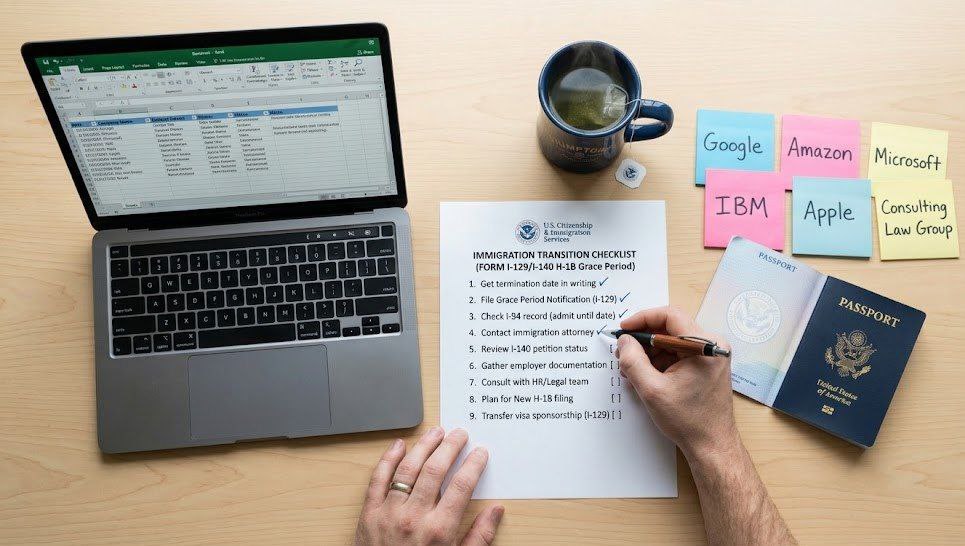
What if the sponsoring company lays you off? Or changes ownership? Or decides mid-year to discontinue their H1B program entirely?
You have a 60-day grace period from the date your employment ends to find a new sponsor, change status, or depart. That window feels long until you’re in it — factor in the time to identify a new employer, clear their hiring process, and initiate a transfer petition, and 60 days is genuinely tight. The detailed breakdown of how that grace period works, what the clock starts on, and what your options are is at usaharmony.com/h1b-60-day-grace-period-after-layoff.
If your petition is approaching its expiration date and you’re mid-extension, the 240-day rule governs whether you can keep working during the processing gap. That rule and how it interacts with extension timelines is covered at usaharmony.com/h1b-extension-240-day-rule-grace-period.
And if your H1B was canceled or revoked — through employer withdrawal, USCIS action, or any other cause — the immediate steps to protect your status are at usaharmony.com/h1b-visa-cancelled-revoked-what-to-do.
Red Flags: 5 Signs a Company’s H1B Sponsorship Claim Isn’t What It Seems
Not every employer who says they “sponsor” will actually deliver. Here are five specific warning patterns to watch:
1. Strong historical filing numbers but no recent activity in the last 12 months. A company that filed aggressively through FY2023 and then drops off the DOL disclosure records in FY2025 is telling you something. Policy changes, budget cuts, and legal team turnover all show up in this pattern. Always cross-reference historical records against the most recent 12-month window. A gap that size isn’t coincidental.
2. The recruiter says “we sponsor” but cannot name a specific contact in their immigration or HR department. Companies with real sponsorship infrastructure have a person, a process, and an immigration law firm they work with. When a recruiter can only say “I believe we sponsor” without being able to connect you to anyone who manages that process, the policy likely exists on paper and hasn’t been executed recently.
3. The job posting language is generic but the fine print says otherwise. Some postings will have “visa sponsorship considered” in the main description and “must be authorized to work in the U.S. without sponsorship” buried in the requirements section. Always read the full posting, not just the headline. The restrictive language in the requirements section is the actual policy.
4. The company appears exclusively as a staffing or consulting firm in LCA filings — with no direct-hire history. High LCA volume from a staffing firm is a fundamentally different signal than high LCA volume from a product company or direct employer. If 95% of a company’s filings are placements at third-party client sites, their “sponsorship” offer means something structurally different from what you’re probably looking for.
5. They ask you to cover any portion of the H1B filing fees. This is illegal under federal regulations. Employers are required to cover certain H1B filing fees themselves — specifically, the base filing fee and the fraud prevention and detection fee. Any employer who asks a worker to pay or “reimburse” these fees is in violation of DOL regulations and is showing you a significant compliance problem before you’ve even started.
Frequently Asked Questions About Finding H1B Sponsors in 2026
No — and be skeptical of any source that claims otherwise. What exists are records of past filings. The USCIS H-1B Employer Data Hub (uscis.gov) is the authoritative source for historical petition data, but it reflects past decisions, not current hiring policies. Real-time verification still requires direct confirmation.
Not necessarily. High LCA counts include renewals, amendments, and transfers — not just new hire sponsorships. Filter for “new employment approvals” specifically and check whether those numbers have been consistent in recent fiscal years.
An LCA is filed with the Department of Labor first, certifying that hiring a foreign worker won’t negatively affect prevailing wages or working conditions. The H1B petition comes after, filed with USCIS. Many more LCAs are certified than H1B petitions are ultimately approved. A company with a high LCA count but low USCIS approval rate is revealing something about either their petition quality or their legal team.
Yes, but the pool is smaller than it was two years ago. The wage-weighted lottery makes sponsoring entry-level workers less efficient for employers. Your best options at this level are companies with strong OPT-to-H1B conversion records, cap-exempt employers, and fast-growing mid-size companies in STEM-intensive sectors.
Ask it directly and professionally: “Does this position support visa sponsorship for qualified candidates?” It’s a clean question. Companies that sponsor know the answer immediately. Companies that don’t will tell you now instead of after three interview rounds — which is exactly the outcome you want.
Software engineering, data science, semiconductor design, biomedical research, AI/ML infrastructure, and quantitative finance consistently show the highest new employment approval rates in public DOL and USCIS data. Healthcare IT and semiconductor engineering have been particularly strong in recent fiscal years.
Legally, yes. But your employment arrangement will be fundamentally different — you’ll be placed at client sites rather than working directly for the sponsor. If the client engagement ends, your position ends even though the staffing firm remains your technical employer. Understand this distinction fully, including the “benching” compliance risk, before accepting any such offer.
The current posting wins. Historical filing data helps you identify which employers to approach, but if their active postings now exclude visa candidates, that’s the current policy. You can always ask a recruiter to confirm directly — but don’t assume historical data overrides what they’re signaling right now.
Related Reading: Setting Up Your Financial Life After You Land
Once you’ve secured your visa and have a start date, there’s a second set of challenges most people don’t expect until they arrive — building a financial foundation from scratch in the U.S. with no credit history.
- Opening a U.S. bank account as a new arrival: usaharmony.com/finance-open-bank-account-usa
- Building a credit score from zero: usaharmony.com/finance-credit-score-usa
- First credit cards that work for H1B holders with no U.S. credit history: usaharmony.com/h1b-visa-credit-card-build-credit-usa
- Best starter credit cards for Indian immigrants: usaharmony.com/first-credit-card-indian-immigrants-usa

Disclaimer
The information in this article is for general informational purposes only and does not constitute legal advice. H1B visa regulations, employer policies, and USCIS processing rules change frequently — particularly in the current regulatory environment. Before making any immigration-related decisions, consult a licensed U.S. immigration attorney. All data referenced reflects publicly available government filings; individual employer sponsorship policies may differ from their historical filing records. USAHarmony.com does not guarantee employment outcomes or visa approvals.