


You landed. You have a job offer, perhaps a salary that would impress people back home. You go into a store and attempt to apply for a credit card. You get rejected.
Not because you’re broke. Not because you’ve ever missed a payment in your life. Because, as far as American lenders are concerned, you don’t exist yet.
This is the part that nobody warns you about. You enter the US with years of financial responsibility under your belt. A clean record, perhaps a high-end credit card from back home. But the US credit system just looks right through you. Blank file. No credit score. No credit history. You’re starting from zero, just like a kid who just left home for the first time at 18.
“I had a 790 CIBIL score and an HDFC Regalia. I got declined for a basic store card my first week in Seattle. It felt embarrassing until someone explained that the two systems don’t talk to each other at all.” — Priya, software engineer, arrived on H1B in 2022
This article is about bridging this gap as quickly as is humanly possible – with specific credit cards, numbers, and a plan.
Why Your Indian Credit History Means Nothing Here (And What Does)
The US credit system runs entirely through three domestic bureaus — Equifax, Experian, and TransUnion. They track your behavior within the American financial system only. They have no data pipeline to CIBIL, no relationship with Indian lenders, no way to verify what you did financially for the past decade in India.
When a US lender pulls your credit for the first time, they find an empty file. The technical term is “credit invisible.” For lenders, invisible and risky are the same thing.
What they want to see is simple: an American account, American payments, American history. None of which you have yet. So the whole challenge is just producing that evidence — quickly, strategically, without making rookie mistakes that slow you down.
The Two Paths Forward (And Why Most People Take the Slower One)
Here’s where most articles fail you. They tell you one thing: get a secured card and wait. That’s not wrong, but it’s incomplete. There are actually two paths, and the faster one is available to a surprising number of Indian immigrants.
Path 1 — Start from scratch with a secured card.
This is the default. A secured card requires a refundable deposit — typically $200 to $500 — which becomes your credit limit. You use it, you pay it off monthly, the issuer reports your behavior to the bureaus, and slowly a credit file takes shape. It works. It just takes time.
Path 2 — Use an existing relationship.
If you already have an American Express card issued in India — even one issued through a partner bank — you may be eligible for the Amex Global Transfer program. This is the single most underutilized shortcut in this entire process, and we’ll cover it in detail below.
If you banked with HSBC or Citibank in India, those banks operate in the US and sometimes allow you to leverage that relationship for a head start here. Not guaranteed, but worth pursuing.
The reason most people end up on Path 1 is simple: they don’t know Path 2 exists. The information is out there, but it’s buried.

The Amex Global Transfer — Your Fastest Lane If You Qualify
If you held an Amex card in India — even if it was co-branded or issued through a partner — this is worth dropping everything to check right now.
American Express runs a program specifically for people moving to the US from eligible countries. India is on that list. The program allows you to apply for a US Amex card and have your existing Amex relationship factored into the decision — even if you have zero US credit history.
How to use it:
Go to americanexpress.com, navigate to their “Global Card Transfer” or “Global Transfer” page, and look for the newcomer application option. You can also call the number on the back of your Indian Amex card and ask specifically to be transferred to the Global Transfer team.
What documents to have ready:
Your existing Indian Amex card details, your US address (even if you just moved in), your passport, and your SSN or ITIN if you have one. Some people have gotten approved without an SSN yet — they just needed a valid US address and their existing card relationship. Having proof of income helps, especially an offer letter if you’re newly employed.
What to expect:
Your application will likely be held for manual review, not instantly approved or declined. Typical review time is 7 to 10 business days. They may call you to verify your identity or confirm your address. Starting limits tend to be modest — $1,000 to $2,000 is common — but American Express typically allows a credit limit increase request after 3 months.
The big advantage here isn’t the limit. It’s that you walk away with an unsecured credit card in your first two weeks in the country, which gets your US credit history clock started immediately.
The HSBC and Citibank Approach
If you banked with either of these institutions in India, walk into a US branch — don’t apply online.
What to bring: Your passport, your Indian account details or debit card, proof of your US address (a utility bill, lease agreement, or even a letter from your employer works), and your employment offer letter or recent pay stubs.
What to say: Be direct. Tell them you’re a recent arrival from India, that you previously banked with them there, and that you’d like to discuss credit card options for someone with an existing international customer relationship. Ask specifically whether they have a “new to country” or “international customer” credit program.
The honest answer is that these programs have become less consistent than they used to be — some branches are more helpful than others, and policies have changed over the years. But the worst outcome is that they say no, which costs you nothing. The best outcome is that a banker manually considers your application with full context rather than leaving it to an algorithm that sees only a blank file.
Getting Your Documents in Order Before You Apply
SSN vs. ITIN — which one you need
If you’re on a work-authorized visa (H1B, L1, O1, etc.), apply for your Social Security Number as soon as you arrive — visit a Social Security Administration office after you’ve been in the country at least 10 days. You’ll have it within 2 to 4 weeks typically.
If you’re not yet eligible for an SSN — maybe you’re on a dependent visa or your work authorization is pending — apply for an ITIN through the IRS using Form W-7. It takes 6 to 8 weeks to process, but it opens up more credit options than most people realize. Several secured cards, some credit union products, and a handful of fintech cards accept ITIN in place of SSN.
US bank account first, always
Open a US bank account before you apply for any credit card. It signals residency, and many issuers require it. If you can open it with the same bank whose credit card you’re planning to apply for — Chase, Bank of America, Discover, wherever — even better. Being an existing customer, even for a few weeks, changes how some issuers view your application.
The branch visit vs. online application
For your first card with no US credit history, applying online is often a waste of a hard inquiry. The automated underwriting system sees a blank file and declines in seconds. That decline stays on your record.
Walking into a branch with your offer letter, passport, and pay stubs gives a banker the ability to manually review your application with full context. It takes more time. It works more often. If your first online application gets declined, your very next move should be a branch visit — not another online application.
The Cards That Actually Make Sense in Year One
If you qualify for Amex Global Transfer: Start there. Any Amex card you can access through that program is better than a secured card because it’s unsecured, it builds your history faster in terms of credit profile quality, and it maintains a relationship with an issuer that has genuinely good long-term products.
If you’re starting completely fresh — the secured card route:
- Discover it® Secured — No annual fee, earns cash back (2% at gas stations and restaurants, 1% everywhere else), and Discover runs an automatic review after 7 months to consider upgrading you to an unsecured card without requiring a new application. For newcomers, this automatic review process is genuinely valuable because it removes the uncertainty of when to reapply.
- Capital One Platinum Secured — The deposit structure is unusually flexible. Depending on your application, you may qualify for a $200 credit limit with a deposit of just $49 or $99 rather than the full $200. No annual fee. Capital One also tends to be relatively immigrant-friendly in their manual review process.
- Bank of America Customized Cash Rewards Secured — If you open a Bank of America checking account first, your chances of approval improve. This card earns cash back in a category of your choice (online shopping, dining, travel, etc.) and has no annual fee. Particularly useful if you already have or plan to open a BofA account.
If you want a card built specifically for the Indian immigrant experience:
- Zolve — Founded specifically for Indians moving to the US. Zolve uses your Indian credit history, employment offer letter, and other alternative data to approve you for a card before or immediately after arrival, often with no US credit history required at all. Credit limits tend to be higher than typical secured cards for first-year immigrants.
- Nova Credit — Nova Credit isn’t a card itself but a platform that translates your Indian CIBIL score into a US-equivalent credit report. Some US card issuers partner with Nova Credit and will accept this translated history as part of their application review. If you have a strong CIBIL score, this can be a meaningful shortcut.
If you have an ITIN but no SSN yet:
- Deserve EDU — Originally designed for international students, Deserve evaluates applicants using non-traditional data including academic background, employment potential, and financial history beyond just a US credit score. Accepts ITIN. Useful for those who can’t get an SSN immediately but need to start building credit.
Credit Unions — The Most Underrated Option
Almost no mainstream article gives credit unions their fair due in this context. They should.
Credit unions are member-owned financial cooperatives, and many of them are significantly more flexible than national banks when evaluating thin-file or no-file applicants. The reason is human judgment — smaller institutions with real loan officers who can evaluate your full situation rather than running you through an algorithm.
Where to find one:
- If you work for a large employer, check whether they have a company-affiliated credit union. Many major tech companies in the Bay Area, Seattle, and Austin have employee credit unions with specific programs for new hires.
- If you’re at a university on OPT or an F1 visa, your school almost certainly has a university credit union. UFCU (University Federal Credit Union, tied to UT Austin) and SECU (State Employees’ Credit Union, North Carolina) are two examples of regional credit unions known for working thoughtfully with newcomers.
- Visit ncua.gov/credit-union-locator to find federally insured credit unions near you, then call and ask directly whether they have credit products for new arrivals with limited US credit history.
When you call, be straightforward: tell them you’re newly arrived, where you work or study, and that you’re looking for a first credit card. You’ll know within that one conversation whether this branch is worth visiting.
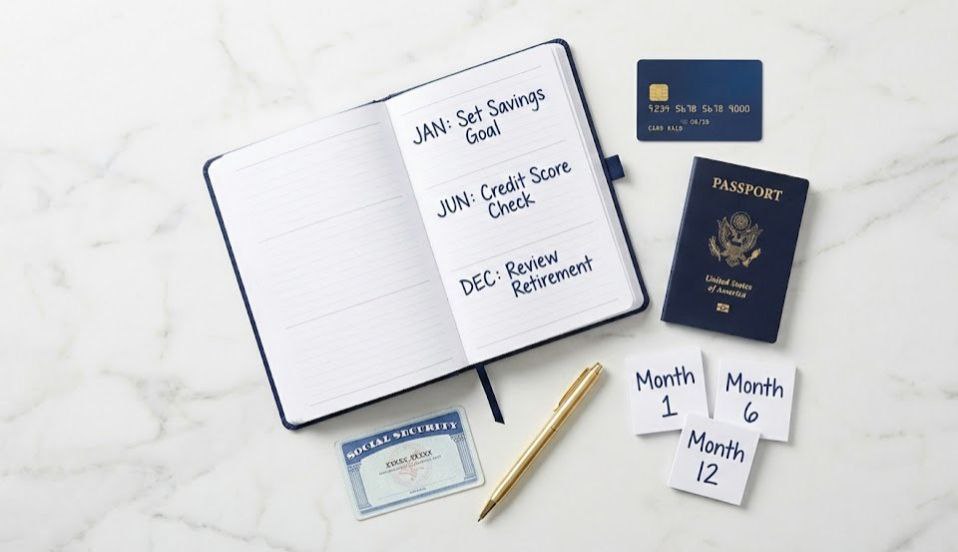
The 12-Month Roadmap
This is the plan. Not the theoretical one — the practical one.
Week 1 Open a US bank account. Do this before anything else. Choose a bank where you might eventually want a credit card. This establishes your US financial presence and is a prerequisite for almost every card application you’ll make.
Week 2–4 Apply for your SSN or begin your ITIN application. If you’re work-authorized, visit your local SSA office. If not, start Form W-7 now because it takes 6 to 8 weeks. Meanwhile, check your Amex Global Transfer eligibility and have your branch conversation at HSBC or Citibank if relevant. Apply for your first card — one application, chosen carefully.
Month 2 Activate your card, set up autopay for the full balance, and make small recurring purchases. A streaming subscription, groceries once a week. Keep your balance below 30% of your limit at statement close. This is also when you set up Experian Boost — connect your bank account and let it pull in your utility and phone payment history. This alone can add 20 to 40 points to a thin file.
Month 3 Check your credit score for the first time. Most card issuers now show you your FICO score for free in their app. At this point you may not have a score yet if your file is too thin — typically you need at least one account that has been open for 6 months with payment activity. But you can see your file status and confirm everything is reporting correctly.
Month 6 You should now have a real credit score. Most people in this situation are in the 640 to 680 range at 6 months — not impressive, but functional. Look into rent reporting services if you haven’t already. Services like Self, Boom, or RentReporters can add your monthly rent payment history to your credit file, potentially adding another 20 to 60 points over the following months. This is especially impactful for Indian immigrants because rent is often the largest monthly expense.
Month 7–8 Consider your second card — but only if your score is moving. If you’re at 650 or above and your first card has been spotless, you can explore a no-annual-fee card with actual rewards. Capital One SavorOne and Discover it are commonly accessible at this stage. Apply once. Don’t apply to three in the same month.
Month 12 You should be approaching 700+. At this point the door starts opening to genuinely good cards — Chase Freedom Rise if you have a Chase checking account, various travel rewards cards, and cards with meaningful sign-up bonuses. This is when the real optimization begins. Your first year was infrastructure. Year two is where you start building toward a card setup that actually serves you.
“By month 14 I had a 718 score and got approved for a Chase Sapphire Preferred. My first card was a $200 secured card. It felt like a long road but looking back — it wasn’t that long.” — Vikram, product manager, arrived in San Jose in 2021
Real Mistakes That Cost People Months
Applying to five cards in your first week.
Hard inquiries from credit applications stay on your file for two years and affect your score for about one year. One or two inquiries on an established file barely moves the needle. On a blank file, multiple inquiries in a short period genuinely damage your chances with subsequent applications. More importantly — each decline from an automated system makes the next human-reviewed application feel more urgent, which leads to worse decisions.
The pattern plays out often enough that it deserves being said plainly: one declined online application followed by five more applications in the next 30 days is probably the single most common mistake in this process.
Treating the secured card as a waiting game.
Getting the card and barely using it doesn’t build credit — it just means you have a card. The bureaus care about consistent activity and consistent repayment. Put something recurring on it, pay the full statement balance monthly, and let the pattern repeat. Six months of that is worth more than two years of minimal usage.
Waiting for the “right” card.
There isn’t one. There’s the card you can get today and the card you’ll qualify for next year. Starting with a $200 secured card and feeling embarrassed about it is understandable. It’s also the thing that costs people six months of credit-building time while they wait for something better to become available.
Your Credit Questions, Answered Directly
Can I get a credit card without an SSN?
Yes. An ITIN works with several issuers — Deserve EDU, various secured cards, some credit unions. A small number of fintech products like Zolve will process applications with just a passport and proof of US residency. The SSN unlocks more options, but it’s not the only key.
Does applying for multiple cards hurt my credit?
Each application creates a hard inquiry. On a thick file, the impact is minimal — typically 5 points or less, lasting about a year. On a brand-new thin file, multiple inquiries in a short period look much worse to lenders. Space applications out by at least 30 to 60 days, especially in your first year.
Can I build credit without any US income?
Technically yes — credit building is about payment behavior, not income. But most card issuers require proof of income or ask you to self-report it on the application. An employment offer letter counts for many issuers even before your first paycheck. If you have no income at all, a secured card (where the deposit mitigates the issuer’s risk) is your most realistic path.
How fast can I realistically reach a 700 credit score?
With consistent on-time payments, low utilization, and rent/utility reporting added to your file: 640 to 680 by month 6, 700 to 720 by month 12 is a realistic range for most people. Experian Boost can accelerate the early months by 20 to 40 points if you have a history of on-time utility and phone payments visible in your bank account. Rent reporting services can add another 20 to 60 points over time. None of these are instant — but they’re real and they’re free or cheap.
Does USCIS check my credit score?
Not for most visa types and standard green card applications. Credit checks are not a standard part of USCIS processing. However, certain public charge determinations (for specific green card categories) may consider your overall financial situation — but this is about financial self-sufficiency, not your credit score number.

Next Steps — What to Do Today
- Open a US bank account this week if you haven’t already — choose a national bank or credit union where you might eventually want a credit card
- Check your Amex Global Transfer eligibility at americanexpress.com if you’ve ever held an Amex card in India — this is your fastest path to an unsecured card
- Apply for your SSN or begin your ITIN application as soon as you’re eligible — don’t wait on this, it unlocks everything downstream
- Choose one card and apply once — Discover it Secured, Capital One Platinum Secured, or Zolve depending on your situation; avoid applying to multiple cards in the same week
- Set up Experian Boost immediately after getting your first card — it’s free, it takes 10 minutes, and it can add real points to your thin file fast
- Look up credit unions near you through ncua.gov or by asking your employer’s HR team — a 15-minute phone call could reveal options your coworkers don’t know about
The first card is just the first step. But it’s the one that starts the clock on everything that comes after — the apartment you want, the car loan you’ll need, the mortgage someday that makes a serious difference in your monthly finances. Start now, with whatever’s available to you. The rest builds from there.
FAQ SECTION
Yes, in some cases. If you held an American Express card in India, you may qualify for a US Amex card through the Global Transfer program within your first two weeks of arrival. If you’re starting fresh, some immigrant-focused fintech cards like Zolve can approve you with just your offer letter and Indian credit history, even before you have a US credit score.
Not always. Several secured cards and fintech products accept an ITIN (Individual Taxpayer Identification Number) in place of an SSN. A small number of products will process applications with just a passport and US address. However, having an SSN or ITIN significantly expands your options and is worth obtaining as early as possible.
With consistent on-time payments, low credit utilization, and additional reporting tools like Experian Boost and rent reporting services, most people reach the 640–680 range by month 6 and cross 700 by month 12. This is not guaranteed — it depends on your specific card usage — but it’s a realistic and common timeline.
Not directly. US lenders cannot access CIBIL data. However, services like Nova Credit translate your Indian credit history into a US-equivalent report that some American card issuers will accept as part of their application review. Separately, the Amex Global Transfer program considers your existing Amex relationship in India. These are the two main bridges between Indian and US credit.
Yes. Secured cards from major issuers — Discover, Capital One, Bank of America — are fully FDIC-insured products. Your security deposit is refundable when you close or upgrade the account. The risk is minimal, and the credit-building benefit is real as long as you pay your balance in full each month and keep your utilization low.
This is one of the most common mistakes and one of the most damaging. Each application creates a hard inquiry on your credit file. Multiple hard inquiries on a blank or thin file make subsequent approvals harder, not easier. Apply to one carefully chosen card, wait for the outcome, and if declined, reassess your approach — don’t apply to three more immediately.
It’s a program by American Express that allows people moving from eligible countries — including India — to apply for a US Amex card using their existing Amex relationship, even with no US credit history. You apply at americanexpress.com through the newcomer or Global Card Transfer page, or by calling the number on your Indian Amex card. Approval typically takes 7–10 business days and may involve identity verification. Starting credit limits are modest but the card is unsecured from day one.
Yes. Zolve is the most prominent example — it was built specifically for Indians moving to the US and uses your Indian credit history, employment offer, and education background to approve you for a card before or immediately after arrival. Nova Credit also specifically supports Indian CIBIL data translation for US card applications. These products exist because the standard US credit system creates a genuine gap for high-quality borrowers arriving from India.
Results vary, but Experian’s own published data suggests the average user sees a 13-point increase, and people with thin files — which describes most new immigrants — tend to see larger gains, often in the 20–40 point range. It’s free, takes about 10 minutes to set up, and the boost is immediate on your Experian report. It doesn’t affect Equifax or TransUnion, but many card issuers pull Experian specifically.
H4 visa holders are not authorized to work and therefore typically don’t qualify for an SSN. However, you can apply for an ITIN and use that for credit applications. Secured cards are your most accessible entry point. Some credit unions will also work with H4 visa holders. The credit-building process works the same way — it just starts from ITIN rather than SSN.
Official Data & Research Sources
-
Social Security Administration (SSA): ssa.gov – For SSN application rules.
-
Internal Revenue Service (IRS): irs.gov – For ITIN (Form W-7) details.
-
Consumer Financial Protection Bureau (CFPB): consumerfinance.gov – Official guide on how credit scores work.
-
AnnualCreditReport.com: annualcreditreport.com – The only Federal-authorized site for free credit reports.
-
NCUA Credit Union Locator: mapping.ncua.gov – To find a credit union near your US address.
Disclaimer:
The information provided in this article is for informational and educational purposes only. It does not constitute legal advice and should not be interpreted as such.
H-1B visa processes, USCIS regulations, and immigration laws are subject to change. Any content in this article — including wage levels, fees, deadlines, or selection rate estimates — may become outdated following official updates. Always verify the latest information directly through USCIS.gov or the Department of Labor’s official website.
For guidance specific to your immigration situation, consult a licensed immigration attorney or qualified legal professional. Every case is different, and general information may not apply to your individual circumstances.
The author and website assume no liability for any consequences arising from reliance on the content of this article.