


A note on 2026 figures: Contribution limits and MAGI phase-out thresholds cited throughout this guide reflect 2025 IRS-confirmed figures and projected 2026 inflation adjustments. The IRS typically announces final numbers in late October or November. Verify current limits at IRS.gov before contributing.
You are earning a real salary in the U.S. You’re paying U.S. taxes. And somewhere in the back of your mind, there’s a recurring question: Should I be doing something with this money — or is retirement planning not really for me yet?
That caution is rational. When your residency status has a defined renewal cycle, financial decisions tied to decades-long assumptions carry real uncertainty. The question isn’t whether to think long-term — it’s how to structure accounts so they work whether you stay or leave.
This guide answers every real question H1B holders actually face. Not the polished generic version. The answers that account for visa uncertainty, cross-border tax consequences, and what happens when life doesn’t follow the plan.
Can H1B Visa Holders Open a Roth IRA?
Yes. Your visa type has nothing to do with eligibility.
The IRS does not tie Roth IRA access to citizenship or permanent residency. What it requires is two things: taxable earned income from a U.S. source, and a Social Security Number. H1B holders working for a U.S. employer and receiving a W-2 satisfy both conditions automatically.
The confusion usually comes from conflating Roth IRA eligibility with Social Security benefits or employer-sponsored plans — which do have citizenship and status-related restrictions. A Roth IRA is a personal account you open independently. No employer involvement. No immigration status check. No citizenship requirement anywhere in the rules.
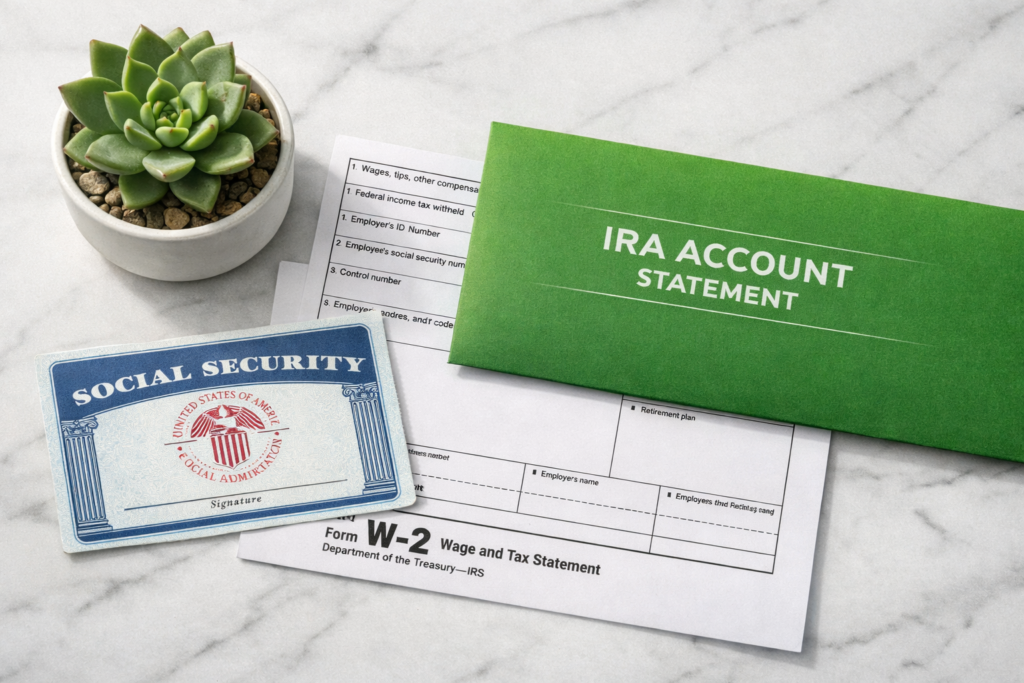
What counts as qualifying income: W-2 wages, net self-employment income, and certain taxable stipends. What does not count: rental income, investment dividends, capital gains, and passive income. For the vast majority of H1B holders who are W-2 employees, this distinction is academic.
2026 Contribution Limits and Income Phase-Outs
The projected annual Roth IRA contribution limit for 2026 is $7,000. If you’re 50 or older, a $1,000 catch-up provision brings that to $8,000.
There is an income ceiling for direct contributions. The phase-out ranges below are projected based on inflation adjustments from 2025 — confirm final figures at IRS.gov once the IRS issues its annual notice:
| Filing Status | Phase-Out Begins | Phase-Out Ends |
|---|---|---|
| Single / Head of Household | $150,000 | $165,000 |
| Married Filing Jointly | $236,000 | $246,000 |
| Married Filing Separately | $0 | $10,000 |
Within the phase-out range, your allowed contribution is reduced proportionally. Above the top threshold, direct contributions are not permitted — though a legal workaround exists (covered in the next section).

A note on Married Filing Separately: Most H1B holders file jointly with their spouses, but some situations make the Married Filing Separately (MFS) status unavoidable or preferable — for example, when a spouse is still living in India and has not yet arrived in the U.S., when one partner has significant foreign income that complicates a joint return, or when a spouse is on a visa type that creates tax residency ambiguity. Filing separately is sometimes the cleaner option in those transitional years. However, the cost is steep: the Roth IRA phase-out for MFS filers begins at $0 and ends at just $10,000 of MAGI — meaning anyone with a meaningful U.S. salary is essentially locked out of direct Roth contributions while filing in this status. If you find yourself in an MFS year, the backdoor Roth conversion remains available and is worth understanding.
A note on MAGI for H1B earners: MAGI is not simply your base salary. Bonuses count. RSUs that vested during the year count. Any taxable fringe benefits count. If you had a strong equity compensation year, your MAGI may be meaningfully higher than your W-2 base pay suggests. Run the actual calculation before assuming you fall below the limit.
401(k) Limits for Reference
The projected 2026 401(k) employee contribution limit is $23,500. For those 50 and older, an additional $7,500 catch-up contribution is permitted, bringing the total to $31,000. Under SECURE 2.0 provisions, employees aged 60–63 qualify for an enhanced catch-up of up to $11,250 above the standard limit — verify 2026 figures at IRS.gov as this provision is subject to regulatory confirmation.
What If You Earn Too Much? The Backdoor Roth Contribution
Exceeding the income phase-out does not permanently close the Roth IRA door. There is a fully legal strategy called the backdoor Roth contribution:
- Contribute to a Traditional IRA — there is no income limit for contributions (only for deductibility).
- Convert that Traditional IRA balance to a Roth IRA. The conversion is a taxable event on any gains, but if you convert promptly after contributing, there is typically little or no growth to tax.
This strategy has been widely used for years, is supported by major brokerage platforms, and the IRS is aware of it.
The pro-rata rule — one important constraint: The IRS does not allow you to isolate which IRA the conversion is coming from. It aggregates all your pre-tax IRA balances — Traditional IRAs, SEP IRAs, and SIMPLE IRAs — when calculating the taxable portion of a conversion. If you have any pre-tax IRA balance anywhere (including a SEP-IRA from prior consulting work, for example), a portion of your backdoor Roth conversion will be treated as taxable income, proportional to the ratio of pre-tax to total IRA funds. If you have never held a pre-tax IRA of any kind, this is not an issue and the conversion proceeds cleanly.
If the pro-rata rule creates complexity for your situation, a tax advisor can help you evaluate whether rolling pre-tax IRA balances into your 401(k) — which removes them from the IRA aggregation pool — makes sense before executing the conversion.
Roth IRA vs. 401(k): Which Should Come First for H1B Holders?
The practical answer is a sequence, not a choice.
Step 1: Capture the full employer 401(k) match. If your employer matches contributions up to a percentage of your salary, contribute at least enough to get that full match before doing anything else. An employer match is an immediate 50% or 100% return on the matched portion — no investment strategy competes with that.
Step 2: Max out the Roth IRA (up to the $7,000 limit). After securing the match, redirect savings toward the Roth IRA. The reasons this takes second priority over additional 401(k) contributions for many H1B holders come down to the nature of each account:
- Roth IRA contributions are made with after-tax dollars — the tax is already paid.
- Your contributions (not earnings) can be returned to you at any time without additional tax or penalty from the U.S. side — an important distinction if your situation changes before retirement age.
- There are no required minimum distributions. You can leave the account growing indefinitely.
- The account is portable — manageable remotely from outside the U.S.
Step 3: Return to the 401(k) for additional contributions. Once the Roth IRA is maxed, contribute further to the 401(k) up to the annual limit. The pre-tax deferral is valuable, but the exit flexibility of the Roth IRA makes it the stronger second priority for most H1B holders.
The pre-tax vs. post-tax question ultimately depends on where you expect your tax rate to land in retirement. If you retire in the U.S. at a similar or higher tax bracket, the Roth advantage compounds over time. If you return to India or another country and withdraw during retirement years there, the pre-tax 401(k) may be more efficient — though cross-border tax treatment introduces its own complications, discussed below.
What Happens to Your Roth IRA If You Leave the U.S.?
Your Roth IRA does not disappear when you leave. It stays open. It continues to grow. You are not required to close it, liquidate it, or notify your custodian simply because you’ve departed the country. The account can be managed online from anywhere in the world.
The nuances arise when you decide to actually withdraw money.
Understanding Non-Resident Alien (NRA) Withholding — Read This Before Any Withdrawal
This is the single most misunderstood area for H1B holders who leave the U.S. It needs to be understood clearly before any other withdrawal decisions are made.
Your original after-tax contributions are not subject to additional U.S. income tax when withdrawn — you have already paid tax on that money. However, if you are a non-resident alien (NRA) at the time of withdrawal, your custodian is generally required to apply 30% withholding on the gross distribution under IRS NRA rules — regardless of whether the amount is actually taxable.

This is a procedural reality, not a final tax. Here is how it works in practice:
Most custodians cannot distinguish between your principal (contributions) and your earnings at the point of distribution. They see a gross withdrawal amount and apply the 30% default withholding rate. You then file a U.S. non-resident tax return (Form 1040-NR) to demonstrate that the distribution consisted of after-tax contributions and was not taxable, and receive a refund of the over-withheld amount. The process takes time and requires filing a U.S. return from abroad — but the money is recoverable.
Tax treaties can reduce the withholding rate. The U.S. maintains income tax treaties with India and most other major H1B origin countries. If a treaty applies to retirement distributions, the withholding rate may be reduced — sometimes significantly below 30%. Claiming treaty benefits requires submitting Form W-8BEN to your custodian before the distribution is made, citing the specific treaty article. If your custodian is unfamiliar with processing treaty claims on IRA distributions, this requires proactive follow-up — the benefit is not applied automatically.
To put numbers on it: suppose you contributed $7,000 per year for four years and your account has grown to $32,000. You contributed $28,000; the remaining $4,000 is earnings. You initiate a full withdrawal as a non-resident. Your custodian withholds 30% ($9,600), sending you $22,400 and remitting the rest to the IRS. You file Form 1040-NR, establish that only the $4,000 in earnings was potentially taxable (subject to penalty if under 59½), and receive a refund of the excess. It resolves — but requires action.
Always consult a cross-border tax advisor before initiating any distribution as a non-resident. This applies whether you are withdrawing contributions only, earnings only, or the full account balance.
The Roth IRA Five-Year Rules — Applied to H1B Timelines
There are multiple five-year rules attached to Roth IRAs. Understanding which applies when matters for visa holders who may access funds before traditional retirement age.
Rule 1 — For Tax-Free Earnings Withdrawals
To withdraw earnings from your Roth IRA completely tax-free and penalty-free, two conditions must both be true:
- The account must have been open for at least five years (measured from January 1 of the first tax year you contributed).
- You must be 59½ or older.
If you’re under 59½ and withdraw earnings early, those earnings are subject to ordinary income tax plus a 10% early withdrawal penalty, unless a specific IRS exception applies (first home purchase, disability, and others — but not “leaving the U.S.”).
If you’re over 59½ but the five-year condition isn’t yet met, earnings are taxed as ordinary income — but the 10% penalty does not apply. The penalty and the tax trigger independently.
What this means on a typical H1B timeline: If you opened your Roth IRA in 2024 and have to leave the U.S. in 2027, your account is three years old. Your contributions come out without additional U.S. income tax (though NRA withholding mechanics apply as described above). Your earnings face both income tax and the 10% penalty at that point — unless you leave them in the account and withdraw later, when both conditions are met.
This is why opening the account early matters more than how much you put in initially. The five-year clock starts January 1 of the year you make your first contribution not from each subsequent contribution. If you open the account in January 2026 and contribute $100 just to establish it, every dollar you add afterwards falls under that same 2026 start date.
Rule 2 — For Backdoor Roth (Converted) Amounts
Converted amounts carry their own separate five-year clock — but this rule only matters if you are under 59½. Each conversion you make starts its own independent five-year holding period. If you withdraw a converted amount within five years of that specific conversion and you’re still under 59½, the 10% early withdrawal penalty applies — even though you already paid income tax on the conversion itself.
After age 59½, this rule becomes irrelevant. If you’re planning backdoor Roth conversions and anticipate needing early access to those funds, account for this timeline.
Rule 3 — For Beneficiaries
Beneficiaries who inherit a Roth IRA have their own five-year rules governing distributions. This is outside the scope of most H1B planning conversations but relevant for estate planning purposes.
Your H4 Spouse Can Have Their Own Roth IRA
One of the most consistently underused opportunities in this space: if you’re an H1B holder married to an H4 visa holder who doesn’t work, your non-working spouse can still have their own Roth IRA funded from your earned income.
This is the spousal IRA rule. The conditions:
- You must file your federal taxes as Married Filing Jointly.
- Your combined earned income must be at least equal to the total contributions for both accounts.
- Each person’s account is titled separately in their own name.

If you earned $90,000, you can contribute $7,000 to your Roth IRA and $7,000 to your spouse’s Roth IRA — $14,000 total going into tax-advantaged accounts from a single income. Both five-year clocks start independently, meaning opening the spousal account early starts that clock running for your spouse as well.
This is particularly valuable for couples where the H4 holder has no independent work authorization. The account belongs to them — the only connection to the working spouse is that your income is the qualifying source.
The Custodian Closure Risk — What Most Guides Skip
Not all financial institutions will continue servicing your account if you’re no longer a U.S. resident. This is not theoretical. Several major financial institutions have informed account holders — with as little as 90 days’ notice — that they were closing accounts for clients who updated their mailing address to a non-U.S. location. The institutions cite regulatory complexity in managing international accounts. For the account holder, the choices become: roll over to a non-resident-friendly custodian, convert to a different product, or face forced liquidation with the associated tax and penalty consequences.
The practical mitigation: If there is any real probability you’ll leave the U.S. within the next few years, verify your custodian’s non-resident policy now — not after you’ve updated your address. Ask directly: “If I become a non-U.S. resident, will you continue to service my Roth IRA?” Get a clear answer.
Some custodians that serve non-resident account holders may require you to maintain a U.S. mailing address (some accept a trusted contact’s address), a U.S. phone number for account verification, or a U.S. bank account for distributions. Transferring to a non-resident-friendly custodian via an IRA-to-IRA transfer — which is generally not a taxable event — is far easier to execute while you are still a U.S. resident. After departure, it becomes significantly more complicated.
Taxes on a Roth IRA: The Complete Picture
U.S. Federal Level
Roth IRA contributions are made with after-tax dollars — there is no deduction going in. For standard contributions, there is nothing additional to report on your federal return; your brokerage files Form 5498 annually confirming the contribution.
If you executed a backdoor Roth conversion, you must file Form 8606 with your federal return. This document establishes that your Traditional IRA contribution was non-deductible (after-tax), and records the conversion. Failing to file Form 8606 creates a documentation gap that can result in the IRS treating your conversion as fully taxable upon withdrawal — even though it wasn’t. Keep copies of all Form 8606 filings permanently.
Qualified Roth IRA distributions in retirement are entirely tax-free at the U.S. federal level.
State-Level Taxes
Most U.S. states follow federal Roth IRA treatment, but not all do. California, notably, has specific rules around early distributions that differ from the federal framework — the state does not recognize all federal exceptions to early withdrawal penalties. For H1B holders working in high-tax states including California, New York, and New Jersey, it is worth confirming your state’s specific treatment with a CPA licensed in that state, particularly if early withdrawal is a possibility.
Home Country Tax Treatment
This is where many returning H1B holders encounter an unexpected tax liability. The U.S. treats qualified Roth IRA distributions as tax-free because taxes were paid at contribution. Your home country does not necessarily agree.
India, for example, does not formally recognize the Roth IRA as a tax-exempt structure in its treaty with the U.S. Distributions received by Indian tax residents may be treated as ordinary income under Indian domestic law — regardless of U.S. tax-free status. Other major H1B origin countries each have their own tax treatment of U.S. retirement account distributions, and these vary significantly.
This does not make the Roth IRA a bad decision — the tax-free growth during U.S. residency years has real value, and many home countries tax Roth distributions at rates lower than what U.S. ordinary income tax would have been. But it means “tax-free” is a U.S. statement only. Understand your home country’s position before planning your distribution strategy.
Tax Treaties
As described in the NRA withholding section above, tax treaties can reduce the withholding rate applied to distributions for non-residents of the U.S. Treaty provisions vary significantly — not all treaties address IRA distributions specifically, and India’s treaty provides limited specific guidance on IRA treatment. Claiming treaty benefits requires proactive submission of Form W-8BEN to your custodian before any distribution is initiated.
FBAR and FATCA What Applies and What Doesn't
A common source of anxiety for H1B holders: does your U.S.-based Roth IRA trigger foreign financial account reporting? No. Your Roth IRA is a U.S.-held account. It does not appear on FBAR (FinCEN Form 114) or require FATCA disclosure under Form 8938.
However, if you hold retirement or investment accounts in your home country — including Provident Fund accounts, NPS, or domestic brokerage accounts — those may require disclosure depending on their aggregate value and your U.S. tax residency status. Consult a tax advisor who works with cross-border clients if you have meaningful assets in both countries.
Opening a Roth IRA: The Practical Steps
Opening an account takes roughly 20 minutes. You do not need your employer’s involvement.
What you need:
- Social Security Number (issued as part of your H1B work authorization)
- U.S. bank account for funding
- Personal information: legal name, date of birth, address
- Minimum deposit: most major brokerages have no minimum — you can open with $1 to start the five-year clock
Select “Roth IRA” as the account type. The platform will walk through eligibility confirmation (earned income, income limits). Once open, you choose how the funds are invested.
If you are not certain how to invest the balance, a target-date index fund aligned with your expected retirement year is a reasonable, low-maintenance default. It is not optimal for every situation but is broadly appropriate and requires no ongoing management decisions.
Before committing to any specific platform: ask about their policy on non-resident account holders. This matters more than the specific investment options available.
Decisions That Depend on Your Specific Situation
Not every H1B holder faces the same calculation.
If you’re building toward a green card and expect to stay long-term: Maximize contributions to both the Roth IRA and the 401(k) beyond the employer match. The tax-free retirement income becomes more valuable the longer your U.S. tenure.
If you have a defined two-to-three year assignment with a firm return date: The Roth IRA can still make sense — specifically because contributions are recoverable without additional U.S. tax on withdrawal (subject to NRA withholding mechanics). But consider whether maxing the 401(k) beyond the employer match is worth the complexity if you’re likely to need access before retirement age. A taxable brokerage account may offer more flexibility with fewer procedural obstacles on exit.
If your income exceeds the direct contribution phase-out: Execute the backdoor Roth conversion. Confirm you have no pre-tax IRA balances that would trigger the pro-rata rule, or consult a tax advisor to address that first.
If your spouse is on H4 without work authorization: Open a spousal Roth IRA in their name immediately. Fund it. Start both five-year clocks running.
If you’re uncertain how long you’ll stay: The Roth IRA is generally more forgiving than the 401(k) in uncertain-departure scenarios precisely because of the contribution withdrawal flexibility. The 401(k) is more valuable when you’re confident you’re staying.
Real Situations That Illustrate Why This Matters
The QA engineer in Dallas who almost panicked his way into a tax mistake. He was a 34-year-old software QA engineer at a mid-size tech company in Dallas, making around $105,000. Four years of Roth IRA contributions, roughly $24,000 in, plus some growth. Then a round of layoffs hit and he was let go on a Friday afternoon. That weekend, sitting in his apartment with his wife, he was convinced he needed to pull everything out before “something happened to it.” He called the brokerage Monday morning ready to liquidate. The rep walked him through what withdrawal would actually look like — the 30% NRA withholding he’d face if he did it after departing, the 1040-NR he’d have to file to recover any excess. He stopped. Found a new employer within five weeks. Three years later, the account is still there, still growing, and he considers that Monday phone call one of the better accidents of his financial life.
The product manager in Seattle whose wife’s account didn’t exist. Arjun — not his real name — was a product manager at a large tech company in Seattle earning $165,000. His wife had been on H4 for three years, staying home with their toddler. He’d been maxing his own Roth IRA every year, filing jointly, fully aware of the spousal rule in the abstract. But it had stayed abstract — he kept meaning to “set it up later.” When his CA introduced him to a financial advisor at a family friend’s party, the advisor asked a single question: “Does your wife have her own Roth IRA?” The silence said everything. He’d left three years of contributions, roughly $21,000 plus compounding, sitting unclaimed. They opened the account the following week. He described the feeling not as regret but as something more like embarrassment — the kind you feel when you realize the answer was obvious the whole time.
The data scientist in the Bay Area who hit the income limit and assumed that was it. She was 31, working in data science at a Series B startup in San Francisco, and her total compensation had cleared $200,000 the previous year — base salary, bonus, and some RSUs that vested in a strong quarter. She mentioned to a colleague that she’d stopped contributing to her Roth IRA “because I make too much now.” The colleague looked at her and said, “Have you heard of the backdoor Roth?” She hadn’t. She went home, researched it, confirmed she’d never held a Traditional IRA or any pre-tax IRA of any kind — so there was no pro-rata complication — and realized she’d sat out two full years for no reason. She executed backdoor conversions going forward. The two missed years weren’t recoverable. She still thinks about them when reviewing her account balance.

The supply chain manager in New Jersey who thought “leaving the U.S.” meant “closing everything.” He was a supply chain manager at a pharma company in New Jersey, in his late 30s, making around $120,000. When his visa renewal hit a complication and it became clear he’d likely need to return to India, he went into full shutdown mode — told himself to get everything out and into an NRE account before he left. He called his brokerage, started the withdrawal process, and was one step away from confirming when something made him pause and Google “Roth IRA non-resident withdrawal.” What he found stopped him: the accounts didn’t have to close, they could stay and keep growing, and if he really needed to access them later, a cross-border tax advisor could walk him through the cleanest way to do it — including how NRA withholding works and how to recover any excess via Form 1040-NR. He put the phone down, packed up, flew home, and left the accounts open. That was four years ago. The accounts are still growing.
A Note on Timing
Visa uncertainty rarely resolves on a timeline that makes financial planning convenient. Most immigration paths involve years of intermediate status — renewals, I-140 approvals, priority date movement — before anything resembling certainty arrives. Planning within that uncertainty, rather than waiting for it to resolve, tends to produce better outcomes for most people.
That said, the right answer depends on your specific timeline and intentions. Someone midway through a defined short-term assignment with a firm return date faces a different calculation than someone pursuing permanent residency. The goal of this guide is to give you the framework to make that call clearly — not to make it for you.
Summary Reference Table
| Account | Tax Treatment | Contributions Accessible Early? | Non-Resident Withdrawal Consideration |
|---|---|---|---|
| Roth IRA | After-tax in, tax-free growth and withdrawal | Yes — anytime, no additional U.S. income tax (but 30% NRA withholding applies; recover via Form 1040-NR) | See NRA withholding section above; treaty may reduce rate via Form W-8BEN |
| Traditional IRA | Pre-tax in, taxed on withdrawal | No — taxes + 10% penalty before 59½ | 30% NRA withholding default; generally fully taxable |
| 401(k) | Pre-tax in, taxed on withdrawal | No — taxes + 10% penalty before 59½; rollover to IRA on job change | 30% NRA withholding default; treaty may reduce |
| Taxable Brokerage | No tax deferral; long-term capital gains rates apply | Yes — anytime, capital gains tax applies | Non-resident aliens generally not taxed by U.S. on long-term capital gains |
FREQUENTLY ASKED QUESTIONS
Yes. H1B visa holders are fully eligible to open and contribute to a Roth IRA. The IRS requires only two things: U.S.-sourced taxable earned income (such as W-2 wages from a U.S. employer) and a Social Security Number. Citizenship and permanent residency are not eligibility conditions.
The projected 2026 Roth IRA contribution limit is $7,000 per year ($8,000 if you are 50 or older). These figures are based on 2025 IRS-confirmed limits and projected inflation adjustments. Confirm the final 2026 figures at IRS.gov after the IRS issues its annual announcement, typically in October or November.
Your Roth IRA stays open. You are not required to close or liquidate it when you leave the U.S. The account continues to grow and can be managed online from abroad. When you eventually withdraw, be aware that your custodian will typically apply 30% NRA withholding on the gross distribution. You can recover excess withholding by filing Form 1040-NR. If a U.S.-India tax treaty provision applies, the withholding rate may be reduced via Form W-8BEN.
Yes, through the spousal IRA rule. As long as you file taxes jointly and your earned income covers the total contributions for both accounts, your non-working H4 spouse can have their own Roth IRA funded from your income. Each account is capped at $7,000 annually and titled in each person’s individual name.
The backdoor Roth is a legal strategy for people whose income exceeds the direct contribution phase-out limits. You contribute to a Traditional IRA (no income limit for contributions), then convert that balance to a Roth IRA. H1B holders can use this strategy. The key condition to check first: if you hold any pre-tax IRA balances (Traditional, SEP, or SIMPLE IRAs), the IRS pro-rata rule will make a portion of the conversion taxable. If you have no pre-tax IRA balances, the conversion proceeds cleanly.
The recommended sequence is: first, contribute enough to your 401(k) to capture the full employer match. Then max your Roth IRA up to the $7,000 annual limit. Then return to the 401(k) for additional contributions. The Roth IRA gets priority because your contributions (not earnings) can be withdrawn at any time without additional U.S. tax or penalty — an important flexibility if your immigration situation changes before retirement age.
To withdraw Roth IRA earnings completely tax-free, the account must be at least five years old and you must be 59½ or older. The five-year clock starts January 1 of the year you make your first contribution — not from each subsequent contribution. For H1B holders who may leave before five years are up, this means contributions can still exit cleanly, but earnings will face income tax and a 10% penalty unless the conditions are met.
RESEARCH DATA & SOURCES
| Source | What It Covers | URL |
|---|---|---|
| IRS Publication 590-A | Roth IRA contributions, eligibility, MAGI limits, spousal IRA rules | IRS.gov/publications/p590a |
| IRS Publication 590-B | Distributions from IRAs, five-year rules, qualified distributions | IRS.gov/publications/p590b |
| IRS Topic No. 557 | Additional tax on early distributions from IRAs | IRS.gov/taxtopics/tc557 |
| IRS Form 8606 Instructions | Nondeductible IRAs, backdoor Roth conversion reporting | IRS.gov/form8606 |
| IRS Form 1040-NR Instructions | Non-resident alien income tax return, withholding recovery | IRS.gov/form1040nr |
| IRS Form W-8BEN Instructions | Certificate of foreign status, treaty benefit claims | IRS.gov/formw8ben |
| FinCEN Form 114 (FBAR) | Foreign bank account reporting requirements | fincen.gov/bsa_forms/fbar |
| IRS Notice 2023-75 | 2024 retirement plan contribution limits (baseline for projections) | IRS.gov |
| SECURE 2.0 Act (Division T of P.L. 117-328) | Enhanced catch-up contributions ages 60-63, enacted December 2022 | Congress.gov |
| IRS Revenue Procedure 2024-25 | 2025 Roth IRA phase-out ranges | IRS.gov |
Disclaimer:This article is for educational and informational purposes only. It does not constitute legal, tax, or financial advice. Tax laws, IRS regulations, and immigration rules change — sometimes significantly and without extended notice. Consult a qualified cross-border tax advisor and licensed financial planner before making decisions specific to your situation. IRS.gov and the official guidance of your home country’s tax authority are the definitive sources for current rules.