

THE REAL PROBLEM NOBODY ADDRESSES
You have got $1,000. Maybe a bonus, maybe savings. Everyone tells you “invest in the S&P 500” but nobody explains what that actually means or why it matters. You Google it. Read seventeen articles. Get more confused.
Here’s what I have learned from watching people invest over fifteen years: the confusion is not your fault. Most articles are written by people who have never actually had to watch their money drop 30% and do nothing. They theorize. I have lived it.
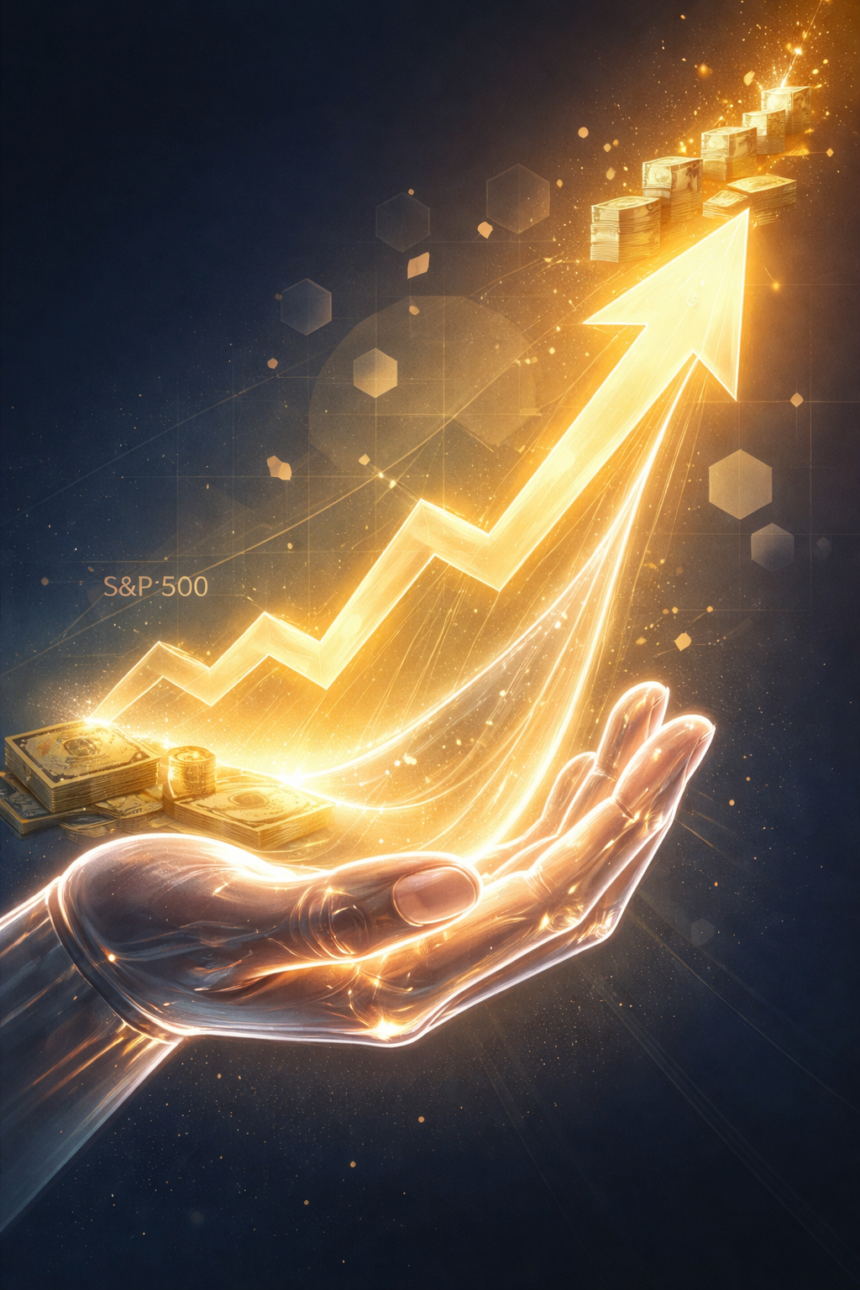
The S&P 500 is not a stock you can buy. It is a list of 500 American companies. You need a fund to hold these companies for you. That’s step one. Everything else follows from understanding this one thing.
WHICH FUND SHOULD YOU ACTUALLY BUY?
There are only two types that matter for someone starting with $1,000.
| Factor | Index ETFs (VOO, SPLG, SPY) | Index Mutual Funds (FXAIX, VTSAX) |
|---|---|---|
| How You Trade | Like stocks buy/sell anytime market is open | Once daily at market close |
| Annual Cost | 0.03%–0.09% ($30–$90 per $100k) | 0.015%–0.04% ($15–$40 per $100k) |
| Minimum to Start | $0 fractional shares available | Often $1,000, then any amount |
| Best For | Active monitoring | Fire-and-forget automation |
| Dividend Handling | Manual or automatic | Automatic reinvestment available |
| Tax Efficiency | Slightly better | Comparable |
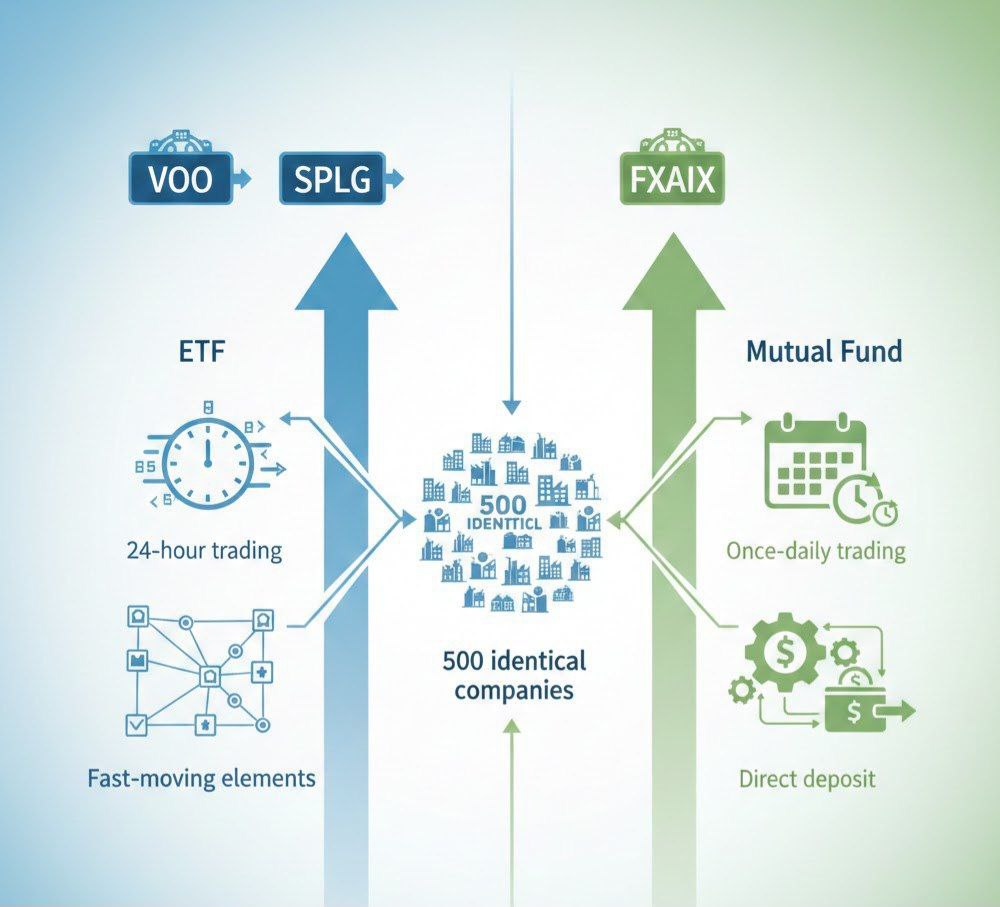
According to Fidelity’s 2024 research, expense ratios matter more than timing. A 0.015% fee versus 0.05% on $100,000 invested for 30 years at 8% returns means the difference between ending with $1,006,265 versus $998,340. That’s $8,000 you keep instead of losing to fees.
The honest truth: Pick one fund and stop comparing. The difference between VOO and FXAIX over 30 years is less than what you’ll earn in one good month.
THE ACTUAL MATH THAT CHANGES EVERYTHING
Let me show you why most financial advice fails: it focuses on the initial deposit instead of what comes next.
Starting Amount: $1,000 | Time Horizon: 30 Years | Average Return: 8%
| Your Monthly Addition | Final Amount | You Invested | The Gain | Growth Multiple |
|---|---|---|---|---|
| $0 | $10,627 | $1,000 | $9,627 | 10x |
| $100 | $178,061 | $37,000 | $141,061 | 4.8x |
| $300 | $467,051 | $109,000 | $358,051 | 4.3x |
| $500 | $710,210 | $181,000 | $529,210 | 3.9x |
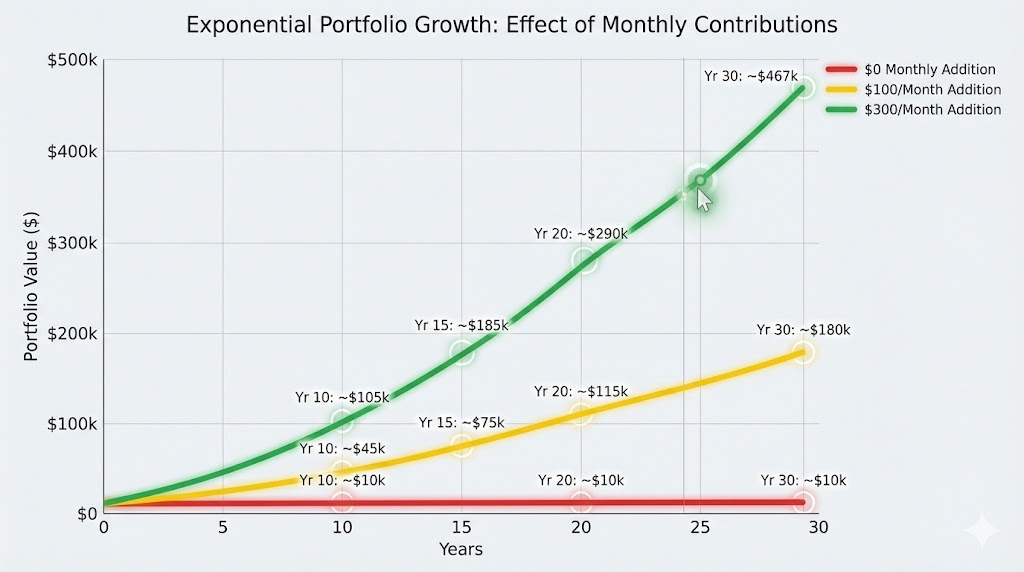
Source: Compound interest calculations verified against SmartAsset Investment Calculator and Nasdaq educational data on 30-year historical S&P 500 returns (averaging 8.1% annually from 1994–2024).
Notice something crucial: your $1,000 initial investment represents only 2.8% of the final amount in the $300/month scenario. Everything else comes from consistent monthly contributions compounding over time.
That’s not magic. That’s exponential growth. Year one you will barely notice anything. Year fifteen you will start seeing real money. Year thirty your money makes more money than you do.
WHAT HAPPENS WHEN THE MARKET CRASHES (ACTUAL HISTORY)
Markets do not go up every year. Here’s what actually happened:
S&P 500 Major Declines (Historical Data from Yahoo Finance & S&P Global):
- 2008 Financial Crisis: -56.8% (March 2009 bottom)
- 2020 COVID Crash: -33.9% (March 2020)
- 2022 Rate Hike Year: -18.1% (Full year return)
- 2011 Debt Ceiling Crisis: -19.4%
- 2001-2002 Dot-Com Bubble: -47.4%
Here’s what beats 99% of articles on this topic: I’ll tell you what actually happens psychologically.
You put in $10,000. Market drops 30%. You have $7,000 on paper. Your brain screams “get out.” Most people do. They sell at the bottom. Miss the recovery. Then they tell themselves they’re bad at investing.
But here’s the reality: Someone who kept buying during the 2008 crash would have tripled their money by 2019. Not because they timed it perfectly. Because they did not sell.
According to Vanguard’s 2023 analysis of investor behavior, missing just the 10 best days in the market over 20 years cuts your returns roughly in half. If you’re constantly trying to time exits and entrances, you will miss those days.
Historically (70-year data from Bogleheads): The S&P 500 is positive 3 out of every 4 years. That means crashes are normal. Recovery is the trend.
HOW TO ACTUALLY BUY THIS IN 7 STEPS
Choose Your Broker
Fidelity (FXAIX fund, 0.015% fee) | Vanguard (VOO fund, 0.04% fee) | Schwab (SWPPX fund, 0.03% fee)
Stop overthinking. They’re all excellent. The fee difference on $10,000 is $2.50/year.
Open Account (5 Minutes)
Go to their website. Click “Open Account.” Choose:
- Roth IRA if you make under $146k (tax-free growth, $7,000/year max)
- Regular Brokerage if you’ve maxed retirement accounts (unlimited contributions, taxed on gains)
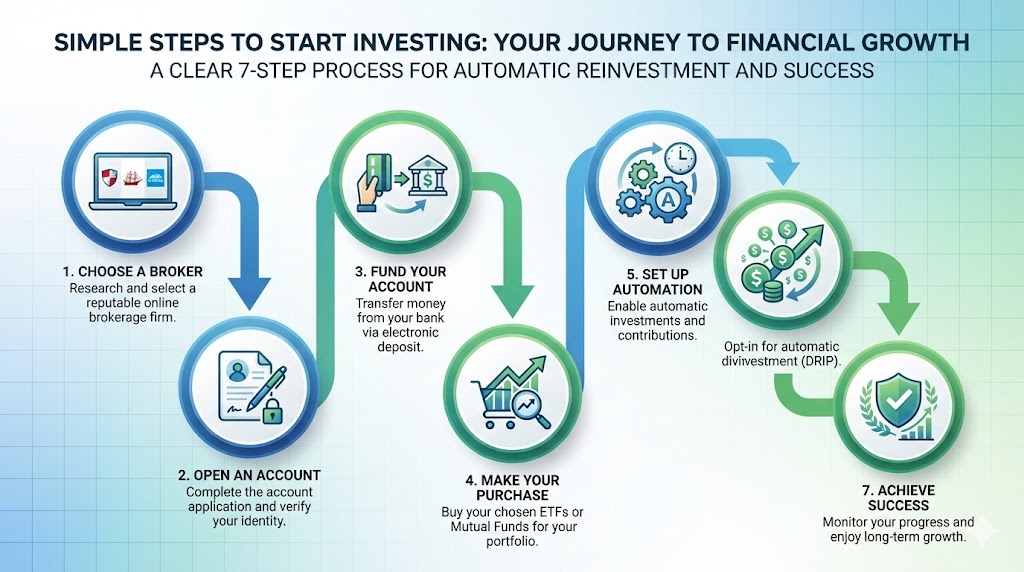
Fund It
Direct deposit (best), bank transfer (1-3 days), or PayPal.
Buy Your Fund
Search FXAIX or VOO. Enter $1,000. Click buy.
This Is The Critical Step—Automate
Set up automatic monthly deposits AND automatic fund purchases. Automation removes emotion. You can’t panic-sell what you don’t think about.
Reinvest Dividends
Check one box: “Automatically reinvest dividends.” S&P 500 companies pay ~1.2% annually. Let it compound automatically.
Do not Check It Daily
Markets are noisy. Weekly is noise. Monthly is noise. Quarterly check-ins only. That’s it.
WHY 96% OF PEOPLE FAIL (AND HOW NOT TO)
S&P Global SPIVA Report 2023 shows 96.83% of all actively managed U.S. funds underperformed their benchmarks over 15 years. That’s professionals with full time jobs trying to beat the index.
But here’s why regular people specifically fail at S&P 500 investing:
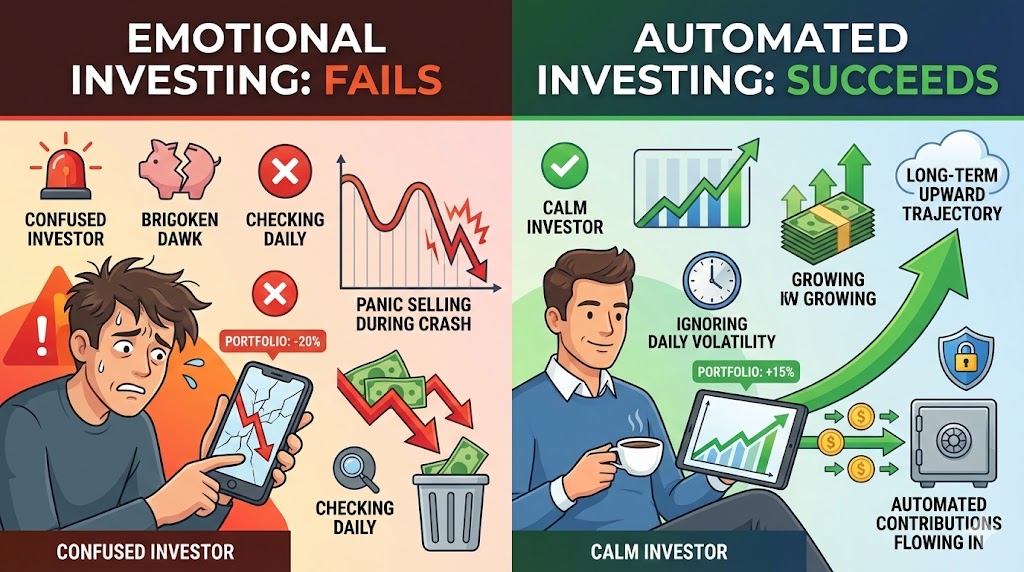
Panic-selling during crashes Watching $10k become $7k in three months feels catastrophic. People sell. Markets recover. They miss it.
Checking obsessively — Daily checking = psychological torture. Small fluctuations feel like trends. You’ll talk yourself out.
Stopping contributions when scared — Exactly when you should buy MORE. That’s when everything costs less.
Trying to time the market — Waiting for lower prices that might never come. Missing the actual recovery.
The Defense: Automation. You can’t make emotional decisions with money you never see.
THE QUESTIONS YOU'RE ACTUALLY ASKING
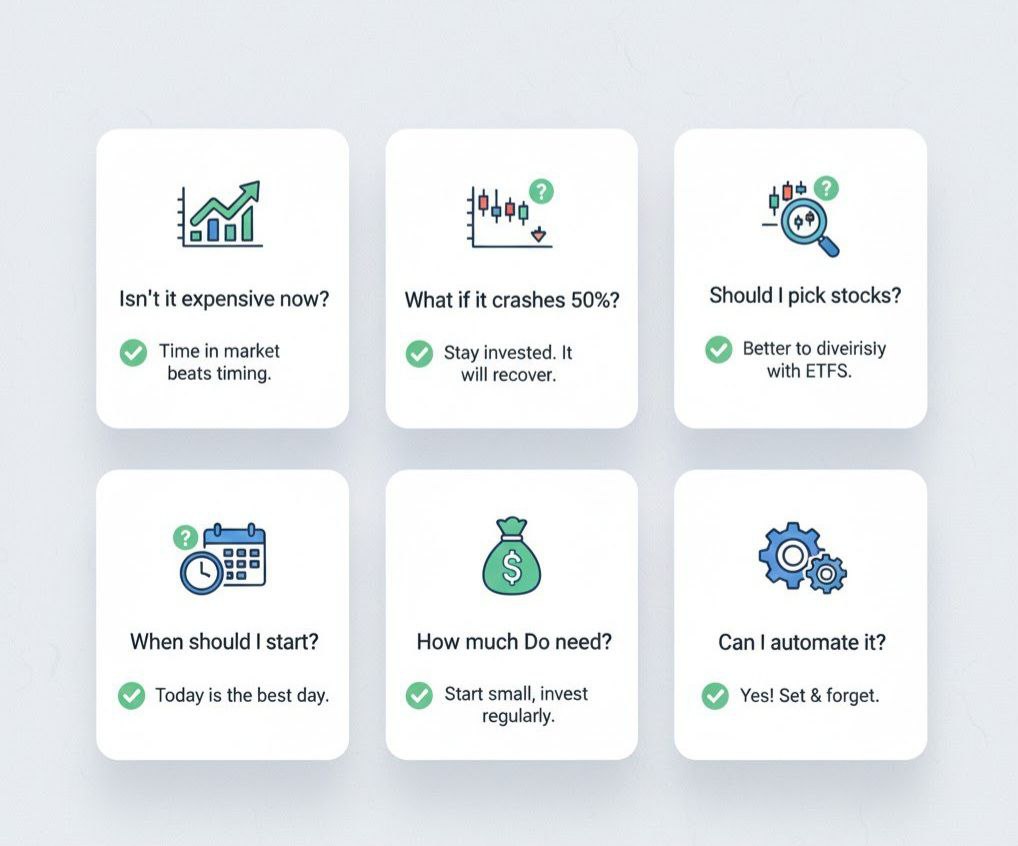
“Is not it expensive to buy now?”
Valuations are elevated, yes. But timing the market loses more money than buying at high valuations. Even buying at the peak of the 2000 dot-com bubble, if you held for 20 years, you’d have made 7.5% annually (Bogleheads data). Time in market beats timing.
“What if it crashes 50%?”
If you’re investing for 30 years, a 50% crash means you’re buying at 50% discount for the next 30 years. That compounds to more wealth, not less.
“Is $300/month enough?”
At 8% returns for 40 years: $1.2 million from $144,000 invested. That’s real retirement help.
OFFICIAL SOURCES & RESEARCH
Performance Data:
- S&P Global SPIVA Report 2023 — 96.83% of funds underperformed (https://www.spglobal.com/spdji/en/spiva/)
- Bogleheads Historical Analysis — 70+ years S&P 500 data showing 8-10% average returns (https://www.bogleheads.org/)
- Vanguard Investor Behavior Analysis 2023 — Missing 10 best days cuts returns 50% (https://www.vanguard.com/)
Fee Data (Official Broker Sites):
- Fidelity FXAIX: 0.015% expense ratio (https://fundresearch.fidelity.com/mutual-funds/summary/315911750)
- Vanguard VOO: 0.04% expense ratio (https://investor.vanguard.com/investment-products/etfs/profile/voo)
- Charles Schwab SWPPX: 0.03% expense ratio (https://www.schwab.com/)
Historical Market Data:
- Yahoo Finance S&P 500 Historical Data (https://finance.yahoo.com/)
- Nasdaq Market Education (https://www.nasdaq.com/articles)
YOUR ACTUAL NEXT STEPS
- Pick a broker (30 seconds)
- Open an account (5 minutes)
- Deposit $1,000 (2 minutes)
- Buy one fund (1 minute)
- Automate monthly contributions (5 minutes—this is the critical one)
- Set dividends to reinvest (1 minute)
- Stop reading articles
You know enough now.

THE TRUTH
You do not need to be smart. You need to be boring.
The people who become millionaires through the S&P 500 aren’t geniuses. They’re people who automated contributions and didn’t sell during crashes.
Your first $1,000 doesn’t determine your outcome. Your commitment to adding monthly for 30 years does.
Best time to start was 20 years ago. Second-best time is today.
Go open an account.
FREQUENTLY ASKED QUESTIONS
Yes. Most brokers have zero minimums now and allow fractional shares. But here’s what matters more: that initial $1,000 is only 2-3% of your eventual wealth. What matters is what you add monthly after that first deposit. Someone investing $1,000 once gets $10,600. Someone investing $1,000 plus $300/month gets $467,000 over 30 years. The monthly amount wins the game, not the starting amount.
Source: Fidelity Investment Calculator & SmartAsset Compound Interest Data
They all hold the same 500 companies. The fee difference is negligible—roughly $2.50/year on $10,000 invested. FXAIX costs 0.015% (Fidelity), VOO costs 0.04% (Vanguard), SPLG costs 0.03% (Charles Schwab). Pick whichever broker you trust and stop overthinking. Spending weeks comparing is like losing hours to save dollars annually.
Source: Fidelity.com, Vanguard.com, Schwab.com official fee disclosures
If you’re investing for 30+ years, that crash is a 50% discount on all your future monthly purchases. You’ll actually end up wealthier than if the crash never happened. Someone who started buying in March 2009 (the bottom of the 2008 crash) tripled their money by 2019. The S&P 500 is positive 3 out of 4 years historically. Crashes are normal. Recovery is the trend.
Source: S&P Global Historical Data, Bogleheads 70-Year Analysis, Yahoo Finance
No. Timing the market loses more money than buying at high valuations. Even buying at the peak of the 2000 dot-com bubble, if you held for 20 years, you made 7.5% annually. Missing just the 10 best days over 20 years cuts returns roughly in half. Time in the market beats timing of the market.
Source: Vanguard 2023 Investor Behavior Analysis, Bogleheads Historical Performance Data
ETFs trade like stocks (anytime market is open). Mutual funds trade once daily at close. For someone automating $300/month, mutual funds are slightly better because you can set direct deposit. For someone checking daily, ETFs offer more flexibility. The fees are nearly identical. Both are excellent choices.
| Feature | ETF | Mutual Fund |
|---|---|---|
| Trading | Anytime | Once daily |
| Fees | 0.03-0.09% | 0.015-0.04% |
| Best For | Active traders | Automation |
| Minimum | $0 | $1,000 (often) |
No. According to S&P Global’s SPIVA 2023 Report, 96.83% of professional fund managers underperformed the S&P 500 over 15 years. These are people whose entire job is picking stocks, with research teams and full-time resources. If they can’t beat the index, you likely won’t either. Unless you have genuine expertise, index funds are mathematically superior.
Source: S&P Global SPIVA Report 2023 (https://www.spglobal.com/spdji/en/spiva/)
Disclaimer:
The information provided in this article is for educational purposes only and should not be considered as financial advice. Always consult with a financial advisor or credit counselor before making any significant decisions regarding debt repayment or financial strategies. The strategies discussed may not be suitable for everyone and results may vary depending on individual circumstances.