


Look, most people say investing in the S&P 500 is the easiest cheapest way to get your feet wet in the stock market. Basically, it is a list of the 500 biggest U.S. power houses think Apple, Microsoft, and Amazon. You can not just buy the index itself but you can put your money into index funds or ETFs that copy what it does. This 2026 guide is here to cut through the noise with real steps, examples, and checklists to make this whole thing actually make sense. We are talking account setu picking the right funds, portfolios, taxes, and those rookie mistakes you definitely want to avoid—basically everything you need to know to get started without the headache
What Is the S&P 500?
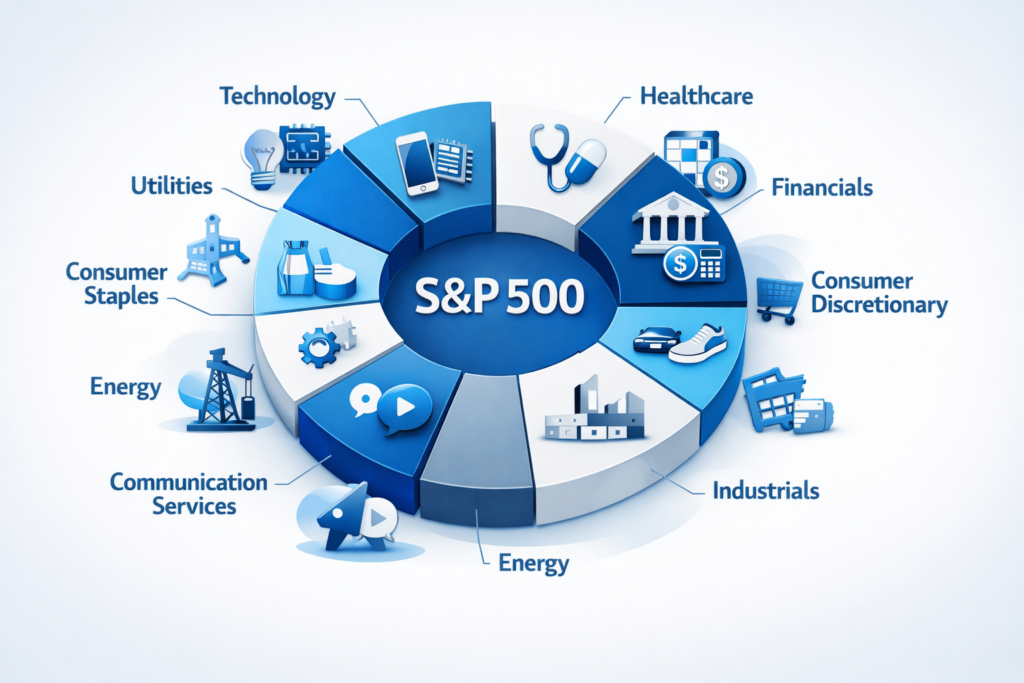
First things first : the S&P 500 is not actually a stock you can go out and buy. Think of it more like a giant scoreboard for the roughly 500 biggest companies in the U.S. It is market cap weighted which is just a fancy way of saying the massive players like Apple carry more weight than the smaller ones on the list. Since it hits every major industry from tech and healthcare to your favorite snacks it is basically a high res snapshot of how the entire U.S. economy is doing.
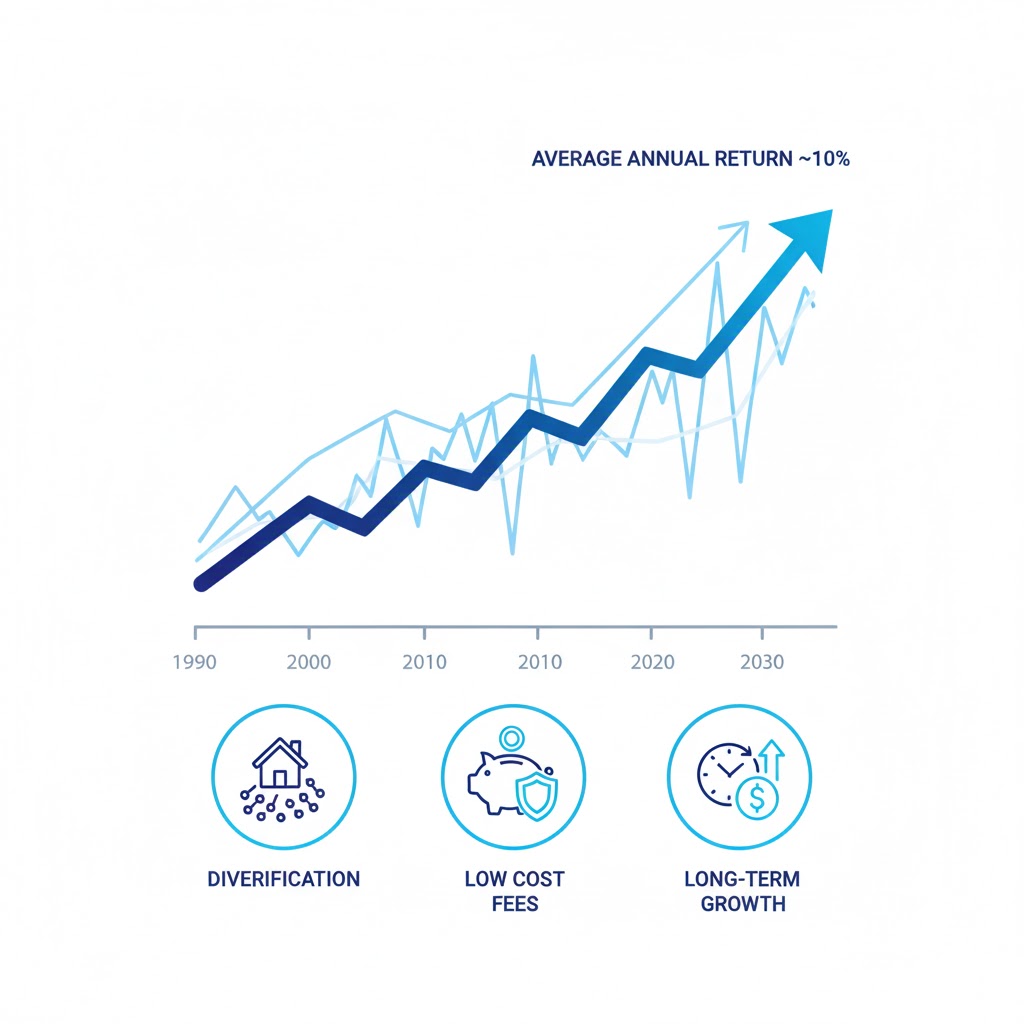
Because it is so spread out everyone uses it as the gold standard for how the market is performing. On average it is banked about 10% returns per year over the long haul (which is around 6–7% )once you account for inflation). While there are no guarantees in life or the market that track record is why people love it for steady growth.
The big takeaway: You can not put money directly into the scoreboard, but you can buy into ETFs or mutual funds that mirror it. These funds hold the exact same stocks so when the index moves your investment moves right along with it.
Why Invest in the S&P 500?
Investing in the S&P 500 has several advantages for beginners:
Low Costs: Most S&P 500 funds are passively managed, meaning nobody is getting paid a huge salary to try and outsmart the market they just mirror the index. Because of that the fees (what we call expense ratios) are dirt cheap—often under 0.05%, or even zero. Cutting those fees might not seem huge now but it saves you thousands of dollars over the long run compared to expensive, active funds.
Historical Performance: Look at the last century: the S&P 500 has averaged about a 10% return every year. Even after inflation eats its share, you are still looking at around 6–7%. While there’s no crystal ball for the future that kind of track record makes it a really solid engine for growing your wealth if you can just stay the course.
Simplicity: Instead of spending your weekends researching balance sheets and trading individual stocks, you just pick a fund and hold onto it. Even Warren Buffett famously says that for most people putting 90% of their money into a low-cost S&P 500 fund is the smartest move they can make.
In short the S&P 500 is like betting on the U.S. economy in one decision. It is popular because it balances risk and return reasonably well for long term investors
Preparing to Invest: The 5-Minute Checklist
Before you start throwing money at the market, you’ve gotta make sure you aren’t set up to fail. Think of this as getting your life together first:
Your Oh Crap Fund: You need 3 to 6 months of cash sitting in a regular savings account. Why? Because life happens. If your water heater blows up, you do not want to be forced to sell your stocks while the market is down just to pay for it.
Kill the Debt: If you are carrying a balance on a credit card with a 22% interest rate, pay that off immediately. No investment not even the S&P 500 is going to consistently give you a 22% return. It’s the smartest investment you can make right now.
The ‘When’ Factor: Ask yourself when you actually need this money. If it’s for a house next year stay away from stocks. The S&P 500 is for the ‘long-haul you’ the one 5 or 10 years down the road. The market is a roller coaster in the short term, so do not play with money you can not afford to leave alone.
The Sleep Test: Imagine waking up and seeing your account down 20%. Would you freak out and sell everything? If yes, you need to rethink your strategy now. You’ve gotta be okay with the red days to get to the green ones.
Just Start Small: Do not worry about having thousands. If you can only swing $50 or $100 a month, that’s totally fine. Just pick an amount you can stick to every single month without thinking about it.
Account Types: Where to Invest
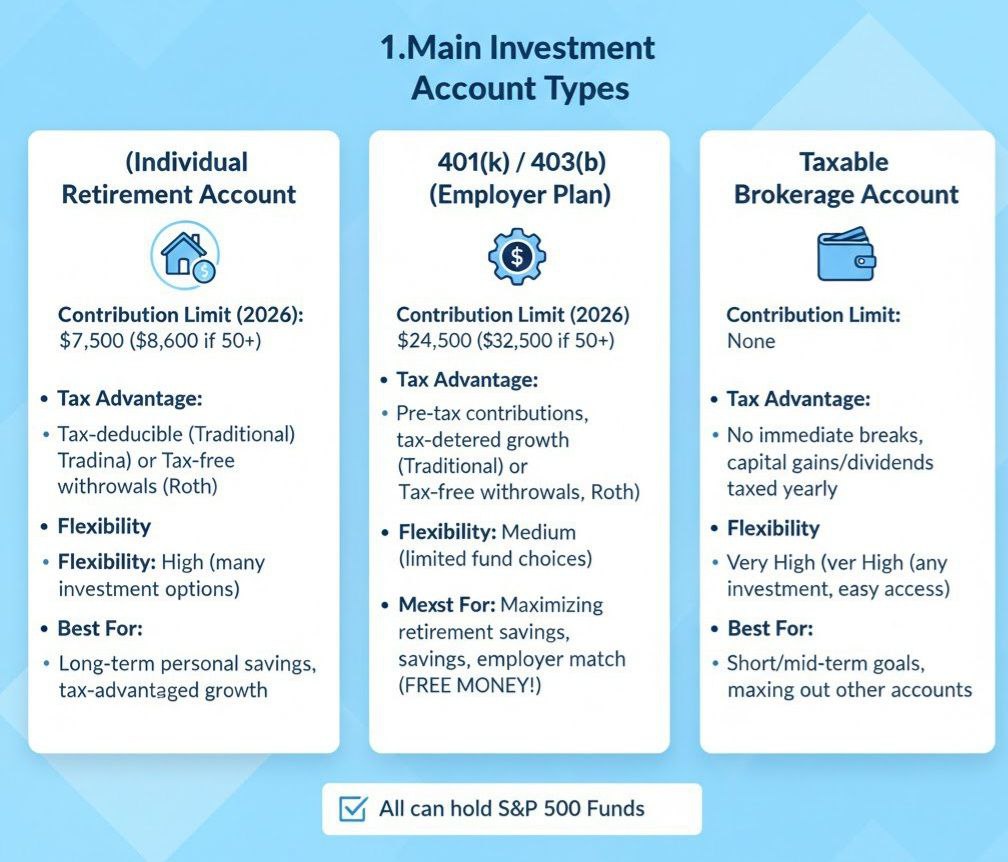
To actually get your hands on an S&P 500 fund you need a “bucket” to hold it in. In the U.S. you have got a few main options depending on your goals:
-
Your Work 401(k) or 403(b): This is the easiest place to start. Most company plans have an S&P 500 option just look for “Large Cap Index” in your fund list. Definitely put in enough to get your employer’s match because that is literally free money. For 2026, you can stash away up to $24,500 here.
-
An IRA (Individual Retirement Account): Whether you go Traditional or Roth these are great because you are in the driver’s seat. In 2026, you can put in $7,500 (or $8,600 if you are 50 or older). It’s a solid way to build wealth with some nice tax perks on the side.
-
A Regular Brokerage Account: Think of this like a normal investment account with no “lock-in” rules. You do not get special tax breaks, but you can pull your money out whenever you want without penalties. It is the way to go if you have already maxed out your retirement stuff or want more flexibility.
Robo-Advisors: If you just want to deposit money and have a computer handle the rest, tools like Betterment or Wealth front are handy. They will usually put a big chunk of your money into the S&P 500 for you, though they do charge a small fee for the convenience.
HSA (The Secret Weapon): If you have a high deductible health plan, do not sleep on your Health Savings Account. It’s “triple tax advantaged,” and most let you invest that money into index funds. It is honestly one of the smartest ways to save long-term.
My advice? If your job offers a match, do that first. Then, open a low-cost account with someone like Fidelity, Vanguard, or Schwab. It’s simple, cheap, and gets the job done.
Step-by-Step: Investing in the S&P 500
Here is the step-by-step guide, rewritten to sound like a seasoned investor walking you through the process over a coffee:
Alright, here is the exact playbook to get this done. No fluff, just the steps:
1. Pick a Home for Your Money First, figure out where this money lives. If your job gives you a 401(k) match, open that account and take the free money. If not, open an IRA (for tax breaks) or a regular brokerage account (if you want easy access). You can do this online with the big names like Fidelity, Vanguard, or Schwab in about 10 minutes. You will just need your Social Security number and a bank account to link up.
2. Move the Cash You can not buy stocks with good vibes; you need cash. Transfer money from your bank. Pro tip: Do not just do it once. Set up a recurring transfer (like $50 or $100 every payday) so you do not have to rely on willpower. It might take 1–3 days for the funds to land, so be patient.
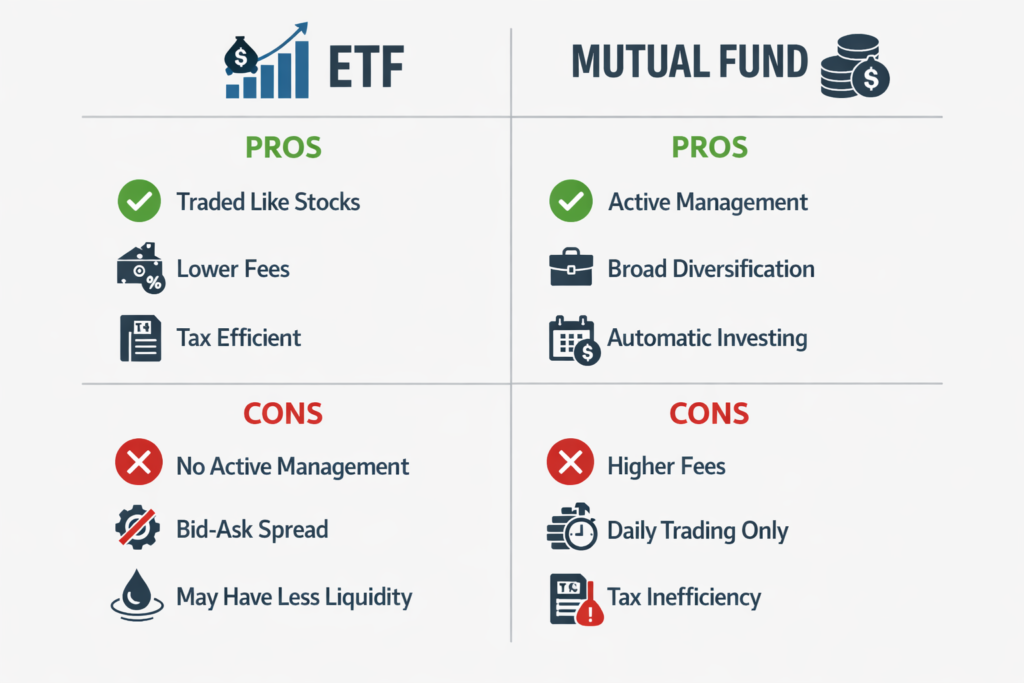
3. Pick Your ‘Vehicle’ You have two main ways to buy the S&P 500. Both get you to the same place, just differently:
ETFs (The popular choice): These trade like stocks. You can buy them instantly anytime the market is open. Look for tickers like VOO, IVV, or SPY.
Index Mutual Funds (The classic choice): These trade once a day after the market closes. They are great for automatic investing. Look for tickers like FXAIX or SWPPX.
My take: If you want to start with $5, go with an ETF. If you want to automate everything in an IRA, mutual funds are often smoother.
4. The 3-Second Quality Check Do not overthink this. When picking a fund, just look at these two things:
Expense Ratio: This is the fee. You want this as close to 0.00% as possible. Anything under 0.05% is a green light.
Provider: Stick to the big guys (Vanguard, BlackRock/iShares, Fidelity, Schwab). They are too big to fail and super cheap.
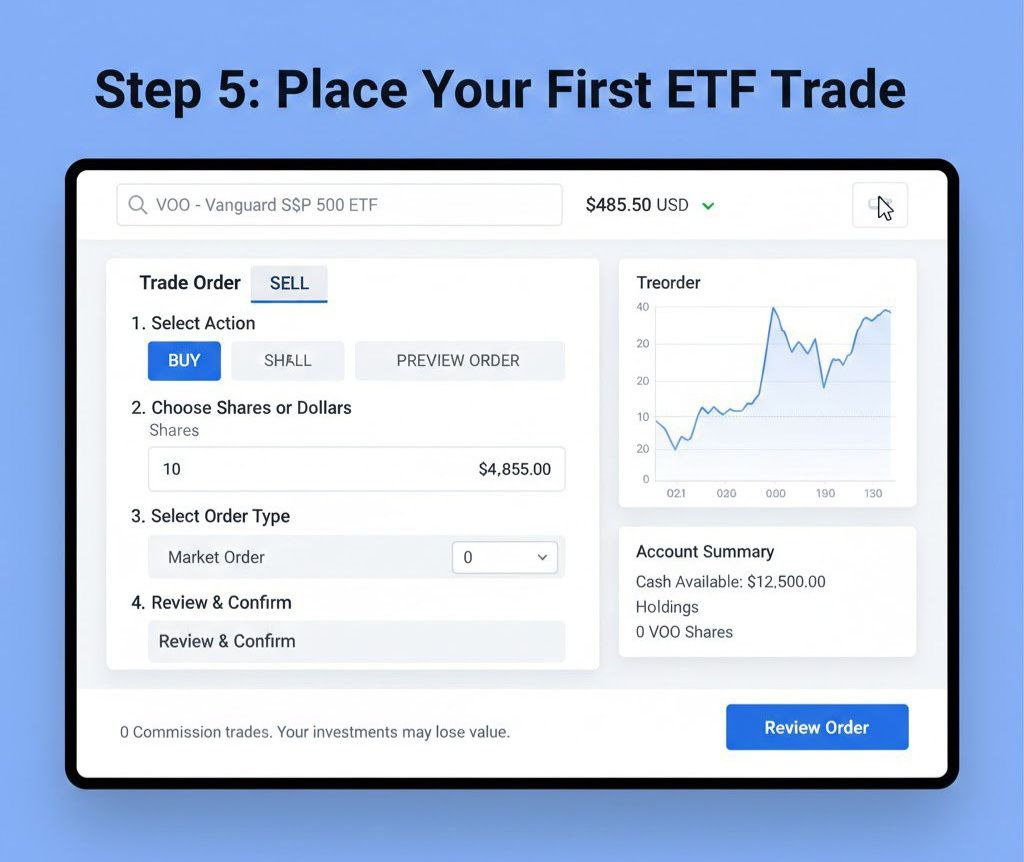
5. Pull the Trigger This is the part that scares people, but it is easy.
For ETFs: Search for the symbol (e.g., ‘VOO’), click ‘Buy,’ and select ‘Market Order’. This tells the broker, ‘Just get me in at the current price.’
For Mutual Funds: You just enter the dollar amount you want to invest (e.g., ‘$500’) and hit submit. It will execute at the end of the day.
6. Put It on Autopilot This is the secret to getting wealthy.
Recurring Buys: Set your account to automatically buy more shares every month. You buy more when the market is down (cheap) and less when it is up (expensive). It is called ‘Dollar-Cost Averaging,’ but I just call it ‘smart.’
Turn on ‘DRIP’: Find the setting for ‘Dividend Reinvestment.’ When the S&P 500 companies pay you dividends, this automatically uses that cash to buy more shares for you. It is a snowball effect that builds massive value over time.
Boom, you are done. You now own a slice of the 500 biggest companies in America. Now, the hardest part: do not touch it.“
ETF vs. Index Fund vs. Other Vehicles
There are a few ways to skin this cat but honestly most of them lead to the same place. Here is how to figure out which ride is right for you:
1. The S&P 500 ETF (The Modern Favorite)
Think: VOO, IVV, SPY.
The Vibe: These trade exactly like stocks. You can buy or sell them instantly in the middle of the day.
Why You will Love It: They are super flexible and usually the cheapest option. Thanks to fractional shares you can buy into these with just the spare change in your pocket—no need to save up thousands first.
The Catch: You need a brokerage account, but that is barely a hurdle these days.
Best For: People starting with small amounts or anyone who wants total control over when they buy and sell.
2. The Index Mutual Fund (The Old Reliable)
Think: FXAIX, SWPPX, VFINX.
The Vibe: These only trade once a day, after the market closes. It is less ‘fast-paced’ than an ETF.
Why You will Love It: They are perfect for automation. You can set them up to pull $100 from your bank and buy shares automatically every month without you lifting a finger.
The Catch: Some (though not all) might require a minimum investment, like $3,000, to get started. Also, make sure you buy a Fidelity fund in a Fidelity account (or Vanguard in Vanguard) to avoid annoying transaction fees.
Best For: The ‘set it-and-forget-it’ crowd, especially in retirement accounts.
3. Robo-Advisors (The ‘Do It For Me’ Option)
Think: Betterment, Wealth front.
The Vibe: You just deposit money, and a computer builds the whole portfolio for you including the S&P 500, plus maybe some bonds or international stuff.
The Catch: You pay for the convenience. They usually charge an extra fee (around 0.25%) on top of the fund fees.
Best For: People who are totally hands-off and don’t mind paying a little extra to never look at a chart.
4. Buying Individual Stocks (The Headache)
The Vibe: Trying to buy all 500 companies yourself, one by one.
My Advice: Don’t do this. It is a logistical nightmare, expensive, and a tax headache. Just buy the fund and save your sanity.
5. Your Work 401(k) (The Easy Button)
The Vibe: If your job offers a plan, look for something called a ‘Large Cap Index’ fund. It’s almost certainly the S&P 500 in disguise.
Why You will Love It: It comes straight out of your paycheck before you can spend it. Plus, no commissions.
The Bottom Line: For 99% of people starting out, it’s a coin toss between the ETF and the Index Mutual Fund.
Want to start with $50 and trade whenever? Go ETF.
Want to set up an auto-draft and never think about it again? Go Mutual Fund.
Sample Investing Portfolios (Asset Allocation Examples)
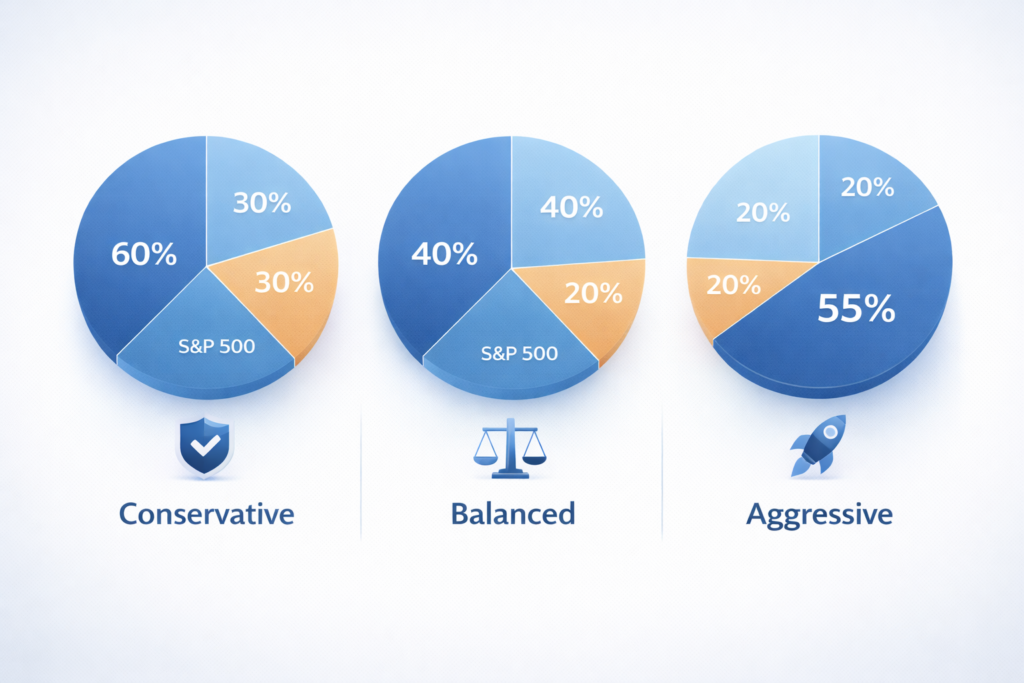
The ‘Play It Safe’ Mix (Conservative)
The Split: 60% S&P 500 / 40% Bonds.
Why do it? You want to grow your money, but you also want to sleep at night. If the stock market takes a 30% dive, those bonds act like a shock absorber so your whole account doesn’t tank.
The ‘Sweet Spot’ Mix (Balanced)
The Split: 80% S&P 500 / 20% Bonds or Cash (or throw in 10% International stocks).
Why do it? This is the middle ground. The stocks are doing most of the heavy lifting for growth, while the rest adds enough of a safety net so you are not totally exposed to the whims of the market.
The ‘Full Send’ Mix (Aggressive)
The Split: 100% Stocks (80% S&P 500 + 20% International).
Why do it? You are playing the long game like 20+ years. You are aiming for maximum growth and you are totally fine with the market swinging wildly in the meantime because you know you are not touching it for a long time.
The Real Talk: There is no one-size-fits-all here. If you are young and have decades until retirement, you can usually afford to go heavier on stocks. If you’re planning to buy a house or retire soon, you will want to lean more on bonds.
For example, if you had $10k to drop today:
Safe: $6,000 in S&P / $4,000 in Bonds.
Balanced: $8,000 in S&P / $2,000 in Bonds.
Aggressive: All $10,000 in stocks (maybe split $8k U.S. and $2k International).
The trick is finding what lets you stay invested without panicking. You can always tweak the recipe once a year as your life changes.
Common Beginner Mistakes (And How to Avoid Them)
- Trying to time the market is a losing game. Seriously, even the guys in suits on Wall Street get it wrong. We all want to buy the dip and sell at the peak, but in reality, you usually just end up missing the best days. The real “secret sauce” isn’t about being a genius at timing—it’s just about being patient and staying in the game as long as possible.
Stop stalking your account. If you’re checking your balance every single morning, you’re just asking for a panic attack. The market is going to wiggle every day; that’s just what it does. If you’re in this for the next decade or two, what happens on a random Tuesday literally does not matter. Save yourself the stress and just check in once or twice a year.
Don’t let the headlines freak you out. Financial news is basically clickbait. It’s designed to make you feel like the world is ending or that you’re missing out on a “once-in-a-lifetime” moonshot. Don’t fall for it. Have a plan—like “I’m staying put even if things get rocky”—and stick to it no matter what the news cycle says.
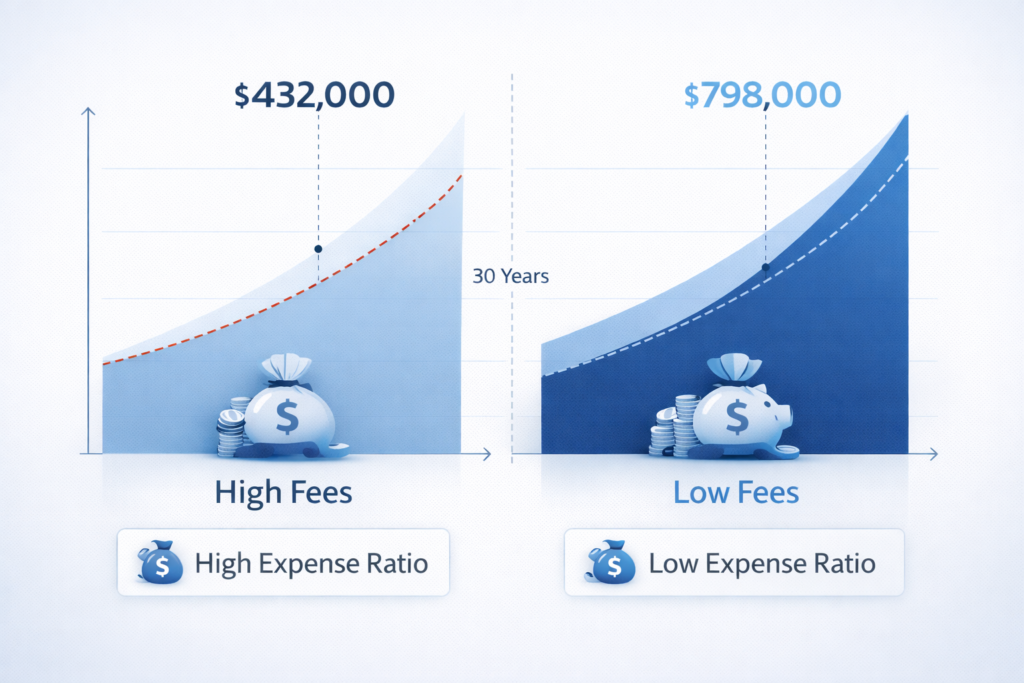
Watch those “tiny” fees—they add up. People overlook a 0.5% fee because it sounds small, but it’s like a slow leak in your tire. Compared to a 0.03% fund, that extra half-percent can eat up tens of thousands of dollars of your profit over time. Don’t leave that money on the table; always go for the cheapest fund that gets the job done.

Don’t bet everything on just one horse. Look, the S&P 500 is great because it spreads your risk across 500 companies, but it’s still just big U.S. companies. It’s okay to start there, but eventually, you’ll want to branch out into international stuff or bonds so you aren’t totally reliant on one single corner of the world.
Keep your “life money” out of the market. This is huge: don’t invest the money you need for rent, groceries, or car repairs. If the market takes a dive right when you need to pay a bill, you’ll be forced to sell your shares for less than you paid. Keep your emergency cash in a boring old savings account where it’s safe and ready when life happens.
Fee and Expense Considerations
Fees are the sneaky part of investing. You might think a low-cost fund is basically free, but there’s always a little bit of friction if you aren’t looking for it. Here’s what you actually need to keep an eye on:
The Expense Ratio: This is the big one. It is the annual fee the fund takes to keep the lights on. You want this as close to zero as possible. Stick with the rock-bottom options like Vanguard’s VOO (0.03%) or Fidelity’s FXAIX (0.015%). If you are paying more than, say, 0.05% for a basic S&P 500 fund in 2026, you’re basically donating your future profits to the bank for no reason.
Taxes (Beginner’s Guide)
Taxes are the boring part but if you do not pay attention, Uncle Sam can end up being your most expensive “partner.” Here is how the tax man looks at your S&P 500 funds:
If you are using a regular brokerage account (Taxable):
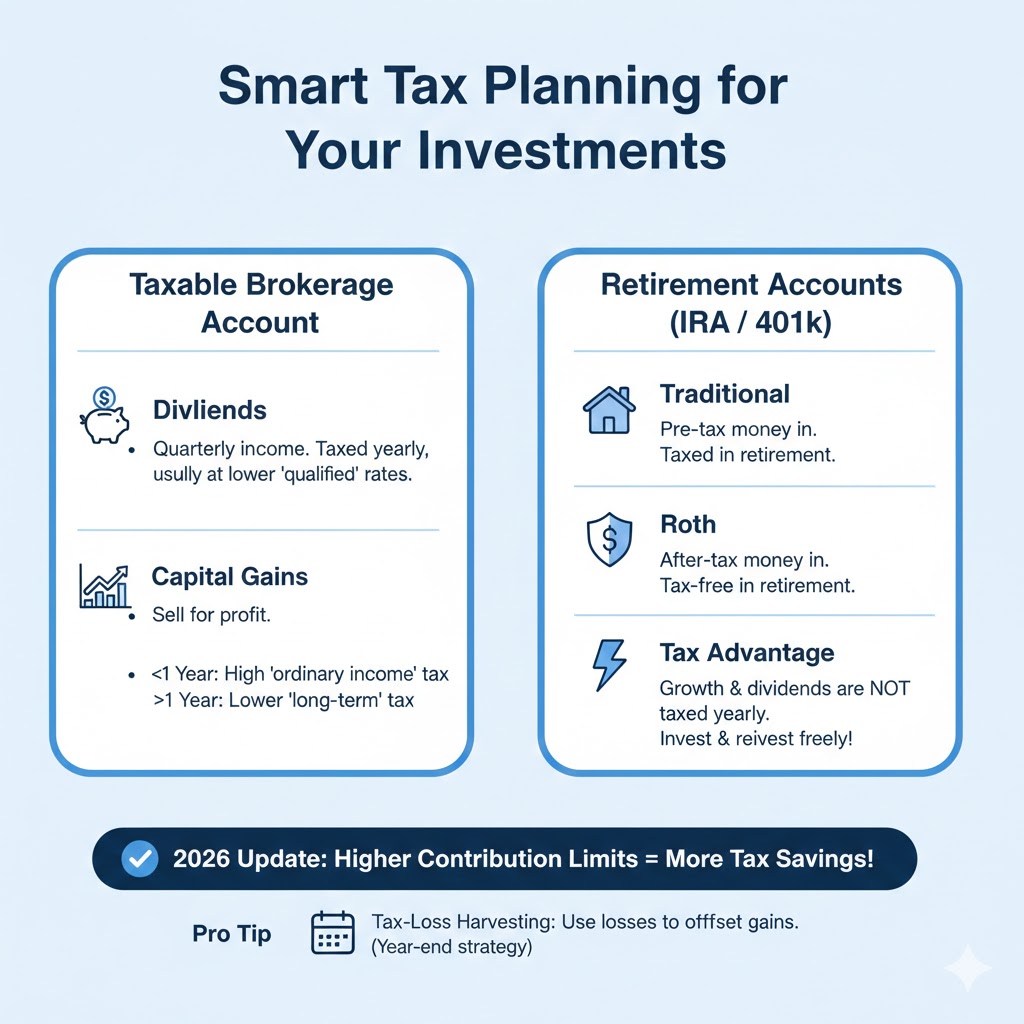
Dividends: The S&P 500 usually cuts you a check every three months. Even if you have “DRIP” turned on and reinvest that money immediately, the IRS still counts it as income. The silver lining? They are usually “qualified dividends,” so you get a bit of a tax break on them compared to your normal paycheck.
Selling for a Profit: This is where your timing matters. If you hold your shares for over a year before selling, you are in “long term capital gains” territory, which is a much lower tax rate. If you flip them in less than a year, you are going to be taxed at the same high rate as your salary.
ETF Advantage: In a regular account, ETFs are usually “cleaner” because they are built to avoid hitting you with surprise tax bills at the end of the year, unlike some mutual funds.
If you are using a Retirement Account (IRA or 401k):
Traditional vs. Roth: With a Traditional account, you might get a tax break today, but you’ll pay the IRS when you withdraw in retirement. With a Roth, you pay your taxes now, but every penny you make from the S&P 500 is 100% tax-free later on.
No “Tax Drag”: The best part of these accounts is that you can buy, sell, and collect dividends all you want without worrying about a tax bill this year. It lets your money snowball much faster.
The 2026 Reality Check: The limits have gone up again this year. You can now stash $7,500 into an IRA (plus an extra $1,000 if you’re 50+) and a whopping $24,500 into your 401(k).
One last pro tip: If you’re using a regular brokerage account, look into “tax-loss harvesting” at the end of the year. It’s basically a way to use your “loser” stocks to cancel out the taxes on your “winners.” And always, always keep track of what you paid for your shares your “cost basis” so you do not accidentally overpay the IRS when it’s time to cash out.
Transaction Fees: Most big-name brokers moved to $0 commissions a long time ago. If your broker is still trying to charge you $5 or $10 every time you hit the “buy” button, it’s time to move your money somewhere else. Just double-check that there aren’t any weird “hidden” fees tucked away in the fine print.
The “Spread” (for ETFs): When you buy an ETF, there is a tiny gap between what people are selling for and what you are paying—that is the bid-ask spread. If you stick with the giants like SPY or VOO, they are so popular that this gap is basically zero. But if you pick some obscure, low-volume fund, you might lose a little bit of money every time you trade just because nobody else is buying it.
Stay Away from “Loads”: Avoid anything called a “sales load.” That is just a fancy old-school word for a commission that goes straight into a broker’s pocket. No legit S&P 500 index fund should charge you a fee just to get in or out of the door.
Account Maintenance Fees: Lastly, check the account itself. In 2026, you should not be paying a “membership fee” just to have an investment account. Most major places charge exactly $0 for the privilege of holding your money.
It might feel like we are nitpicking over tiny fractions of a percent, but over 30 years, a 0.1% difference in fees can eat up tens of thousands of dollars. Being a “cheap” investor is actually the smartest way to play the game.
2026-Specific Updates
It is 2026, and the game has changed a bit. Here’s what’s actually different right now:
First off, the government is letting you stash more away for retirement. You can now put up to $7,500 in an IRA and $24,500 in your 401(k)—definitely try to hit those numbers if you can to keep the tax man away. Also, you do not need to be rich to start anymore. Most brokers let you buy “fractional shares” now, so if an ETF share costs $500 but you only have $50, you can still buy a piece of it and get started today.
If you are looking to save every single penny, keep an eye out for “Zero-Fee” funds. Fidelity, for example, has been making waves with funds that literally have a 0% expense ratio. If you are thinking about using a Robo-advisor, just remember you are paying for the convenience they usually tack on an extra 0.25% to 0.50% in fees on top of whatever the funds cost.
One big thing to watch in 2026: the S&P 500 is really heavy on tech right now. Since those big tech giants make up such a huge chunk of the index, it might be worth throwing in some “value” stocks or international funds just to make sure you are not puting all your eggs in one (digital) basket.
Things move fast, so always do a quick gut-check on the latest fees and yields on sites like Vanguard or Fidelity before you put your money down.
Managing Volatility and Risk
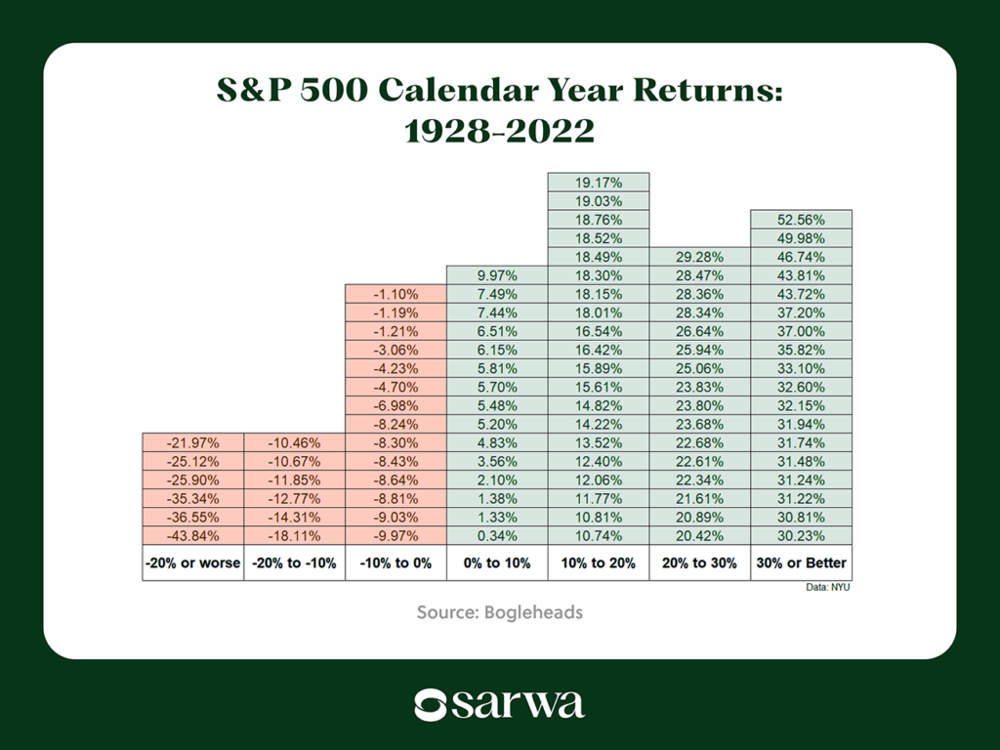
Look, let’s be real: the S&P 500 is a total roller coaster. If you look at the history going all the way back to 1928, it’s a sea of bright green years where everyone feels like a genius, and deep red years where everyone wants to hide under their bed.
The biggest mistake you can make? Panic-selling. When the market drops, your gut instinct is to “get out before it hits zero,” but that’s exactly how you lose. Historically, if you miss even just a few of those big “bounce-back” days because you were sitting on the sidelines in cash, your long-term returns take a massive hit. Sometimes the best thing you can do for your money is… absolutely nothing.
A couple of things to keep your sanity:
- Rebalance once a year: Think of this as your annual tune-up. If your plan was to have 80% stocks and 20% bonds, but the S&P 500 had a monster year, you might suddenly be at 90% stocks. Rebalancing just means selling a little of what’s up and buying what’s down. It’s a built-in way to “buy low” without having to overthink it.
Keep your eyes on the horizon: If you’re investing for retirement 20 years from now, why are you stressed about what the market did this afternoon? Remind yourself of the goal.
Expect the chaos: Remember 2022? It was a bloodbath—down about 20% or 30%. But we’ve also seen years where it rips up 50%. This volatility isn’t a sign that something is “broken”—it’s just the price of admission for long-term growth.
Over the decades, the trend has always been up. You just have to stay in your seat while the ride is moving.
Frequently Asked Questions
You can start with almost any amount. Thanks to fractional shares, even $100 (or less) can be invested in S&P 500 ETFs. The important part is to start and then build up regularly.
ETFs (like SPY or VOO) are great if you want intraday trading or have a taxable account (tax-efficient). Index mutual funds (like Vanguard 500 Index Fund) are fine for IRAs/401(k)s and can auto-invest dividends. Both track the same stocks and should return essentially the same long-term performance
You could, but it’s inefficient. You’d need to buy all 500 stocks in proportion, rebalance quarterly, and pay many trade commissions. This is only practical for institutional investors, not beginners.
If you have a lump sum, market timing is a factor. Studies often show lump-sum wins slightly on average, but DCA reduces regret. For beginners, regular DCA (e.g. monthly) is a safe, disciplined approach, especially in uncertain markets.
No one knows the market’s peak or trough. Historically, staying invested is more important than trying to outguess the market top. If you have long-term goals (5+ years), starting now is usually better than waiting for a dip.
Yes, but through international brokerages or international ETFs (e.g. Vanguard S&P 500 UCITS ETF for EU). Remember currency risk and tax differences. The core concept is the same: low-cost fund tracking the index.
Infrequently. For long-term investments, checking quarterly or semi-annually is plenty. Daily or even monthly checking can lead to overtrading.
Yes. The companies in the S&P 500 pay dividends, and index funds pass these to shareholders (often automatically reinvested if you enable DRIP). As of mid-2025, the index yield was around ~1.2%.
In taxable accounts, you’ll owe tax on dividends each year and on gains when you sell. In retirement accounts, these grow tax-deferred (or tax-free for Roth). If using a taxable account, consider a tax-efficient broker and consult a tax advisor if unsure.
If you have an employer match in a 401(k), contribute to get the full match first (it’s free money). IRAs (especially Roth IRAs) are great too. The choice also depends on your tax situation. Many do both: max match, then IRA, then extra in taxable.
Checklist: What to Do Before Buying an S&P 500 Fund
- Emergency Fund: 3–6 months of expenses saved.
- Debt: Paid off high-interest debt first.
- Broker Account: Open a low-cost broker (Vanguard, Fidelity, Schwab, etc.).
- Retirement Accounts: Max out 401(k) match, consider IRA (2026 limit $7,500).
- Research Funds: Compare top S&P funds (e.g. VOO, SPY, IVV, FXAIX, SWPPX). Check expense ratios and track record.
- Set Goals: Decide how much to invest now and regularly. Align investments with timeline.
- Plan Discipline: Decide you will stay invested long-term, and set up automation (recurring buys, DRIP).
Completing this list ensures you’re ready to buy and hold smartly.
Final Thoughts
Investing in the S&P 500 is a powerful starting point for beginners, but it’s just one piece of a broader financial plan. Follow the steps above, use low-cost funds, and keep your focus long-term. By doing so, you put yourself on track to benefit from decades of U.S. economic growth — without spending years picking individual stocks or fearing every market fluctuation.
Remember: Time in the market beats timing the market. Start early, stay disciplined, and let the broad market work for you. Good luck on your investing journey!
Disclaimer:
The information provided in this article is for educational purposes only and should not be considered as financial advice. Always consult with a financial advisor or credit counselor before making any significant decisions regarding debt repayment or financial strategies. The strategies discussed may not be suitable for everyone and results may vary depending on individual circumstances.