


Introduction: Clearing Up the Confusion
When U.S. investors compare Roth IRA vs. S&P 500, they are often comparing two different things. A Roth IRA is a tax-advantaged retirement account, while the S&P 500 is a stock market index representing 500 of the largest U.S. companies.
The simplest way to look at it is: The Roth IRA is the “container” (the bucket), and the S&P 500 is the “investment” (the water) that you put inside that bucket. In this article, we’ll explain why using a Roth IRA to invest in the S&P 500 is one of the most powerful wealth-building strategies for Americans.
What Is a Roth IRA?
A Roth IRA (Individual Retirement Account) is a retirement savings tool available to U.S. taxpayers. It allows you to contribute after-tax dollars (money you’ve already paid taxes on), and in return, your investments grow tax-free.

Key Benefits for U.S. Investors:
-
Tax-Free Growth: You don’t pay taxes on capital gains or dividends every year.
-
Tax-Free Withdrawals: Once you reach age 59½ and have held the account for 5 years, every dollar you take out is 100% tax-free.
-
Flexibility: You can withdraw your original contributions (but not earnings) at any time without taxes or penalties.
2026 Contribution Limits (IRS):
-
$7,000 if you are under age 50.
-
$8,000 if you are 50 or older.
What Is the S&P 500?
The S&P 500 is an index that tracks the performance of 500 of the largest publicly traded companies in the United States (like Apple, Microsoft, and Amazon). It is considered the gold standard for measuring the health of the U.S. stock market.

Investors don’t “buy” the index itself; instead, they buy Index Funds or ETFs (like VOO or SPY) that mirror the S&P 500. Historically, the S&P 500 has delivered an average annual return of about 10% over the long term.
Roth IRA vs. Taxable Brokerage: Which is Better for S&P 500?
Many investors wonder if they should invest in the S&P 500 through a Roth IRA or a standard Taxable Brokerage Account (like Robinhood, E*TRADE, or Fidelity).
| Feature | Roth IRA | Taxable Brokerage |
| Taxes on Dividends | None (Tax-Free) | Taxed annually |
| Taxes on Profit | None (Tax-Free) | Capital Gains Tax (15-20%) |
| Contribution Limit | $7,000/year (under 50) | No limit |
| Withdrawal Rules | Best for retirement | Withdraw anytime |

The Verdict: If you are saving for the long term, the Roth IRA is superior because “tax drag” in a brokerage account can cost you hundreds of thousands of dollars in potential growth over 30 years.
The Power of Tax-Free Compounding (Example)
Let’s compare investing $500 a month for 30 years at an 8% annual return:
In a Roth IRA: Your total would grow to approximately $745,000. Because it’s a Roth IRA, you keep the full amount.
In a Taxable Account: After paying annual taxes on dividends and capital gains (assuming a 1% “tax drag”), your total might only be $610,000.
By using a Roth IRA, you save over $135,000 in taxes!
Top 3 S&P 500 Funds for U.S. Investors
If you have a Roth IRA, you can buy these low-cost S&P 500 funds inside it:
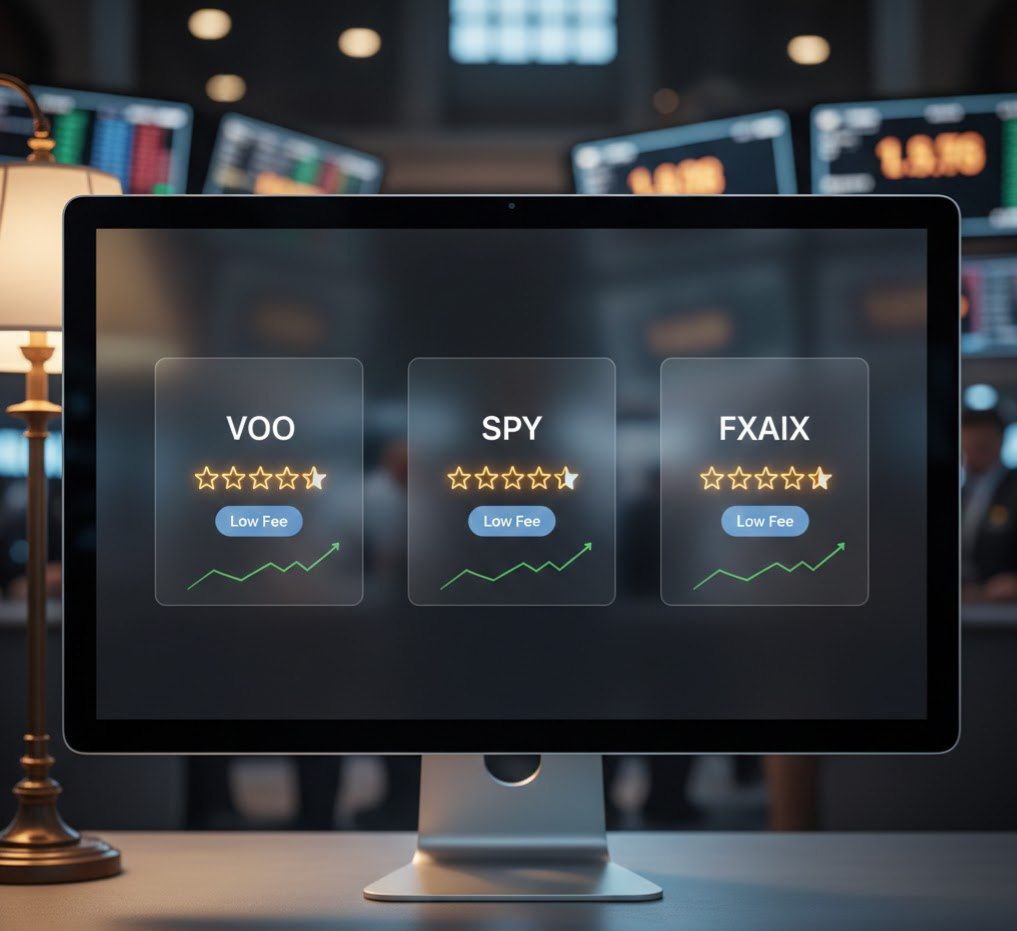
VOO (Vanguard S&P 500 ETF): Extremely low expense ratio (0.03%).
FXAIX (Fidelity 500 Index Fund): One of the cheapest options available (0.015%).
SPY (SPDR S&P 500 ETF): The most famous and highly liquid S&P 500 ETF.
Real-Life Example: The "Either/Or" Mistake
A common mistake is thinking you have to choose either a Roth IRA or the S&P 500.
Wrong: “I’m not sure if I should pick the Roth IRA or the S&P 500.”
Right: “I am opening a Roth IRA account and using it to buyS&P 500 index funds.”
Sources
IRS. (2026). “Roth IRAs.” IRS.gov (accessed January 2026).
S&P Dow Jones Indices. (2021). “S&P 500 Index Overview.” spglobal.com (accessed January 2026).
Conclusion
The Roth IRA vs. S&P 500 debate is simple: Use the Roth IRA as your vehicle and the S&P 500 as your engine. For U.S. investors looking to build long-term wealth, this combination offers the best balance of growth and tax efficiency.
FAQs
Yes. A Roth IRA is just an account. If the stocks or funds inside it (like the S&P 500) go down in value, your account balance will drop.
Yes, you can invest in the S&P 500 through a 401(k), a Traditional IRA, or a standard taxable brokerage account.
Most U.S. residents with earned income are eligible. However, if you earn more than $161,000 (single) or $240,000 (married filing jointly) in 2024, your ability to contribute directly is limited (though you can look into a “Backdoor Roth IRA”).
The earlier, the better! Because of compound interest, a 20-year-old who invests $100 a month will often end up with more money than a 40-year-old who invests $500 a month.
Disclaimer:
The information provided in this article is for educational purposes only and should not be considered as financial advice. Always consult with a financial advisor or credit counselor before making any significant decisions regarding debt repayment or financial strategies. The strategies discussed may not be suitable for everyone and results may vary depending on individual circumstances.