


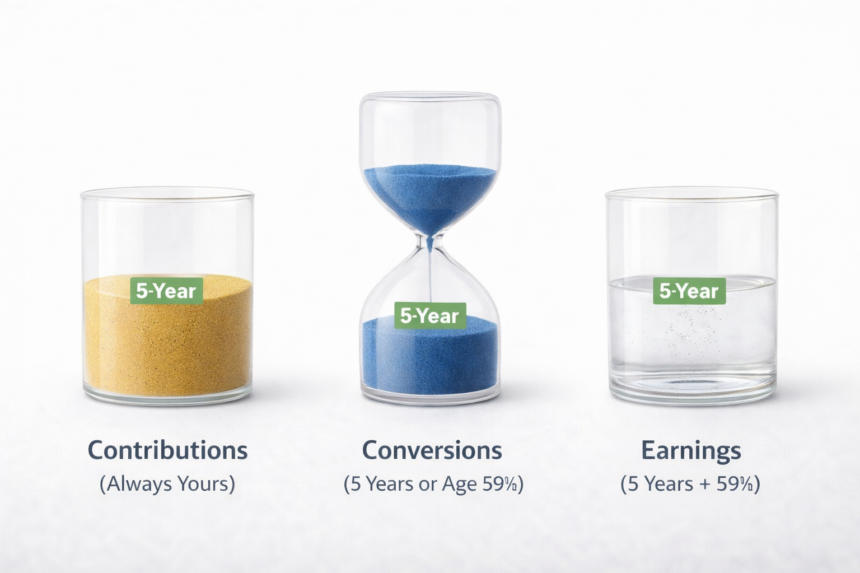
Mini Summary: Roth IRA 5-Year Rule
The Roth IRA “5-year rule” is actually three separate rules: your contributions can always be withdrawn tax-free and penalty-free at any time, your investment earnings need both a 5-tax-year account age and age 59½ (or an exception) to come out tax-free, and each Roth conversion has its own 5-year penalty window that only matters if you’re under 59½—after that age, conversion penalties disappear entirely, making the conversion rule mostly irrelevant for people near traditional retirement age, while inherited Roths use the original owner’s timeline regardless of the beneficiary’s age, meaning the real magic numbers are reaching 59½ (which eliminates most penalty concerns) and having a 5-year-old account (which makes earnings tax-free when combined with age 59½).
You’ve probably heard about the Roth IRA five-year rule. Maybe your financial advisor mentioned it. Maybe you read about it online and got more confused. Here’s the thing—most explanations make this sound like one simple rule, and that’s where people go wrong.
There aren’t actually “five-year rules.” There are three separate timing requirements, and they govern completely different parts of your money. Get them mixed up, and you might pull cash out thinking you’re in the clear, only to face penalties or taxes you didn’t expect.
Let’s fix that.
Why Everyone Gets This Wrong (And Why It Matters to Your Money)
The confusion starts with the name itself. When people hear “the five-year rule,” they assume there’s one clock ticking down somewhere. Open a Roth IRA, wait five years, done. Everything’s tax-free after that, right?

Not quite.
Here’s what actually happens: You’ve got separate rules governing your contributions, your conversions, and your earnings. Each one has different waiting periods. Each one triggers different tax consequences if you mess it up. And to make things interesting, your age—specifically whether you’ve hit 59½—changes how these rules apply.
I’ve seen people in their early 60s panic about making new contributions, convinced each deposit locks their money away for another five years. I’ve also seen folks do Roth conversions at 58, thinking they’re being clever, then realize they’ve created a penalty trap for themselves.
The stakes are real. We’re talking about 10% penalties on top of ordinary income taxes in some cases. That’s not pocket change.
Let’s Clear This Up: The Roth IRA Has THREE Separate 5-Year Rules
So here’s the framework. These aren’t three variations of the same rule—they’re completely different requirements that happen to share a five-year timeline.
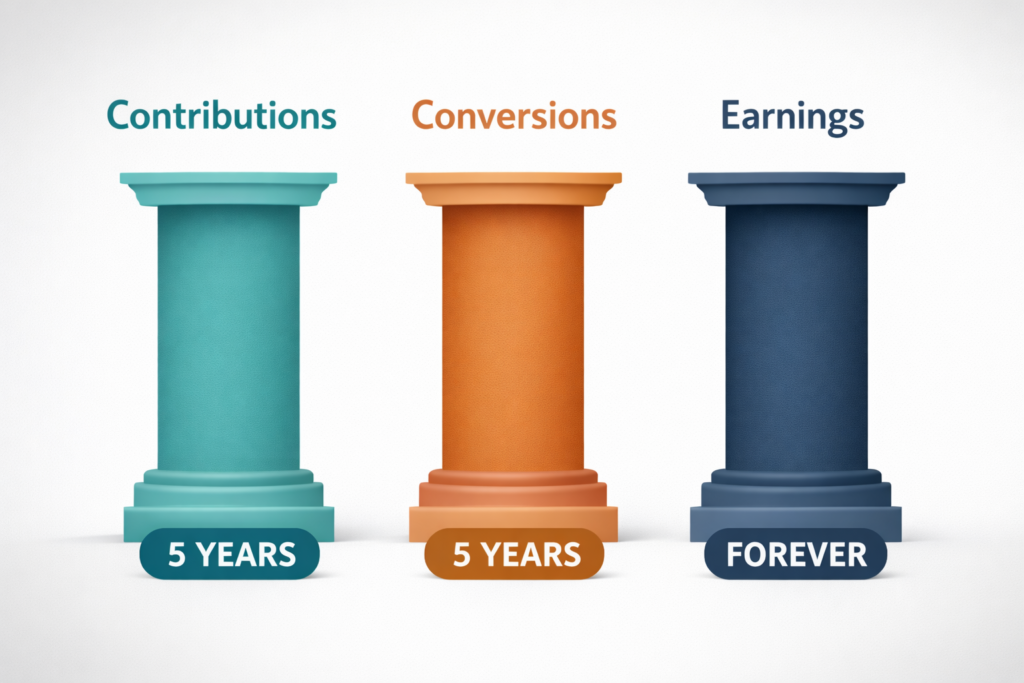
Rule 1: The Five-Year Rule for Contribution Earnings
This one governs when the growth on your contributions becomes tax-free. Notice I said growth, not contributions.
The clock starts on January 1 of the tax year when you made your first Roth IRA contribution. Doesn’t matter if you actually deposited the money in April or December—the IRS uses January 1 as your starting line.
Let’s say you open a Roth IRA in March 2026 and contribute $7,000. Your five-year clock started on January 1, 2026. By January 1, 2031, you’ve satisfied this requirement for earnings, assuming you’re also 59½ or older by then (or you meet one of the exceptions we’ll get to).
Here’s the critical part most people miss: This rule only affects your investment earnings. Your actual contributions? Those are always accessible without taxes or penalties, which brings us to our next point.

Rule 2: The Five-Year Rule for Each Conversion
This is where things get messy, especially if you’ve done multiple conversions.
When you convert traditional IRA money to a Roth IRA, you pay taxes on that conversion in the year it happens. The five-year rule for conversions doesn’t determine whether you owe taxes—you already paid those. Instead, it determines whether you’ll face a 10% early withdrawal penalty if you pull that converted money out before the waiting period ends.
And here’s the kicker: Each conversion has its own separate five-year clock
Convert $30,000 in 2023? That amount becomes penalty-free in 2028. Convert another $30,000 in 2025? That batch won’t clear until 2030. If you’ve been doing annual conversions, you’ve essentially created multiple buckets, each aging on its own schedule.
But there’s good news. Once you turn 59½, all conversion penalties disappear regardless of how recently you converted. We’ll dig into why that matters in a minute.

Rule 3: The Five-Year Rule for Inherited Roth IRAs
Inherit a Roth IRA from someone, and you’re working with their timeline, not yours.
Let’s say your parent opened a Roth IRA in 2022 and passed away in 2026. Even if you’re 65 years old yourself, you can’t withdraw earnings tax-free yet because the original account hasn’t hit its five-year mark. You’ll need to wait until 2027 (five years from when they first contributed) before earnings become tax-free.
Your age doesn’t shortcut this requirement. You’re bound to the original owner’s account birthday.
Now here’s where it gets complicated with the new rules: Beneficiaries often have to empty inherited Roth IRAs within 10 years. If your parent’s account was only three years old when you inherited it, you might be withdrawing taxable earnings during those first couple years, even though you’re otherwise depleting the account as required.
What You Can Actually Withdraw Right Now (Without Waiting)
Let’s talk about what money is always yours for the taking.
Your Contributions: Always Available, No Waiting
This is the most reassuring part of Roth IRAs, and somehow it gets lost in all the rule discussions.
Every dollar you contributed to your Roth IRA can be withdrawn at any time, at any age, for any reason. No taxes. No penalties. No five-year waiting period.
Contributed $7,000 each year for the past ten years? That’s $70,000 you can access immediately if you need to. The government already taxed that money before you put it in the Roth, so they’re not going to tax it again on the way out.
The five-year rules only govern the profits those contributions have earned—the growth from investments. And here’s how the IRS makes this work in your favor.

The Withdrawal Order That Protects You
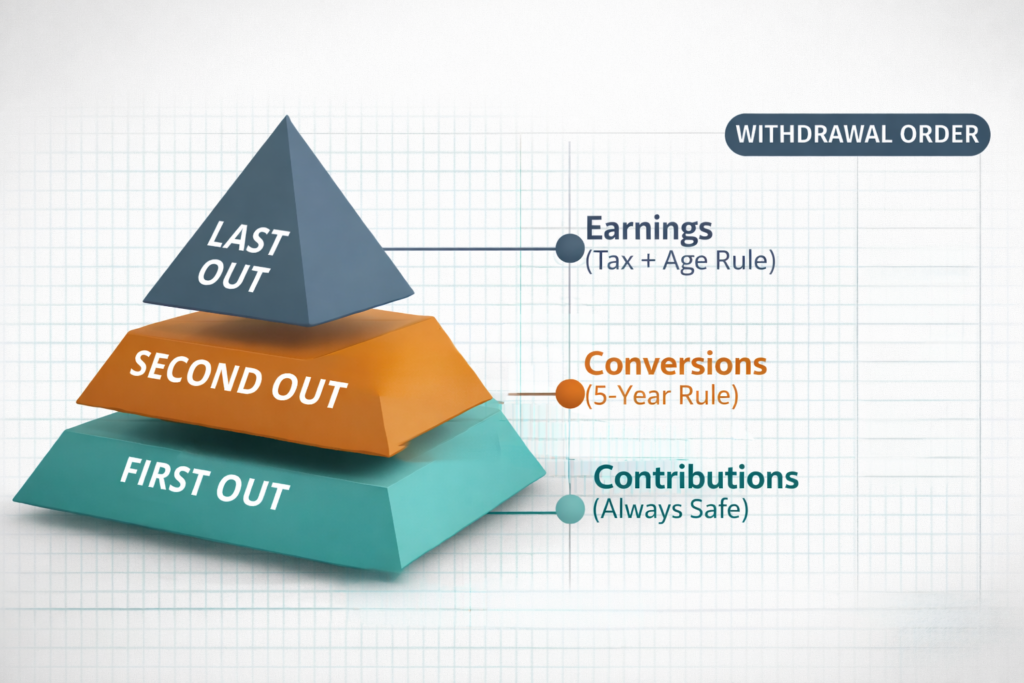
When you take money from a Roth IRA, the IRS has a specific order for what comes out first:
- Your regular contributions
- Your converted amounts (oldest conversions first)
- Your earnings
This ordering rule is actually designed to protect you. It means the money most likely to trigger taxes or penalties comes out last.
So if you’ve contributed $50,000 over the years and your account has grown to $80,000, you can pull out that entire $50,000 contribution base without touching the $30,000 in earnings. No taxes, no penalties, no waiting.
The Age 59½ Game-Changer Most Articles Bury
Here’s what changes everything: Turning 59½ eliminates most of your penalty concerns.
A lot of articles treat age 59½ as just another requirement you need to meet alongside the five-year rules. But it’s more powerful than that. Once you hit this age, the conversion penalty rules basically stop mattering.

Why 59½ Eliminates Most Penalty Worries
Remember those conversion rules where each converted amount has its own five-year penalty window? After 59½, that’s done.
You could do a $100,000 conversion at age 60 and withdraw it the next day without any penalty. The conversion five-year rule only triggers the 10% early withdrawal penalty, and “early withdrawal” is defined as before 59½. After that age, there’s no such thing as an early withdrawal, so there’s no penalty.
This is huge for people planning conversions in their late 50s or early 60s. If you’re 58 and convert $50,000, yes, you’ve technically started a five-year penalty clock. But in 18 months, you’ll be 59½ and that penalty clock becomes irrelevant. You don’t actually have to wait the full five years.
I’ve seen people twist themselves into knots trying to time conversions perfectly, not realizing that age is going to override the conversion timing anyway.
The Two Requirements for Completely Tax-Free Withdrawals
For earnings—the investment growth in your account—to come out completely tax-free, you need both:
- Your Roth IRA must be at least five tax years old
- You must be 59½ or older (or qualify for one of the specific exceptions)
Miss either requirement, and you’ll owe taxes on earnings. Meet both, and everything comes out clean.
So if you opened a Roth IRA at 30 and you’re now 58, you can withdraw contributions freely, but earnings would be taxable (though not penalized in certain circumstances). Once you hit 59½ with that same account, everything—contributions and earnings—becomes fully accessible without taxes or penalties.
Real-Life Scenarios: When the Rules Actually Bite (Or Don't)
Theory is fine, but let’s look at how this plays out with actual money.
Scenario 1: The Early Saver (Opened at 30, Now 58)
Someone opened a Roth IRA at 30 and has been contributing $6,000-7,000 annually. They’re 58 now, and the account has grown to $180,000. About $140,000 of that is contributions, the rest is earnings.
Right now, they can withdraw the entire $140,000 contribution base anytime they want. Zero taxes, zero penalties. Their account has been open way longer than five years, so that’s satisfied.
But if they tried to withdraw any of the $40,000 in earnings right now, they’d owe income tax on it—even though the account is old enough—because they’re not 59½ yet.
In 18 months when they turn 59½? The entire $180,000 (or whatever it’s grown to) becomes completely accessible without any taxes or penalties.

Scenario 2: The Late-Career Converter (Age 57, Just Converted $80,000)
This person is 57 and just converted $80,000 from a traditional IRA to a Roth. They paid taxes on the conversion already. Now they need that money for a down payment on a house.
Bad news: If they withdraw that $80,000 now, they’ll face a 10% penalty ($8,000) even though they already paid the income taxes. The conversion happened this year, so it hasn’t satisfied its five-year penalty window.
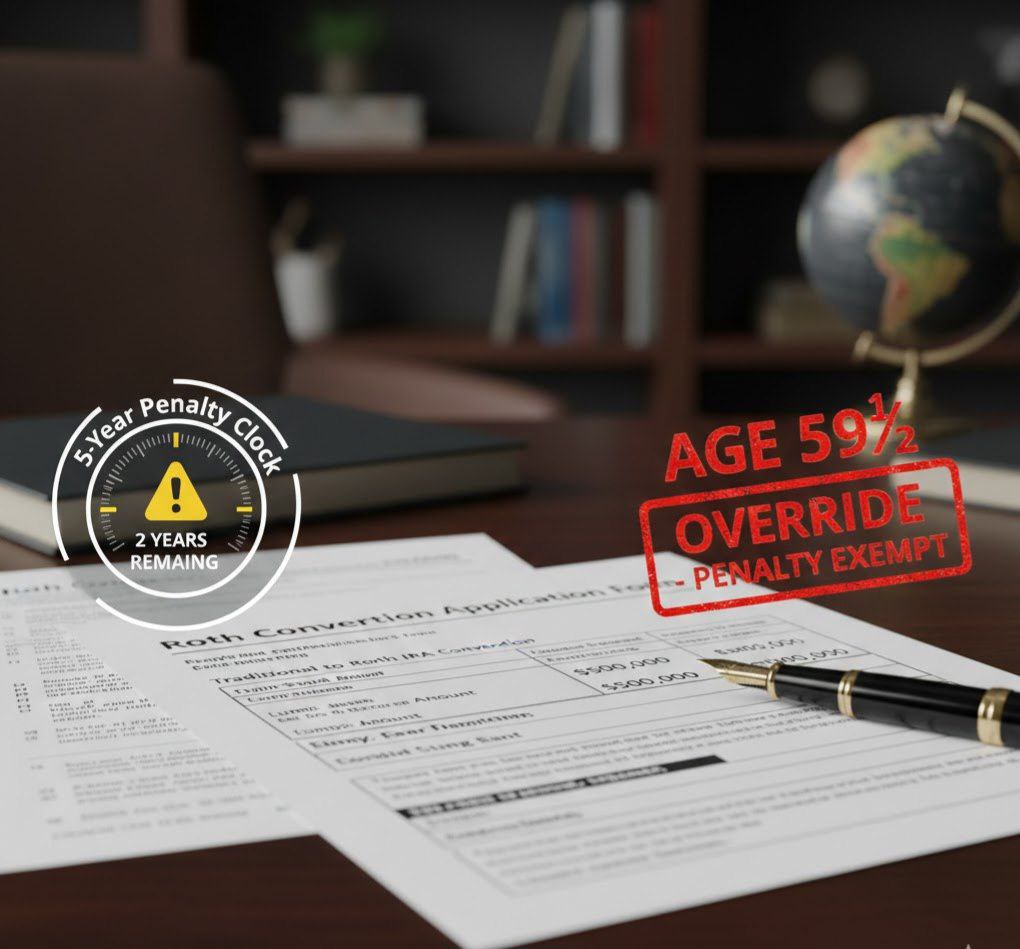
But here’s what they should know: They only have to wait until they’re 59½—about 2.5 years—not the full five years. At that point, the penalty disappears.
If they can delay the home purchase or fund it differently for 30 months, they save $8,000. That’s the kind of thing worth planning around.
Scenario 3: The Serial Converter (Multiple Conversions, Age 52)
Let’s say someone has been doing strategic Roth conversions every year. They converted $25,000 in 2023, another $25,000 in 2024, and just converted $25,000 in 2025. They’re 52 years old.
Each of those conversions has its own penalty timeline:
- 2023 conversion: penalty-free in 2028 (five years) OR when they turn 59½ in 2032, whichever comes first
- 2024 conversion: penalty-free in 2029 OR age 59½
- 2025 conversion: penalty-free in 2030 OR age 59½
Scenario 3: The Serial Converter (Multiple Conversions, Age 52)
Let’s say someone has been doing strategic Roth conversions every year. They converted $25,000 in 2023, another $25,000 in 2024, and just converted $25,000 in 2025. They’re 52 years old.
Each of those conversions has its own penalty timeline:
- 2023 conversion: penalty-free in 2028 (five years) OR when they turn 59½ in 2032, whichever comes first
- 2024 conversion: penalty-free in 2029 OR age 59½
- 2025 conversion: penalty-free in 2030 OR age 59½

The math works out differently depending on which bucket they pull from. If they needed money in 2029, they could withdraw the 2023 and 2024 conversions penalty-free (those five-year clocks have expired), but touching the 2025 conversion would trigger penalties.
In practice? They should just wait until 59½ when all penalty concerns disappear regardless of conversion dates.
This is why I’m not a huge fan of conversion laddering for people close to traditional retirement age. The penalty windows become mostly irrelevant once you hit 59½ anyway
Scenario 4: The Inheritor (Received Parent’s 3-Year-Old Roth)
Someone inherits a Roth IRA from a parent who opened it in 2023 and passed away in 2026. The beneficiary is 65 years old—well past 59½.
You’d think their age would mean tax-free access to everything. Not quite.
The account is only three years old (based on when the parent first contributed). Earnings withdrawn before 2028 would be taxable to the beneficiary, even though they’re 65. Their age doesn’t override the original owner’s timeline.
Regular contributions? Those can come out tax-free immediately. Converted amounts the parent made? Also accessible without penalty because the beneficiary is over 59½. But earnings? Taxable until the original account hits its five-year birthday.
And with the 10-year depletion rule for most inherited IRAs, this person might be forced to take taxable distributions of earnings during years one through three, then tax-free distributions after that.
Scenario 5: The Contribution Panicker (Worried New Deposits Lock Up)
I’ve talked to people in their 60s who stopped contributing to their Roth IRAs because they thought each new contribution would be locked away for five years.
That’s not how it works. The five-year clock for contribution earnings is based on your first contribution to any Roth IRA you’ve ever owned. Once that clock runs out, all future earnings become eligible for tax-free withdrawal (assuming you’re 59½+).
If you opened your Roth in 2015, every contribution you made from then on benefits from that 2015 start date. The account age applies to all contributions collectively, not individually.
So a 68-year-old who opened a Roth in 2010 can contribute $8,000 today and withdraw it tomorrow if they want. The contribution comes out penalty-free and tax-free. The earnings on that $8,000? Also tax-free eventually, because the account age requirement was satisfied back in 2015.
Exceptions That Let You Skip the Penalties (But Usually Not the Taxes)
The IRS does recognize that life happens. There are specific situations where you can withdraw earnings before meeting all the normal requirements without facing the 10% penalty.
When Penalties Disappear (Even Before Age 59½)
You can pull earnings out penalty-free (though potentially not tax-free) for:
First-time home purchase: Up to $10,000 lifetime. “First-time” means you haven’t owned a home in the past two years, so you might qualify even if you previously owned property.
Permanent and total disability: Pretty self-explanatory, but it has to meet IRS definitions.
Death: If you die, your beneficiaries can withdraw without penalties (though taxes on earnings may apply if the five-year account rule isn’t met).
Medical expenses: If you have unreimbursed medical bills exceeding 7.5% of your adjusted gross income, you can withdraw earnings to cover them penalty-free.
Health insurance premiums while unemployed: Lost your job? You can tap Roth earnings to pay health insurance premiums without penalty.
Qualified education expenses: College costs for yourself, your spouse, children, or grandchildren. This includes tuition, fees, books, supplies, and room and board for students enrolled at least half-time.
Substantially equal periodic payments (SEPP): This one’s complicated. You commit to taking regular distributions for five years or until you reach 59½, whichever is longer. Break the schedule, and you owe all the penalties you avoided plus interest.
IRS levy: If the IRS has levied your Roth IRA to collect unpaid taxes, those withdrawals aren’t penalized (though you’ve got bigger problems at that point).
The Critical Distinction: Penalty-Free ≠ Tax-Free
Here’s what trips people up: These exceptions eliminate the 10% penalty. They don’t necessarily eliminate taxes on earnings.
If your Roth IRA is only three years old and you’re 50, you can withdraw $10,000 of earnings penalty-free for a first home purchase. But you’ll still owe income tax on those earnings because your account hasn’t satisfied the five-year earnings rule.

Let’s put some numbers to it. Say you’re 52, your Roth is four years old, and you’ve got $15,000 in earnings you want to use for a down payment. You’re a first-time homebuyer in the IRS’s eyes.
You withdraw $10,000 in earnings. No 10% penalty because you meet the first-home exception. But you’ll owe income tax on that $10,000 at your ordinary income rate. If you’re in the 24% tax bracket, that’s $2,400 to the IRS.
Compare that to waiting one more year (until your account hits five years) and you’re 59½. Then? Zero taxes, zero penalties. Sometimes patience saves thousands.
Common Mistakes That Cost Real Money
Let me walk you through the mistakes I see most often.
Mistake 1: Assuming Each Contribution Has Its Own 5-Year Lock
This misconception stops people from using their Roth IRAs effectively.
Your Roth IRA has one age, based on your first contribution ever. That age applies to all earnings in the account, regardless of when you contributed the money that generated those earnings.

So if you made your first Roth contribution in 2020, and you contribute again in 2025, both contributions’ earnings become eligible for tax-free withdrawal on the same date (January 1, 2025, assuming you’re 59½ by then).
There’s no separate five-year clock for each year’s contribution. The account itself ages, not individual deposits.
Mistake 2: Thinking Any Roth Account Satisfies the Clock for All Roths
Here’s a related point: You can have multiple Roth IRA accounts at different brokerages, but they all share the same five-year timeline for contribution earnings.
Open a Roth at Fidelity in 2020, then open another at Vanguard in 2023? Both accounts’ earnings become eligible for tax-free withdrawal based on that 2020 start date.
The government doesn’t care how many Roth IRA accounts you have. They care when you made your first Roth IRA contribution anywhere. That’s your official starting point.
Moving money between Roth IRAs doesn’t reset anything either. Transfer your Fidelity Roth to Schwab? Your account age stays the same. Just make sure your new custodian codes your tax forms correctly—sometimes they mark accounts as “new” when they’re actually transfers of old accounts.
Mistake 3: Converting Just Before Needing the Money
I’ve seen this one hurt people.
Someone’s 58 years old, planning to retire at 59. They do a large Roth conversion, thinking they’re being tax-smart by converting in a low-income year. Then they realize they need that converted money for living expenses in their first year of retirement.
Problem: They’re not 59½ yet, and the conversion is brand new. Pulling that money out triggers a 10% penalty on the converted amount.
Better approach? Either wait until you’re 59½ to do the conversion (so you can access it immediately), or convert well in advance knowing you won’t need the money for a while.
Converting in December and needing the cash in January is about the worst timing possible.
Mistake 4: Not Tracking Multiple Conversion Dates
If you’ve done several Roth conversions over the years, you need to know exactly when each one occurred.
Your brokerage might not track this for you. When you take a distribution, they report it to the IRS, but they don’t necessarily code it with information about which conversion bucket it came from.
That’s on you. Keep a simple spreadsheet:
- Date of conversion
- Amount converted
- Year it becomes penalty-free (five years later)
Otherwise you’re flying blind when trying to figure out if a withdrawal will trigger penalties. And trust me, the IRS won’t give you the benefit of the doubt.
The Tax-Year Timing Trick Almost Nobody Uses
Here’s something that actually gives you a legitimate timing advantage.
How April Contributions Can Start the Clock 15 Months Early
You can make Roth IRA contributions for a given tax year up until the tax filing deadline—usually April 15 of the following year.
But here’s the trick: The five-year clock starts on January 1 of the tax year you’re contributing for, not the date you actually make the contribution.
Make a $7,000 contribution in April 2026 and designate it for tax year 2025? Your five-year clock started on January 1, 2025. You’ve just given yourself about a 15-month head start on satisfying the earnings rule.
This doesn’t make a huge difference if you’re decades from retirement. But if you’re close to the five-year mark and want to start pulling earnings soon, that extra15 months can matter.
Why Conversions Don’t Get This Same Advantage
Conversions work differently. They can only be counted in the year they actually occur.
Convert traditional IRA funds in January 2026? That’s a 2026 conversion. You can’t backdate it to 2025 to get a head start on the five-year penalty clock.
The IRS wants to make sure you pay taxes on conversions in the right year, so they’re strict about timing. You convert it, you own the tax bill in that year, and the five-year penalty clock starts January 1 of that year.
This matters for people trying to be strategic with conversion timing. Don’t convert in December thinking you can somehow attribute it to the previous year. Doesn’t work.
Does a Roth Rollover or Transfer Reset Your Five-Year Clock?
This question comes up constantly, and I get why—the stakes feel high.
Direct Transfers: Your Timeline Travels With You
Moving your Roth IRA from one brokerage to another through a direct transfer (also called a trustee-to-trustee transfer) does not reset your five-year clock.
Your account keeps its original birthday. If you opened a Roth at Charles Schwab in 2018 and transfer it to Fidelity in 2025, Fidelity is supposed to recognize that as a 2018-vintage account.
The catch: Some brokerages mess this up. They might code the account as new when it’s actually a transfer of an old account. That doesn’t change the actual IRS rules—your account age is still based on your first contribution—but it can create paperwork headaches at tax time.
If you’re doing a transfer, tell your new custodian explicitly that this is a transfer of an existing Roth IRA and confirm they’re coding it with the correct account establishment date.
Roth 401(k) to Roth IRA Rollovers: More Complex
Rolling a Roth 401(k) into a Roth IRA has different rules depending on whether you already have a Roth IRA.
If you already have a Roth IRA: The rollover gets absorbed into your existing Roth IRA and uses that earlier start date for purposes of the earnings rule. So if your Roth IRA was opened in 2019 and you roll over a Roth 401(k) in 2025, the earnings from both sources become tax-free based on that 2019 date.
If you don’t have a Roth IRA yet: The rollover creates one, and your five-year clock starts on January 1 of the rollover year. This can create situations where someone has had a Roth 401(k) for a decade but their “Roth IRA age” is brand new.
For contribution vs. earnings tracking, the IRS considers Roth 401(k) funds to include both contributions and earnings. When rolled into a Roth IRA, those buckets stay separate. The contribution portion can be withdrawn anytime, but the earnings portion follows the five-year earnings rule.
Planning Strategies: How Financial Advisors Use These Rules
Let’s talk about how to actually use this information strategically.
The Conversion Ladder Strategy
This gets talked about a lot in early retirement communities, but it’s less useful than people think for most situations.
The idea: Do a series of small conversions over multiple years instead of one large conversion. Each conversion creates a separate bucket that becomes penalty-free five years later.
In theory, this gives you a staggered set of penalty-free conversion amounts you can tap into during early retirement (before 59½).

In practice? It’s most useful for people retiring in their early 50s who need converted funds before 59½. If you’re retiring at 58, you’ll be 59½ in 18 months, which makes the conversion ladder pretty pointless. Just wait a bit and all conversion penalties disappear.
Also, don’t forget that your regular Roth contributions remain accessible regardless of conversion rules. If you’ve been maxing out a Roth IRA for 20 years, you’ve got a substantial contribution base you can tap without worrying about any waiting periods.
Early Account Opening (Even With Minimal Contributions)
There’s something to be said for opening a Roth IRA early, even if you’re only putting in $500 or $1,000.
That starts your five-year earnings clock. Later contributions benefit from that earlier start date.
Someone who opens a Roth at 45 with a small contribution, then starts making larger contributions at 50-55, gets to count those 50-55 contribution earnings against the clock that started at 45. By the time they’re 59½, everything’s been aging for years.
Compare that to someone who waits until 55 to open their first Roth IRA. Even with much larger contribution amounts, they’re starting that five-year clock later.
The difference? The person who started at 45 has full tax-free access to all earnings at 59½. The person who started at 55 has to wait until they’re 64½ for the same treatment (age 59½ plus five years from first contribution).
Neither person paid penalties, but one got tax-free earnings access five years earlier.
Strategic Withdrawal Sequencing
When you’re actually in retirement, the order you tap different accounts matters.
Standard advice: Pull from taxable accounts first (because those face ongoing tax drag from annual taxation), then traditional IRAs (because you’ll have RMDs forcing withdrawals eventually anyway), and save Roth IRAs for last (because they offer tax-free growth with no required distributions).
The Roth’s combination of tax-free growth and no RMDs makes it incredibly valuable to preserve. Every year that money stays in the Roth, it’s growing without any tax consequences.
So if you’ve got other money sources, use those first and let the Roth continue compounding tax-free.
Low-Income Year Conversion Opportunities
Here’s a strategy worth considering if you’re in a transition period.
The gap between when you retire and when RMDs start (currently age 73) can create perfect conversion windows. You’re no longer earning W-2 income, but you’re not yet forced to take traditional IRA distributions.
During those years, your taxable income might be quite low. That’s when you convert traditional IRA money to Roth, filling up lower tax brackets while you can.
Yes, each conversion starts a five-year penalty clock. But if you’re already past 59½, who cares? The penalty rule is irrelevant. And you’re converting while your tax rate is low, then letting it grow tax-free from that point forward.
Can You Bypass or Avoid the Five-Year Rules Entirely?
People ask this all the time, looking for some clever workaround.
The Short Answer: Not Really, But Age Makes Them Less Relevant
There’s no legitimate way to skip the five-year requirements. They’re written into the tax code, and you can’t trick your way around them.
But what you can do is understand that age 59½ fundamentally changes the equation. At that point:

- All conversion penalties disappear regardless of timing
- Contributions remain accessible (as they always were)
- Only the earnings rule still matters, and if your account is five years old, that’s satisfied too
So the “bypass” isn’t really a bypass—it’s just reaching the age where most of the rules stop affecting you.
What Doesn't Work (Despite Internet Claims)
Let me save you some time by debunking common myths:
Opening multiple Roth IRAs doesn’t create separate timelines. You have one Roth IRA age no matter how many accounts you open.
Moving money between accounts doesn’t restart the clock. Direct transfers preserve your timeline.
Converting in December vs. January doesn’t help you manipulate dates for the previous year. Conversions only count in the year they occur.
Having a Roth 401(k) doesn’t count toward your Roth IRA age. These are separate account types with separate rules.
Your Action Plan: What to Do With This Information
So what should you actually do with all this?
If You’re Under 50: Start the Clock Now
Even if you can only contribute a little bit, open a Roth IRA and get that five-year earnings clock ticking.
You’re not going to need those earnings anytime soon anyway—you’ve got contributions you can access if necessary. But starting that clock early means by the time you’re thinking about retirement in your late 50s or early 60s, your account will have long since satisfied the five-year requirement.
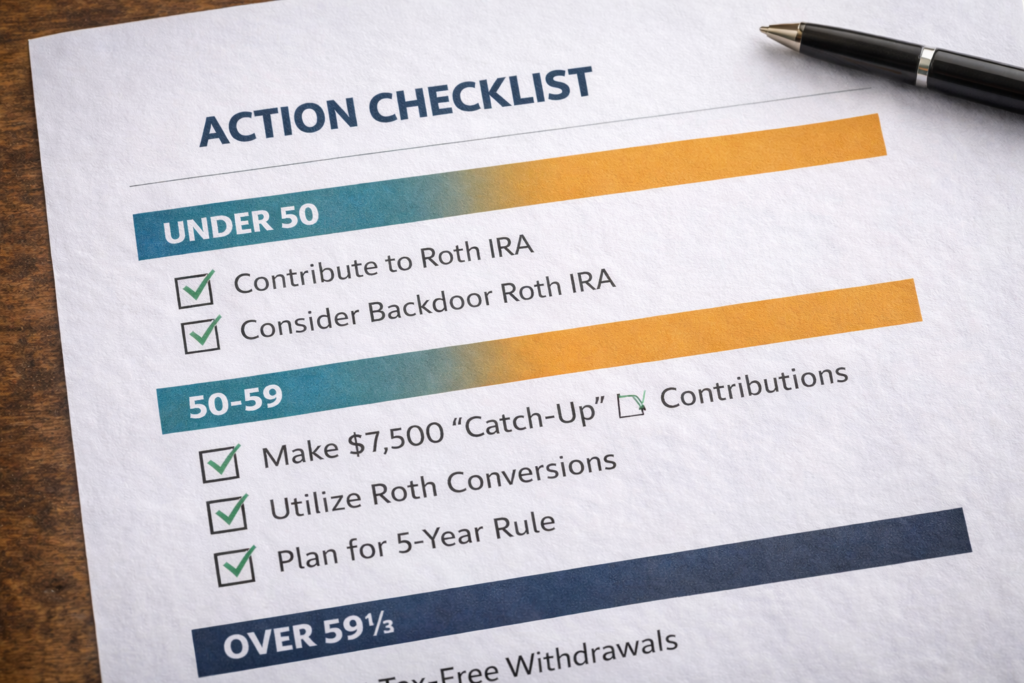
Plus, you’re getting tax-free growth for decades. That’s the real value.
If You’re 50-59: Conversion Timing Matters Most
This is when Roth conversions start making sense for a lot of people, but you need to think about your timeline to 59½.
If you’re 57, doing conversions now means you’ll hit 59½ before any five-year conversion clocks run out. So the conversion penalty rule won’t ever actually affect you. Focus on tax efficiency of the conversions themselves, not penalty timing.
If you’re 53, you’ve got six years until 59½. Converting now creates a five-year penalty window, but you’ll be past it by the time you hit traditional retirement age. Still probably fine.
The tricky spot is if you’re retiring early and need converted funds before 59½. That’s when conversion laddering might actually be useful, but honestly, most people in this situation are better off having other funds available and leaving the Roth alone.
If You’re Over 59½: Simplified Rules Apply
Lucky you. Conversion penalties are off the table. The only question is whether your account is five years old for purposes of tax-free earnings.
If you opened your Roth recently, you might still owe taxes on earnings withdrawals until you hit that five-year mark. But no penalties.
If your account is old enough, everything comes out tax-free. At that point, the Roth becomes an incredibly flexible planning tool—you can pull money out for large expenses without it affecting your taxable income, Medicare premiums, or Social Security taxation.
If You’re Planning Conversions: Track Everything
Seriously, create a spreadsheet. Date, amount, tax year. That’s all you need.
Most brokerages won’t do this for you, and you’ll kick yourself at tax time trying to reconstruct what happened when. Takes five minutes to set up, saves you hours of headaches later.
Bottom Line: It's Three Rules, Not One—And Age 59½ Changes Everything
Here’s what you need to remember:
Contributions are always accessible. No waiting period, no taxes, no penalties. Every dollar you put in can come back out anytime you want it.
Conversions each have their own five-year penalty clock if you’re under 59½. After 59½? Penalty clocks don’t matter anymore. Pull converted money out whenever.
Earnings need both a five-year account age and a qualifying condition (usually being 59½ or older, though certain exceptions apply). Meet both requirements and earnings come out tax-free.
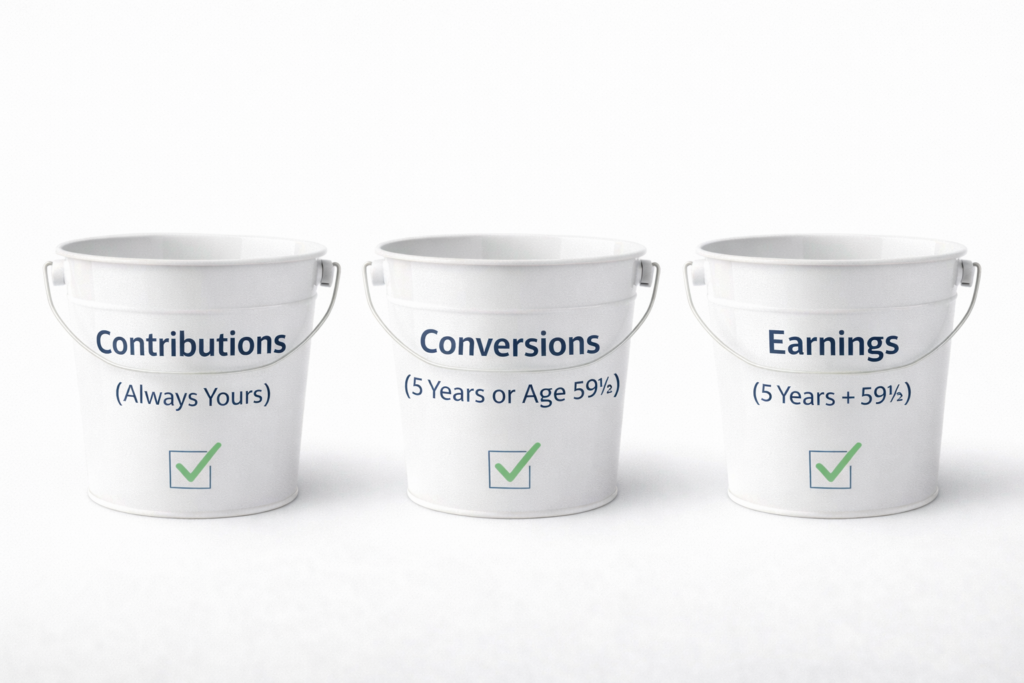
The magic age is 59½. At that point, conversion penalties disappear, and if your account is five years old, everything becomes tax-free. You still might face the five-year earnings rule if you opened your Roth recently, but no penalties.
The magic timeline is five tax years from your first contribution. That’s when earnings become eligible for tax-free treatment (assuming you’ve met the age or exception requirement).
And honestly? For most people, once you understand that contributions are always accessible and age 59½ eliminates most penalty concerns, the rules become a lot less scary. Just don’t touch your earnings early, keep decent records of your conversion dates, and you’ll be fine.
Frequently Asked Questions
There are actually three separate five-year requirements. The first governs when earnings can be withdrawn tax-free (five tax years from first contribution plus being 59½ or meeting an exception). The second creates five-year penalty windows for each conversion you do, though these become irrelevant after age 59½. The third applies to inherited Roth IRAs, where the original owner’s timeline determines when earnings are tax-free for beneficiaries.
No. You can withdraw your contributions at any time without taxes or penalties, regardless of account age. The five-year waiting period only affects earnings (investment growth) and converted amounts. Once your account reaches five tax years old and you’re 59½, everything becomes fully accessible without taxes or penalties.
After five tax years, earnings become eligible for tax-free withdrawal if you’re also 59½ or older (or meet another qualifying exception like disability). Before 59½, even after five years, earnings withdrawals would be taxable though potentially not penalized. Once both requirements are satisfied—five years and age 59½—your entire account becomes a tax-free income source.
Yes, but it uses the original account owner’s timeline, not the beneficiary’s. If the person you inherited from opened their Roth less than five years ago, earnings withdrawn before that five-year mark will be taxable to you regardless of your age. Once the original account hits five years (from when they first contributed), earnings become tax-free for beneficiaries.
No. Conversions can only be attributed to the tax year when they actually occur. If you convert funds in January 2026, that’s a 2026 conversion—you can’t backdate it to 2025. However, regular Roth IRA contributions can be made up until the tax filing deadline and designated for the previous year, giving you that timing flexibility.
Several situations let you avoid the 10% penalty (though not always the tax) on early earnings withdrawals: first-time home purchases up to $10,000, permanent disability, death, unreimbursed medical expenses over 7.5% of AGI, health insurance premiums while unemployed, qualified education costs, and substantially equal periodic payments. Reaching age 59½ is the most common exception that eliminates penalties entirely.
Deep Research URLs
Primary Authoritative Sources:
- https://www.irs.gov/publications/p590b
- https://www.kitces.com/blog/understanding-the-two-5-year-rules-for-roth-ira-contributions-and-conversions/
- https://www.fidelity.com/learning-center/personal-finance/retirement/roth-ira-5-year-rule
- https://www.schwab.com/learn/story/what-to-know-about-five-year-rule-roths
- https://www.bankrate.com/retirement/roth-ira-5-year-rule/
- https://www.nerdwallet.com/retirement/learn/roth-ira-5-year-rule
- https://smartasset.com/retirement/roth-ira-5-year-rule
- https://investor.vanguard.com/investor-resources-education/iras/ira-withdrawal-rules
- https://www.investopedia.com/ask/answers/05/waitingperiodroth.asp
- https://www.wealthenhancement.com/blog/understanding-the-5-year-rule-for-roth-ira-withdrawals
Disclaimer:
The information provided in this article is for educational purposes only and should not be considered as financial advice. Always consult with a financial advisor or credit counselor before making any significant decisions regarding debt repayment or financial strategies. The strategies discussed may not be suitable for everyone and results may vary depending on individual circumstances.