



You work hard, you save consistently, and someone once told you a Roth IRA is one of the best retirement tools available. Tax-free growth, no forced withdrawals, money that compounds quietly for decades and comes out the other side completely untaxed.
Then you check the income limits and realize — you might be right on the edge. Or over it. Or you’ve been over it for two years and just found out today.
This guide is written for that exact moment. Not to overwhelm you with tax code language, but to explain how the 2026 limits actually work, what happens at different income levels, and what real options exist when direct contributions aren’t available anymore.
Plain-English Glossary: Terms You’ll See Throughout
Before diving into numbers, here are the key terms explained simply — no tax degree required.
Modified Adjusted Gross Income (MAGI): Think of MAGI as your “true income” for IRS eligibility purposes. It starts with your total income, subtracts above-the-line deductions to get AGI, then adds certain deductions back in. For most salaried workers, MAGI and AGI are nearly identical. For business owners or those with rental income, they can differ by thousands of dollars.
Non-Deductible Contribution: Money you put into a traditional IRA using income you’ve already paid taxes on — and you don’t claim a tax deduction for it. This after-tax money is the foundation of the backdoor Roth strategy.
Pro-Rata Rule: An IRS rule that determines what portion of a Roth conversion is taxable. If you have a mix of pre-tax and after-tax money across all your IRAs, the IRS won’t let you cherry-pick which dollars to convert — it treats everything proportionally.
Phase-Out Range: The income band where your Roth IRA contribution limit gradually shrinks to zero. You’re not cut off entirely at the bottom of the range — you can still contribute a reduced amount until you reach the very top.
Form 8606: An IRS form you file with your tax return to track non-deductible IRA contributions. It tells the IRS your after-tax basis so you don’t get taxed twice when you convert.
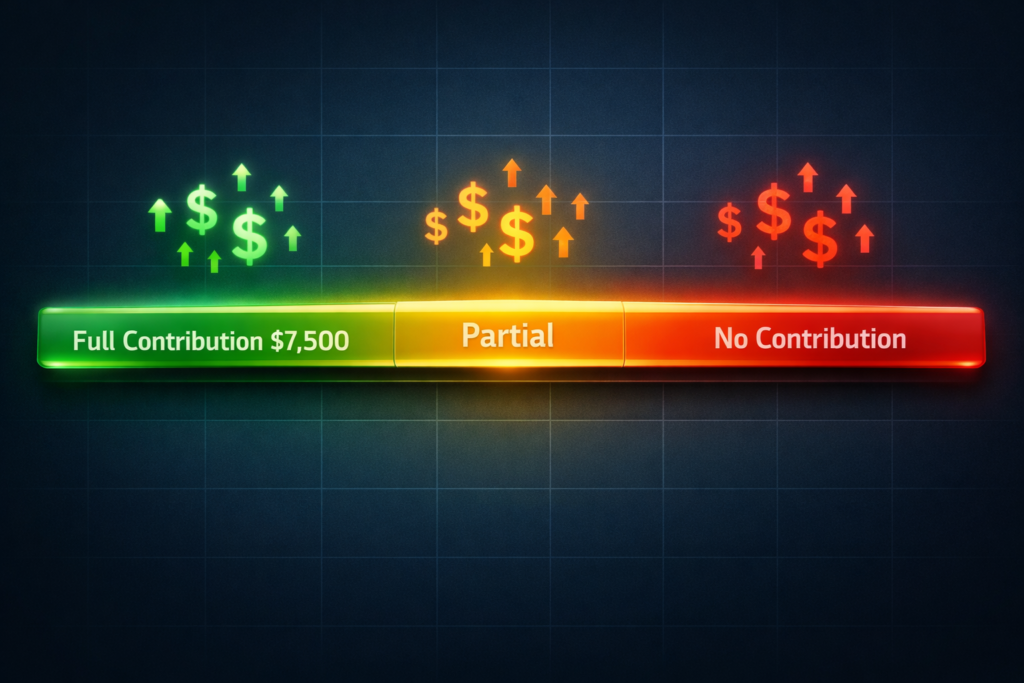
Roth Conversion: Moving money from a traditional pre-tax IRA into a Roth after-tax IRA. You pay income tax on the pre-tax portion in the year of conversion, but all future growth becomes permanently tax-free.
Why These Limits Exist at All
When Congress created the Roth IRA in 1997, the intent was to give middle-income Americans a way to save for retirement using after-tax dollars, with the payoff being completely tax-free withdrawals later. The income limits were built in to prevent high earners from using the same vehicle.
The irony is that Roth conversions — moving money from a traditional IRA into a Roth — have had no income limits since 2010. And Roth 401(k) contributions through employers have never had income limits. So the restriction only ever applied to one narrow mechanism: direct annual contributions to a Roth IRA.
That gap is exactly what the backdoor Roth IRA exploits. But we’ll get to that.
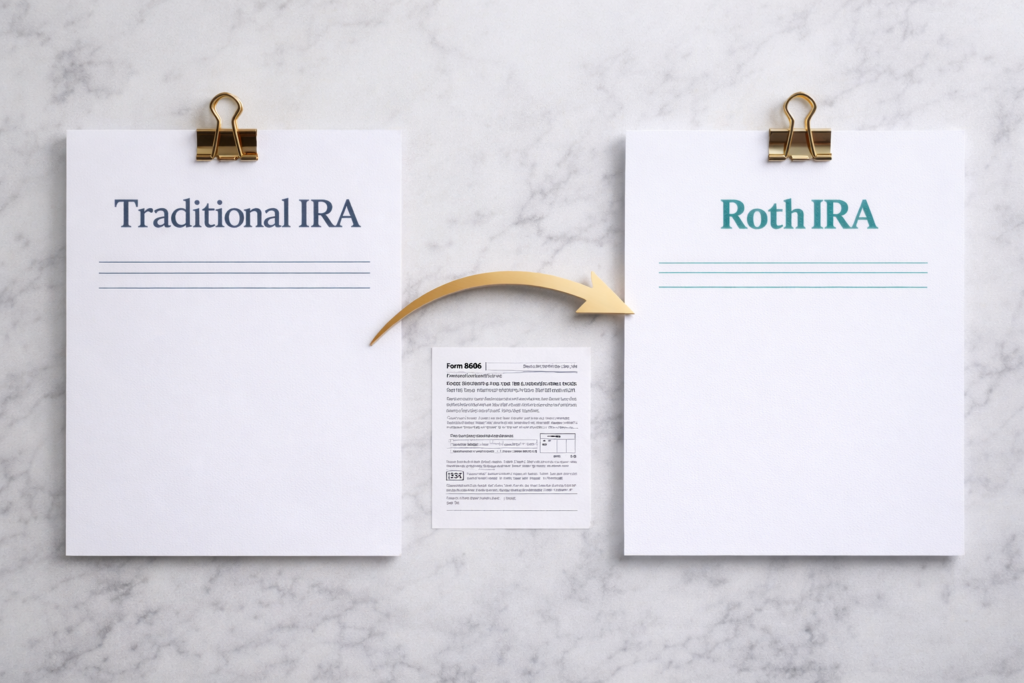
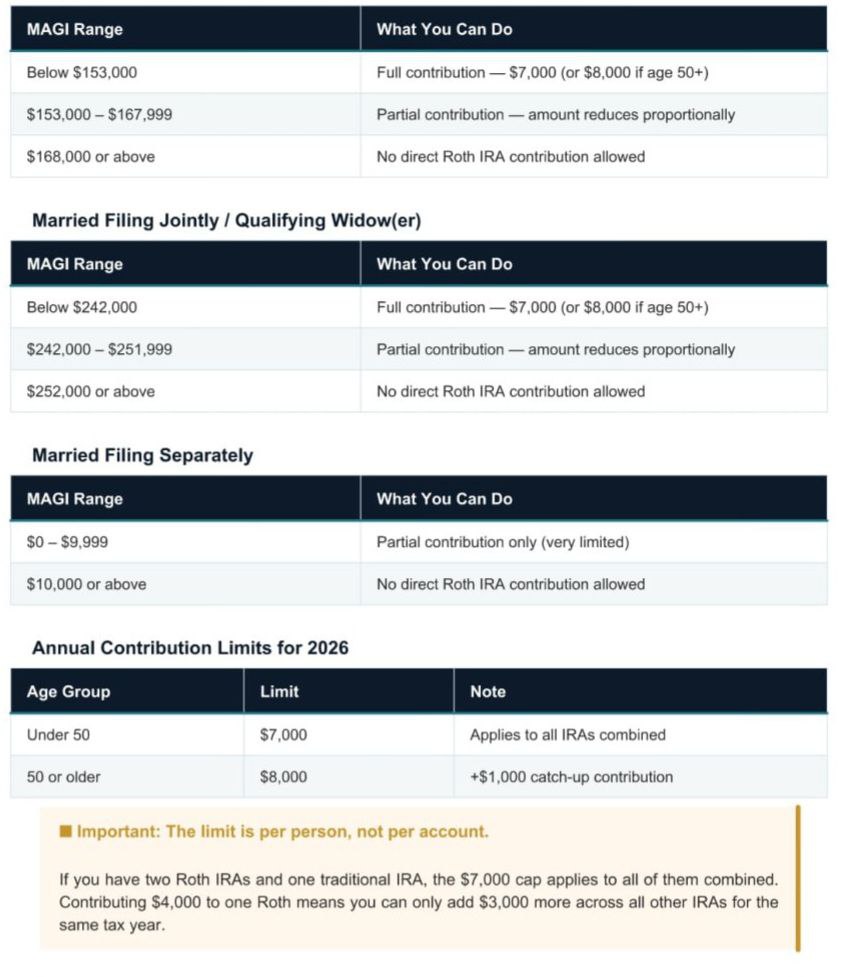
2026 Roth IRA Income Limits — Full Breakdown
Single Filers / Head of Household
Understanding MAGI: The Number That Actually Matters
Your paycheck, your W-2, even the AGI on your tax return — none of these are the number the IRS uses to determine Roth eligibility. That number is MAGI. For most people they’re almost identical, but for business owners, landlords, and those with complex financial lives, the difference can be thousands of dollars.
How MAGI Is Calculated — Step by Step
Step 1 — Start with gross income: Every dollar you earned — wages, freelance income, business profits, dividends, capital gains, rental income, alimony received.
Step 2 — Subtract above-the-line deductions to get AGI: These include traditional 401(k) contributions, HSA contributions, half of self-employment tax, alimony paid on pre-2019 divorces, student loan interest, and others.
Step 3 — Add back certain deductions to get MAGI: The IRS adds back student loan interest deductions, IRA deductions, excluded foreign income, rental losses, and passive income adjustments.
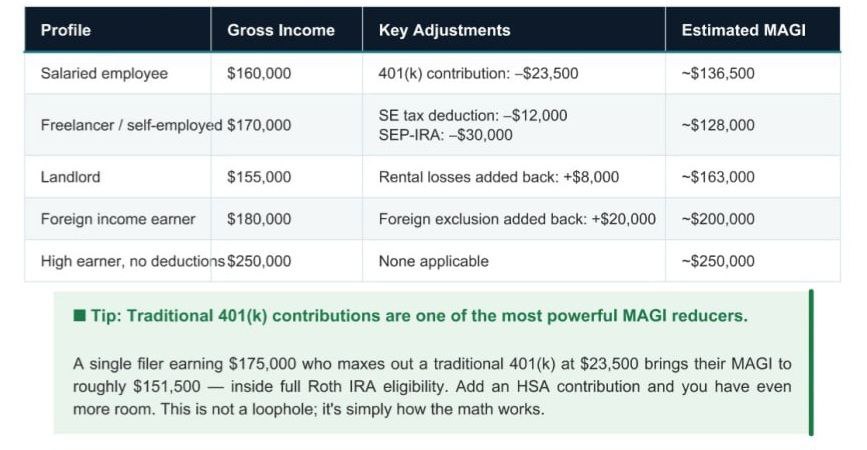
MAGI by Income Profile — How Different People Are Affected
The Phase-Out Range: You’re Probably Not Fully Disqualified
Most people hear “phase-out” and assume they’re either fully in or fully out. That’s wrong. The phase-out is a slope, not a cliff. Inside the range, your allowable contribution shrinks gradually — it doesn’t hit zero until you reach the very top of the band.
The Calculation — Step by Step
Using a single filer with a MAGI of $161,000 as the example:
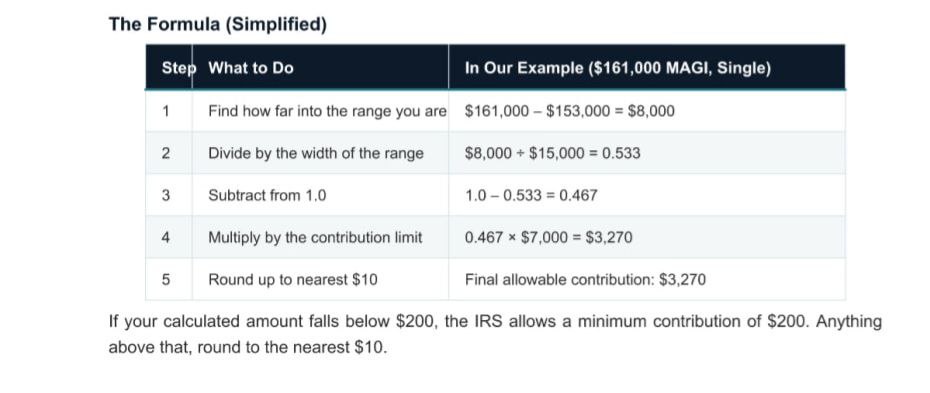
That person can contribute $3,270 directly — not zero, not the full $7,000, but a real amount worth making. If the calculated number falls below $200, the IRS allows a minimum contribution of exactly $200.
Real-Life Scenarios: What to Do at Your Income Level
Case 1 — Sarah, Teacher, $112,000 MAGI, Single
Sarah earns $112,000 as a department head. She contributes $6,000 to a traditional 401(k) and wonders if she qualifies for a Roth IRA.
With a MAGI of $112,000, she’s well below the $153,000 single-filer threshold. She can contribute the full $7,000 directly to a Roth IRA for 2026. No extra steps, no workarounds.
Key lesson: Being comfortably under the limit means direct contributions — simple and clean. She should also consider increasing her 401(k) contributions to keep MAGI low as her salary grows over time.

Case 2 — James, Marketing Director, $158,000 MAGI, Single
James earns $158,000 in total MAGI. He’s inside the 2026 single-filer phase-out range and isn’t sure how much he can contribute.
Using the formula: ($158,000 − $153,000) ÷ $15,000 = 0.333. Remaining eligibility: 1 − 0.333 = 0.667. Allowable contribution: 0.667 × $7,000 = $4,670.
James can contribute $4,670 directly to his Roth IRA — more than half the maximum limit.
Key lesson: Don’t assume you’re completely locked out if you’re in the phase-out range. Run the numbers. A partial contribution is still worth making and still compounds tax-free for decades.
Case 3 — Priya & Rohan, Dual-Income Couple, $268,000 Combined MAGI
Priya is a software engineer, Rohan is a product manager. Combined MAGI: $268,000. They’re above the $252,000 married filing jointly ceiling. Neither has any existing traditional IRA balance.
Since there are no pre-existing pre-tax IRA balances, the backdoor Roth is clean for both of them. Each spouse makes a $7,000 non-deductible traditional IRA contribution, then converts to Roth. Together they put $14,000 into Roth accounts for 2026. They each file Form 8606 to document the after-tax basis.
Key lesson: When both spouses have zero pre-tax IRA money, the backdoor Roth is straightforward. Do it early in the year and convert quickly to minimize any taxable growth during the waiting period.
Case 4 — David, Business Owner, $220,000 MAGI, $85,000 Pre-Tax IRA
David runs a consulting firm. He wants to do the backdoor Roth but has $85,000 sitting in a rollover IRA from a previous employer. He adds a $7,000 non-deductible contribution, bringing his total IRA balance to $92,000.
Pro-rata calculation: $7,000 after-tax basis ÷ $92,000 total = 7.6% tax-free. On a $7,000 conversion, only $532 is tax-free. The remaining $6,468 is taxable income. At his 32% tax rate, that’s roughly $2,070 in unexpected tax — on money he thought was going in cleanly.
The solution: David rolls his $85,000 rollover IRA into his solo 401(k) first, which accepts outside rollovers. Now his IRA balance is just the $7,000 non-deductible contribution. The entire conversion becomes tax-free.
Key lesson: Always check for existing pre-tax IRA balances before attempting the backdoor. Rolling them into an employer 401(k) is the cleanest fix — but confirm your plan accepts rollovers before counting on this approach.
The Pro-Rata Rule: A Detailed Explanation
The pro-rata rule is the single most misunderstood part of the backdoor Roth strategy. Most simplified guides mention it in one paragraph and move on. Here’s what it actually means.
Why the Rule Exists
The IRS views all your traditional, SEP, and SIMPLE IRA accounts as one combined pool when determining the tax treatment of a conversion. You cannot choose to convert only the after-tax portion. Every conversion is treated as coming proportionally from both the pre-tax and after-tax buckets across all your IRAs — regardless of which brokerage holds them or when the contributions were made.

The Pro-Rata Formula
| Component | Formula |
|---|---|
| Tax-free percentage | Total after-tax basis ÷ Total IRA balance (all IRAs) |
| Taxable percentage | 1 minus the tax-free percentage |
| Tax-free portion of conversion | Conversion amount × tax-free percentage |
| Taxable portion of conversion | Conversion amount × taxable percentage |
Three Scenarios Side by Side
| Scenario | Pre-Tax IRA Balance | After-Tax Contribution | Total IRA | Tax-Free % | Tax on $7,000 Conversion (32%) |
|---|---|---|---|---|---|
| Clean — no pre-tax IRA | $0 | $7,000 | $7,000 | 100% | $0 |
| Mixed — some pre-tax | $63,000 | $7,000 | $70,000 | 10% | ~$2,016 |
| Heavy pre-tax | $193,000 | $7,000 | $200,000 | 3.5% | ~$2,163 |
The third scenario is particularly striking. Someone with a large pre-tax IRA attempting the backdoor Roth ends up paying nearly as much tax as someone doing a straightforward conversion — despite all the extra steps. That’s why clearing the pre-tax balance first is so important when the numbers are that skewed.
The Clean Backdoor Checklist
- Confirm all your traditional, SEP, and SIMPLE IRAs have a $0 balance before contributing
- If you have pre-tax IRA money, check whether your 401(k) accepts incoming rollovers
- Roll the pre-tax balance into the 401(k) first
- Then make your non-deductible IRA contribution and convert immediately
- File Form 8606 every single year — without exception
Over-Contributions: How to Fix Them and How to Prevent Them
Contributing more than you’re allowed feels like a minor mistake until you realize the 6% excise tax repeats every year until you correct it. Here’s exactly what to do — and more importantly, how to avoid it entirely.
Step-by-Step Fix When You’ve Over-Contributed
Step 1 — Confirm the over-contribution. Log into your brokerage and check your contribution total for the year. Then calculate your actual MAGI to confirm your exact allowable amount. The difference between what you contributed and what you were allowed is your excess.
Step 2 — Act before the tax filing deadline. You have until your return due date — including extensions — to request a “return of excess contribution.” For most people the standard deadline is April 15; with an extension, October 15. Contact your brokerage directly and use that exact phrase — the terminology matters for how it’s processed.
Step 3 — Understand what comes back out. The brokerage returns your original excess contribution plus a proportional share of any earnings attributed to it. Those earnings are added to your taxable income for the year the contribution was made — not the year you withdrew them. If you’re under 59½, you may also owe a 10% early withdrawal penalty on the earnings portion.
Step 4 — File Form 5329 if you missed the deadline. If you didn’t catch it in time and the excess is still sitting in the account, you must file Form 5329 to calculate and report the 6% excise tax. This applies for every year the excess remains — so the sooner you act, the less it costs.
Step 5 — Consider the future-year carryforward. If you’re eligible to contribute in the following year and haven’t hit your limit yet, you can designate the excess as that next year’s contribution instead of withdrawing it. This avoids the withdrawal process, but the 6% penalty still applies for the year the over-contribution originally occurred.
How to Prevent Over-Contributions Before They Happen
| Your Situation | Recommended Prevention Strategy |
| Salary only, predictable income | Contribute in January: Your Modified Adjusted Gross Income (MAGI) is stable and easy to estimate early on. |
| Bonus or commission income | Contribute in November or December: Wait until your full-year income is finalized to avoid exceeding limits. |
| Self-employed / Freelance | The “Wait and See”: Contribute to a Traditional IRA in January; decide in December whether to convert to Roth. |
| Near the phase-out threshold | The Partial Top-up: Contribute the minimum amount you’re certain of; add the remainder in December. |
| Major life event (Marriage, job change, etc.) | Pause and Recalculate: Reassess your MAGI before contributing; don’t assume prior eligibility still applies. |
Over the Limit: Three Real Paths Forward
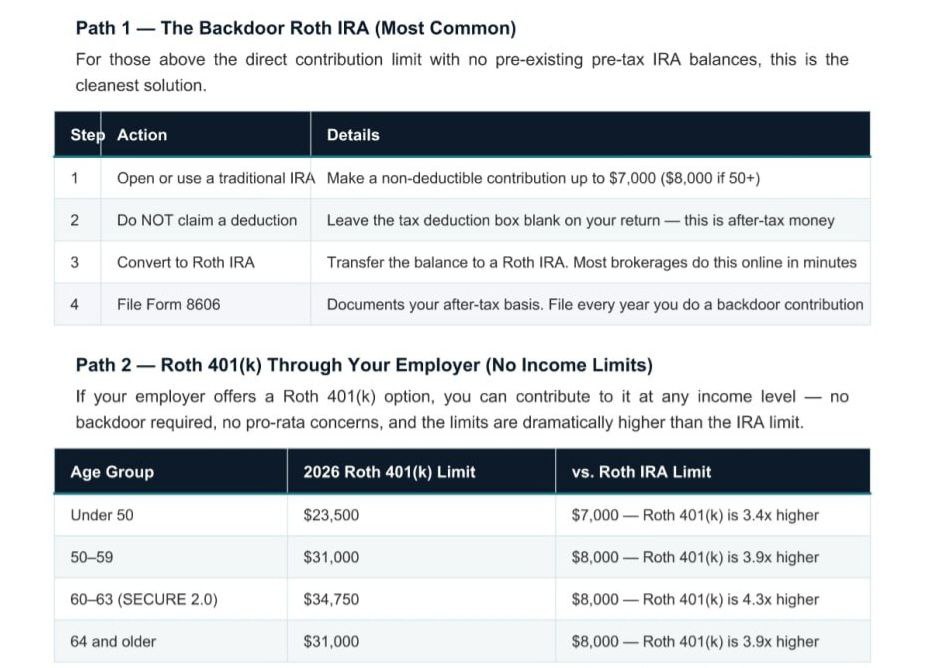
Path 3 — Lower Your MAGI to Stay Directly Eligible
For those within striking distance of the phase-out threshold, reducing MAGI through pre-tax contributions can keep direct Roth eligibility intact.
| Account / Vehicle | 2026 Limit | Effect on MAGI |
|---|---|---|
| Traditional 401(k) | $23,500 | Reduces dollar for dollar |
| HSA — Self-only coverage | $4,300 | Reduces dollar for dollar |
| HSA — Family coverage | $8,550 | Reduces dollar for dollar |
| SEP-IRA (self-employed) | 25% of net SE income | Reduces dollar for dollar |
| Traditional IRA (if deductible) | $7,000 | Reduces dollar for dollar |
Questions People Actually Search For
Can I contribute to a Roth IRA after age 70?
Yes — and this changed with the SECURE Act. Prior rules had an age cap on traditional IRA contributions, but Roth IRAs never did. Under current law, as long as you have earned income — wages, salary, net self-employment income — you can contribute to a Roth IRA at any age. Social Security payments and investment income do not count as earned income for this purpose.
Does marriage suddenly change my Roth eligibility?
Often yes, and it surprises couples in their first joint filing year. Two single people each earning $130,000 can both contribute to Roth IRAs directly. Once married and filing jointly, their combined $260,000 MAGI puts them above the 2026 joint ceiling of $252,000. The joint income limit is not simply double the single limit — and the year of marriage is frequently the year the backdoor strategy becomes necessary for the first time.
Can I fund a Roth IRA if my only income is Social Security?
Not directly. Social Security is not earned income for IRA purposes. However, if you have a spouse who earns wages or salary, that working spouse’s income can support a spousal IRA contribution in your name. In 2026, a single-income household can contribute up to $14,000 total — $7,000 per person into separate accounts — as long as the working spouse’s earned income covers the combined amount.
At what age does a Roth conversion stop making sense?
There’s no universal answer — it depends on your tax rate now versus what you’d pay on distributions later. If you’re in your late 60s before Required Minimum Distributions start at age 73, that window is often ideal for partial annual conversions. You convert just enough to fill your current tax bracket without pushing into the next one. Once RMDs are forcing large taxable distributions regardless, the case for additional conversions weakens. It’s genuinely a case-by-case calculation, not a rule tied to a specific age.
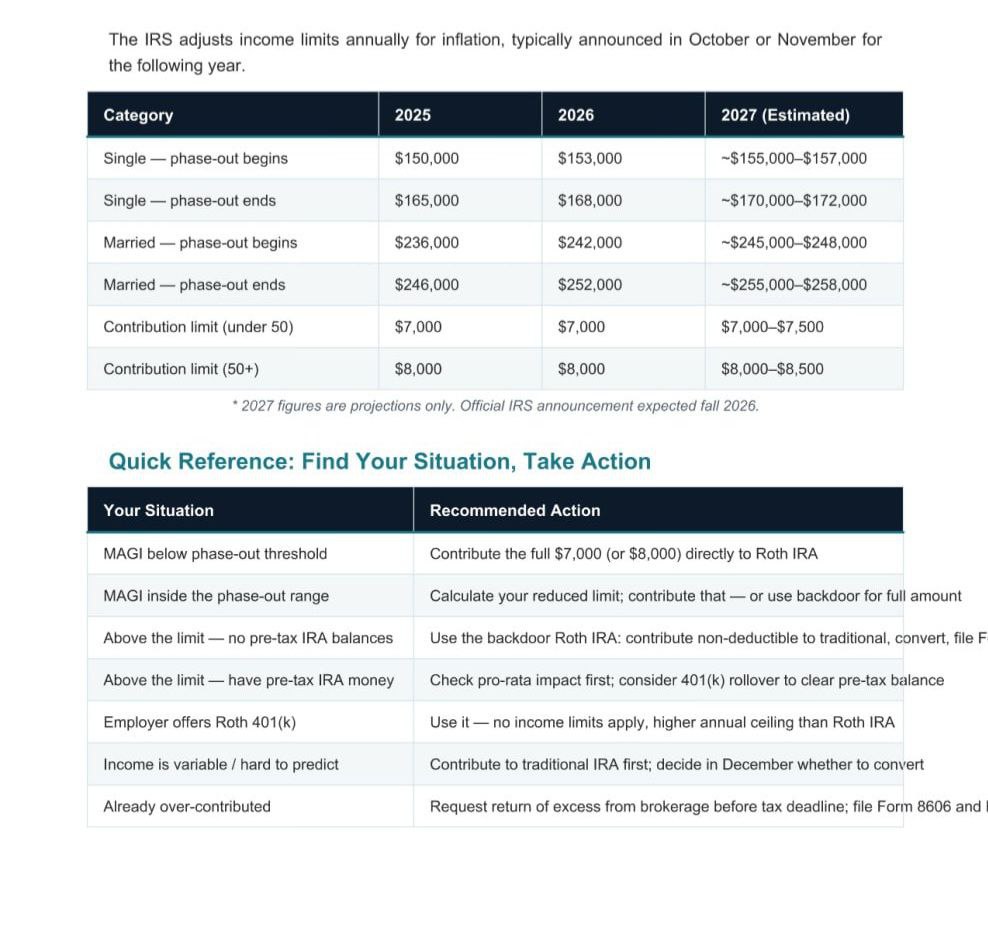
2025 → 2026 → 2027: How the Numbers Are Moving
The 7 Most Important Takeaways
1. The income limit applies to your MAGI — not gross income. Pre-tax 401(k) and HSA contributions reduce MAGI and can move you inside the eligible range even if your salary looks too high.
2. The phase-out range is a slope, not a wall. Earning $5,000 over the threshold doesn’t disqualify you — it reduces your contribution. Run the calculation before assuming you can’t contribute anything.
3. The backdoor Roth IRA is legal, IRS-acknowledged, and available at any income level. It involves two steps, one tax form, and about 20 minutes once you’ve done it the first time.
4. The pro-rata rule can quietly turn a tax-free conversion into a taxable event. Always check for pre-existing pre-tax IRA balances before attempting the backdoor. The fix is rolling that balance into a 401(k) first.
5. Roth 401(k) contributions have no income limits whatsoever. If your employer offers this option, it’s the simplest path to Roth growth for high earners — with limits nearly four times higher than the Roth IRA ceiling.
6. Over-contributions cost 6% per year until corrected. Request a return of excess contribution before your tax filing deadline. If your income is unpredictable, contribute to a traditional IRA first and convert later.
7. There is no age cap on Roth IRA contributions. As long as you have earned income, you can contribute at 72, 78, or beyond. And unlike traditional accounts, you’ll never be forced to take distributions from a Roth IRA during your lifetime.
The Roth IRA income limits have always felt more like a permanent wall than they actually are. In practice, the limits only block the simplest route in — they don’t close the destination. High earners who know the terrain have multiple IRS-sanctioned paths to the same tax-free outcome. The people who end up genuinely locked out are usually those who didn’t know the alternatives existed until after they’d already made a mistake.
Now you know. Pick your row in the quick-reference table above, take the corresponding action before December 31st, and file Form 8606 if the backdoor is your route.
OFFICIAL SOURCE URLS — DEEP RESEARCH
Primary Government Sources
| Source | URL | Use Case |
|---|---|---|
| IRS Official 2026 Announcement | https://www.irs.gov/newsroom/401k-limit-increases-to-24500-for-2026-ira-limit-increases-to-7500 | All 2026 limits — most authoritative |
| IRS Notice 2025-67 (Official PDF) | https://www.irs.gov/pub/irs-drop/n-25-67.pdf | Complete legal text of all 2026 adjustments |
| IRS — IRA Contribution Limits Page | https://www.irs.gov/retirement-plans/plan-participant-employee/retirement-topics-ira-contribution-limits | Contribution rules, all years |
| IRS — Roth IRA Contribution Amount | https://www.irs.gov/retirement-plans/plan-participant-employee/amount-of-roth-ira-contributions-that-you-can-make | Phase-out calculation formula |
| IRS Publication 590-A | https://www.irs.gov/publications/p590a | MAGI calculation, Form 8606 rules |
| IRS Form 8606 | https://www.irs.gov/forms-pubs/about-form-8606 | Non-deductible contributions tracking |
| IRS Form 5329 | https://www.irs.gov/forms-pubs/about-form-5329 | Excess contribution penalty |
Trusted Financial Institutions
| Source | URL | Use Case |
|---|---|---|
| Fidelity — 2026 Contribution Limits | https://www.fidelity.com/learning-center/personal-finance/retirement/2026-contribution-limits | Plain-English breakdown |
| Fidelity — IRA Contribution Limits | https://www.fidelity.com/learning-center/smart-money/ira-contribution-limits | Combined IRA rules |
| Vanguard — Roth IRA Income Limits 2026 | https://investor.vanguard.com/investor-resources-education/iras/roth-ira-income-limits | MAGI and Roth eligibility |
| Voya — 2026 Retirement Contribution Limits | https://www.voya.com/article/retirement-contribution-limits-2026 | SECURE 2.0 + catch-up rules |
Legislative & Legal Sources
| Source | URL | Use Case |
|---|---|---|
| SECURE 2.0 Act Full Text | https://www.congress.gov/bill/117th-congress/house-bill/2954/text | Catch-up contribution rules, age 60-63 |
| IRS — Backdoor Roth / Conversions | https://www.irs.gov/retirement-plans/retirement-plans-faqs-regarding-iras-contributions | Conversion legality |
| IRS — Pro-Rata Rule (Publication 590-A, Worksheet) |
Disclaimer :All figures reflect 2026 IRS guidance. 2027 estimates are projections only — confirm official thresholds via IRS.gov in October–November 2026. This article is for educational purposes only; consult a qualified tax professional for advice specific to your situation.