



You came across something about setting up a Roth IRA for your child, thought it was a brilliant idea and it is, genuinely and then hit a wall. Your kid doesn’t have a job. Maybe they’re 6. Maybe they’re 14 but haven’t worked yet. The internet keeps telling you to open one, but nobody explains clearly what to do when the earned income requirement is staring you in the face.
This article solves that. All of it. Not just the rule but the workarounds, the alternatives, the mistakes families make, and the real path forward depending on your child’s age and situation. By the end, you’ll know exactly what to do with that money right now.
Quick Answer: A child with no earned income cannot have contributions deposited into a Roth IRA — but there are legitimate strategies and strong alternatives depending on your situation. Keep reading.
What Is a Custodial Roth IRA — And Why Does Earned Income Matter So Much?
A custodial Roth IRA is simply a Roth IRA opened on behalf of a minor. A parent or guardian manages the account until the child reaches the age of majority 18 in most states, 21 in a few. After that, it becomes the child’s account outright. No strings. No conditions.
The money inside grows completely tax-free. When your child eventually withdraws funds in retirement, they pay zero federal income tax on those earnings. That’s the core advantage of a Roth. And because a 15-year-old has 50+ years of compound growth ahead of them, even small early contributions can become serious wealth by retirement age.
But here’s the catch that most headlines gloss over: the IRS requires that contributions to any IRA including a Roth be backed by earned income. Not gifted money. Not allowance. Not birthday checks from grandma. Actual wages or self-employment income, reported to the government.
The contribution ceiling is the lower of two numbers: the annual IRS limit ($7,000 in 2025) or the child’s total earned income for the year. If that earned income is zero, the ceiling is zero. No contributions allowed, period.
Warning: Opening the account is fine at any age. Funding it without earned income creates an “excess contribution” — which carries a 6% annual IRS penalty until corrected. This doesn’t fix itself. It has to be actively unwound.
What Counts as Earned Income for a Child? (The Complete Answer)
This is where most parents either overestimate or underestimate what’s possible. The IRS definition of earned income is broader than many people realize — and stricter in ways that trip up families who aren’t paying attention.


The key principle running through all of this: earned income is compensation for services rendered. Whether it comes from a formal employer or informal neighborhood work doesn’t matter — as long as it’s real, documented, and reasonably compensated.
The Family Business Opportunity — And Its Limits
If you own a business, you can legally employ your child and have them perform legitimate, age-appropriate tasks. Filing, organizing supplies, cleaning the workspace, helping with inventory these have held up under IRS review when done correctly.
The wage must reflect what you’d actually pay a stranger to do the same work. Paying a 9-year-old $8,000 a year to occasionally sort mail is going to look exactly like what it is. Paying a 14-year-old $15/hour to help during busy seasons, with documented hours worked — that’s a different story entirely.
Important: If your business is structured as an S-Corporation, different payroll tax rules apply. Talk to a CPA before putting a child on the payroll of an S-Corp.
Your Child Has No Income Right Now. Here Are Your Actual Options.
If your child genuinely has no earned income and won’t for a while the Roth IRA stays on hold. But your money doesn’t have to sit still.
There are three serious alternatives, each with distinct trade-offs. The right choice depends on what this money is really for.
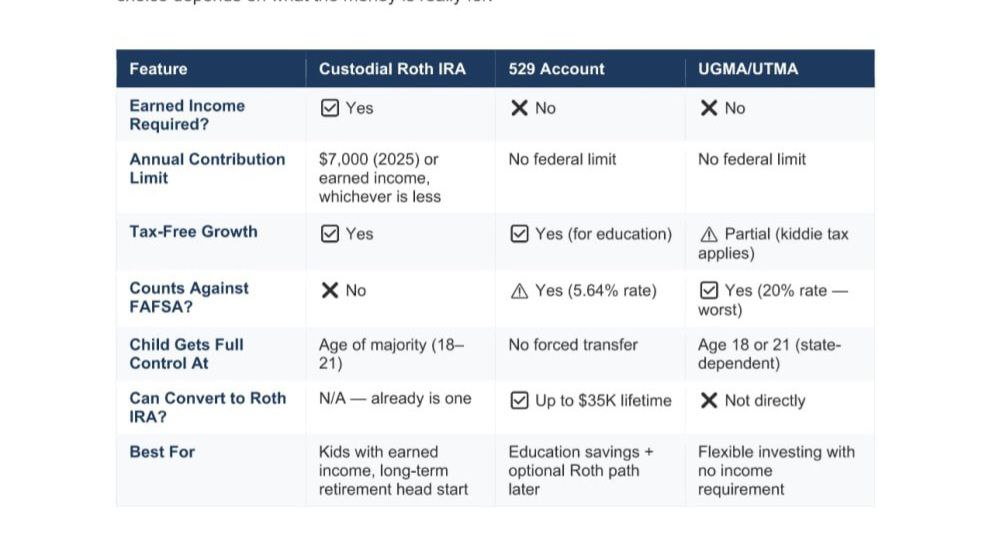
Option 1: The 529 Account — Education Savings With a Roth Backdoor
A 529 is a state-sponsored education savings account. Money grows tax-free when used for qualifying educational expenses — tuition, books, room and board, trade school, even K-12 in certain states.
What changed the math significantly is a rule introduced in 2024: unused 529 funds can now be rolled over into a Roth IRA for the same beneficiary. But most articles summarize this too loosely. Here are the actual rules:
- 15-year minimum: The 529 account must have been open for at least 15 years before any rollover is permitted
- 5-year contribution freeze: Money contributed within the last 5 years cannot be rolled over — only older funds qualify
- $35,000 lifetime cap: The total rollover across all years cannot exceed $35,000 per beneficiary
- Annual limits still apply: You can’t move everything at once. The standard annual Roth IRA contribution limit governs how much rolls over each year
- Earned income still required: In the year of the rollover, the child must have earned income at least equal to the rollover amount
The bottom line: a 529 is a real path toward eventually funding a Roth IRA, but it’s a long game. And it doesn’t bypass the earned income requirement — it just pushes that requirement to a time when the child is far more likely to be earning.
Best choice if: Education costs are a realistic concern, OR you’re building toward a 529-to-Roth conversion over 15+ years.
Option 2: UGMA/UTMA Custodial Brokerage Account
A custodial brokerage account under UGMA (Uniform Gifts to Minors Act) or UTMA (Uniform Transfers to Minors Act) rules lets you invest in a child’s name with no earned income requirement and no annual contribution limit. Think of it as a standard investment account — stocks, index funds, ETFs — just held in trust for the child until they’re old enough to take control.
The trade-offs deserve honest attention:
- FAFSA impact: Assets here count against need-based financial aid at a 20% rate — the harshest of any account type. A $50,000 UGMA balance could reduce aid eligibility by $10,000.
- No take-backs: Once money is gifted into this account, it legally belongs to the child. When they reach the age of majority, they control it completely — no conditions, no restrictions.
- Kiddie tax: Investment gains beyond roughly $2,700 per year (2025 threshold) get taxed at the parent’s rate, not the child’s. This erodes some of the tax efficiency.
Best choice if: You want total flexibility on how the money gets used, and financial aid eligibility isn’t a concern for your family.
Option 3: Open the Roth IRA Now Fund It the Moment Income Arrives
This option gets overlooked, and it shouldn’t. You can open a custodial Roth IRA today at any major brokerage and let it sit at zero. The account is established. The moment your child earns their first dollar from legitimate work, contributions can begin without any delay.
Some families do this specifically to make the concept feel real to their kids. The account exists. The child knows it exists. And earning money starts to feel connected to something concrete and growing rather than an abstract future idea.
How to Document Your Child's Income (So the IRS Never Has Questions)
Informal income is the most common source of Roth IRA contributions for younger teens and the most common source of problems when families skip the record-keeping step. The income is valid. The documentation is what makes it defensible.
For Formal W-2 Employment
This is the easy path. The employer handles everything. Your child receives a W-2 at tax time, and that document alone substantiates the earned income for IRA purposes. Nothing additional required.
For Informal / Self-Employment Income
A little effort here goes a long way. You don’t need a formal business structure or a CPA on retainer. You do need evidence that the income was real. Here’s what works:
- Keep a simple log: date, job performed, who paid, how much
- Use checks or digital payment apps (Venmo, Zelle, Cash App) — these create automatic timestamps and searchable records
- Save any text messages or emails confirming a job was done and paid
- If the work is for your own business, keep payroll records like you would for any employee
One frequently-missed detail: if a child earns money through self-employment — meaning nobody withheld taxes for them — they may owe self-employment tax even if their total income falls below the standard deduction. Income tax might be zero. Self-employment tax is a separate calculation, currently 15.3% on net self-employment income above $400. A single CPA consultation in year one can prevent a genuinely unpleasant surprise.
The Parent Matching Strategy: The Best Way to Motivate a Teen and Maximize the Account
Here’s the move that doesn’t get nearly enough attention.
Your child doesn’t have to use their own earnings to fund their Roth IRA. You can fund it entirely — as long as the contribution doesn’t exceed their earned income for the year. The IRS doesn’t care where the deposited dollars physically came from. What matters is the ceiling that earned income creates.
In practice: your teenager earns $4,000 from a summer job. They want to spend some of it — understandably. You deposit $4,000 into their Roth IRA from your own funds and give them the $4,000 they earned as spending money. Total deposited into the Roth: $4,000 (within the $7,000 limit, within earned income). Completely legal. Completely clean.
Many families formalize this into a matching arrangement — for every dollar the child contributes from their own earnings, the parent matches it dollar for dollar. This does several things simultaneously:
- Creates real motivation. The child’s work directly builds retirement savings, doubled.
- Teaches financial cause-and-effect. Earning → saving → watching it grow becomes tangible.
- Maximizes the tax-free growth window. More money in earlier means more compound time.
A teenager who watches their savings double every time they work has a fundamentally different relationship with money than one who doesn’t. This is one of the best financial habits you can instill — and it costs you no more than you would have gifted anyway.
The Power of Starting Early: Numbers That Actually Make the Case
The math behind early Roth IRA contributions is striking when you actually look at it. This assumes a 7% average annual return — conservative by historical US stock market standards:
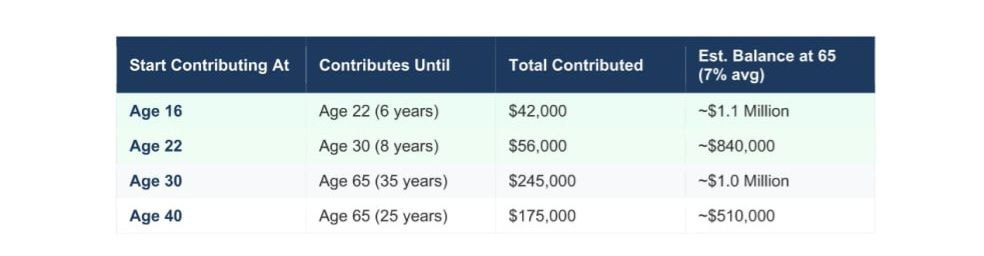

Read that again. The 16-year-old who contributes for just 6 years and stops ends up ahead of the 30-year-old who contributes consistently for 35 years. Time is the dominant variable. Not the contribution amount. Not the frequency. Time.
This is why the goal isn’t to wait until your child has a “real” job before thinking about this. The goal is to capture earned income the moment it first appears — even if it’s $600 from a summer of babysitting.
5 Mistakes Parents Make With Custodial Roth IRAs
| The Mistake | What Actually Happens | How to Avoid It |
|---|---|---|
| Contributing without earned income | 6% annual IRS penalty on the excess until corrected | Confirm earned income first — contribution comes second |
| Treating gifts as earned income | Creates excess contribution — same penalty applies | Gifted money goes to a brokerage account, not an IRA |
| No documentation for informal work | Impossible to defend the contribution if audited | Keep a written or digital job log from day one |
| Inflating pay for business work | IRS scrutiny — compensation must be market-rate | Pay only what the work is actually worth to the business |
| Ignoring self-employment tax | Tax owed even when income tax is zero | Calculate SE tax before assuming no filing is needed |

The 6% Penalty Is Worse Than It Looks
If you contribute $3,000 to a child’s Roth IRA in a year where they had zero earned income, that entire $3,000 is an excess contribution. The IRS charges 6% per year — $180 annually — until you remove both the excess and any earnings it generated. Forget about it for three years and you’ve paid $540 in penalties, plus the administrative hassle of unwinding it properly. The fix exists — but it requires paperwork, math on earnings attribution, and potentially an amended return. Just don’t get there in the first place.
When Your Child Does Start Earning: A Step-by-Step Action Plan
When legitimate earned income arrives — whether it’s a first W-2 job or informal neighborhood work — here’s exactly what to do:
Step 1 — Document the income first. W-2, 1099, or a written log for informal work. Before you think about the IRA at all, know the exact earned income total for the year. That number sets your ceiling.
Step 2 — Open the custodial Roth IRA if you haven’t already. Most major brokerages offer this. The process takes 10–15 minutes online. You’ll need the child’s Social Security number and your own ID.
Step 3 — Determine the contribution ceiling. It’s the lower of $7,000 (2025 limit) or total earned income for the year. If your child earned $2,400, the max is $2,400 — not a dollar more.
Step 4 — Decide who funds it. The child can contribute their own earnings, the parent can contribute on the child’s behalf, or a combination. As long as the total stays at or below the ceiling, it’s valid.
Step 5 — Check the contribution deadline. You have more time than you think. Contributions for a given tax year can be made up until Tax Day of the following year — typically April 15. Income earned in 2025 can fund a 2025 Roth IRA contribution as late as April 15, 2026.
Step 6 — Determine if a tax return needs to be filed. If income came from a W-2 employer and is below the standard deduction ($15,000 in 2025), no filing may be required. Self-employment income above $400 typically triggers a filing requirement due to self-employment tax, even when income tax is zero.

Frequently Asked Questions
A custodial Roth IRA account can be opened for a child with no income — it simply cannot receive any contributions until earned income exists. The account costs nothing to maintain and is ready to receive deposits the moment qualifying income arrives.
Yes. Babysitting, tutoring, lawn care, dog walking, and similar services all qualify as self-employment income for IRA purposes. The income needs to be real and reasonably compensated, and a simple log of dates, clients, and amounts is usually sufficient documentation.
Yes. A parent can fund the contributions entirely on the child’s behalf. The deposited money can come from the parent’s account — but the total contributed cannot exceed the child’s earned income for the year, or the annual IRS limit, whichever is lower.
Not always. If total income falls below the standard deduction and came from an employer, filing may not be required. But if the income is from self-employment, a return is likely necessary because of self-employment tax obligations — even when income tax itself is zero.
No. There is no minimum age. Any child with earned income — regardless of how young — can have a custodial Roth IRA opened on their behalf. The account stays custodial until the child reaches the age of majority in their state.
At the age of majority, the custodial account converts to a standard Roth IRA in the child’s name. They gain full control — contributions, withdrawals, investment decisions all become entirely theirs. It’s worth having this conversation with teenagers before the transition happens, not after.
No. Household chores and allowance-based tasks do not qualify as earned income. However, if a child performs legitimate, age-appropriate work for a parent’s business — and receives a market-rate wage for actual work done — that income can qualify. The work must be real and the compensation must be defensible.
The primary disadvantage is the earned income requirement, which makes the account inaccessible until a child actually works. The account also transfers to the child’s full, unrestricted control at adulthood. For some families, that’s exactly the point. For others, it’s worth thinking through carefully before contributions add up to a significant balance.
A 529 account is typically the strongest option for families prioritizing education savings, with the added flexibility of eventually rolling up to $35,000 into a Roth IRA (subject to specific conditions). For general investing without an income requirement, a UGMA/UTMA custodial brokerage account provides flexibility — though it carries FAFSA implications and transfers fully to the child at majority.
Yes — but only if they have at least $7,000 in earned income that year. The gift itself isn’t what creates eligibility. The earned income is what sets the ceiling. If your child earned $7,000 or more, you can gift them $7,000 to deposit — or deposit it yourself on their behalf — and the contribution is fully valid.
The Bottom Line
A Roth IRA for a child with no income isn’t a closed door. It’s a door with a specific key — and that key is earned income. It arrives earlier than most parents expect when they actually start looking for it. Babysitting, tutoring, summer jobs, legitimate family business work — all of it counts.
In the meantime, your money doesn’t have to sit idle. A 529 builds tax-advantaged savings with a genuine path toward Roth conversion later. A custodial brokerage account puts money to work immediately with maximum flexibility. And opening the Roth IRA now — even at a zero balance — costs nothing and means you’re ready the moment income shows up.
The families that set their children up best aren’t necessarily the ones who found the perfect account structure on the first try. They’re the ones who started the conversation early, kept the records they needed to keep, and didn’t let the perfect setup become the enemy of doing something real.
The best time to open a Roth IRA for your child was when they first had earned income. The second best time is as soon as they do — and the smartest thing to do before that point is understand exactly what you’re working with.
Disclaimer: This article is for educational purposes only and does not constitute financial, tax, or legal advice. Consult a qualified tax professional or financial advisor for guidance specific to your family’s situation.
OFFICIAL SOURCES — DEEP RESEARCH
IRS (Internal Revenue Service) — Primary Government Source
| Topic | Official URL |
|---|---|
| Roth IRA — Main IRS Page | https://www.irs.gov/retirement-plans/roth-iras |
| IRA Contribution Limits (Official) | https://www.irs.gov/retirement-plans/plan-participant-employee/retirement-topics-ira-contribution-limits |
| Publication 590-A — IRA Contributions (Full PDF) | https://www.irs.gov/pub/irs-pdf/p590a.pdf |
| Publication 590-A — Web Version | https://www.irs.gov/publications/p590a |
| Publication 590-B — IRA Distributions | https://www.irs.gov/publications/p590b |
| Earned Income Definition (IRS) | https://www.irs.gov/credits-deductions/individuals/earned-income-tax-credit/earned-income-and-earned-income-tax-credit-eitc-tables |
| Excess Contributions & 6% Penalty (IRS) | https://www.irs.gov/publications/p590a#en_US_2024_publink1000231061 |
| Self-Employment Tax | https://www.irs.gov/businesses/small-businesses-self-employed/self-employment-tax-social-security-and-medicare-taxes |