



Yes. You can have two Roth IRAs. You can have five if you want. The IRS doesn’t cap the number of accounts — only how much money goes into them each year.
That’s the short answer. But the reason people keep searching this question isn’t really because they don’t know the yes or no. It’s because they’re sitting on two accounts and quietly wondering if they’ve made a mistake, or they’re thinking about opening a second one and not sure if there’s a catch.
There is a catch. It’s just not the one most people expect.
The One Rule That Changes Everything
When you hold multiple Roth IRAs, the annual contribution limit — $7,500 in 2026, $8,600 if you’re 50 or older — applies to your total across all of them combined. Not per account. Total.
So if you have two Roth IRAs and you put $4,250 into one and $4,250 into the other, you’ve just over-contributed by $1,000. And that mistake doesn’t go unnoticed.
Every financial institution that holds an IRA files Form 5498 with the IRS each year, which reports your contribution to that account. If you have two accounts at two different brokerages, both institutions are filing separately, and the IRS can see the aggregate. There’s no scenario where excess contributions hide quietly — the paper trail exists whether you’re aware of it or not.
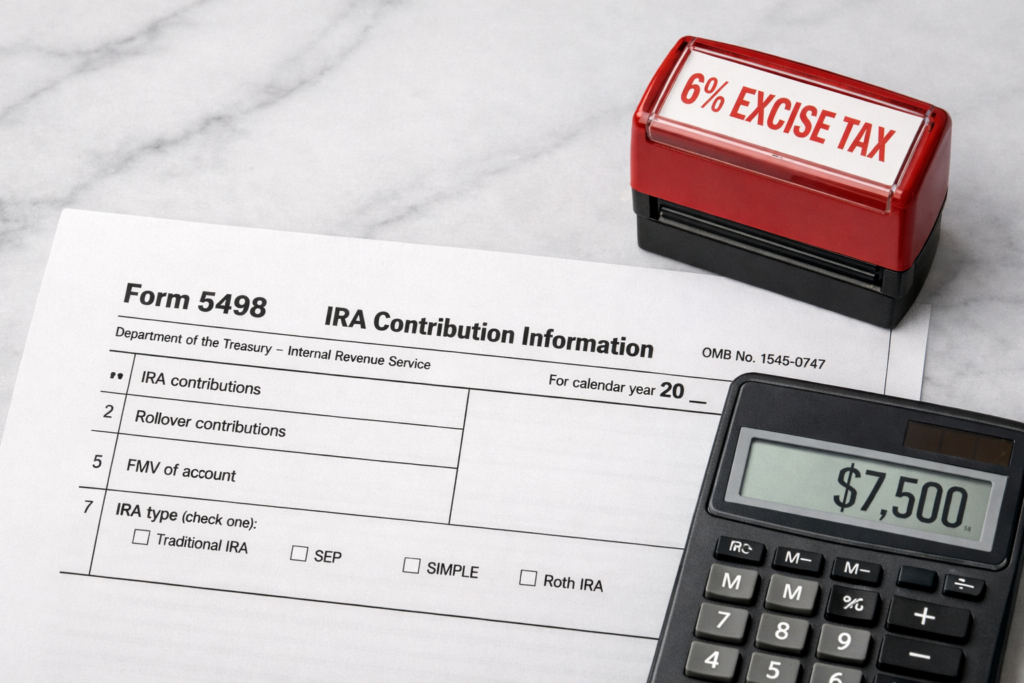
The penalty for going over is a 6% excise tax on the excess amount. Worse, that penalty repeats every year the money stays in the account uncorrected. A $1,000 over-contribution that you don’t catch for three years becomes a $180 problem. Not catastrophic, but entirely avoidable.
The fix is straightforward: withdraw the excess plus any earnings it generated before the tax filing deadline for that year. If you catch it early, this isn’t a big deal. The reason it matters is that splitting contributions across two accounts makes it easier to lose track — especially if you’re contributing at different times of year, or setting up automatic deposits separately in each account.
Why Do People End Up With Two Roth IRAs Anyway?
It usually happens one of three ways.
The platform explorer. Someone opens their first Roth IRA at a brokerage, then discovers another platform with better tools, lower fees, or a sign-up incentive. Instead of transferring, they just open a second account and start using both. This is probably the most common scenario, and it’s not inherently wrong — it just creates tracking overhead over time.
The employer confusion. This one causes real problems. A person opens a personal Roth IRA, then starts a new job that offers a “Roth” option through their retirement plan. They assume it’s the same thing and start treating the two as parallel accounts operating under the same rules. But a Roth 401(k) through an employer and a personal Roth IRA are legally separate account types. They have different contribution limits, different rules around withdrawals, and different administrative structures. Opening a Roth IRA while already contributing to a workplace Roth 401(k) is completely fine — the contribution limits don’t conflict. Confusing the two is where people get into trouble.
The intentional split. Some people open a second Roth account on purpose — often to access a specific type of investment that their primary brokerage doesn’t offer, or to hold different asset classes in separate places for clarity. This is a legitimate strategy, particularly for investors who want to keep, say, index funds in one account and alternative assets in another. It requires a bit more discipline, but it works.
The 5-Year Rule Nobody Explains Correctly
Here’s where a lot of articles get it wrong. So let’s be precise.
For regular Roth IRA contributions, the 5-year clock is aggregate across all your accounts. It starts from the first tax year you ever contributed to any Roth IRA — not each individual account you open. So if you opened your first Roth IRA in 2020 and then opened a second one in 2026, the earnings in both accounts are governed by the same clock. That clock already started running in 2020. The new account didn’t reset anything.
For a qualified distribution of earnings to be completely tax-free, two conditions must be met: the 5-year holding period from your very first Roth contribution has to have passed, and you have to be at least 59½.
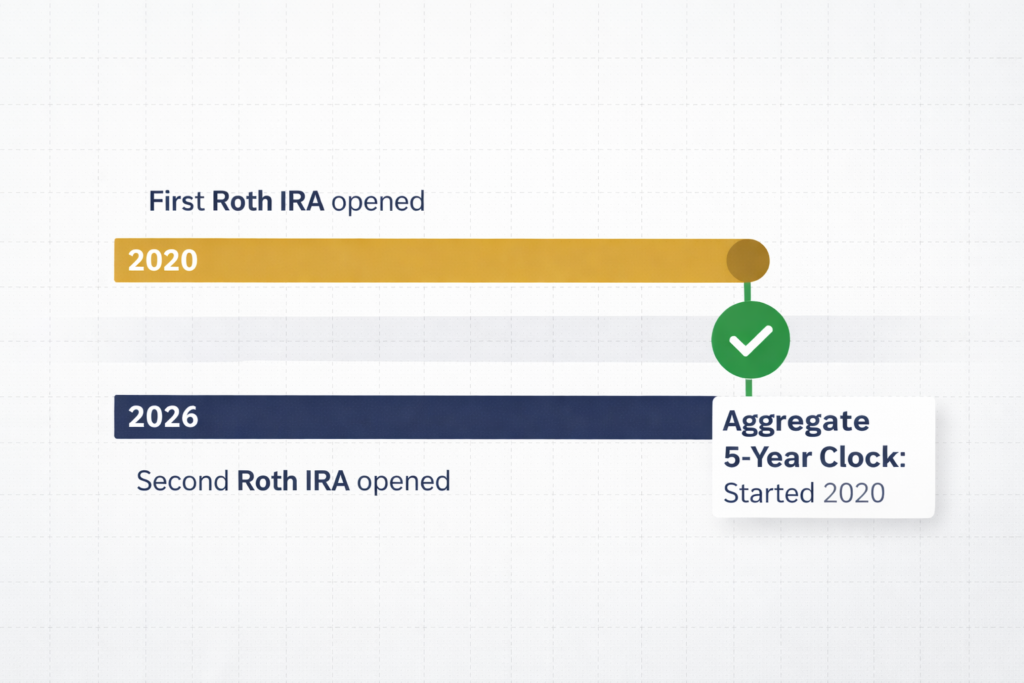
What does have its own separate clock is conversions. If you do a backdoor Roth conversion or roll money in from a traditional IRA, each conversion carries its own independent 5-year window for penalty-free withdrawal of that converted amount. So if you’ve been contributing to a Roth IRA since 2018 and you do a backdoor conversion in 2026, the contribution earnings are clear — but the newly converted amount has its own 5-year waiting period before you can touch it penalty-free.
This distinction matters practically if you’re doing both: regular contributions and conversions inside the same (or multiple) accounts. Keeping records of which dollars came in how and when becomes more important the more you layer these strategies. For most people with straightforward contribution histories, it’s simpler — your aggregate clock is the one that matters, and one account or two doesn’t change that.
Is It Smart to Have Two Roth IRAs?
It depends on why you have them.
If the second account exists because you haven’t gotten around to consolidating yet, that’s fine for now but probably worth cleaning up eventually. Two logins, two sets of tax documents, two year-end statements — the mental overhead adds up in a way that’s hard to quantify until you suddenly can’t remember which account holds what.
If the second account serves a real purpose — different investment access, separating contributions for different beneficiaries, or testing a new platform before committing — then having two makes sense. The strategy just needs to be deliberate.
The consolidation process is simpler than most people expect. You can initiate a transfer directly between brokerages. One thing worth knowing: if you transfer assets in-kind (meaning you move your actual holdings rather than cash), some institutions charge a fee for outgoing transfers. Because this happens inside a Roth, you can sell everything in the account, transfer the cash, and repurchase on the other side — no tax consequences. Cash transfers are usually faster and cheaper than moving securities directly.
The Roth IRA and 401(k) Combination Most People Get Backwards
A lot of people think they have to choose between a Roth IRA and a 401(k). They don’t.
These two accounts operate under completely separate rules. Maxing your Roth IRA has no effect on how much you can contribute to a 401(k), and vice versa. They’re not competing with each other. The $7,500 Roth IRA limit and the $24,500 401(k) limit in 2026 exist in parallel.

What many financial advisors recommend — and the forum consensus generally agrees — is that a traditional 401(k) paired with a Roth IRA is one of the more efficient combinations available to most workers. The 401(k) reduces your taxable income now. The Roth IRA builds a reserve of money you’ll never pay taxes on again. Together they give you flexibility in retirement to manage your tax situation year by year.
The Roth-only-at-work option tends to be misunderstood. A Roth 401(k) through an employer eventually becomes subject to required minimum distributions, which a personal Roth IRA never does. So for long-term tax-free flexibility, the personal Roth IRA holds an advantage that the workplace version doesn’t.
The Backdoor Strategy for Higher Earners
If your income exceeds the threshold for direct Roth IRA contributions — $153,000 for single filers (where the phase-out begins), $242,000 for married couples filing jointly in 2026 — you can still access the account through what’s commonly called the backdoor Roth.
The process involves making a non-deductible contribution to a traditional IRA and then converting that balance to a Roth IRA. Done cleanly, it’s legal, widely used, and the conversion doesn’t count against the annual contribution ceiling. It’s a separate mechanism entirely.
This strategy matters in the context of multiple accounts because it often results in people holding a Roth IRA funded through conversion alongside one or more accounts funded through direct contributions. The underlying tax treatment of those funds can differ, which is another reason that keeping clear records — and ideally, working with a tax professional at least once to set it up correctly — is worth the effort.
What SECURE 2.0 Changes in 2026 (Especially If You Earn Over $150k)
This is new, and it’s catching a lot of people off guard — particularly higher earners.
Starting in 2026, if your income in the prior year exceeded $150,000, your 401(k) catch-up contributions are now required to go into a Roth 401(k). You can no longer make pre-tax catch-up contributions if you’re above that income threshold. This is a SECURE 2.0 Act provision that was delayed a couple of times but is now in effect.
What that means practically: if you earned more than $150,000 in 2025 and you’re 50 or older, your catch-up dollars in your 401(k) are going in after-tax in 2026 whether you want that or not. You don’t get to choose pre-tax treatment for those extra contributions.

There’s also a separate provision worth knowing if you’re between 60 and 63. That age band now qualifies for a “super catch-up” — the 401(k) catch-up limit for this group is $11,250 in 2026, rather than the standard catch-up amount. This is designed to give people in the final stretch before typical retirement age an extra window to accelerate savings.
Neither of these changes affects the Roth IRA contribution limit directly. But if you’re trying to coordinate your overall retirement savings across a Roth IRA and a workplace plan, understanding how these 401(k) rules shifted changes the math on which account you might want to prioritize in a given year.
Age and Roth IRAs: The Questions People Ask But Don't Say Out Loud
A surprising number of people feel quietly embarrassed about opening a Roth IRA “late.” Forty-two. Fifty. Sometimes older.
There’s no age ceiling on contributing to a Roth IRA, as long as you have earned income. And the question of whether it’s worth starting at a given age almost always has the same answer: yes, because the alternative is not starting.
A person who opens a Roth IRA at 45 and contributes consistently for 20 years still ends up with two decades of tax-free compounding. That’s not nothing. At 50, the IRS actually acknowledges the lateness problem and addresses it directly through catch-up contributions — allowing an additional $1,100 per year on top of the $7,500 standard limit, bringing the total to $8,600. It’s a small number in isolation, but over time it closes some of the gap.
The “is it too late” framing tends to come from comparing yourself to an imaginary version of yourself who started at 22. That comparison isn’t useful. The more relevant question is whether starting now is better than not starting. It always is.
Should You Max Out Your Roth IRA?
Generally, yes — if the rest of your financial picture supports it.
The tax-free growth and withdrawal flexibility that a Roth IRA offers are genuinely difficult to replicate elsewhere. Qualified withdrawals in retirement don’t touch your taxable income, don’t affect your Medicare premiums, and don’t trigger taxes on Social Security benefits. There’s also no requirement to take money out at a certain age, which gives you real control over your tax situation in retirement.
That said, the order of operations matters. If you’re carrying high-interest debt, maxing a Roth IRA while paying 20%+ on credit cards is probably not the optimal sequence. And without a meaningful emergency fund, locking away money in a retirement account — even one where contributions can theoretically be withdrawn — creates a fragility you don’t want.
The practical answer for most people: capture any employer match in your 401(k) first (that’s an immediate 50–100% return on those dollars), then prioritize the Roth IRA, then go back to maximizing the 401(k) if you have remaining capacity.
One Account or Two: A Practical Decision Framework
Rather than treating this as a philosophical question, here’s a practical way to think about it:
Keep two accounts if: You’re actively using both — different investment access, different beneficiary designations, or a deliberate trial period with a new platform. You’re tracking contributions carefully and you’re confident you won’t accidentally exceed the annual limit.
Consolidate if: One account is just sitting there from a previous era. You rarely check both. You have to mentally add things up to know where you stand. The complexity isn’t delivering any real benefit.
Before consolidating, confirm: Whether you’ve done any Roth conversions in either account — because those do carry their own individual 5-year clocks. Regular contributions follow the aggregate clock (starting from your first-ever Roth IRA), so consolidating doesn’t affect that. But conversion dollars have their own timers, and you’ll want to track those separately regardless of whether you consolidate or not.
The accounts themselves are neutral. They’re just wrappers. What matters is whether the structure you have is one you can actually manage clearly over a long horizon — because the value of a Roth IRA compounds over decades, and small administrative mistakes along the way can erode that value in ways that take years to notice.
Two accounts isn’t inherently better or worse than one. But one account, managed with clarity and consistency, tends to outperform two accounts managed with occasional confusion. That’s not a rule — it’s just how it usually goes.
FAQ SECTION
Yes. There’s no IRS rule against holding or contributing to multiple Roth IRAs simultaneously. The only requirement is that your total contributions across all accounts stay within the annual limit — $7,500 in 2026, or $8,600 if you’re 50 or older.
No. For regular contributions, the 5-year clock is aggregate — it starts from the year you made your very first Roth IRA contribution ever, regardless of how many accounts you open later. Only Roth conversions carry their own separate 5-year clocks.
You’ll owe a 6% excise tax on the excess amount, and it repeats every year the money remains in the account. The correction is to withdraw the excess plus any earnings it generated before your tax filing deadline. Catching it early eliminates the penalty entirely.
Yes — and this is one of the cleanest ways to double household Roth IRA capacity. Each spouse is entitled to their own separate contribution limit. So a married couple can together contribute up to $15,000 in 2026, or $17,200 if both are 50 or older. Each account is independent.
Absolutely. A Roth IRA and a Roth 401(k) are separate account types with separate contribution limits. Having one does not reduce what you can put into the other. They coexist independently.
In 2026, the phase-out begins at $153,000 for single filers and $242,000 for married couples filing jointly. Above those levels, you can’t contribute directly — but the backdoor Roth conversion strategy remains available regardless of income.
Yes, and it’s generally straightforward. You can do a direct transfer between brokerages, or an indirect rollover (where you receive the funds and re-deposit within 60 days). Direct transfers are cleaner — no 60-day risk, no tax implications, and you avoid the once-per-year indirect rollover limit.
Not in itself. Each brokerage files its own Form 5498 with the IRS, and you’re responsible for ensuring the combined total doesn’t exceed the annual limit. The IRS can cross-reference both filings — so the only tax problem arises if you over-contribute, not from simply holding two accounts.
The SECURE 2.0 rule affects your 401(k) catch-up contributions, not your Roth IRA. If you earned over $150,000 in 2025, your 2026 401(k) catch-up must go into a Roth 401(k) — pre-tax catch-up is no longer an option at that income level. Your Roth IRA contribution limit and rules remain unchanged.
In most cases, yes — unless both accounts are actively serving a distinct purpose. Consolidation simplifies tracking, reduces the risk of over-contributing, and eliminates the administrative overhead of maintaining two separate account logins, statements, and beneficiary designations. The process has no tax consequences when done correctly inside a Roth account.
DATA & DEEP RESEARCH SOURCES
CATEGORY 1: IRS Official Sources (irs.gov)
| Topic | Official URL | Status | |
|---|---|---|---|
| 1 | Roth IRA — Main IRS Page | irs.gov/retirement-plans/roth-iras | Live |
| 2 | Publication 590-A (HTML version) — Contributions to IRAs | irs.gov/publications/p590a | Live (2025 edition) |
| 3 | Publication 590-A (PDF) — Full document | irs.gov/pub/irs-pdf/p590a.pdf | Live |
| 4 | IRA Contribution Limits — Official Retirement Topics Page | irs.gov/retirement-plans/plan-participant-employee/retirement-topics-ira-contribution-limits | Live |
| 5 | Traditional and Roth IRAs — Official Comparison | irs.gov/retirement-plans/traditional-and-roth-iras | Live |
| 6 | Amount of Roth IRA Contributions — 2024 Official Table | irs.gov/retirement-plans/plan-participant-employee/amount-of-roth-ira-contributions-that-you-can-make-for-2024 | Live |
| 7 | Form 5329 Instructions — Excess Contribution Reporting | irs.gov/instructions/i5329 | Live |
| 8 | About Publication 590-A | irs.gov/forms-pubs/about-publication-590-a | Live |
| 9 | SECURE 2.0 Roth Catch-Up Final Regulations — IRS Newsroom | irs.gov/newsroom/treasury-irs-issue-final-regulations-on-new-roth-catch-up-rule-other-secure-2point0-act-provisions | Live |
| 10 | IRS Notice 2023-62 (PDF) — SECURE 2.0 Section 603 Guidance | irs.gov/pub/irs-drop/n-23-62.pdf | Live |
Disclaimer :All figures reflect 2026 IRS guidance. 2027 estimates are projections only — confirm official thresholds via IRS.gov in October–November 2026. This article is for educational purposes only; consult a qualified tax professional for advice specific to your situation.