


You have a job offer, a work visa, and a salary that would qualify you for a loan in almost any other country. But the moment you apply for a basic credit card in the United States, the system automatically denies you without a second thought.
This is not an error. This is simply how the credit system in the United States works, and it catches almost every single H-1B visa holder off guard in their first year. The good news is that this issue is entirely fixable, usually within 12 months, and you won’t have to wait years to get access to real financial services.
This guide will put you in the know: why this issue is a problem, which banks and services to use, and a timeline so you know exactly what you’re doing and when.

Why Your Credit Score Literally Does Not Exist Here
The U.S. credit system — run by three independent bureaus, Experian, Equifax, and TransUnion — only tracks financial behavior that happened inside the United States. Your credit history from India, the UK, Nigeria, or anywhere else is invisible to them.
According to the Consumer Financial Protection Bureau (CFPB)
(https://www.consumerfinance.gov/consumer-tools/credit-reports-and-scores/)
So you’re not starting with bad credit. You’re starting with no credit file at all. That’s actually harder to work with, because lenders have zero data to evaluate. An automated system sees a blank file and declines immediately — regardless of your income.
There’s a second layer to this. H-1B visas are temporary, and lenders know it. If you default on a balance and move back home, the lender has almost no way to recover that money internationally. That risk quietly affects the products they’ll offer you and the limits they’ll start you with, even when your income is strong.
According to USCIS official data (https://www.uscis.gov/working-in-the-united-states/h-1b-specialty-occupations),
Understanding both of these dynamics — no history, temporary status — explains every frustration you’ll encounter. It also tells you exactly how to solve it.
SSN vs. ITIN: Get This Straight Before You Do Anything Else
An SSN (Social Security Number) is issued to H-1B holders who are authorized to work. Your employer’s HR team will walk you through applying at a local Social Security Administration office,(https://www.ssa.gov/ssnumber/) usually in your first week. Apply immediately. Most major credit products require an SSN, and your timeline for building credit starts the day you have one.
One important clarification: if you previously held an F-1 or J-1 visa and were issued an SSN then, that’s your permanent number. It doesn’t change when your visa type changes.
An ITIN (Individual Taxpayer Identification Number) is for people who need to file U.S. taxes but don’t qualify for an SSN — most commonly H-4 visa spouses without work authorization. ITINs are issued by the IRS using Form W-7, (https://www.irs.gov/forms-pubs/about-form-w-7)and the process typically takes 7–11 weeks. A handful of issuers — including(https://www.irs.gov/help/contact-your-local-irs-office)Bank of America and some credit unions — will accept an ITIN for a secured credit card application. We’ll cover that in the H-4 section below.
Your Foreign Credit History Isn't Completely Useless — If You Use Nova Credit
For newcomers from select countries, there’s a way to skip the “start from zero” phase entirely.
Nova Credit (https://www.novacredit.com/)is a cross-border credit bureau that translates your home country credit history into a format U.S. lenders can read. American Express has formally integrated Nova Credit into their application process, meaning if you’re arriving from India, the UK, Canada, Mexico, Australia, Brazil, the Philippines, South Korea, or several other countries, you may qualify for an unsecured Amex card on day one — no U.S. credit history required.
This isn’t a workaround or a loophole. It’s a legitimate, lender-integrated program. Check Nova Credit’s website (novacredit.com) before you apply anywhere else. If your home country is supported, this single step can save you 6–12 months of building from scratch.(https://www.novacredit.com/credit-passport)
If Nova Credit doesn’t cover your country, there’s another angle: if you held an American Express card in your home country, call Amex’s U.S. line directly. Their Global Card Transfer program(https://www.americanexpress.com/en-us/credit-cards/features-benefits/global-card-transfer/) can approve a U.S. card based on your international account history, and in many cases they’ll backdate the U.S. account to your original opening date — instantly giving you years of account age in the U.S. system.
The Four Real Paths to Your First H-1B Credit Card
Path 1: The Secured Card (Most Reliable Starting Point)
A secured credit card requires a cash deposit — typically $200 to $500 — which becomes your credit limit. You use it like a regular card, pay it monthly, and the issuer reports your payment behavior to all three bureaus.
Discover it® Secured(https://www.discover.com/credit-cards/secured-credit-card/) is the strongest option in this category. It has no annual fee, reports to all three bureaus, and automatically reviews your account for graduation to an unsecured card after seven months of on-time payments — returning your deposit in the process. Capital One Platinum Secured (https://www.capitalone.com/credit-cards/platinum-secured/)is a solid second choice, with a lower minimum deposit option.
Avoid store-branded cards and anything from issuers you’ve never heard of. The interest rates are often predatory, and the credit-building benefit is identical to what you’d get from Discover or Capital One.
Path 2: The In-Branch Strategy (Fastest Path to Unsecured Credit)
This is the most powerful and most overlooked approach for H-1B holders with documentation.
Several major banks have internal programs for foreign nationals that bypass the standard credit-scoring algorithm. These programs are not advertised online. They only work in person.
Bank of America has a Foreign National Mortgage and Banking program. When you open a checking account at a branch and provide your SSN, passport, visa, employment offer letter, and proof of address, a branch banker can submit your credit card application through a separate internal review process — not the automated online system. Approvals typically take two days and credit limits can start around $2,500–$10,000 depending on your salary documentation. If a banker tells you the decision will be instant, stop — that means they’ve accidentally run you through the online system, which will reject you immediately.(https://www.bankofamerica.com/deposits/manage/international-banking.go)
Chase offers a similar pathway. Open a Chase(https://creditcards.chase.com/cash-back-credit-cards/freedom/rise) checking account with a minimum deposit (typically $25 or more), then ask in the branch about the Chase Freedom Rise card for people new to U.S. credit. This card was specifically designed for limited-history applicants and is frequently approved for H-1B holders who have an active Chase checking account. Do not apply online. Go into a branch, mention that you’re a new arrival, and ask specifically about this card.
First Tech Federal Credit Union (https://www.firsttechfed.com/articles/h1b-visa-financial-services) deserves special mention. They serve employees at major tech companies including Google, Amazon, Microsoft, and others — companies that sponsor large numbers of H-1B visas. First Tech has a documented track record of approving credit products for H-1B and TN visa holders who have minimal U.S. credit history, including car loans and credit cards, based on the employment relationship. Check whether your employer is an eligible member organization at firsttechfed.com.
Path 3: The Authorized User Shortcut
If your spouse, a family member, or a close friend already has a U.S. credit card in good standing, ask them to add you as an authorized user. Every piece of that account’s history — payment record, account age, credit limit — gets added to your credit file. You don’t need to use the card. You just need to be listed. (The CFPB confirms (https://www.consumerfinance.gov/ask-cfpb/what-is-an-authorized-user-and-how-does-being-added-as-one-affect-my-credit-en-1241/)
This is legal, it’s effective, and it can compress 12 months of credit building into a matter of weeks. It works even before your SSN arrives if the primary cardholder adds you in advance.
Path 4: Employer Credit Unions
Many large employers — especially in tech, finance, and healthcare — have affiliated credit unions that offer accounts and credit products to employees from day one. Because the credit union has direct visibility into your payroll, they can extend credit based on employment rather than credit history alone.
Check with your HR department or employee benefits portal to see if your employer has an affiliated credit union. The National Credit Union Administration (NCUA) maintains a credit union locator at (https://www.mycreditunion.gov/about-credit-unions/credit-union-locator) If they do, this is often the fastest and most favorable path to both a credit card and a small personal loan.
Documents to Bring to Any Branch Visit
Walk in with all of these:
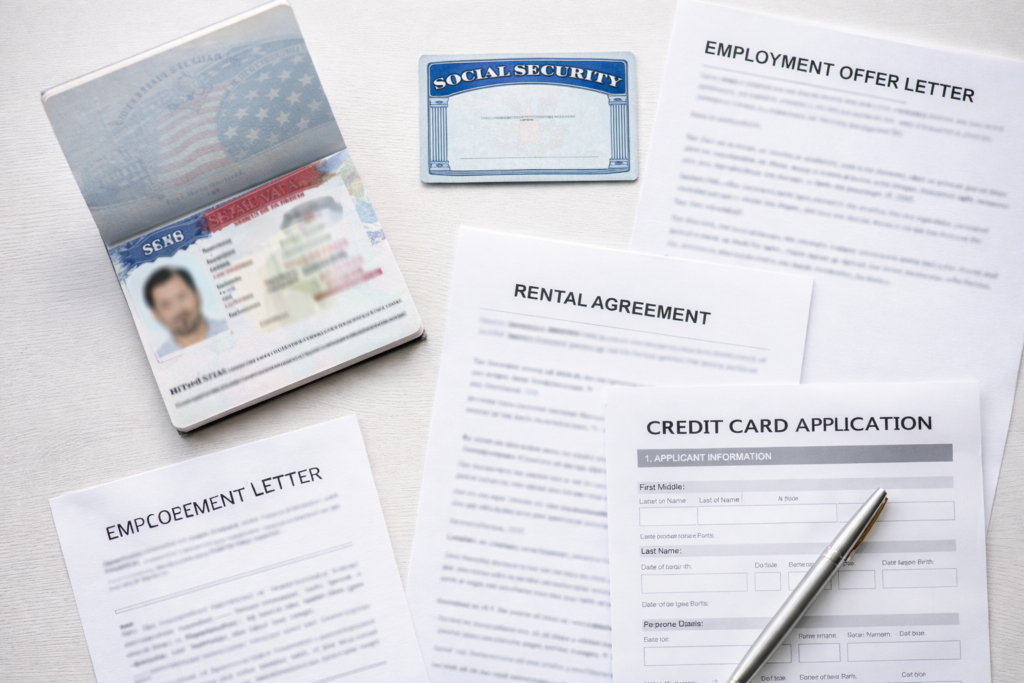
Your SSN card or documentation. Passport with current visa stamp. I-94 arrival record (printable at i94.cbp.dhs.gov). Employment offer letter showing your U.S. salary and employment period. Proof of U.S. address — a lease agreement, utility bill, or a letter from your company’s HR department on company letterhead. A recent pay stub if you’ve received one.
Go to a branch near a large employer campus or in an area with a significant immigrant population. Those bankers handle these applications regularly. A suburban branch in a low-immigration area may not even know the internal programs exist.

How to Actually Use Your First Card to Build Credit Fast
Getting the card is step one. How you use it determines how fast your score grows.
Keep your credit utilization below 30% — ideally below 10%. Credit utilization is the ratio of your current balance to your credit limit. (https://www.myfico.com/credit-education/whats-in-your-credit-score)If your secured card has a $500 limit and you charge $400, your utilization is 80% — which actively hurts your score. Charge $40–$50 per month on a recurring subscription or small purchase, then pay it in full.
Pay your full balance every month, not just the minimum. Paying the minimum keeps you in good standing but leaves a balance, which increases utilization. Full payment each cycle is the single most powerful credit-building habit you can develop.
Don’t apply for multiple cards at once. Every application triggers a hard inquiry, which temporarily lowers your score. In your first six months, focus on one or two accounts. Breadth comes later.
Request a credit limit increase at the six-month mark. Most issuers allow a limit increase request after six months of on-time payments. A higher limit with the same spending automatically lowers your utilization ratio, which boosts your score without any additional effort.
H-4 Visa Holders: Your Specific Roadmap
H-4 spouses face additional complexity because without an Employment Authorization Document (EAD), you can’t get an SSN. Here’s the realistic path forward.
Apply for an ITIN using IRS Form W-7.(https://www.irs.gov/forms-pubs/about-form-w-7) You’ll need your passport, your H-4 visa, and a valid federal tax reason for the ITIN — which your tax preparer or accountant can help establish. Processing takes 7–11 weeks when mailed, or faster if you visit an IRS Taxpayer Assistance Center in person.
With an ITIN, Bank of America will consider secured credit card applications at the branch level. Some local credit unions also accept ITINs. The product range is narrower than what’s available with an SSN, but the credit-building mechanics are identical.
In parallel, get added as an authorized user on your spouse’s or partner’s accounts immediately. This costs nothing, requires no ITIN, and begins building your credit file right away.
When your EAD comes through, apply for an SSN that same week. At that point, the credit history you’ve accumulated as an authorized user becomes your foundation, and you can apply for your own unsecured products.
Your Action Timeline
Week 1: Apply for your SSN immediately. Open a checking account at Chase or Bank of America in person. If your home country is supported, check Nova Credit before applying anywhere else. Get added as an authorized user on a trusted person’s account if possible.
Month 1: If Nova Credit applies, apply for an Amex card through their portal. If not, apply in-branch for a Chase Freedom Rise or Bank of America credit card using your foreign national documentation. If both are declined, open a Discover it® Secured card as your foundation.
Month 3: Check your credit score — it should now exist. Most banks show your FICO score free in their app. Keep utilization under 10% and pay balances in full every month.
Month 6: Request a credit limit increase on your existing card. Consider applying for a second card from a different issuer to add breadth to your credit profile.
Month 12: If you started with a secured card, your account may graduate automatically. Your score should be in the 680–740 range if you’ve maintained good habits. You now qualify for most mainstream rewards cards and can begin optimizing for cashback or travel points.

What Happens to Your U.S. Credit If You Leave
Your U.S. credit file does not disappear when you leave. The history stays in the bureaus’ records indefinitely. If you return on a future visa, that history is still there.
However, some issuers close accounts if they discover you’ve relocated internationally. Before any international move, pay down all balances and call your issuers to ask about their policy on accounts held by non-U.S. residents. Keeping balances at zero before departure removes your financial exposure and preserves your credit record cleanly.
Unpaid U.S. credit card debt does not automatically affect your immigration applications, but it can create complications in certain public charge analyses during green card processing. Maintain clean balances, especially if a green card application is in your future.
Best Credit Cards for H-1B Visa Holders in 2026 — Compared by Year of Arrival
Not every card works for every stage of your U.S. credit journey. The right card in year one is almost never the right card in year two — and applying for the wrong product at the wrong time wastes a hard inquiry and sets you back. Here’s exactly which cards work for H-1B holders at each stage, and why.

Year 1 — No U.S. Credit History Yet
These cards are specifically designed for people starting from zero. They don’t require an existing credit score, and all of them report to all three major bureaus.
| Card | Annual Fee | Deposit Required | Reports to All 3 Bureaus | Key Advantage |
|---|---|---|---|---|
| Discover it® Secured | $0 | $200 min | Yes | Auto-graduates to unsecured at 7 months |
| Capital One Platinum Secured | $0 | $49–$200 | Yes | Lowest possible deposit to start |
| Chase Freedom Rise | $0 | None | Yes | 1.5% cashback from day one, needs Chase checking |
| Bank of America Customized Cash Secured | $0 | $200 min | Yes | In-branch foreign national program |
| Petal 2 “Cash Back, No Fees” | $0 | None | Yes | No deposit, approves on income not score |
Which one to pick in Year 1: If you want the safest, most reliable approval — Discover it Secured. If you already have a Chase checking account — Chase Freedom Rise. If you want no deposit at all — Petal 2.
Year 2 — Score Exists, Building to 700+
By month 12–18, your score should be in the 660–720 range if you’ve used your first card correctly. At this point, unsecured cards with real rewards become accessible.
| Card | Annual Fee | Minimum Score Needed | Best Reward | Key Advantage |
|---|---|---|---|---|
| Chase Freedom Unlimited | $0 | ~670 | 1.5% cashback on everything | Pairs with future Chase Sapphire |
| Capital One Quicksilver | $0 | ~670 | 1.5% cashback | Simple flat-rate, no categories |
| Citi Double Cash | $0 | ~680 | 2% on everything | Highest flat cashback available |
| Amex Blue Cash Everyday | $0 | ~670 | 3% groceries, 3% online | Best for everyday H-1B spending |
Which one to pick in Year 2: Chase Freedom Unlimited if you plan to eventually get Chase Sapphire — these cards stack together. Citi Double Cash if you want maximum simplicity and best cashback rate.
Year 3+ — Score Above 720, Premium Cards Now Accessible
At this stage you qualify for cards that were completely out of reach when you arrived. These are the cards most H-1B professionals are working toward.
| Card | Annual Fee | Minimum Score | Best Benefit | Worth It If |
|---|---|---|---|---|
| Chase Sapphire Preferred | $95 | ~720 | 3x dining, 2x travel, transfer partners | You travel to India regularly |
| Amex Gold | $250 | ~720 | 4x dining, 4x groceries | You spend heavily on food |
| Capital One Venture X | $395 | ~740 | 2x everything, $300 travel credit | You want one premium card |
| Chase Sapphire Reserve | $550 | ~750 | 3x travel + dining, Priority Pass lounge | Frequent flyer, airport lounges |
Note on annual fees: A $95 or $250 annual fee is worth it only if the rewards you earn exceed the fee. For most H-1B professionals traveling home to India once or twice a year, Chase Sapphire Preferred typically pays for itself in the first trip.
Special Situation: Arrived This Week, Want a Card Today
If you landed in the U.S. within the last 30 days and haven’t built any credit history yet, you have two real options before the standard paths open up:
Option 1 — American Express via Nova Credit If your home country is India, UK, Canada, Mexico, Australia, Brazil, Philippines, or South Korea — go to novacredit.com before applying anywhere else. Amex has integrated Nova Credit directly into their application. Your home country credit history translates into a U.S.-readable format, and you can be approved for an unsecured Amex card on day one. No U.S. credit history required.
Option 2 — American Express Global Card Transfer If you held an Amex card in your home country, call the U.S. Amex line directly at 1-800-528-4800 and ask about the Global Card Transfer program. They can approve a U.S. card based on your international account history — and in many cases backdate the U.S. account to your original opening date, instantly giving you years of account age in the system.
One Mistake That Costs H-1B Holders the Most
Applying for multiple cards in the same month. Every application triggers a hard inquiry. Multiple hard inquiries in a short window signals risk to lenders and drops your score — at exactly the moment you need it to grow. In your first year, apply for one card, use it correctly for six months, then consider a second. Slow and deliberate wins every time.
Start This Week — Not Next Month
Building credit on an H-1B visa isn’t complicated. It just requires starting early and being deliberate about the first few steps.
Use Nova Credit if your country is supported. Walk into a Chase or Bank of America branch with your documentation if it isn’t. Get added as an authorized user on day one. Keep your utilization low, pay every balance in full, and check your score monthly.
The people who arrive and start immediately are the ones who qualify for a mortgage, a car loan, or a premium rewards card by year three. The people who wait until year two are always playing catch-up. You now know exactly what to do. The only variable left is when you start — and the best answer is this week.
FAQ
A: You can apply for a secured card relatively quickly, especially if you already have your SSN. For unsecured cards, most banks want to see at least a basic banking relationship first. A checking account opened at arrival gives you the foundation to apply for a credit card within the first few weeks at select institutions.
A: The fastest combination is: get added as an authorized user on someone’s established account immediately, while simultaneously opening your own secured card. These two tracks running in parallel can produce a meaningful credit score within three to four months.
A: No. Credit applications and credit history are handled by private financial institutions and are entirely separate from immigration records. USCIS does not check or consider your credit score when processing visa renewals or status adjustments.
A: Not directly. The green card application process looks at factors like public charge risk — whether you’re likely to become dependent on government assistance — but credit card debt by itself does not factor into that determination. However, carrying significant debt while demonstrating limited income could theoretically complicate a public charge analysis in specific circumstances, which is why financial stability is generally advisable during the green card process.
A: Most premium rewards cards require a score of 700 or above, with the best ones looking for 740+. If you’ve been building credit consistently for 12–18 months with no late payments and low utilization, reaching 700 is realistic. Many H-1B holders report reaching the 700s within their first year of active credit building.
A: No. Closing credit cards typically hurts your credit score by reducing your available credit and potentially shortening your average account age. If you’re concerned about spending, simply stop using the card — but keep the account open if possible. The history stays on your record as long as the account exists.
A: No, and this distinction matters. A prepaid debit card doesn’t build credit because the transactions are never reported to credit bureaus. A secured credit card is a real credit product — your deposit is just collateral. Your payment behavior is reported to the bureaus monthly, which is what builds your score.
Disclaimer:
The information provided in this article is for informational and educational purposes only. It does not constitute legal advice and should not be interpreted as such.
H-1B visa processes, USCIS regulations, and immigration laws are subject to change. Any content in this article — including wage levels, fees, deadlines, or selection rate estimates — may become outdated following official updates. Always verify the latest information directly through USCIS.gov or the Department of Labor’s official website.
For guidance specific to your immigration situation, consult a licensed immigration attorney or qualified legal professional. Every case is different, and general information may not apply to your individual circumstances.
The author and website assume no liability for any consequences arising from reliance on the content of this article.