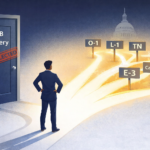



There is a certain kind of stress that comes with the H-1B lottery. It is not like waiting for a job offer or a test result, because those things are the result of effort. This is not. You do everything right, your company files on time, you have the degree, you have the job, and then you wait to see if a computer will pick your name. For many people, that is what happens three, four, sometimes five times before anything changes.
But this year is different in one significant way: the computer is no longer completely random.
The 2026 registration window, which applies to employment from October 1, 2026, and is officially known as the FY 2027 cap season, includes a wage-weighted lottery system, which affects who gets picked and how. If you are an international student, an international professional already in the U.S., or an employer trying to determine how to approach this season, this is the most important thing in this guide.
The Lottery Isn't Random Anymore — Here's What That Actually Means
For years, the H-1B lottery worked like this: every registration had an equal shot. It didn’t matter if the role paid $65,000 or $250,000. A software engineer at a startup and a senior architect at a Fortune 500 company had identical odds. That system was simple and predictable — and it’s gone.
Starting with the March 2026 registration window, USCIS implemented a final rule published December 29, 2025, that ties lottery entries to the Department of Labor’s four-level prevailing wage system. The higher the wage level of the offered position, the more entries that registration receives.
Here’s how it breaks down:
| DOL Wage Level | What It Represents | Lottery Entries |
|---|---|---|
| Level I | Entry-level, limited experience | 1 entry |
| Level II | Qualified, some experience | 2 entries |
| Level III | Experienced, full performance | 3 entries |
| Level IV | Expert, leadership, specialized | 4 entries |
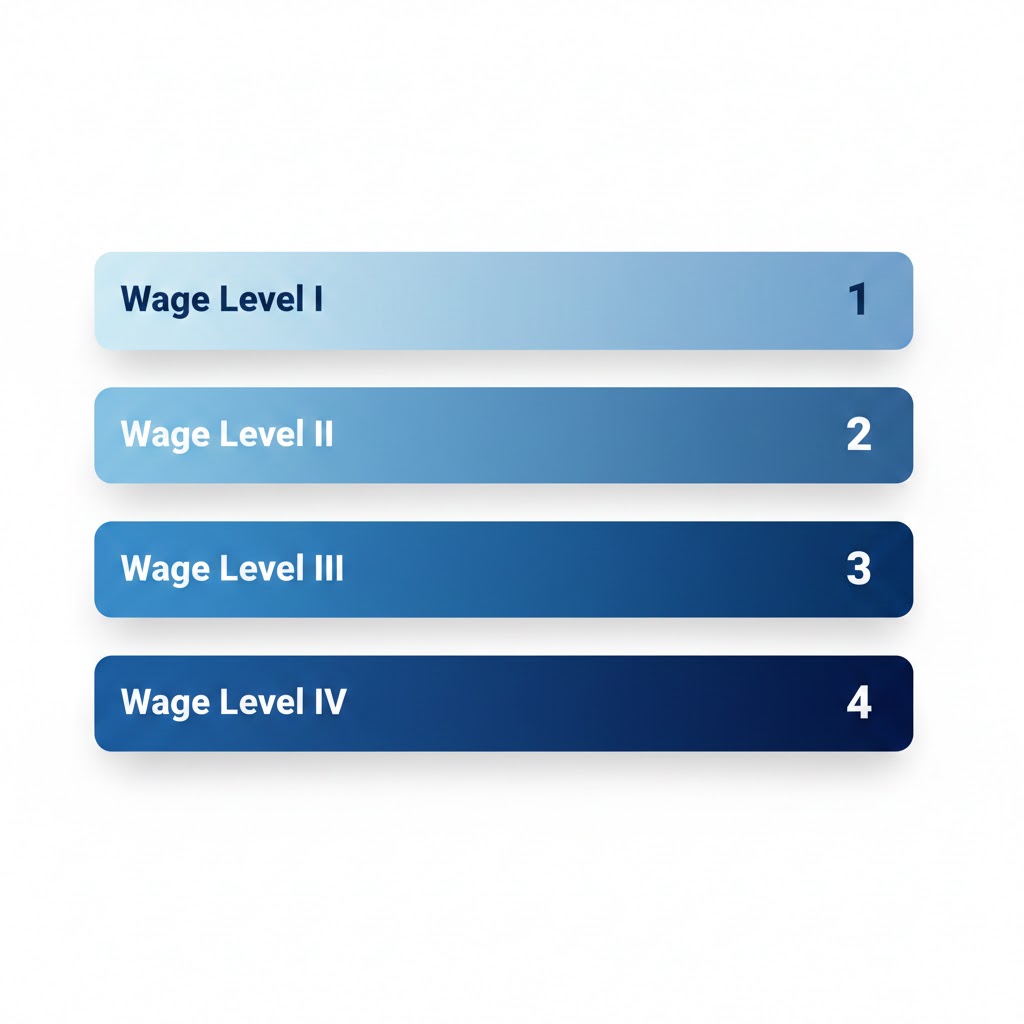
In practical terms, a Level IV candidate has four times the selection probability of a Level I candidate. Over a pool of hundreds of thousands of registrations, that difference is significant.
How the Four Wage Levels Work in Practice
The wage level isn’t something your employer invents. It’s determined by the Department of Labor’s Occupational Employment and Wage Statistics data for the specific job title and geographic location. You can look up prevailing wages directly at the DOL FLAG wage search tool.
A junior data analyst in Austin, Texas might have a Level I prevailing wage of $62,000. If your employer offers $85,000 for that same role and classification, you might qualify for Level II — two lottery entries instead of one. The offered salary has to genuinely meet or exceed the threshold for that level in that location.
What this means practically: employers are now being asked to think more carefully about what wage level a position warrants before registration. That determination used to be purely a compliance step. Now it also directly affects whether the worker gets selected at all.
Why Entry-Level Candidates Are in the Hardest Position Right Now
The math is uncomfortable for recent graduates and early-career professionals. If you’re coming off OPT or STEM OPT into a role that objectively qualifies as entry-level in your field, your registration carries one lottery entry. The person next to you with five more years of experience and a senior title carries four.
This doesn’t mean you can’t get selected. It means your odds are meaningfully lower than they were under the old system, and you should plan accordingly rather than assume the process works the same way it did for people who went through it a few years ago.
The historical overall selection rate in FY 2026 was approximately 35%, with 120,141 registrations selected from 353,981 eligible ones. Under the weighted system, that aggregate rate doesn’t distribute evenly anymore — Level IV candidates will see meaningfully higher individual rates, and Level I candidates will see lower ones.
Here’s what the math implies directionally, even before USCIS publishes Level-by-Level selection rates — which have not yet been released for FY 2027: if the same pool of 353,981 registrations from FY 2026 were entered under the weighted system, a registration carrying four entries would have roughly four times the statistical pull of a single-entry registration. The effective selection rate for Level IV candidates could plausibly approach 60–70% or higher, while Level I candidates could see rates well below 20%. These are directional estimates, not official figures. The actual distribution will depend heavily on how employers classify their roles this year and what proportion of the total pool falls into each tier. USCIS is expected to publish data on Level-by-Level registration counts after the window closes, which will make the picture clearer.
The Anti-Gaming Rule Nobody Talks About — And Why It Has Real Teeth
Here’s where most articles mention the anti-gaming provision briefly and move on. That’s a mistake, because the consequences of getting this wrong aren’t administrative — they can be permanent.
USCIS built explicit protections into the weighted lottery rule to prevent employers from inflating wage levels to gain more entries. The final rule makes clear that the wage level declared at registration must be supported by the actual job duties, the worker’s qualifications, and the prevailing wage for the occupation and location. If they don’t align, the consequences escalate quickly.
The consequences, in order of severity:
Request for Evidence (RFE): If USCIS adjudicators flag a mismatch between the declared wage level and the job duties described in the petition, they can issue an RFE demanding additional documentation — detailed position descriptions, organizational charts, proof of the worker’s qualifications, and evidence that the role genuinely warrants the declared level. RFEs delay the process significantly and cost both time and additional attorney fees to respond to properly.
Outright Denial: If the RFE response doesn’t resolve the inconsistency — or if USCIS determines the mismatch is too significant to be fixed with additional documentation — the petition is denied. A denied petition means the employer spent tens of thousands of dollars in fees and legal costs, and the worker is back to square one, likely on a ticking OPT clock.
Petition Revocation: Even after approval, USCIS retains the authority to revoke a petition if it later determines the wage level was inflated at registration. This can happen during an audit, a site visit, or as part of a targeted compliance review. A revocation after approval is particularly damaging because the worker may have already started employment — and suddenly loses H-1B status mid-job.
Fraud and Misrepresentation Bar Under INA 212(a)(6)(C): This is the one that carries lifelong consequences. If USCIS or USCBP determines that the wage level was inflated through willful misrepresentation of a material fact — meaning someone knowingly declared a higher wage level than the facts supported, with the intent to improve lottery odds — that finding can trigger a permanent bar on admissibility under Section 212(a)(6)(C) of the Immigration and Nationality Act. A misrepresentation bar doesn’t just affect the current petition. It can make the foreign national inadmissible to the United States permanently, blocking future visa applications, green card petitions, and even visitor entry. This bar is serious, it’s difficult to waive, and it can follow a person for the rest of their life.
There’s also a lesser-known structural rule that compounds this risk: if multiple employers register the same person, the lottery assigns entries based on the lowest wage level among all registrations. So if your primary employer registers you at Level III and a second employer also registers you at Level I, you don’t get the benefit of the higher level — the lower one governs. Think about that before assuming more registrations equals better odds. And think carefully before asking any employer to declare a wage level that the job duties and your experience don’t genuinely support. The short-term lottery advantage is not worth what’s on the other end of a misrepresentation finding.
The Key Dates — And Why Starting Late Is the Biggest Mistake
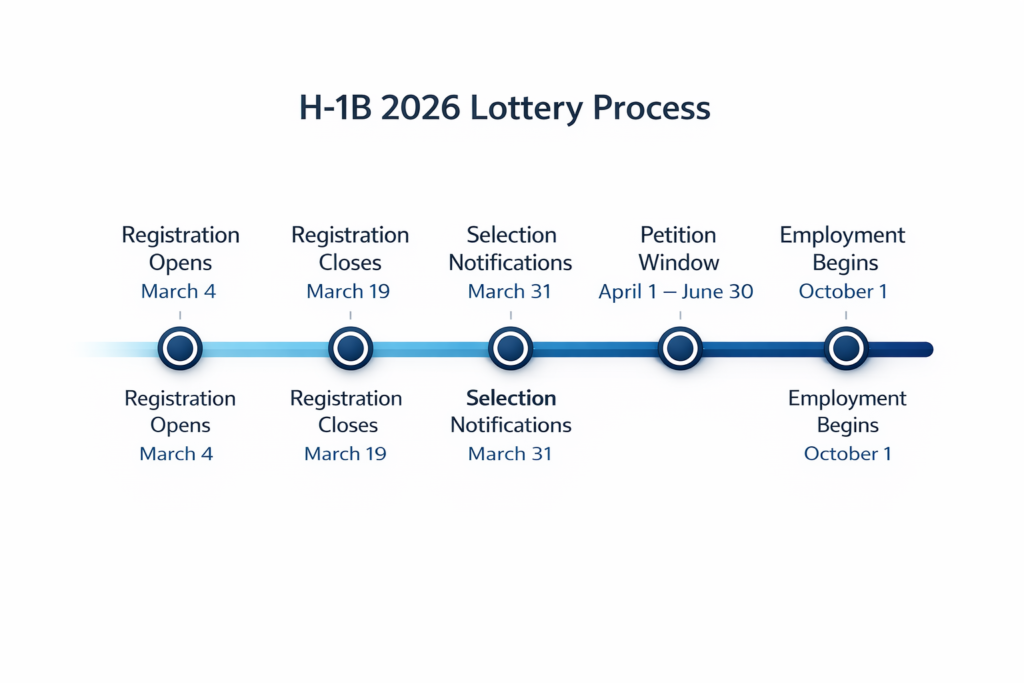
The 2026 registration window is 15 days. That’s it.
| Milestone | Date |
|---|---|
| Weighted lottery rule takes effect | February 27, 2026 |
| Registration window opens | March 4, 2026 at noon ET |
| Registration window closes | March 19, 2026 at noon ET |
| Selection notifications expected | By March 31, 2026 |
| Petition filing window opens | April 1, 2026 |
| Petition filing deadline | June 30, 2026 |
| H-1B employment start date | October 1, 2026 |
Source: USCIS FY 2027 H-1B Cap Registration Announcement
Missing the March 19 deadline is not recoverable. There is no late registration option, no appeals window, and no exception for employers who were slow to get organized. If the registration isn’t in before noon on the 19th, you wait until next year.
That’s why the conversation between an international student and their employer needs to happen now — not after the window opens.
The FY2027 / 2026 Naming Confusion (Explained Once and For All)
This trips up nearly everyone encountering the process for the first time. The registration happening in March 2026 is for the FY 2027 cap. The fiscal year starts October 1, 2026 — that’s when approved H-1B workers can begin employment. So the lottery you’re entering in March 2026 produces H-1Bs that activate in October 2026, under the fiscal year 2027 label.
When someone says “H1B lottery 2026,” they almost always mean the registration happening in March 2026. When official sources say “FY 2027,” they mean the same thing. Same event, different naming conventions.
What Your Employer Needs to Do Before March 4
Your employer — not you — is the one who registers. They do it through the USCIS myaccount portal, pay the $215 non-refundable registration fee per person, and submit the required information including your job details, wage level, and work location.
What you need to provide them with before that window opens:
- Passport information (country of birth and citizenship, not just current nationality)
- Current visa/status documentation
- The wage level determination (which should involve their immigration attorney, not a guess)
- Educational credentials confirming you qualify for a speciality occupation
If your employer hasn’t engaged an immigration attorney yet, that conversation is already running behind. The wage level determination and LCA preparation — which must be complete before a full petition can be filed if selected — take time that disappears quickly.
The $100,000 Fee — Who Pays It and Who Doesn’t
This has caused more confusion and unnecessary panic than almost anything else in the 2026 cycle. Let’s be direct about it.
A September 2025 presidential proclamation imposed a $100,000 supplemental fee on certain new H-1B petitions. The operative word is “certain.” Not all of them. Not even most of them, depending on the applicant pool.
The fee applies when:
- The petition is cap-subject (going through the lottery)
- The beneficiary is located outside the United States
- The person needs consular processing to enter the U.S.
The F-1 Student Exemption
If you are an F-1 student currently studying or working on OPT/STEM OPT inside the United States, and your employer files a change-of-status petition — meaning you don’t need to leave and get a visa stamp to activate your H-1B — you are not subject to the $100,000 fee.
Once your H-1B activates, your first financial priority should be building credit from scratch — here’s the complete guide for Indian immigrants on getting your first US credit card.
USCIS confirmed this exemption explicitly. The fee is tied to consular notification, not to the lottery itself.
This distinction is what caused a lot of employers to quietly put junior-level sponsorships back on the table after initially assuming the fee applied universally. An F-1 graduate changing status from within the U.S. is a fundamentally different cost scenario than sponsoring someone currently living abroad.
What “Consular Processing” Actually Triggers the Fee
If a candidate is outside the United States — whether they’ve never been here or they’re currently abroad — they need a visa stamp from a U.S. consulate to enter as an H-1B worker. That’s consular processing, and that’s what triggers the $100,000 fee.
One important nuance: even if a candidate is currently inside the U.S., USCIS may determine that a change-of-status request isn’t approvable — for example, if there’s a gap in lawful status. In that situation, the employer would need to process the case consularly, which would trigger the fee. This makes maintaining clean, continuous status more important than ever for candidates who want to avoid that outcome.

The Real Cost of H-1B Sponsorship (Full Breakdown)
When employers ask “how much does H-1B cost,” the honest answer is: it depends heavily on the scenario. Here’s a realistic breakdown.
For a domestic F-1 change-of-status (no $100K fee):
| Fee Component | Approximate Amount |
|---|---|
| Lottery registration fee | $215 |
| Base USCIS filing fee (I-129) | $730 |
| Fraud prevention and detection fee | $500 |
| Asylum program fee (large employer) | $600 |
| ACWIA training fee (employer size dependent) | $750 – $1,500 |
| Premium processing (optional, 15-day guarantee) | $2,805 |
| Attorney fees (varies widely) | $2,000 – $5,000+ |
| Total (without premium, large employer) | ~$5,000 – $8,500 |
For a candidate requiring consular processing from abroad:
Add $100,000. That changes the math entirely for most employers and explains why domestic F-1 students have become significantly more attractive sponsorship candidates in 2026 compared to offshore hires at similar experience levels.
Note: USCIS fee schedules are subject to change. Always verify current amounts at uscis.gov/forms/our-fees.
What Happens If You're Not Selected
This is where most guides get vague or falsely reassuring. Let’s be honest: not getting selected is genuinely hard, particularly if it’s your second or third time, or if your STEM OPT window is closing.
But there are real options, and some of them are better than most people realize.
STEM OPT and the Cap-Gap Extension
If you’re on OPT or STEM OPT when the lottery results come out and you were selected, the cap-gap extension protects your work authorization from when your OPT expires through October 1, when H-1B status begins. As of 2024 rule changes, this protection now runs through April 1 of the following year in some circumstances, giving more runway.
While you wait for the next cycle, the smartest move is building your US financial foundation early — here’s the complete guide on how H1B holders can get a credit card and build credit history in the US.
If you weren’t selected, your OPT authorization remains valid until its original expiration. You don’t lose any time because of the lottery result — but you need to plan around what happens when it does expire.
For STEM OPT holders with time remaining: you still have the next lottery cycle. That’s not a guarantee, but it’s a real opportunity, and staying employable in the interim matters.
Cap-Exempt Jobs Are More Valuable Than Most People Realize
Universities, nonprofit research organizations, and government research entities are not subject to the H-1B cap. If you work for one of these employers, you can file for H-1B at any time of year, without going through the lottery, with no cap limit. That’s a fundamentally different process — and for many people, a more stable one.
Three concrete examples of qualifying cap-exempt employers:
1. A state university research department. A public university like the University of Michigan or UCLA qualifies as an institution of higher education under 8 U.S.C. § 1101(a)(15)(H). A foreign national employed as a postdoctoral researcher, lecturer, or staff scientist there can receive H-1B sponsorship at any point in the year, with no lottery, no cap, and no March deadline.
2. A nonprofit hospital or medical research center affiliated with a university. Organizations like Mayo Clinic or Johns Hopkins Medicine — as nonprofit entities affiliated with accredited universities — often qualify for cap exemption. A physician, researcher, or clinical scientist joining one of these institutions can be sponsored without cap exposure. The affiliation requirement has specific legal criteria; the employer’s immigration counsel must verify it applies.
3. A government-funded national laboratory. Facilities operating as nonprofit research organizations under government contract — such as national energy laboratories or federally funded R&D centers — frequently qualify. A data scientist or engineer hired into one of these organizations can receive H-1B status year-round without entering any lottery pool.
How cap-exempt filing works differently in practice:
There is no registration window, no lottery, and no October 1 start date requirement. The employer files the I-129 petition directly with USCIS at any point during the year, and employment can begin as soon as the petition is approved — or, with premium processing, within 15 business days of filing. The substantive requirements — specialty occupation, appropriate degree, employer-employee relationship — are identical to cap-subject petitions. What’s removed is the entire lottery layer.
Practical tip for someone transitioning from a cap-subject to a cap-exempt employer:
If you’re currently working under an approved cap-subject H-1B and considering a move to a cap-exempt employer, you do not need to go back through the lottery. Your H-1B status transfers through a standard portability filing under AC21. The new employer files an H-1B transfer petition, and you can begin working as soon as it’s filed — not just after approval. What this means strategically: if you’ve been grinding through the lottery for two or three years, a cap-exempt employer isn’t a consolation option. It’s an exit from the annual lottery cycle entirely, with no sacrifice of H-1B status.
The O-1A and EB-2 NIW Are Parallel Pathways, Not Backup Plans
Let’s reframe something that gets said constantly in the wrong way: people who’ve been through two or three failed lottery cycles often describe the O-1A or EB-2 NIW as their “Plan B.” That framing undersells both options and delays preparation unnecessarily. These are legitimate primary immigration pathways that happen to require a different kind of documentation than H-1B — and they can be built in parallel with lottery participation, starting now.
The O-1A Visa: What USCIS Actually Looks For
The O-1A is for individuals with extraordinary ability in their field — defined not as fame, but as a level of expertise indicating the person is among the small percentage who has risen to the very top of their field. USCIS evaluates O-1A petitions against eight criteria, of which the applicant must satisfy at least three:
- Receipt of nationally or internationally recognized prizes or awards for excellence in the field
- Membership in associations that require outstanding achievements as a condition of entry, judged by recognized experts
- Published material about the person in professional or major trade publications or major media
- Participation as a judge of the work of others in the same or allied field
- Original scientific, scholarly, artistic, athletic, or business-related contributions of major significance
- Authorship of scholarly articles in professional journals or other major media in the field
- Employment in a critical or essential capacity for organizations with a distinguished reputation
- Command of a high salary or remuneration relative to others in the field
Two realistic examples of who qualifies:
Example 1: A machine learning engineer with four published papers in peer-reviewed conferences (criteria 6), who has reviewed submissions for a top AI conference (criteria 4), and whose salary is documented to be in the top 10% for their role in their metro area (criteria 8). That’s three criteria, each supported by documentation. O-1A is a realistic option.
Example 2: A biomedical researcher who received a nationally recognized graduate fellowship (criteria 1), has contributed to published findings cited over 200 times (criteria 5), co-authored articles in a major scientific journal (criteria 6), and serves on a review panel for a government research grant (criteria 4). Four criteria, solid documentation trail. O-1A isn’t a stretch — it’s the appropriate visa.
The O-1A is employer-specific, requires a U.S. petitioner, and doesn’t have a cap. You can file at any time of year. It’s typically valid for three years with one-year extensions indefinitely. Critically, it does not require a permanent job offer or an intent to stay permanently — which makes it flexible in ways that H-1B sometimes isn’t.
The EB-2 NIW: The Dhanasar Three-Prong Test in Plain Language
The EB-2 National Interest Waiver allows certain professionals to petition for permanent residence without employer sponsorship and without going through the PERM labor certification process — if they can demonstrate their work is in the national interest of the United States. The governing legal standard comes from a 2016 USCIS Administrative Appeals Office decision called Matter of Dhanasar, which established a three-prong test. USCIS describes the full NIW standard here.
Here’s what the three prongs actually mean in non-legal terms:
Prong 1: The proposed endeavor has substantial merit and national importance. Your work needs to matter in a meaningful way — not just to your employer or your field, but to the United States more broadly. Research in energy, healthcare, technology infrastructure, national security, education, or economic development tends to satisfy this prong. The question USCIS is really asking: does this work contribute to something that benefits the country, not just the company?
Prong 2: You are well positioned to advance the proposed endeavor. You need to demonstrate that you specifically are credible to do this work — not just that the work is important. This is where your education, publications, prior results, citations, employment history, and recognition from peers become evidence. The more you can show that people in your field already recognize your contributions, the stronger this prong becomes.
Prong 3: On balance, it would be beneficial to the United States to waive the job offer and labor certification requirements. This is where self-petitioning becomes possible. If USCIS finds that requiring you to go through PERM would slow down work that genuinely benefits the U.S., they can waive those requirements. This prong rewards urgency and uniqueness — if your work addresses a gap, solves a real problem, or contributes to a national priority, USCIS is more likely to find the waiver justified.
The EB-2 NIW doesn’t require an employer at all. You can file it yourself, through an immigration attorney, at any time. It leads directly to permanent residence, not temporary work authorization. For researchers, engineers, physicians, educators, and entrepreneurs whose work has documented national impact, it’s often a more direct path to long-term stability than H-1B ever was.
Both of these pathways — O-1A and EB-2 NIW — require documentation that takes time to build. Publications, citation records, award nominations, salary comparisons, letters from recognized experts in the field, evidence of peer review or judging roles. None of that materializes overnight. The right time to start thinking about them is not after a third lottery failure. It’s now, while you’re still building your career trajectory and can make choices that strengthen your profile intentionally.

Questions People Actually Ask (That Most Articles Skip)
What Happens If You Lose Your Job on H-1B
Your H-1B is tied to your employer. When that relationship ends — whether you were laid off or resigned — a 60-day grace period begins. During that time, you can:
Job loss on H-1B puts your financial health at risk too — especially your credit score. Here’s how the US credit score system works and how to protect it during uncertain times.
- Have a new employer file an H-1B transfer petition
- Change to a different visa status (B-2, F-1, H-4, etc.)
- Depart the United States
You cannot work during this period. The clock starts on the day employment ends, not the day you find out about it, and not your last paycheck date. If the grace period expires without a resolution, you begin accruing unlawful presence — which triggers three-year or ten-year bars on future visa applications depending on how long that presence accumulates.
Act quickly. USCIS’s 60-day grace period regulation provides limited but real protection — don’t waste days waiting to see how things unfold.
Can You Change Employers After H-1B Approval
Yes, and you can start working for the new employer as soon as they file a transfer petition — before it’s approved. This is the portability provision under AC21 (American Competitiveness in the 21st Century Act).
The requirements for portability: your original H-1B was properly approved, the new petition is bona fide (not frivolous), and the new role qualifies as a specialty occupation. You don’t have to wait for the new approval notice to start working — the filing itself is sufficient.
If you switch employers before the transfer petition is filed, you’re working without authorization. The order matters.
What the 240-Day Rule Actually Protects
If your H-1B extension petition was filed before your current status expired, you can continue working for the same employer for up to 240 days while the extension is pending — even after your original I-797 expiration date.
This protection evaporates the moment the extension is denied. And it only applies to continued employment with the same employer filing the extension. Changing jobs during this window doesn’t fall under this protection — the new employer would need to file their own petition and you’d need to rely on portability provisions instead.
The Emotional Reality of This Process (And How to Stay Functional)
The results window — usually the last week of March — is genuinely hard to describe to someone who hasn’t been through it. People check their email every twenty minutes. Law firms process cases in batches, so some people hear days after others at the same company. The silence reads like rejection even when it isn’t.
What’s worth saying plainly: the results trickle in over several days. Selections are issued across a window ending March 31, and law firms vary significantly in how quickly they communicate results to employers, who then communicate to employees. Not hearing by Friday doesn’t mean you weren’t selected. Hearing before Monday doesn’t mean you were — there have been instances of erroneous preliminary communications.
It’s also worth saying that multiple lottery attempts are normal, not unusual. The community threads from previous cycles are full of people selected on their third, fourth, fifth attempt — and full of people who found their way through entirely different pathways after the lottery stopped being viable.
The worst thing you can do is build your entire plan around a single outcome you can’t control. The best thing you can do is understand what happens in each scenario well enough that none of them catches you unprepared.

FAQ Section
The registration window for the FY 2027 H-1B cap opens on March 4, 2026 at noon Eastern Time and closes on March 19, 2026 at noon Eastern Time. There are no extensions and no late filings accepted. Employers must complete registration and pay the $215 fee per candidate within this 15-day period. Source: USCIS FY 2027 H-1B Cap Registration Announcement
Instead of every registration having an equal shot, candidates are now entered into the lottery multiple times based on the Department of Labor wage level of their offered position. Level I (entry) gets 1 entry, Level II gets 2, Level III gets 3, and Level IV (expert/leadership) gets 4. The wage level must be accurately determined before registration — inflating it to gain more entries can result in RFE, petition denial, revocation, or a permanent misrepresentation bar under INA 212(a)(6)(C). Source: USCIS Weighted Selection Final Rule
No — F-1 students filing a change of status from within the United States are exempt from the $100,000 supplemental fee. That fee only applies to petitions requiring consular processing, meaning the candidate is outside the U.S. and needs a visa stamp from a U.S. consulate to enter. Students already in the country on valid F-1 status transitioning to H-1B domestically are not subject to it. Source: USCIS H-1B Cap Season Guidance
That depends on how your position is classified under DOL prevailing wage data for your specific occupation and city. A junior software developer in a lower cost-of-living area may qualify only for Level I (1 entry). The same title in San Francisco with a higher offered salary might qualify for Level II (2 entries). Your employer’s immigration attorney should run this determination before registration. Source: DOL FLAG Wage Search Tool
If your H-1B employment ends — whether you’re terminated or you resign — a 60-day grace period begins on the first day you are no longer employed. During this period you cannot work, but you’re still in a period of authorized stay. You can use this time to secure a new employer willing to file a transfer petition, change to another status, or leave the country. The clock starts on the last day of employment, not the day you learn about it. Source: USCIS Policy Manual – Grace Period
No. Only the employer (or the employer’s authorized law firm) can check the registration status through the USCIS organizational account. Individual workers do not have independent access to their own registration records. If you want to confirm you were actually registered, ask your employer for the confirmation receipt or the name of the law firm handling the case. Source: USCIS H-1B Electronic Registration Process
Yes. Two spouses can each independently hold H-1B status if each has their own qualifying employer and job offer. They each go through the lottery separately, and neither needs to be classified as a dependent of the other. This is different from the H-4 dependent scenario, where one spouse holds H-1B and the other holds H-4 status. Source: USCIS H-1B Specialty Occupations
The standard maximum is six years — an initial three-year approval with a single three-year extension. Beyond six years, extensions are generally not available unless you’ve reached a qualifying milestone in the employment-based green card process: specifically, an approved I-140 or a PERM application that has been pending for at least 365 days. If either condition is met, annual or three-year extensions can continue indefinitely until the green card case is resolved. Source: USCIS H-1B Extensions Beyond Six Years
Yes, part-time H-1B employment is permitted, but the terms of the petition must specifically reflect part-time status, including the hourly wage and reduced schedule. The employer must still pay at least the prevailing wage calculated for part-time hours in the relevant occupation and location. Part-time filings can face more scrutiny during adjudication, particularly around whether the role genuinely qualifies as a specialty occupation at reduced hours. Source: USCIS I-129 Instructions
Possibly, but not guaranteed. USCIS conducts additional draws only when approved petitions from the initial selection fall short of the 85,000 annual cap — which happens when selected employers don’t file, petitions are withdrawn, or approvals come in below projections. In the FY 2026 cycle (March 2025), only one draw was conducted. In prior years, two or three were needed. You cannot register again once the initial March window closes — only beneficiaries from the original registration pool are eligible for any subsequent draws. Source: USCIS H-1B Electronic Registration Process – Historical Data
Disclaimer:
The information provided in this article is for informational and educational purposes only. It does not constitute legal advice and should not be interpreted as such.
H-1B visa processes, USCIS regulations, and immigration laws are subject to change. Any content in this article — including wage levels, fees, deadlines, or selection rate estimates — may become outdated following official updates. Always verify the latest information directly through USCIS.gov or the Department of Labor’s official website.
For guidance specific to your immigration situation, consult a licensed immigration attorney or qualified legal professional. Every case is different, and general information may not apply to your individual circumstances.
The author and website assume no liability for any consequences arising from reliance on the content of this article.