

There’s a particular kind of frustration that occurs mid-process: you’re filling out a government form, you come across a field labeled “visa number,” and you’re just not sure if what you’re looking at is correct. Not because you’re not prepared. Because the US immigration system assigns multiple identification numbers across multiple documents without ever clarifying which is which until you need one of them to fill out a form right now.
If you got an I-797 approval notice [INTERNAL LINK: Complete Guide to Reading Your I-797] and thought that was your visa number, that’s the confusion this article will rectify. If you’re trying to determine if the number on your approval notice is the number the form is asking for – it’s not. If your visa stamp has expired and you’re quietly freaking out about what that means for your legal residency – probably nothing, and we’ll get to that.
This is the guide that will address all of this and more without sending you off to click somewhere else for the real answer.
The Approval Notice Is Not a Visa — And That's Where the Confusion Starts
When your employer’s immigration attorney sends over the approved I-797A and your status officially changes to H-1B, it feels like the process is complete. The petition was filed, reviewed, and approved. What else could there possibly be?
“If you’re still early in the process and want to understand how the H-1B petition selection works before reaching the stamping stage, our guide on H-1B lottery, new rules, and costs covers that in full.”
Quite a bit, actually. What the I-797 confirms is your work authorization status — your right to work and remain in the United States. What it does not do is authorize you to board an international flight and re-enter the country afterward. Those are two separate permissions, governed by two entirely different federal agencies, and that distinction has very real consequences.
The I-797 is issued by US Citizenship and Immigration Services (USCIS), which sits under the Department of Homeland Security. USCIS controls whether you’re authorized to work and stay. The visa stamp in your passport is issued by the US Department of State — a completely different agency — and that stamp is what controls your ability to enter after traveling abroad. You can verify how USCIS handles approval notices at uscis.gov.
In practical terms: if your H-1B was approved through a change of status while you were already inside the US, you may have never needed a visa stamp at all — until you book an international flight. That’s the moment the distinction stops being theoretical.
The visa number only exists after the State Department has reviewed your case and physically stamped your passport at a consulate or embassy. Before that moment, there is no visa number anywhere, because there is no visa yet.
What a Visa Number Actually Is, What It Looks Like, and Where It Lives
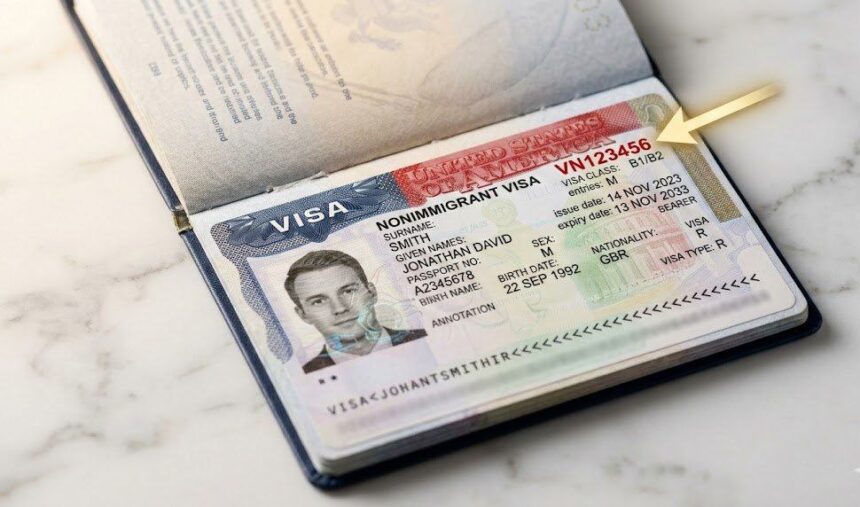
Once a consular officer approves your application, the consulate places a visa foil directly into your passport. This is a laminated sticker-type document printed with your visa category, your name, the validity dates, the number of permitted entries — and the visa number.
The visa number is the unique identifier for that specific visa issuance. The Department of State uses it to record and track that particular document. Every time you get a new stamp, you get a new visa number. It is sometimes called the foil number or the control number — these terms all refer to the same thing.
The Format — So You Recognize It the Moment You See It
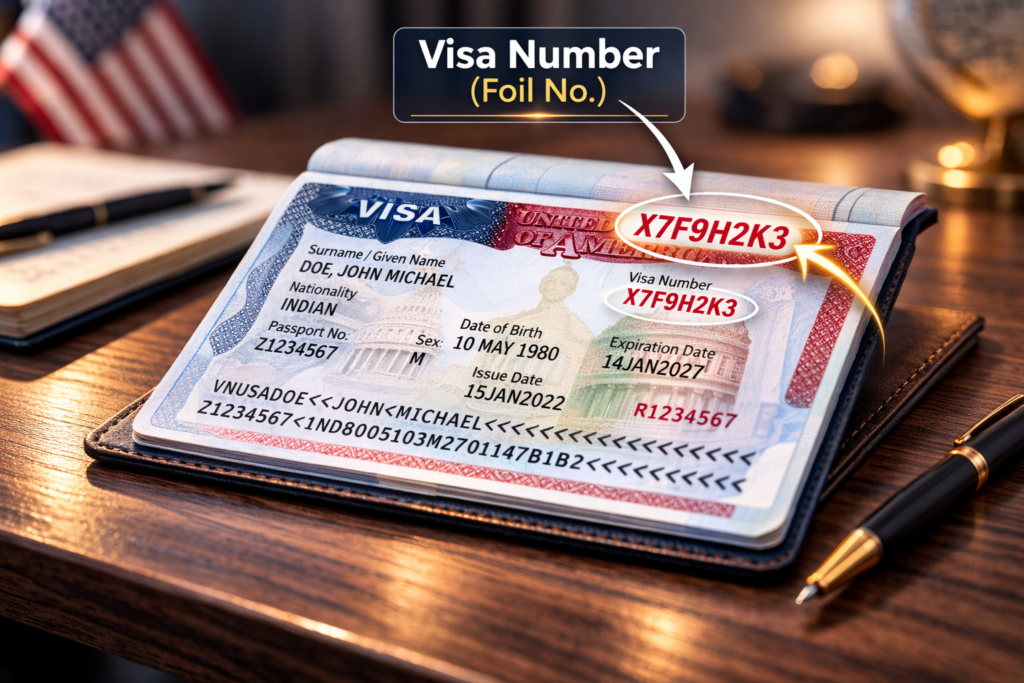
A US nonimmigrant visa number is typically 8 characters long. It starts with one or two letters, followed by a sequence of digits. It is printed in red ink on the visa foil — usually in the upper right corner — which is the fastest way to locate it. All other fields on the stamp are printed in black. The visa number is in red. That contrast is your visual anchor.
Some visa foils label it clearly as “Visa No.” Others label it “Foil No.” Others don’t label it at all — which is exactly why people end up searching online at 11pm wondering if they’ve found the right thing. If you see a short alphanumeric string in red ink that doesn’t match your passport number, that’s almost certainly it.
For a full breakdown of what every field on a US visa stamp means and where it’s positioned, the State Department’s visa information FAQ is the most reliable official source.
The Other Numbers on Your Documents — and Why They Keep Tripping People Up
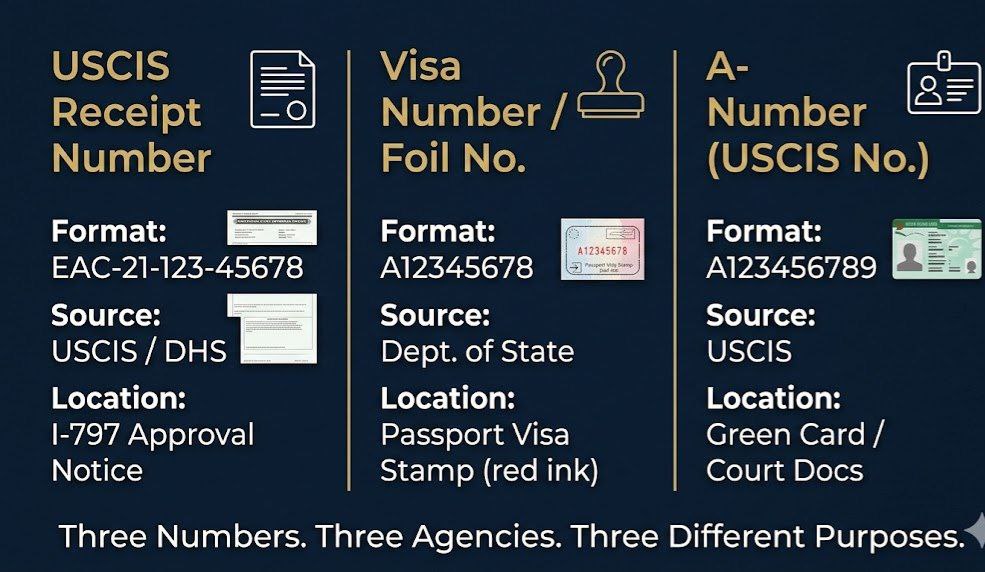
Over the course of an H-1B petition, you accumulate several different identifying numbers across several different documents. Each one means something different. Each one comes from a different agency. And they look similar enough that putting the wrong one in the wrong form field is easy to do — especially when you’re doing this for the first time.
Receipt Number vs. Visa Number — The Comparison Nobody Explains Clearly
The receipt number is a 13-character case identifier — something like EAC-21-123-45678 — assigned by USCIS the moment your petition is filed. The first three letters indicate which USCIS service center processed the case. This number is on your I-797 notice, and it’s what you use to check case status through the USCIS Case Status Online tool.
The visa number is not on your I-797. It doesn’t exist until after a consular officer approves your case and stamps your passport. It’s shorter, formatted differently, and comes from a completely different government agency.
Both get casually called “your visa number” in everyday conversation. In official terms, they are entirely different identifiers that belong in different fields on every form you’ll encounter. Entering your receipt number in the visa number field — or vice versa — is one of the more common H-1B paperwork errors, and it’s completely understandable why it happens.
The A-Number — Why Most H-1B Holders Don’t Have One Yet
The A-number (Alien Registration Number) is a 7-to-9-digit number preceded by the letter “A” — like A123456789. It’s a permanent identifier, but it isn’t automatically assigned to every visa holder.
For H-1B workers, the A-number typically appears in one of a few scenarios: immigration court proceedings, a pending green card application, or certain other immigration processes that generate USCIS records tied to your person rather than to a specific petition. Many H-1B holders — particularly those who have been in the country for years on work visas with no adjustment of status application filed — simply don’t have one yet.
If a form asks for your A-number and none of the above apply to you, the correct answer is “None” or “N/A.” Don’t invent a number and don’t substitute your receipt number. If you need to locate your A-number, check your immigration court documents, any prior green card, or previous USCIS correspondence. Official guidance is available at uscis.gov.
How to Find Your Visa Number on the Physical Stamp — Step by Step
If you have an existing visa stamp in your passport — a current H-1B, a previous F-1, a B1/B2, any category — here’s how to locate the number quickly.
Open your passport to the page with the US visa foil. It’s the page with the laminated sticker-type document, printed with text and usually a small photo. Look toward the upper right area of that foil. You’re looking specifically for a number printed in red ink, not black. That short alphanumeric string — starting with a letter, about 8 characters long — is your visa number.
Some foils label it “Visa No.” Some label it “Foil No.” Some don’t label it at all. If red ink and upper-right position match, you’ve found it. For a detailed visual walkthrough of every labeled field on a US visa stamp, CitizenPath has a thorough annotated breakdown worth bookmarking.
If you’ve never been stamped — if you entered on a different visa and changed status domestically to H-1B without ever leaving — you simply don’t have an H-1B visa number yet. Your passport may contain a stamp from a previous category (F-1, for example). In that case, the number from that prior stamp is what most forms mean when they ask for your “nonimmigrant visa number from this passport.”
Which Forms Ask for a Visa Number — and What to Actually Enter
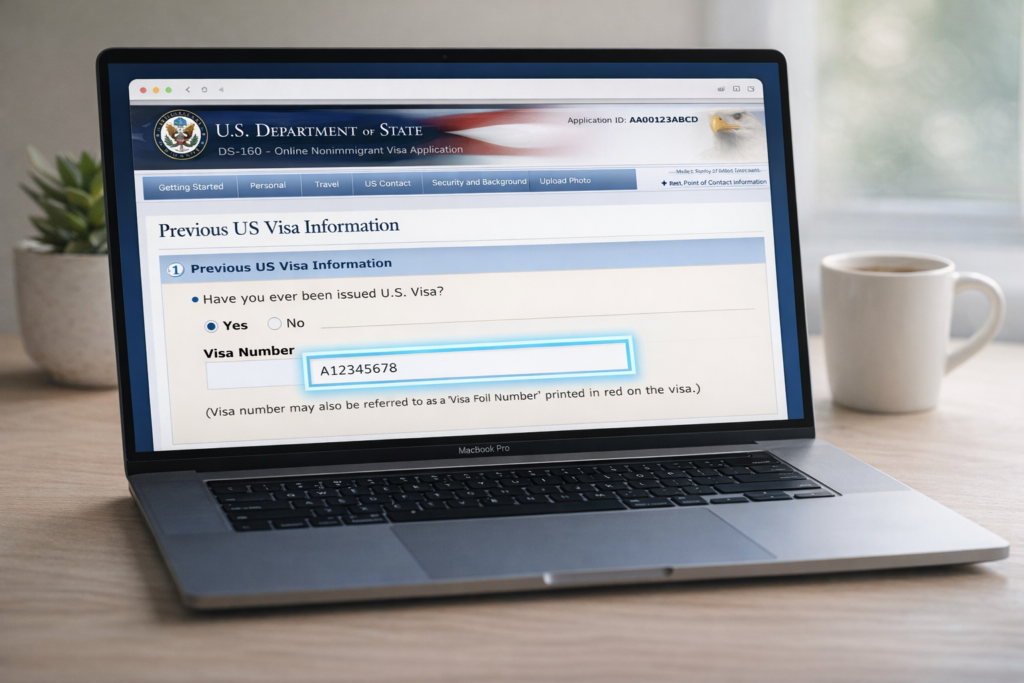
The DS-160 Visa Application Form
The DS-160 [INTERNAL LINK: DS-160 step-by-step walkthrough] is the online application you complete before your consular interview. One section asks about prior US visas — and if you’ve had one, it asks for the number from that previous stamp.
If you previously held an F-1 and are now preparing for your first H-1B stamping appointment, the answer is straightforward: enter the visa number from your F-1 foil. That’s the number from the most recent US stamp in your passport, whatever category it was. If you’ve never held any US visa before, the form lets you indicate that. You won’t need to invent a number.
One thing that frequently trips people up in the DS-160: the section about arrival dates. If you don’t have flights booked yet, enter a reasonable estimate. Choosing “No” when asked whether travel arrangements are confirmed is perfectly fine and won’t cause issues at the interview. For the petition-related section, you’ll enter your I-797 receipt number — but that goes in the petition field, not the visa number field. The official DS-160 form is at ceac.state.gov/genniv.
When the Field Is Optional or Says “If Any”
Some USCIS benefit applications include a visa number field marked as “if any” — meaning it’s optional. If you’re in H-1B status but have never been stamped (you changed status domestically and never traveled internationally), you have no H-1B visa number. Leave the field blank or enter “N/A” as the specific form instructs. Do not substitute your receipt number, your I-94 number, or your passport number. Those are wrong identifiers for that field.
For the I-485 [INTERNAL LINK: I-485 adjustment of status guide] — the green card adjustment of status application — Question 22 asks for the nonimmigrant visa number from your current passport. If a stamp exists in your passport, use that number. If none exists, follow the form’s own blank or N/A guidance. The I-485 instructions are at uscis.gov/i-485.
Getting Stamped Outside Your Home Country — The Real Risks Nobody Talks About
Consular appointment backlogs — particularly significant in India — have pushed a large number of H-1B holders toward third-country stamping. The logic is simple: travel somewhere with shorter wait times, attend the interview, get the stamp, return to work. In practice, it works. But the risk profile is higher than most guides admit.
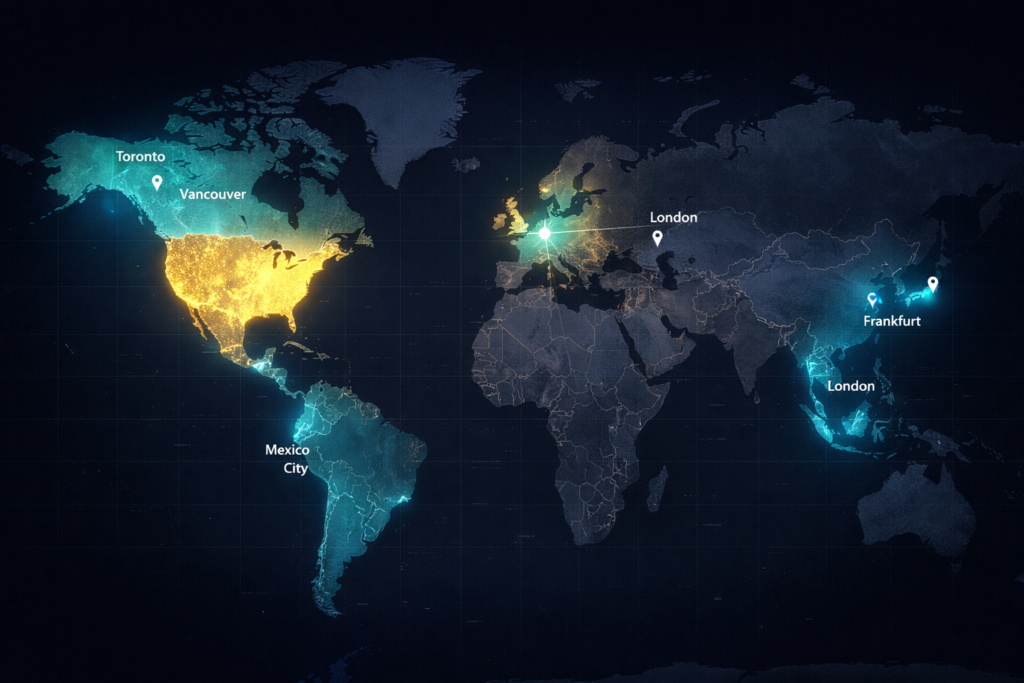
Canada — particularly Toronto and Vancouver — has been the most popular third-country option for Indian nationals. To attend a US consular interview in Canada, you generally need valid Canadian status: a tourist visa, study permit, work permit, or permanent residency. The interview itself is structurally identical to what you’d experience at any other US consulate. The risk is what can happen after.
If your case is flagged for administrative processing — a background or security review that the consulate neither explains nor puts a timeline on — you could be waiting weeks or months abroad before your passport is returned. During that time you cannot re-enter the US, you’re missing work, and you’re covering extended costs with no end date. This is not a fringe outcome; it’s common enough to be a genuine factor in your decision.
For most applicants with straightforward cases and clean immigration histories, third-country stamping proceeds without complication — the risks above are real, but they represent the exception, not the rule.
First-time H-1B stamping can happen in a third country — there’s no rule requiring your first stamp to come from your home country. What matters is your approved I-797 petition, documentation of your employment, and whatever the specific consulate requires. Extension stamping is generally lower risk than first-time stamping because an existing US immigration record makes verification faster.
Appointment slots at Canadian consulates do open up — but often outside standard business hours. Many people who successfully booked reported checking late evenings rather than during the day. Slots change in real time and often reappear when others cancel. Current consular wait time estimates by country are published at travel.state.gov/content/travel/en/us-visas/visa-information-resources/wait-times.html.
Your Stamp Expired. Your Status Probably Didn't. Here's Why That Matters.
This is worth saying directly because it produces more unnecessary anxiety than almost any other H-1B misconception: an expired visa stamp does not mean you are out of status.
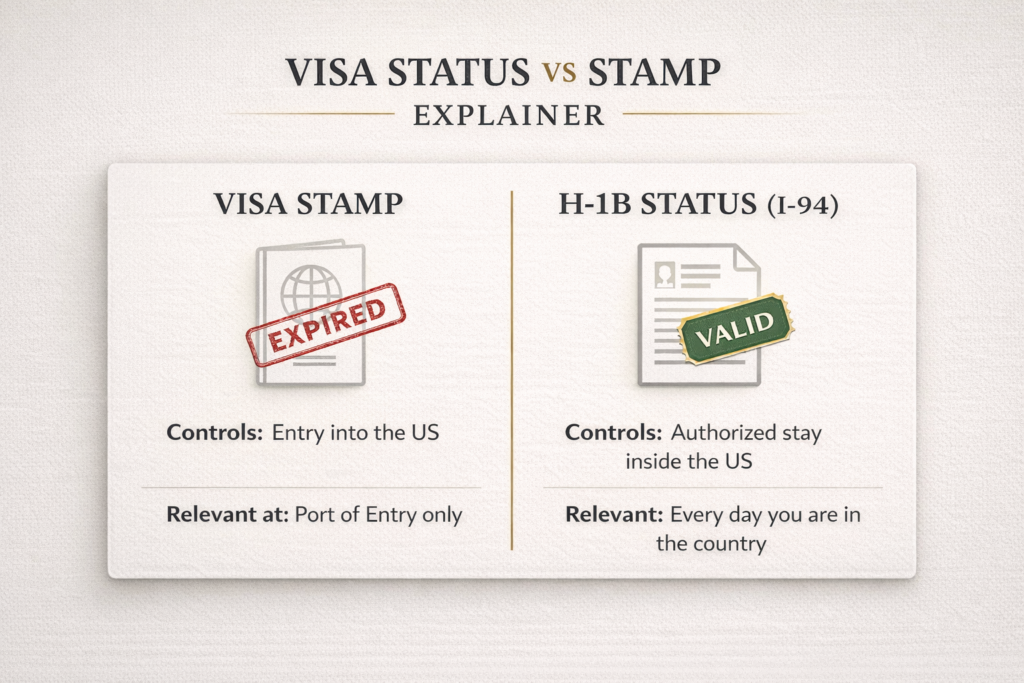
The stamp’s expiration date is only relevant at a port of entry. Once you’re inside the United States, the document that controls how long you may legally stay is your I-94 arrival/departure record — not your stamp. The I-94 is generated when you enter and reflects the authorized period granted by Customs and Border Protection at that time. For H-1B holders, that period typically aligns with the end date on the I-797 petition.
So if your stamp expired two years ago but your I-797 is still valid and your I-94 shows an unexpired authorized stay, you are in lawful status. You can work. You can renew your driver’s license. “In fact, most of the financial milestones that matter during your time here — like building credit in the US on an H-1B visa — have nothing to do with your stamp status.”Nothing about your daily life inside the US requires a currently valid stamp. The stamp only becomes relevant again when you travel internationally: if you leave with an expired stamp, you cannot use it to return. You’ll need a new one from a US consulate abroad before coming back. Plan for that before booking any international travel. You can review your current I-94 record at i94.cbp.dhs.gov.
One additional scenario worth noting: some H-1B holders hold a stamp that hasn’t expired yet, but it was issued under a previous employer. Switching employers doesn’t automatically void the stamp — but whether it can be used for re-entry after a job change is genuinely nuanced, and it’s a situation where professional legal advice before any international travel is worth the consultation fee. USCIS guidance on H-1B portability is at uscis.gov/working-in-the-united-states/h-1b-specialty-occupation/h-1b-portability.
Straight Answers to the Questions Everyone Searches For
Is the H-1B visa number the same as the receipt number?
No. The receipt number — formatted like EAC-21-123-45678 — is assigned by USCIS when your petition is filed and tracks your case internally. The visa number is issued by the Department of State, only exists after consular processing, and appears on the physical stamp in your passport. Different agencies, different formats, different purposes. They belong in different fields on every form you’ll fill out
FAQ H -1B Visa
It’s typically 8 characters: one or two letters followed by digits, printed in red ink in the upper right area of your visa foil. It’s sometimes labeled “Visa No.” or “Foil No.” — and sometimes not labeled at all. The red ink is the fastest way to locate it on the stamp page.
It’s both — and the difference matters practically. H-1B status is the work authorization granted by USCIS that lets you work and remain in the US. The H-1B visa stamp is a travel document issued by the State Department that lets you re-enter the US after traveling abroad. You can hold valid H-1B status without ever having had an H-1B stamp — which is common for anyone who changed status domestically without traveling internationally.
There’s no legal deadline for getting stamped. If you’re already inside the US on valid H-1B status, you can live and work here without a stamp for as long as your petition remains valid and your I-94 shows authorized stay. The stamp only becomes a hard requirement when you travel internationally and need to come back.
If the form asks for a “previous US visa number” and you’ve had any prior visa of any category, use the number from that stamp. If you’ve genuinely never held any US visa, indicate “none” or “N/A” as the form directs. Do not enter your receipt number, your I-94 number, or your I-797 case number in a visa number field — those are wrong identifiers for that field.
No. The I-797 is a USCIS petition approval notice. It confirms your authorized status inside the US. It is not a travel document, and it does not authorize entry into the country. Airlines cannot verify it in their boarding systems the way they can verify a visa stamp. The physical stamp is what authorizes entry and what both airlines and border officers check. For detailed I-797 guidance, uscis.gov is the authoritative source.
Yes — provided your I-94 record shows an unexpired authorized stay and your underlying petition remains valid. The stamp governs entry; the I-94 and petition govern your right to stay. What you cannot do with an expired stamp is leave the country and re-enter without first getting a new stamp from a consulate abroad.
The confusion around H-1B documentation is a structural problem, not a personal one. It reflects a system where two separate federal agencies issue two separate documents that serve two entirely different legal functions — and neither one explains that clearly. Understanding which number belongs in which field, and which document controls which right, is what separates a clean filing from a costly one. For day-to-day questions about your authorized stay, start with your I-94 record at i94.cbp.dhs.gov. For petition-related questions, uscis.gov is the authoritative source. And when the stakes are high — a new employer, an upcoming trip abroad, or an active green card application — a licensed immigration attorney’s review is worth every dollar of the consultation fee.
“And if you’ve recently arrived and are figuring out financial basics alongside your visa paperwork, our guide on getting your first US credit card as an immigrant is a practical next step.”
DISCLAIMER
Legal Disclaimer
The information provided in this article is for general informational and educational purposes only. It does not constitute legal advice, immigration advice, or a substitute for consultation with a licensed US immigration attorney or accredited representative.
US immigration laws, regulations, consular procedures, and USCIS policies are subject to change without notice. While every effort has been made to ensure the accuracy of the information presented here at the time of publication, we make no representations or warranties — express or implied — regarding the completeness, accuracy, reliability, or suitability of this content for your specific situation.
Do not rely solely on this article when making decisions about your visa application, travel plans, change of employer, or any immigration filing. Individual circumstances vary significantly, and what applies in one case may not apply in another.
For advice specific to your situation, consult a qualified US immigration attorney licensed to practice in your state. You can find a licensed immigration attorney through the American Immigration Lawyers Association (AILA) at aila.org.
This website is not affiliated with, endorsed by, or in any way officially connected to the US Department of Homeland Security (DHS), US Citizenship and Immigration Services (USCIS), the US Department of State, Customs and Border Protection (CBP), or any other US government agency.
External links to government websites (uscis.gov, travel.state.gov, i94.cbp.dhs.gov, ceac.state.gov) are provided for reference only. We are not responsible for the content, accuracy, or availability of those external sites.
Last reviewed and updated: 2025