

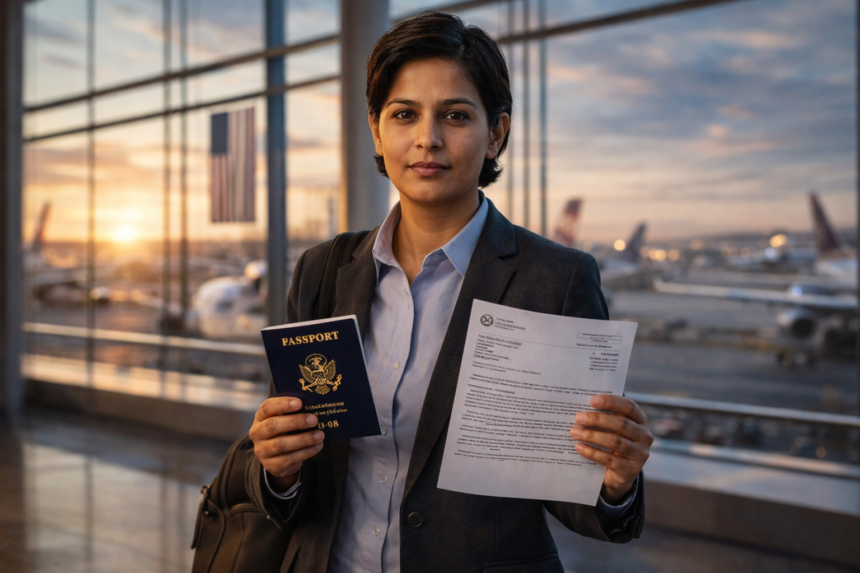
The rules changed. The appointments disappeared. And thousands of people are still figuring out what that means for their lives.
There’s a version of this article that opens with something like “H-1B visa stamping is a critical step in your immigration journey.” You’ve read that sentence before. Probably a dozen times. It tells you nothing about what’s actually happening right now — which is that people are getting their appointments rescheduled to 2027, companies are quietly terminating employees who’ve been stuck abroad for four months, and a process that used to feel routine has become one of the most stressful experiences in the entire U.S. immigration system.
So let’s skip the generic intro and talk about what’s real.
This article is for people currently navigating H-1B stamping — whether you’re about to travel for the first time, sitting in India waiting for an appointment that keeps moving, or trying to figure out whether it’s safe to go home at all. It’s also for employers trying to understand what their obligations are when someone on their team can’t get back.
We’ll cover the fundamentals because they matter, but we won’t stop there. The policy environment shifted dramatically in 2025, and a lot of what you read elsewhere hasn’t caught up.
The Thing Most People Get Wrong First: Your Stamp Is Not Your Status
Before anything else, let’s clear this up — because the confusion here causes real problems.
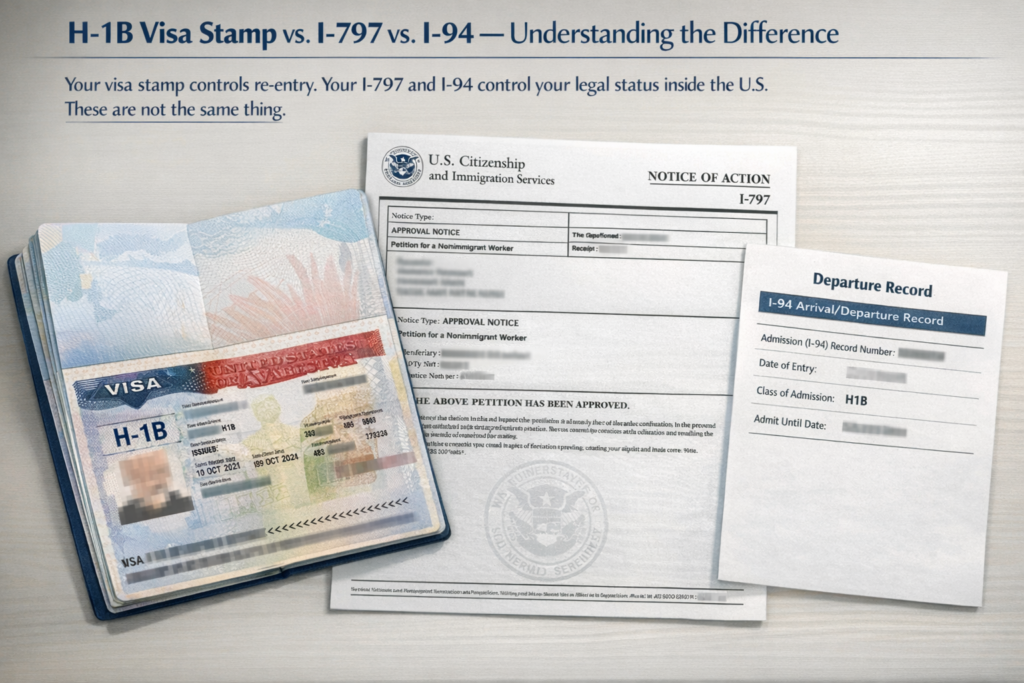
Your H-1B visa stamp, the physical foil sticker in your passport, is a travel document. It lets you present yourself at a U.S. port of entry. That’s it. It does not determine whether you can legally work in the United States. It does not determine how long you can stay. Those things are governed by your I-797 approval notice from USCIS and your I-94 arrival record.
What this means practically: if you’re already inside the United States with valid H-1B status — meaning your I-797 is approved and your I-94 hasn’t expired — you can work legally even if your visa stamp expired six months ago. You don’t need to rush to get a new stamp just because the date on the sticker passed.
The stamp only becomes necessary the moment you plan to travel internationally and need to re-enter the U.S. Then yes, you need a valid stamp. But until that trip happens, an expired stamp doesn’t affect your day-to-day work authorization.
This distinction matters enormously right now, because a lot of people are making premature decisions about when to travel based on a misunderstanding of this. Some are rushing to get stamped “before it expires” when there’s no actual urgency. Others are unaware their status is fine and are panicking unnecessarily.
Source: USCIS — H-1B Specialty Occupations: https://www.uscis.gov/working-in-the-united-states/temporary-workers/h-1b-specialty-occupations
How H-1B Stamping Actually Works — The Real Process
Let’s go through this sequentially, because the steps matter and the order matters.
Your H-1B petition gets approved by USCIS. You receive Form I-797. If you’re outside the United States at that point — or when you eventually travel internationally and need to return — you must go through the stamping process at a U.S. embassy or consulate. USCIS and the State Department are two separate agencies. USCIS approves your right to hold H-1B status. The State Department decides whether you can travel on it. Both agencies have to say yes.
Your I-797 approval notice is the single most important document in your stamping packet. If you’re unsure what your H-1B visa number means and where it appears on your approval documents, it’s worth reviewing that before your appointment — officers sometimes ask about it directly.
Here’s the sequence:
Step one is completing Form DS-160 online — the nonimmigrant visa application through the State Department’s system. This takes roughly 90 minutes, and everything you enter needs to match your petition exactly. Inconsistencies between your DS-160 and your I-797 are one of the most common reasons for complications at the interview.
Step two is paying the visa application fee. The base MRV fee is $205 as of current guidance, though total costs including attorney fees and employer-paid filing fees can run significantly higher. This payment is valid for one year, so if you pay and then can’t secure an appointment, the payment doesn’t disappear.
Source: U.S. Department of State Visa Application: https://travel.state.gov/content/travel/en/us-visas.html
Step three is scheduling your appointment. For Indian applicants specifically, this is actually two appointments — first at a Visa Application Center (VAC) for biometrics and fingerprinting, then separately at the U.S. embassy or consulate for the actual interview. The VAC appointment must be scheduled at least one day but no more than three days before the interview. This two-step structure is specific to India and a handful of other high-volume countries.
Step four is the interview itself. A consular officer will ask you about your employer, your job responsibilities, your qualifications, and your intent. They’re looking for consistency — between what you’ve said on your DS-160, what’s in your petition, and what you’re telling them in person. Be direct, be honest, and bring everything in organized order.
If everything is in order, the consulate retains your passport and returns it with the stamp within a few days — typically 7 to 10 days, though this varies.
If the officer issues a 221(g), that’s a different situation and we’ll address it separately.
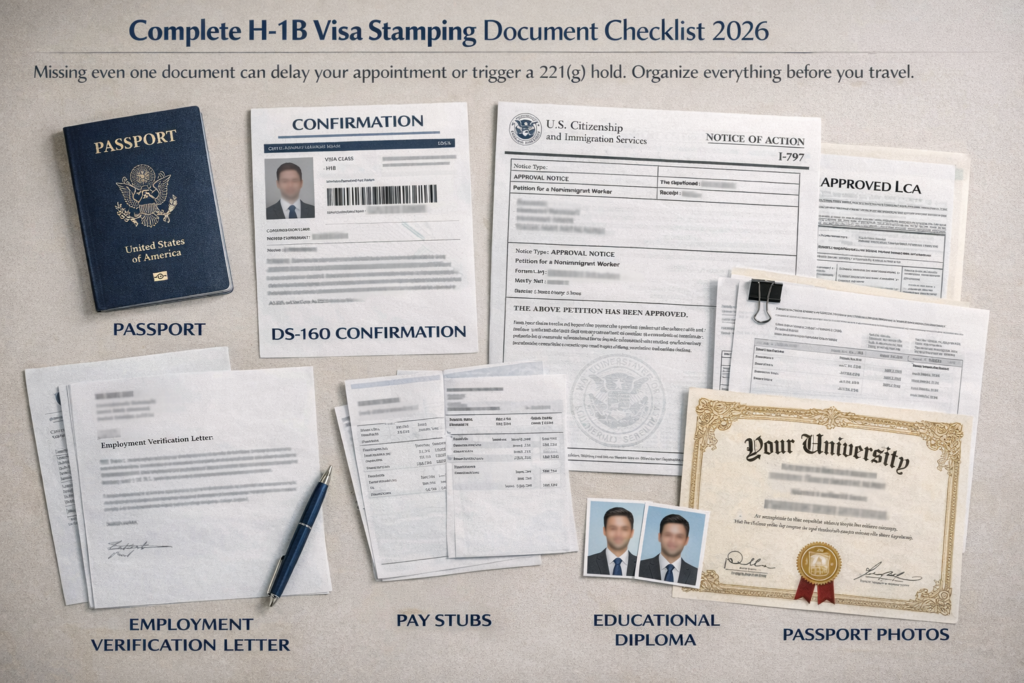
What You Need to Bring — The Real Document Checklist
This isn’t the place to be vague. Here’s what you actually need:
- Valid passport — must be valid for at least six months beyond your intended stay in the U.S. If you have a previous passport with prior visa stamps, bring that too.
- DS-160 confirmation page — printed, with the barcode visible.
- I-797 approval notice — the original or a clear copy of your most recent H-1B approval.
- I-94 printout — downloaded from the CBP portal showing your most recent admission record.
- Labor Condition Application (LCA) — the certified document your employer filed with the Department of Labor.
- Employment support letter — from your employer, confirming your role, salary, work location, and status.
- Pay stubs — typically the three most recent.
- Educational credentials — your highest degree diploma and transcripts. If your degree is from outside the U.S., include a credential evaluation from a recognized agency.
- Passport photos — meeting current State Department specifications.
- Fee payment receipt
If you’re transitioning from F-1/OPT to H-1B, also bring your I-20 forms, EAD card copies, and any OPT-related documents. Former J-1 visa holders should bring DS-2019 forms and, if applicable, documentation related to the two-year home residency requirement or an approved waiver.
Source: tryalma.com H-1B stamping checklist: https://www.tryalma.com/blog/h1b-visa-stamping-documents-checklist
What Changed in 2025 — And Why Everything Feels Different Now
Here’s where a lot of articles stop being useful. They describe the process as it existed a couple of years ago and leave out the part where the entire operating environment shifted.
Three major changes hit in 2025, and together they fundamentally altered what the stamping process looks like.
First: the dropbox program was effectively ended.
The interview waiver program — commonly called “dropbox” — allowed qualifying visa renewal applicants to submit documents without attending an in-person interview. This was a significant convenience, particularly for people renewing the same visa category within a recent window. In February 2025, the eligibility window was narrowed from 48 months to 12 months. Then in July 2025, the State Department announced that effective September 2, 2025, dropbox eligibility would be eliminated for most nonimmigrant visa categories — including H-1B, L-1, H-4, F-1, and others. The only narrow remaining exception is B1/B2 applicants renewing within specific parameters.
This is not a temporary pause. This is the current policy.
Source: Reddy Neumann Brown PC on dropbox changes: https://www.rnlawgroup.com/major-changes-to-u-s-visa-interview-waiver-dropbox-program-starting-september-2-2025-what-you-need-to-know/
Second: social media vetting became mandatory.
Starting December 15, 2025, H-1B applicants and their H-4 family members are required to set their social media profiles to public so consular officers can review online activity as part of expanded security screening. Officers are using this to verify employment backgrounds, check for inconsistencies, and identify any security concerns. The same model had been applied to student visas earlier in the year.
The practical fallout was immediate. Consulates — especially in India — needed time and additional resources to implement the new vetting. Mass appointment rescheduling followed. People with December 2025 appointments were being pushed to April 2026. Then to July. In some cases, into 2027.
Source: Fisher Phillips on social media vetting: https://www.fisherphillips.com/en/insights/insights/new-h-1b-vetting-rules-disrupt-india-interviews-with-more-countries-likely-next
Third: third-country stamping was largely restricted.
Historically, workers from India could avoid long domestic wait times by getting stamped in a third country — Mexico and Canada were popular options because of shorter appointment queues. Effective September 6, 2025, the State Department moved to require most nonimmigrant visa applicants to apply in their country of nationality or legal residence. The practical effect is that the third-country workaround is no longer available to most Indian nationals the way it was before.
These three changes together created the situation many people are living right now: no dropbox, mandatory in-person interviews, no third-country shortcut, social media vetting adding processing time, and consulate appointment queues that have collapsed under the weight of all of the above.
Source: WashU OISS Immigration Updates: https://oiss.washu.edu/apply-for-visa-stamp/
The 221(g) Hold — What It Is and What Happens Next
A 221(g) is not a denial. It’s a pause. But the pause can last a long time, and most articles explain what it is without telling you what to actually expect.
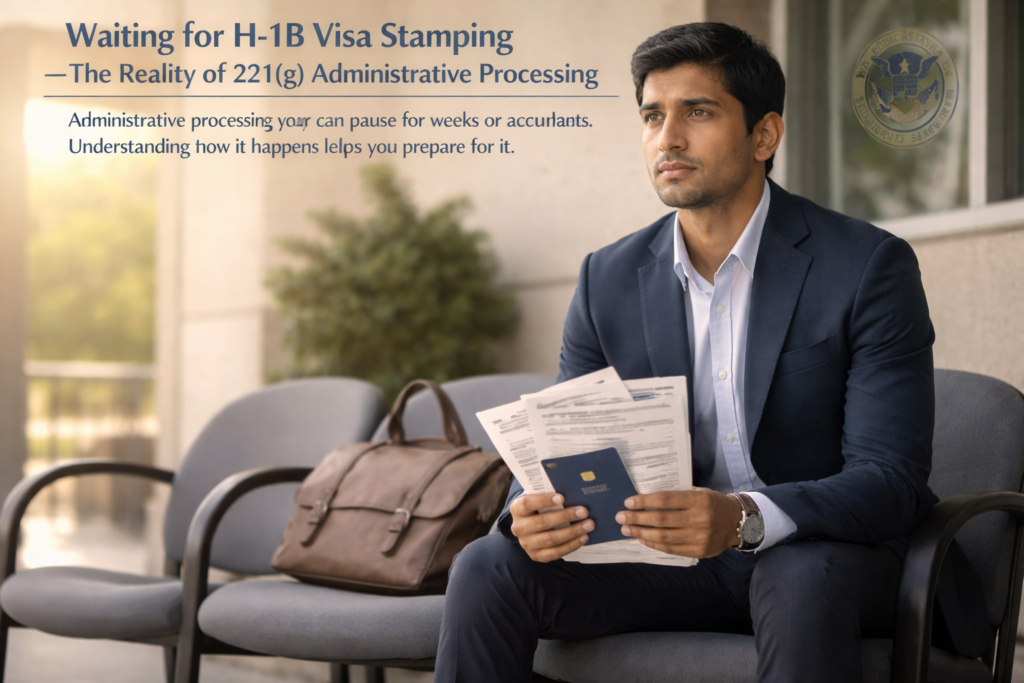
When a consular officer issues a 221(g), it means the application is placed under administrative processing — the consulate needs additional time to review the case, verify information, or request supplemental documents. Sometimes it resolves in a few weeks. Sometimes it takes months. There is no premium processing option at the consular stage. There is no reliable escalation path.
The most common triggers include inconsistencies between documents, employer information that raises questions, complex technical job descriptions in fields that get extra scrutiny, prior visa issues, or security screening flags. With the new social media vetting layer added to the process, additional 221(g) holds are expected as officers encounter content that requires more investigation.
If you get a 221(g), cooperate fully with whatever documents are requested, respond promptly, and have your employer’s immigration team looped in. The timeline is genuinely outside your control.
There’s also a harder reality that almost no article mentions: a USCIS-approved H-1B petition can still be refused at the consular stage. Petition approval from USCIS and visa issuance from the State Department are separate determinations. Consular officers have independent authority. An approved I-797 does not guarantee a stamp.
The I-94 Trap Nobody Talks About Until It’s Too Late
Here’s a practical issue that comes up constantly and gets almost no dedicated coverage.
When you re-enter the United States, the CBP officer at the port of entry generates your I-94 record. This record determines your authorized period of stay — not your visa stamp, not your I-797. The I-94 is supposed to reflect your full petition validity. But here’s what sometimes happens: if you return while your old visa stamp is still technically valid but you have a newer I-797 that extends your status further, the officer may issue an I-94 that only goes to the stamp’s expiration date rather than the petition’s end date.
This matters enormously, because once that I-94 date passes, you start accruing unlawful presence — even if your I-797 is valid for two more years.
The fix is simple but requires you to act at the border: when re-entering, hand the CBP officer your new I-797 approval and explicitly say you have an updated petition and need an I-94 that reflects the full petition validity. Officers are busy. They will not necessarily look for this on their own. If you don’t say something, you may not get the correct record.
Check your I-94 online at i94.cbp.dhs.gov after every re-entry. Make sure the “admit until” date matches your petition. If it doesn’t, work with your employer’s immigration team to correct it.
Source: CBP I-94 Portal: https://i94.cbp.dhs.gov
The Employer Situation Nobody Is Comfortable Saying Out Loud
If you’re stuck outside the United States waiting for a stamping appointment, your employer’s position is one of the most important variables in your situation — and it’s one of the least predictable.
Some companies have formal policies allowing a fixed number of days of international remote work — thirty days is a common threshold, ninety is more generous. After that, the employee either returns, takes unpaid leave, transfers to a local office, or is separated. Larger companies with international offices sometimes have internal transfer pathways. Smaller companies typically don’t.
Working remotely from outside the United States on an H-1B carries legal complexity that many people don’t fully appreciate. The H-1B petition specifies a U.S. worksite and a work location documented in the LCA. Working from a foreign country for an extended period can create employer tax exposure, payroll compliance issues in the foreign jurisdiction, and potential inconsistency with the terms of the petition itself. Employers that allow this without legal review may be taking on liability they haven’t accounted for.
The harder truth is that an employer’s tolerance isn’t a legal protection. Even if a company is fine with you working from India for four months, they may also have a financial or operational threshold where they decide to move on. And once the employment relationship ends, the H-1B petition loses its employer-sponsor foundation — leaving a very complicated situation to untangle from abroad.
Source: Fisher Phillips employer compliance guidance: https://www.fisherphillips.com/en/insights/insights/new-h-1b-vetting-rules-disrupt-india-interviews-with-more-countries-likely-next
The Domestic Renewal Pilot: What It Was, What It Wasn’t, and Where It Stands
The 2024 domestic renewal pilot was genuinely useful for a narrow group of people. It ran from January 29 through April 2024, offered approximately 20,000 total application slots, and allowed qualifying H-1B holders to renew their visa stamp without leaving the United States.
The eligibility requirements were tight:
- Only H-1B renewals — not first-time stamps, not other visa categories
- Prior H-1B visa had to have been issued by the U.S. mission in India or Canada
- Applicants could not have had a visa refusal in the past 12 months
- No pending administrative processing or clearance annotations
- Fingerprints already on file with the State Department
- Currently maintaining valid H-1B status with an active I-94
H-4 dependents were excluded entirely. First-time visa issuance was excluded. Anyone whose biometrics weren’t already on file was excluded.
The process involved mailing your passport to a designated State Department facility — which meant you could not travel while your case was pending, a period of roughly six to eight weeks with no expedite option. If you needed to travel urgently during that window, you had to withdraw the application and go to a consulate abroad instead.
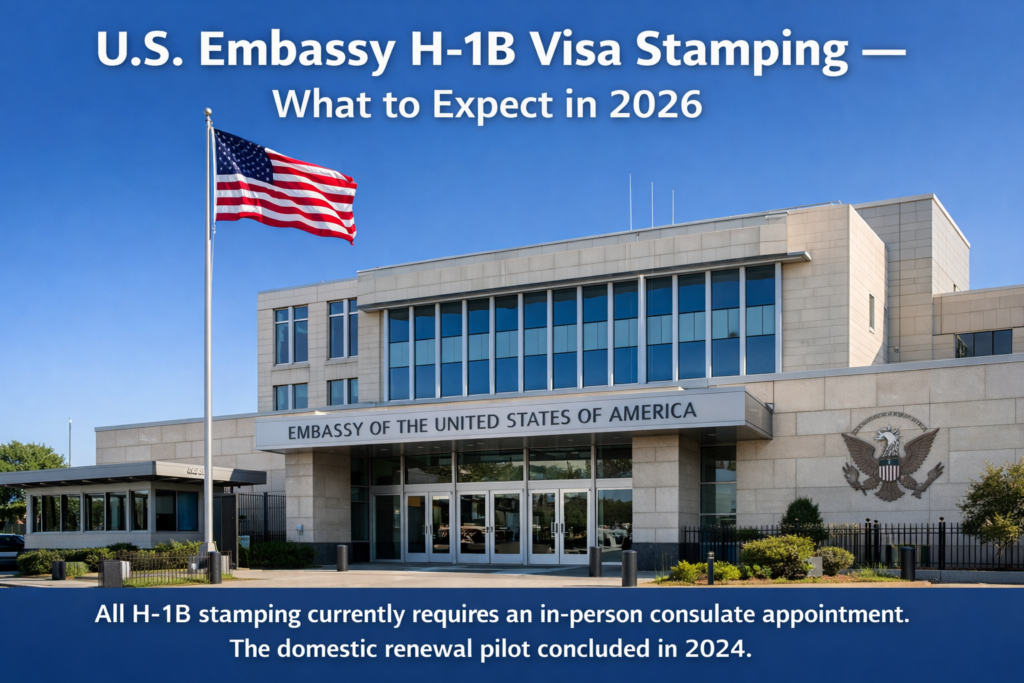
The pilot concluded. As of 2026, with the dropbox program eliminated and the political environment around immigration enforcement significantly tightened, domestic stamping is not available. Whether it returns — and in what form — is genuinely uncertain.
Source: Employment Law Worldview domestic pilot analysis: https://www.employmentlawworldview.com/u-s-department-of-state-implements-domestic-visa-renewal-pilot-program/ Source: redbus2us domestic pilot details: https://redbus2us.com/h1b-visa-stamping-in-usa-pilot-program/
The 240-Day Rule: Your Safety Net During an Extension Delay
If your H-1B status is about to expire and your employer has filed a timely extension petition, you’re protected by the 240-day rule. This allows you to continue working for up to 240 days beyond your I-94 expiration date while your extension is pending with USCIS — as long as the petition was filed before your status expired.
A few things to understand clearly here:
The 240-day rule covers work authorization only. It does not extend your visa stamp validity. It does not allow you to travel internationally and return. If you leave the U.S. while relying on 240-day protection, you cannot re-enter without a valid stamp — because at the port of entry, the officer sees an expired stamp, and that’s the end of the conversation.
If your extension petition is denied, your 240-day work authorization ends at the moment of the denial decision. There’s no wind-down period.
This rule is genuinely useful and protects a lot of workers from gaps in employment authorization during routine extension processing. But understanding its limits — particularly around travel — is essential.
Source: USCIS H-1B FAQs: https://www.uscis.gov/working-in-the-united-states/temporary-workers/h-1b-specialty-occupations/faqs-for-individuals-in-h-1b-nonimmigrant-status
The $100,000 Fee: Who Pays It and Why It Matters for the 2026 Lottery
The $100,000 H-1B fee generates a lot of confusion. Let’s be direct about what it is.
The $100,000 fee applies to employers classified as “H-1B dependent.” If you want to understand exactly how this affects your lottery odds and what the complete cost structure looks like for 2026, we’ve covered how the 2026 H-1B lottery selection actually works in detail separately.
This fee applies to employers that are classified as “H-1B dependent” — meaning a significant percentage of their workforce consists of H-1B or L-1 visa holders. This primarily affects large staffing companies and outsourcing firms that rely heavily on work visa placements. It is an employer obligation, not an employee obligation. Workers themselves do not pay this fee.
Universities, nonprofits, and government research organizations are cap-exempt and are also generally not subject to this fee structure.
For the 2026 lottery cycle, one practical effect of this fee is that it reduces the number of petitions filed by high-volume staffing companies, which historically submitted a disproportionate share of total registrations. This theoretically increases the selection odds for everyone else in the general pool. Some immigration attorneys have noted this as a meaningful shift for the 2026 cycle.
The lottery itself remains randomized — not salary-ranked. There has been a long-running regulatory discussion about moving to a wage-based selection system that would prioritize higher-paying positions, but as of the 2026 cycle, that change has not been implemented.
Source: USCIS H-1B Cap Season: https://www.uscis.gov/working-in-the-united-states/temporary-workers/h-1b-specialty-occupations/h-1b-cap-season
If You’re Thinking About Traveling Right Now
This section is not legal advice. But it’s the honest framing that most people need before making a decision.
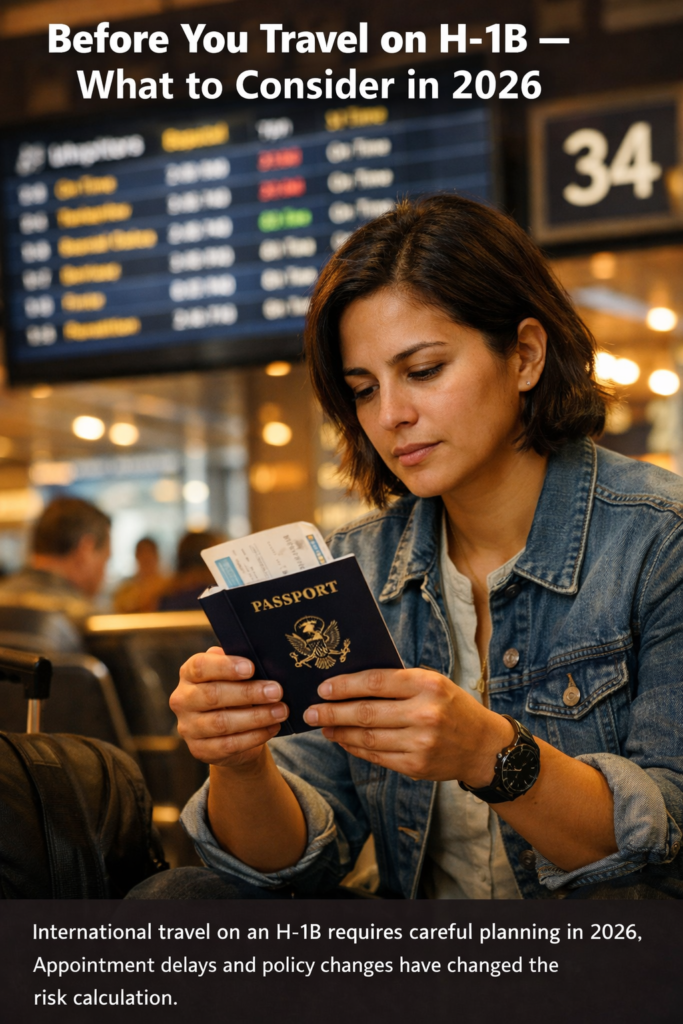
The current environment is genuinely different from two or three years ago. The risk profile of international travel on an H-1B has increased, not because the legal framework changed, but because the practical infrastructure supporting that travel — appointment availability, dropbox as a fallback, third-country options — has contracted significantly.
Before you travel, ask yourself:
Can you afford to be outside the United States for three to six months if something goes wrong? Not three to six weeks — months. Appointment rescheduling is happening at that scale. Administrative processing adds more time on top of that.
Does your employer have a written policy on international remote work duration? If not, the absence of a policy is not protection — it’s ambiguity that resolves in the employer’s favor.
Have you verified your I-94 is accurate and will be accurate on return? Do you have your current I-797 with you and are you prepared to present it proactively at the port of entry?
Are there family members whose visas also need stamping? H-4 dependent stamping involves a separate appointment. Coordinating timing for a family adds another layer of complexity and unpredictability.
If none of these concerns apply to your situation — your appointment is confirmed, your employer is supportive, your status is clean, your documents are organized — then traveling is a calculated risk you can make with clear eyes. But going in without asking these questions is where people end up in positions they didn’t anticipate.
After Six Years: Your Options for Staying Longer
H-1B status is granted in three-year increments. One standard extension brings you to six years total. After that, further extensions require a green card process that has reached specific milestones.
Specifically: if your employer has filed an I-140 immigrant petition that has been approved, you can get one-year extensions beyond the six-year cap. If a PERM labor certification has been pending for 365 days or more, the same applies. These extensions are available as long as you maintain valid H-1B status and continue working for a qualifying employer.
Long-term H-1B planning isn’t just about visa status — financial stability matters too. If you’re settling in for the extended runway that green card processing requires, understanding building credit in the U.S. as an H-1B holder is one of the more practical things you can do in parallel.
For workers from India, this matters enormously because the green card backlog for employment-based categories from India stretches decades under current visa bulletin priority dates. The path from H-1B to green card is legally available but practically extremely long. Starting the PERM process early — ideally well before year five of H-1B status — is the most important thing a worker can do to preserve long-term options.
The H-1B is formally a nonimmigrant visa, but it carries “dual intent” status — meaning you can hold it while simultaneously intending to pursue permanent residency. This is one of the few visa categories where that dual intent is explicitly permitted and protected.
Source: Boundless H-1B explainer: https://www.boundless.com/immigration-resources/the-h-1b-visa-explained
A Few Things Worth Knowing That Most Guides Skip
Automatic visa revalidation. If you hold a valid H-1B stamp and travel to Canada or Mexico for less than 30 days, you may be able to re-enter the United States without getting a new stamp — even if the stamp expires while you’re there. This applies only to short trips to those two countries and doesn’t apply to other destinations. Given the third-country stamping restriction that took effect in September 2025, the interaction between automatic revalidation and the new residency requirements is something to verify with an immigration attorney before relying on it.
Employer-change stamping confusion. If you switch employers while in the U.S. and then travel internationally, you have a stamp from your old employer and a new I-797 from your new employer. You can technically re-enter on the old stamp with the new I-797 together — but expect questions at the port of entry about the discrepancy. Some people choose to get a fresh stamp under the new employer before traveling to avoid this conversation. That’s a personal risk calculation more than a legal requirement.
The social media preparation you need to do now. If you have an upcoming stamping appointment, set your social media accounts to public now — not the morning of your interview. Review your profiles for anything that might raise questions about your employment history or create inconsistencies with your petition. This is not about hiding anything — it’s about making sure what’s publicly visible is accurate and explainable. Officers are checking, and the process is not designed to give you a chance to clarify before a decision is made.
Source: WashU OISS Social Media Updates: https://oiss.washu.edu/apply-for-visa-stamp/
What This All Means
The H-1B system is under more pressure than it has been in a long time. The stamping process specifically has become the most visible point of friction — not because the legal requirements changed dramatically, but because the infrastructure that made stamping manageable (dropbox, third-country options, the domestic pilot) has contracted while the scrutiny applied to each individual case has increased.
People are making significant life decisions — whether to attend weddings, whether to change jobs, whether to stay in the United States at all — based on appointment availability. That’s a strange thing to write in an article about immigration, but it’s where things actually are.
The most useful thing anyone can do right now is understand the system accurately — not the version from 2022, not the optimistic version, the current version. Know what your stamp does and doesn’t control. Know what’s changed and when. Know your I-94. Keep your employer informed. And make decisions with full information about what the real risks look like.
That’s not pessimism. It’s just what informed decision-making looks like in a complicated environment.
This article reflects publicly available information and official guidance current as of early 2026. Immigration rules change frequently. For decisions affecting your specific situation, work with a qualified immigration attorney.
Key Sources Referenced Throughout:
- USCIS H-1B Resource Center: https://www.uscis.gov/working-in-the-united-states/temporary-workers/h-1b-specialty-occupations
- U.S. Department of State Visa Information: https://travel.state.gov/content/travel/en/us-visas.html
- CBP I-94 Portal: https://i94.cbp.dhs.gov
- USCIS H-1B Cap Season: https://www.uscis.gov/working-in-the-united-states/temporary-workers/h-1b-specialty-occupations/h-1b-cap-season
- U.S. Embassy India Visa Services: https://in.usembassy.gov/visas/
DISCLAIMER
Disclaimer: This article is intended for general
informational purposes only and does not constitute
legal advice. Immigration laws, policies, and
procedures change frequently — sometimes with little
or no advance notice. The information provided here
reflects publicly available guidance and official
sources current as of early 2026, but may not reflect
the most recent regulatory developments at the time
you are reading this.
Every immigration case is unique. Decisions regarding
international travel, visa stamping, employment
authorization, or immigration status should be made
in consultation with a qualified, licensed immigration
attorney who can evaluate your specific circumstances.
The authors and publishers of this article accept no
liability for actions taken or not taken based on the
contents of this page. Always verify critical
information directly with official sources including
USCIS (uscis.gov), the U.S. Department of State
(travel.state.gov), and CBP (cbp.dhs.gov) before
making any immigration-related decisions.