


There’s a specific kind of stress that comes with being on OPT and watching your expiration date get closer every month.
You’re working. You’re contributing. Your employer genuinely likes you. But somewhere in the back of your mind, there’s a clock ticking — and the H-1B lottery is the only realistic door most F-1 students have to stay and work in the U.S. long-term.
The problem is that the OPT-to-H-1B transition in 2026 looks different than it did even two years ago. New fees. New lottery rules. Consular processing delays stretching into 2027. Policy changes that moved faster than most HR departments could track. A lot of the guides floating around online are either outdated or vague in exactly the places where the details matter most.
This is the detailed version. Every step, every deadline, every thing that quietly goes wrong — and what you can actually do about it.
What OPT Actually Is — Because Most People Half-Understand It
Optional Practical Training is a work authorization benefit attached to your F-1 student status. It is not a separate visa. It is not independent of your student status. When you’re working on OPT, you’re still an F-1 student — just with temporary permission to work in your field of study.
Standard OPT gives you 12 months of work authorization after graduation. If your degree falls under a STEM-designated field, you can apply for a 24-month STEM OPT extension, bringing your total to 36 months. That’s the ceiling. There is no further extension after that.
H-1B, by contrast, is a completely separate employer-sponsored work visa. Moving from OPT to H-1B isn’t a status upgrade or a renewal — it’s a full visa transition with its own petition, its own legal requirements, its own government fees, and its own risks. The two are connected only in the sense that OPT gives you time while you wait for H-1B approval.
Understanding this distinction matters because it shapes every decision you’ll make in 2026 — when to start, what to ask your employer, and how much runway you actually have.

The 2026 H-1B Timeline: Dates That Actually Matter
The H-1B lottery runs on a fixed annual cycle. Missing any window means waiting a full year to try again. Here’s how the 2026 cycle works — and what the petition timeline looks like for people already selected.
February–March 2026 — Registration Window USCIS opens the H-1B electronic registration portal. Employers submit registrations for their intended H-1B workers during this window. Each registration costs $215. No supporting documents are needed at this stage — just basic employer and employee information. This is not the petition. This is just the lottery entry.
Late March 2026 — Lottery Selection USCIS runs the lottery from all submitted registrations. U.S. master’s degree holders get entered into two separate pools — the regular cap pool (65,000 visas) and the advanced degree exemption pool (20,000 visas) — giving them two statistical chances at selection.
April–June 2026 — Petition Filing Window Employers whose workers were selected must file the full H-1B petition — Form I-129, the approved Labor Condition Application, and all supporting documentation — within the deadline USCIS sets. This is the legal-heavy phase where attorney involvement matters most.
October 1, 2026 — H-1B Status Begins This is the earliest date a cap-subject H-1B approval becomes effective. No matter when the petition is approved, the actual H-1B employment start date cannot be earlier than October 1st.
If you weren’t selected in the 2026 lottery, the next cycle opens in early 2027. That’s not a consolation — it’s just how the annual cap system works.
For a full breakdown of how the wage-weighted selection odds work in 2026 and what changed from previous years, this H-1B lottery rules guide covers it thoroughly.
Step-by-Step: How the OPT to H-1B
Transition Actually Works
Step 1 — Confirm Your Employer Will Sponsor You (Earlier Than You Think)
This sounds obvious. It isn’t — at least not in practice.
Some employers hire OPT workers with genuine intent to sponsor H-1B. Others hire OPT workers for the duration of authorization without any concrete plan to petition. The difference rarely gets communicated clearly at the job offer stage.
Have a direct, explicit conversation with your employer before the registration window opens in February. You need clear answers to:
- Is the company registered with USCIS as an H-1B petitioner?
- Do they work with an immigration attorney?
- Are they committing to register you in the 2026 lottery specifically?
- What is the plan if you’re not selected — STEM OPT extension, cap-exempt opportunity, or something else?
If the employer is vague on any of these, that’s important information to have in January, not March.
Step 2 — Confirm Your Individual Eligibility
Not every OPT worker qualifies for H-1B. Before your employer invests time and money in registration, verify both sides of the eligibility equation.
Your side:
- You must hold a bachelor’s degree or higher — from a U.S. institution or a foreign institution evaluated as equivalent
- That degree must be in a specific academic field relevant to the position
The position’s side:
- The job must qualify as a “specialty occupation” — meaning it normally requires a bachelor’s degree in a specific discipline to perform the duties
- The employer must be able to pay the prevailing wage for the role in your city
The most common failure point is the degree-to-job connection. If you studied computer science and you’re working as a software engineer — clean match. If you studied business administration and you’re in a broad generalist operations role — USCIS will want to see why that specific degree is necessary for those specific duties. A weak connection here leads to a specialty occupation RFE, which is the most common and most expensive type to respond to.
The 2026 H-1B eligibility requirements guide breaks down the specialty occupation standard by field, including which roles consistently qualify and which ones face heightened scrutiny.
Step 3 — Employer Files the Labor Condition Application
Before USCIS can receive the H-1B petition, the employer must get an approved Labor Condition Application from the Department of Labor’s FLAG system. This happens after lottery selection — the LCA is not part of the registration phase.
The LCA commits the employer to:
- Paying whichever is higher: the prevailing wage for the occupation in that geographic area, or the actual wage paid to comparable workers at the company
- Not displacing U.S. workers in equivalent roles
- Posting a notice of the LCA filing at the physical worksite for 10 business days
The geographic component of the prevailing wage matters more than people realize. The same software engineering role can have dramatically different required wages in rural Ohio versus San Francisco. If you’re working remotely, the LCA must reflect your actual work location — not the employer’s headquarters address.
Getting the LCA wrong — wrong wage level, wrong occupational classification, wrong location — invalidates the petition downstream. It’s not a fixable typo after the fact.

Step 4 — The I-129 Petition Is Filed
This is the actual H-1B petition. Form I-129, along with the approved LCA and a package of supporting evidence, is submitted to USCIS. This is the legal-heavy stage — what goes into this package directly determines whether the case sails through or gets questioned.
The petition package typically includes:
- Form I-129 with H classification supplement
- Certified LCA (ETA-9035E)
- Employer support letter explaining the position, duties, and necessity of the degree
- Educational credentials and any equivalency evaluations
- Evidence supporting specialty occupation — industry standards, job market data, organizational charts
- Worker’s resume, transcripts, and any relevant certifications
- Form I-94 and current immigration status documentation
For positions where specialty occupation is straightforward — engineering, medicine, architecture — the package is more streamlined. For positions in gray areas — business analysis, IT consulting, project management — the employer’s attorney often needs to build a more substantive legal argument using industry data and precedent decisions.
This is the moment where having an attorney matters most. The specialty occupation argument isn’t a form — it’s a legal brief.
Step 5 — Regular Processing or Premium Processing?
After filing, you choose (or your employer chooses) between two processing tracks.
Regular processing has no guaranteed timeline. In recent years, processing has taken anywhere from 3 to 9 months, though USCIS publishes current processing time estimates that fluctuate.
Premium processing costs an additional $2,805 (as of 2026) and guarantees a response — approval, denial, or RFE — within 15 business days. It does not guarantee approval. It guarantees a faster decision.
Who pays for premium processing follows a specific rule: if premium processing benefits the employer (faster hiring, operational needs), the employer pays. If it benefits the employee personally (a travel deadline, a personal timeline), the worker can choose to cover it themselves.
Most attorneys recommend premium processing for OPT workers close to their expiration date, simply because the certainty is worth it given the cap-gap timing complexities.
Step 6 — Change of Status vs. Consular Processing
This is the decision that determines whether the $100,000 fee applies to you. It deserves a clear explanation.
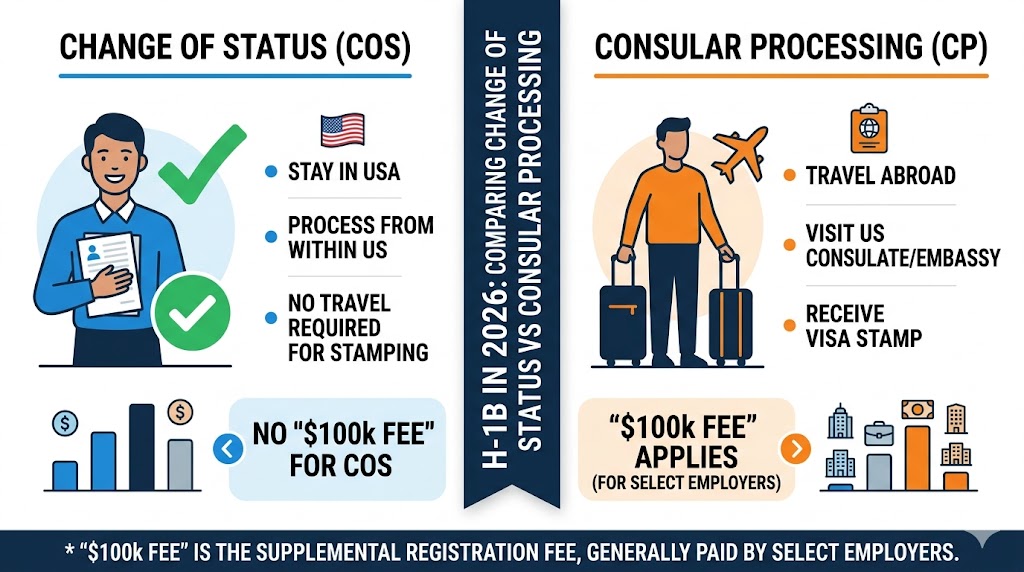
Change of Status (COS): You stay in the U.S. throughout the process. USCIS processes the petition and changes your status from F-1 to H-1B domestically. No consulate visit required. No travel needed. And critically — in 2026, the $100,000 per-petition fee introduced by the September 2025 Presidential Proclamation does not apply to COS filings for workers already inside the U.S.
Consular Processing: The petition is approved, but you must travel to a U.S. consulate in your home country to get the actual H-1B visa stamp before entering (or re-entering) the U.S. This path is required if you’re outside the country when the petition is filed. For new H-1B petitions requiring consular processing in 2026, the $100,000 fee does apply — and it’s the employer’s legal responsibility to pay it.
For almost every OPT worker who is currently in the U.S., Change of Status is the correct path. It avoids the fee, avoids the consular appointment nightmare (more on that shortly), and keeps you in the country legally throughout the process.
If you want to understand the full $100,000 fee structure — who pays it, what it covers, and how the lawsuits challenging it are progressing — this complete H-1B fee breakdown lays it out clearly.
The Cap-Gap: What It Is and Why It Saves You
If your OPT expires before October 1st — which is the earliest H-1B can begin — you’d technically be in a status gap. That’s where cap-gap protection comes in.
Cap-gap is a regulatory provision that automatically extends both your F-1 status and your OPT work authorization from the moment your OPT expires until October 1st, as long as:
- Your H-1B petition was filed before your OPT expired
- You remain employed with the same employer who filed the petition
- The petition is still pending or has been approved
Under cap-gap, you can legally continue working without interruption. Your STEM OPT extension, if you have one, is also protected during this period.
What cap-gap does not do: it doesn’t help if the petition is denied. If your H-1B is denied and you’re in cap-gap territory, your authorized stay ends quickly — and you’ll need to either leave or find an alternative status solution fast.
This is one of the less-discussed risks of the OPT-to-H-1B path. The cap-gap assumes the petition will at minimum be pending. If for any reason the petition isn’t filed in time, the cap-gap doesn’t kick in.
What the Wage-Weighted Lottery Means for OPT Workers in 2026
The H-1B lottery was reformed in a way that significantly affects OPT workers — particularly those in entry-level or early-career roles.
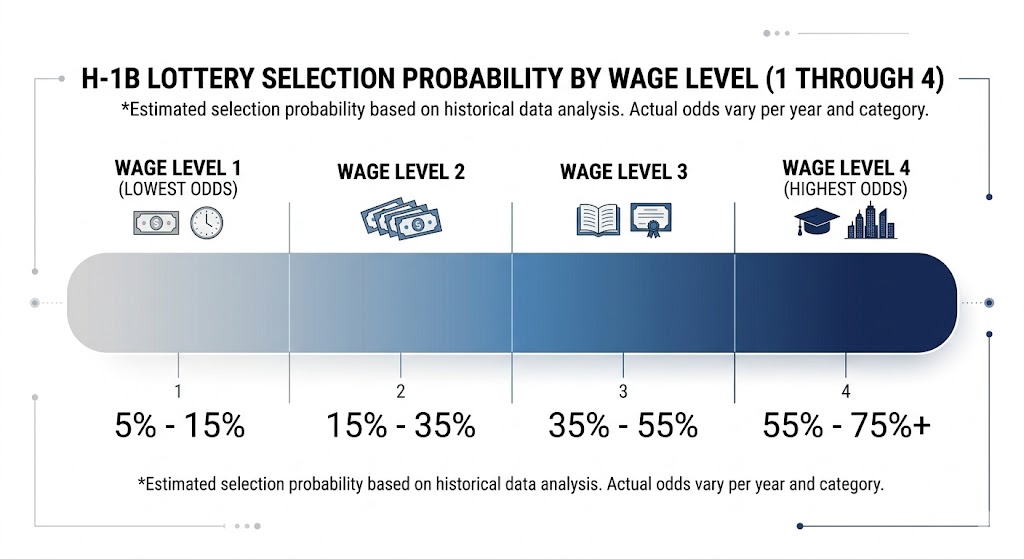
Under the current system, USCIS assigns lottery selection odds based on the prevailing wage level of the registered position. The four wage levels correspond to experience and complexity:
- Level 1 — Entry-level, minimal experience required. Lowest lottery odds.
- Level 2 — Qualified, some experience required. Below-average odds.
- Level 3 — Experienced, full performance expected. Above-average odds.
- Level 4 — Expert/specialist level. Best lottery odds.
For recent OPT graduates in their first one to two years of work, many roles fall at Level 1 or Level 2. This means that statistically, entry-level OPT workers face worse lottery odds than more senior candidates — not because of the lottery being “unfair,” but because the system is explicitly designed to prioritize higher-wage positions.
The practical implication: if your employer has flexibility in how they structure the position and the salary, having an attorney review the wage level selection before registration can matter. Wage level should reflect the actual role and pay — but there’s often a legitimate range, and where you land in that range has direct odds implications.
The $100,000 Fee: What OPT Workers Need to Know
Since the September 2025 Presidential Proclamation introduced this fee, it’s been the single most anxiety-inducing topic in H-1B discussions. Let’s be precise about what it does and doesn’t mean for OPT workers specifically.
It does NOT apply if:
- You are in the U.S. on F-1 OPT and your employer files a Change of Status H-1B petition domestically
- You have an existing valid H-1B stamp and your new petition doesn’t require new consular issuance
- Your petition is an extension or transfer filed within the U.S.
It DOES apply if:
- You are outside the U.S. when the H-1B petition is filed
- Your petition requires consular processing to obtain a new visa stamp
For the vast majority of OPT workers currently in the U.S. — the fee simply doesn’t apply. Change of Status is the standard path, and COS is explicitly exempt under current USCIS guidance.
The fee also faces active legal challenges as of early 2026. Multiple lawsuits argue that a $100,000 executive fee requires Congressional authorization. Courts have been receptive to these arguments, but no final ruling has overturned the fee yet. It remains in effect while litigation continues.
The complete 2026 H-1B new rules update tracks both the fee’s current status and the ongoing lawsuit developments.
What Happens If You’re Not Selected in the Lottery
This is the part nobody wants to plan for, but everyone should.
If you submit for the lottery and aren’t selected, your OPT continues as normal — you didn’t lose anything by registering. But you now have a timeline problem. You need a solution before your OPT or STEM OPT expires.
Option 1: STEM OPT Extension (if you haven’t used it) If you’re on standard 12-month OPT and your degree is in a qualifying STEM field, apply for the 24-month extension immediately. This buys you two more lottery cycles. You must apply before your OPT expires — you cannot apply retroactively.
Option 2: Cap-Exempt Employment Universities, nonprofit research institutions, and government research organizations don’t count against the annual H-1B cap. If you can find a position at one of these employers, they can file an H-1B for you at any time of year with no lottery. It’s not the most obvious career path, but for researchers, academics, or those with flexibility, it’s a legitimate route. This cap exemption guide explains which employers qualify and how the process works differently from cap-subject cases.
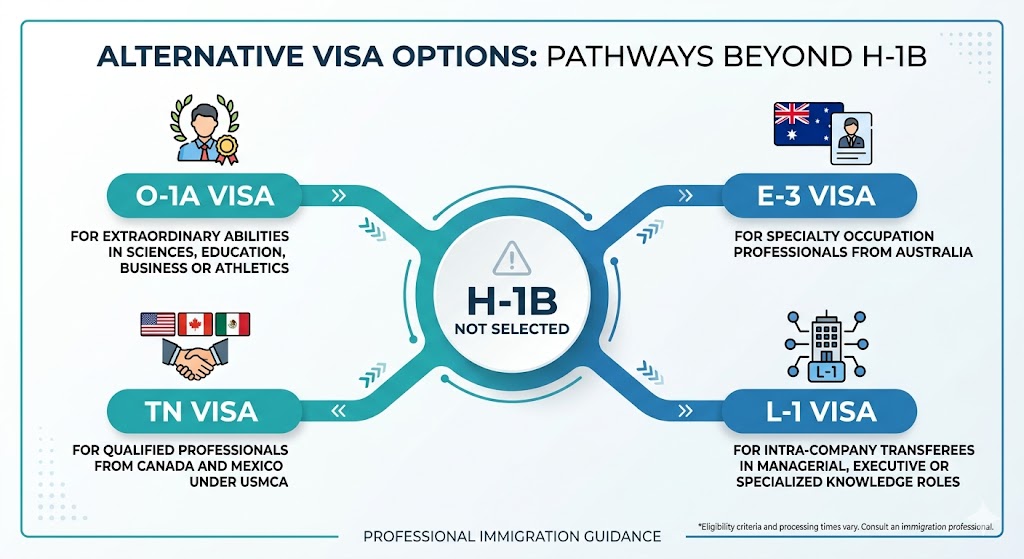
Option 3: Alternative Visa Classifications Depending on your background and accomplishments, you may qualify for:
- O-1A: For individuals with extraordinary ability — significant publications, major awards, media coverage, leading roles in distinguished organizations. Harder to qualify for but lottery-free.
- TN Visa: Available only to Canadian and Mexican citizens under USMCA for specific professional categories.
- E-3: Available only to Australian nationals in specialty occupations.
- L-1: For intracompany transferees — requires at least one year of employment with the same company abroad.
None of these are easy alternatives, but they exist. An attorney consultation specifically to evaluate alternative pathways is worth the time if you’ve been through two or three lottery cycles without selection.
Option 4: Re-Enter Next Year’s Lottery If you have STEM OPT remaining, you can try again. Employers can register you in each annual cycle. Previous non-selection doesn’t affect future odds — each year is a fresh draw.
The 60-Day Grace Period: Shorter Than You Think
If your H-1B is denied after you’ve been through the full petition process, or if you lose your job while on H-1B later down the line, you have a 60-day grace period from the date of termination to either find a new employer and file a transfer, change to a different status, or leave the country.
Sixty days sounds reasonable. In practice, it’s a sprint.
Here’s why: by the time you process the news, start job searching, receive an offer, have the new employer engage an attorney, prepare the transfer petition, and actually file — you may have 30 days left, not 60. Attorneys who work on H-1B transfers consistently say that people wait too long to start the process after a job loss, and by the time they contact legal counsel, the window has shrunk dangerously.
The 60-day clock starts on the last day of employment — not the day you find out, not the day your employer sends the termination letter, not the day USCIS is notified.
If you’re in this situation right now, this guide on what to do when your H-1B is cancelled or at risk is the most immediately useful thing to read. And for a detailed explanation of the 240-day rule that applies in extension scenarios, the H-1B extension and grace period guide covers that separately.
Do You Need an Immigration Lawyer for OPT to H-1B?
No law requires it. But let’s be direct about what “not required” actually means in this context.
The H-1B petition is a legal document making a legal argument. The specialty occupation determination is not a checkbox — it’s a case built from job duties, educational requirements, industry standards, and regulatory interpretation. If USCIS disagrees with how the case is framed, they send an RFE. Responding to an RFE without the attorney who built the original filing is significantly harder and more expensive than having gotten it right the first time.
The employer typically bears all legal costs. If your employer is resistant to using an attorney, that itself is a signal worth paying attention to — H-1B employers who have done this before almost universally use legal counsel because they’ve seen what happens when they don’t.
If your employer is genuinely a small company that’s never sponsored H-1B before, encourage them to at least consult an immigration attorney before the petition filing window. The consultation itself — usually a flat fee or hourly engagement — can identify risks before they become denials.
Visa Stamping After H-1B Approval: The Step OPT Workers Often Don’t Think About
If your H-1B is approved through Change of Status, you don’t automatically have an H-1B visa stamp in your passport. You have approved status and a valid I-94 — which is sufficient to work and live in the U.S.
The stamp only becomes relevant when you travel internationally and need to re-enter. If you leave the U.S. after your H-1B is approved through COS, you’ll need to get your visa stamped at a U.S. consulate abroad before you can come back.
In 2026, this is a significant planning consideration. Consular appointment availability — particularly in India — has been severely restricted, with many applicants unable to find appointments until 2027. This isn’t a bureaucratic inconvenience; it’s a genuine barrier to international travel.
Before you make any international travel plans after your H-1B approval, understand your stamping situation fully. The H-1B visa stamping guide for 2026 covers the current appointment landscape, dropbox eligibility, and what to expect at a consular interview. If you think you might qualify for the interview waiver (dropbox) process, this H-1B interview waiver guide explains the eligibility criteria specifically.
Your Spouse’s Options While You’re on H-1B
Once your H-1B is approved, your spouse and unmarried children under 21 can apply for H-4 dependent visas. H-4 allows them to live in the U.S. with you legally, attend school, and generally accompany you — but it does not automatically authorize employment.
For an H-4 holder to work, they must apply separately for an H-4 EAD (Employment Authorization Document). And here’s the critical requirement: the H-4 EAD is only available when the primary H-1B holder has an approved I-140 immigrant petition. Without that I-140 approval, employment authorization isn’t available for H-4 dependents.
This connection between the green card process and the H-4 EAD is one of the strongest practical reasons to start the green card process as early as possible. The earlier your employer files your I-140, the earlier your spouse can work.
If your spouse is currently on OPT or another work authorization and you’re transitioning to H-1B, understanding how H-4 EAD works is important for household financial planning. The H-4 EAD guide for 2026 covers eligibility, current processing timelines, and what the elimination of the automatic extension rule means for spouses whose EADs are expiring.
Planning for What Comes After H-1B: The Green Card Path
Most people on H-1B aren’t planning to be on H-1B indefinitely. The long-term goal is a green card — permanent residence. How you handle your H-1B years has direct implications for how your green card process unfolds.
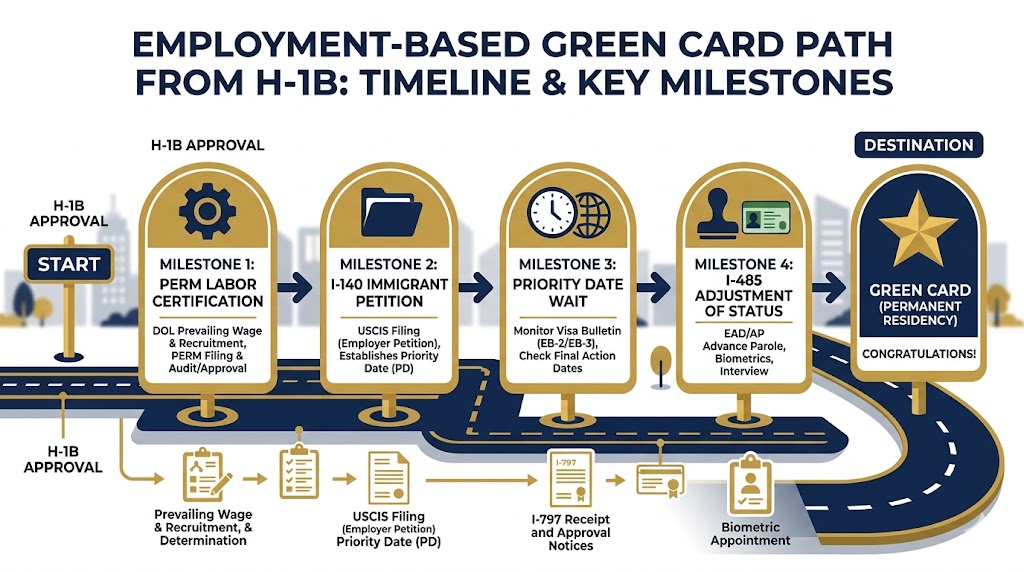
H-1B is a dual-intent visa. Unlike most nonimmigrant classifications, it explicitly allows you to simultaneously pursue permanent residence. You can file an I-140 while on H-1B, renew your H-1B while your green card application is pending, and generally move along both tracks at the same time.
The standard employment-based green card path involves three stages: PERM labor certification, I-140 immigrant petition approval, and then Adjustment of Status (I-485). The entire process timeline varies enormously by country of birth — workers from countries without significant backlogs may complete it in two to four years. Workers born in India face backlogs in the EB-2 and EB-3 categories that currently stretch into decades.
This is where the I-140 approval becomes strategically critical. Once your I-140 is approved, you can extend your H-1B beyond the standard six-year maximum in one-year increments — indefinitely, while waiting for a visa number to become available. Starting the green card process late means fewer protection years built up before your six-year H-1B clock runs out.
For a realistic timeline and cost breakdown — particularly for Indian nationals where the backlog issue is most severe — this H-1B to green card timeline guide lays out what the process actually looks like from petition to approval.
Common Mistakes OPT Workers Make During H-1B Transition
These aren’t edge cases. They happen regularly, and most of them are avoidable.
Waiting until March to confirm employer sponsorship. The registration window opens in February. If you’re having the sponsorship conversation in March, you may already be behind. Confirm commitment in December or January.
Assuming STEM OPT buys unlimited time. STEM OPT gives you 24 more months and potentially two more lottery cycles. It doesn’t make the H-1B requirement go away. Don’t treat it as a delay strategy — treat it as a strategic window.
Not understanding the cap-gap. If your OPT expires between April and September, you need cap-gap to bridge to October 1st. Cap-gap only works if the petition is filed before your OPT expires. A petition filed one day after your OPT expires does not trigger cap-gap.
Traveling internationally mid-process without understanding the consequences. If your H-1B Change of Status petition is pending and you leave the U.S., USCIS treats the COS as abandoned. You’d then need consular processing — which in 2026 means potential exposure to the $100,000 fee and months of appointment delays. Do not travel internationally between petition filing and approval without talking to an attorney first.
Changing employers during the pending period without filing a transfer. Your H-1B petition is employer-specific. If you change jobs while the petition is pending, the original petition becomes irrelevant. The new employer would need to file their own petition — and you’d need to have maintained status throughout.
Not asking about wage levels before registration. The wage level your employer selects affects your lottery odds directly under the 2026 system. It’s a legitimate question to ask before registration, not after.
A Realistic Picture of H-1B Approval Rates
Overall, H-1B approval rates have historically run between 85–95%. But that average covers an enormous range of case types and shouldn’t make you complacent.
The cases that get denied or heavily RFE’d share common characteristics: positions where the specialty occupation argument is weak, IT staffing arrangements where the employer-employee relationship is unclear, and petitions filed with minimal supporting documentation.
For OPT workers in classic specialty occupation fields — engineering, computer science, accounting, architecture, medicine — approval rates for well-prepared petitions are high. For OPT workers in roles that are harder to categorize, an experienced attorney preparing the specialty occupation argument makes a meaningful difference.
If you’re job-hunting and want to know which companies have strong H-1B sponsorship histories, the H-1B visa sponsors guide for 2026 and this H-1B sponsorship job search guide are useful references for identifying employers who are genuinely committed to sponsoring international workers.
Practical Financial Planning for Your First Year on H-1B
The OPT-to-H-1B transition also marks a financial shift that most guides don’t address. On OPT, some international students defer certain financial decisions because their long-term U.S. stay feels uncertain. Once you have H-1B approved and are beginning the green card process, that calculation changes.
Building credit history early matters. Many H-1B holders start without a U.S. credit history, which affects everything from apartment rentals to loan applications. This guide on building credit as an H-1B holder and the broader credit score building guide for beginners in the U.S. are practical starting points if this is new territory.
Opening the right bank account early also simplifies your financial life considerably — this guide on opening a bank account in the U.S. covers what to expect as a visa holder.

Questions People Ask That Don’t Get Clear Answers Elsewhere
Can I apply for H-1B without having been on OPT? Yes. OPT is not a prerequisite for H-1B. If you have a qualifying degree and an employer willing to sponsor you, they can petition for H-1B regardless of whether you’ve been on OPT. The lottery applies either way.
Does H-1B approval mean I have a visa stamp? No. Change of Status approval gives you H-1B status and a valid I-94. The visa stamp is a separate document issued by a U.S. consulate, only needed when you travel internationally and re-enter the country.
What if my OPT expires in July and my H-1B is still pending? If the petition was filed while your OPT was still valid, cap-gap protects your status and work authorization through October 1st. After October 1st, if the petition is still pending, you remain protected under cap-gap until a decision is made. If approved, your H-1B begins. If denied, you need to act quickly.
Can I switch employers after H-1B is approved? Yes, through an H-1B transfer. The new employer files a transfer petition, and under portability rules, you can typically start working for the new employer once the transfer receipt is issued — not after approval. The transfer must be in a same or similar occupational classification as the original petition.
Is STEM OPT worth applying for even if I think I’ll get H-1B? Yes. Apply for STEM OPT if you qualify. It costs relatively little, buys you additional runway if the lottery doesn’t go as planned, and doesn’t interfere with your H-1B petition in any way. There’s no downside to having it as a backup.
The Bottom Line
The OPT-to-H-1B transition in 2026 is manageable — but it requires more planning, more precision, and more awareness of new rules than it did even a couple of years ago.
The timeline is fixed and unforgiving. The lottery is luck-based, but your preparation isn’t. The $100,000 fee mostly doesn’t apply if you’re already in the U.S. and going through Change of Status. The wage-weighted lottery means your wage level selection matters both legally and strategically. And cap-gap is your friend — but only if the petition is filed in time.
Most importantly: the earlier you confirm employer commitment, verify eligibility, and get qualified legal counsel involved, the fewer surprises you’ll face when the stakes are highest.
For a complete picture of what the H-1B requirements look like in 2026, the full eligibility guide is the most useful next step. And once you’re ready to understand every cost layer — government fees, attorney fees, and optional costs — the 2026 H-1B fee breakdown covers it all in one place.
The clock on OPT doesn’t wait. Neither should your planning.
Disclaimer:This article is for informational purposes only and does not constitute legal advice. Immigration rules change frequently. Consult a licensed immigration attorney for guidance specific to your situation.