


The short version: The interview waiver program lets qualifying H-1B holders renew their visa stamp from within the U.S. — no consulate appointment needed. In 2026, with Indian consulate appointments backed up to 2027, this program matters more than it ever has. But not everyone qualifies, and the eligibility rules have specific conditions that most people don’t fully understand until they’re already mid-process.
Here’s the situation I keep seeing play out. Someone got their H-1B stamp in Canada in 2023 — a totally reasonable call at the time, given that Indian consulate wait times were already climbing. They assumed they’d do the same thing next time. Then September 2025 happened. The third-country stamping option closed for most Indian nationals. Now they need a new stamp, can’t go back to Canada, can’t get a regular appointment in India until spring 2027, and they’re scrambling to figure out whether the interview waiver even applies to them.
Sometimes it does. Sometimes it doesn’t. The difference comes down to a specific eligibility condition most people don’t think about until they’re already mid-process.
That gap — between assuming you qualify and actually checking — is exactly what this guide is for.
The interview waiver lets qualifying H-1B holders renew their visa stamp without going to a consulate at all. No appointment. No in-person interview. You submit a document package by mail or dropbox, the consulate reviews it, and your passport comes back with the new stamp. In a year where Indian consulate slots are booked into 2027 and the old third-country workaround is gone, this program matters more than it ever has.
But there are real eligibility conditions. Several of them. And they all have to be met at the same time.
One thing to understand before we get into conditions: the interview waiver applies only to visa stamp renewal. It’s for H-1B holders who already have an approved petition and need a new stamp because their current one has expired or is about to. It doesn’t apply to first-time H-1B applicants. It doesn’t change your petition or your status inside the U.S. It’s purely about the stamp you need to re-enter after international travel.
What the Interview Waiver Program Actually Is
Standard visa stamping requires an in-person appearance at a U.S. consulate. A consular officer reviews your application, checks your documents, asks questions, and approves your stamp. That’s the default process.
The interview waiver is an exception to that default. Under specific conditions, the State Department allows certain applicants to submit their applications by mail or dropbox — no in-person interview required. The consulate processes the paperwork and mails the passport back with the new stamp.
For H-1B holders, the waiver runs through two mechanisms:
The standard interview waiver — Available to H-1B holders renewing in the same visa category, subject to age requirements and other conditions.
The Dropbox program — The specific mechanism used at U.S. consulates in India (Mission India). This is what matters for most Indian H-1B holders. The Dropbox has its own eligibility rules, slightly different from the broader waiver criteria.
These two overlap but aren’t identical. Understanding the Dropbox-specific rules is what actually matters if you’re applying through Mission India.
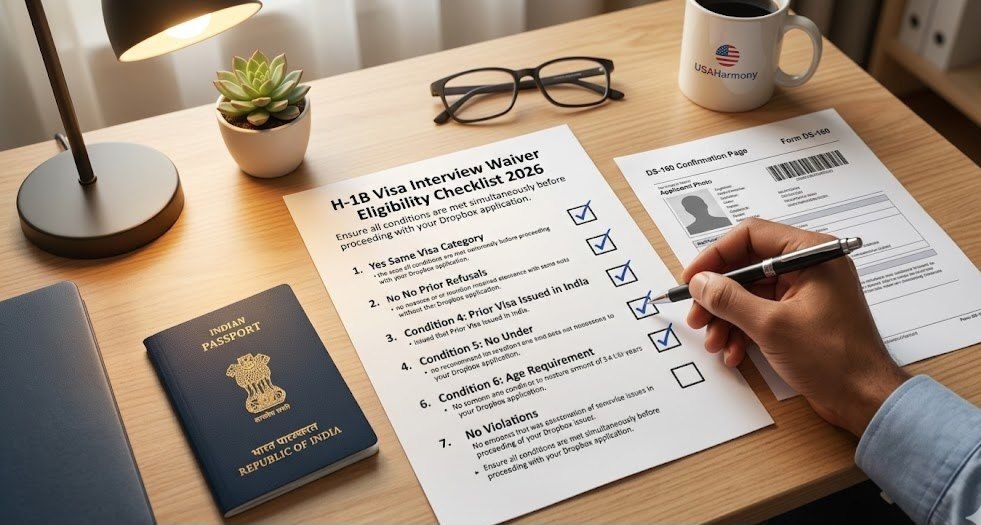
Who Qualifies — The Full Eligibility Requirements
This is where vagueness will hurt you. The eligibility requirements have multiple conditions. All of them have to be satisfied at once. Miss one and you’re back to the regular appointment queue, which in 2026 means waiting until 2027.
Condition 1: Renewing the Same Visa Category
You must be renewing the same visa classification as your most recent U.S. visa. An H-1B holder renewing an H-1B stamp qualifies. Someone who previously held an F-1 and is now applying for their first H-1B stamp doesn’t — because that’s not a renewal, it’s a first application in a new category.
H-1B is H-1B. H-1B1 (the specialty category for Chilean and Singaporean nationals) is treated separately. H-4 dependents have their own renewal rules, covered later in this guide.
Condition 2: Previous Visa Was Not Refused
Your most recent visa application in the same category must not have been refused. A prior refusal — even years ago, even with circumstances that have completely changed — can disqualify you.
One nuance worth knowing: a 221(g) administrative processing hold that eventually resolved with an approval is not a refusal. If your application sat in 221(g) for months and then was approved, you were delayed, not refused. The interview waiver should still be available to you.
A denial under INA §214(b) — where the officer found you failed to overcome the presumption of immigrant intent — is a refusal. Prior denials under that provision can affect your waiver eligibility.
Condition 3: Age Requirement
Applicants under 14 or over 79 are generally exempt from the interview requirement entirely, regardless of category. Adult H-1B applicants between 14 and 79 can use the Dropbox if the other conditions are met.
Condition 4: Prior Visa Issued in the Same Country
This is the condition that trips people up most.
For the Dropbox at Mission India, your most recent H-1B visa generally must have been issued at a U.S. consulate in India. If your last H-1B stamp was issued in Canada, Germany, or anywhere else — which was common before September 2025 — you may not qualify for the Indian Dropbox.
I’ve seen this specific situation catch people off guard repeatedly. Someone stamped in Canada in 2023 thinking they were being practical about the backlog. Now they find themselves ineligible for the Dropbox because their last stamp wasn’t issued in India — and also unable to go back to Canada because of the September 2025 restriction. The result is a gap nobody planned for: regular interview required, earliest appointment is 2027.
If your last H-1B stamp was issued at an Indian consulate, this condition is satisfied. If it wasn’t, contact the specific U.S. consulate where you intend to apply and ask directly before submitting anything or paying any fees.
(Source: U.S. Embassy India — Dropbox Eligibility)
Condition 5: Visa Must Not Have Been Revoked or Cancelled
If your most recent visa in the same category was revoked or cancelled — by the State Department, at a port of entry, or for any reason — you don’t qualify for the interview waiver. You need a regular interview.
This matters in the current enforcement environment. Prudential revocations by the State Department increased significantly in 2025 and 2026. If your visa was prudentially revoked, even if your I-94 status inside the U.S. remained valid, you’ll need a full interview for your next stamping. The H-1B visa revocation guide on USAHarmony covers the different revocation types and what each means for future stamping appointments.
Condition 6: No Visa Overstay or Immigration Violations
Applicants who overstayed a previous U.S. visa, or who have immigration violations in their record, are generally not eligible for the interview waiver. Clean record required.
Condition 7: No Criminal Record
Prior arrests — including dismissed cases, expunged charges, and charges that were reduced — can affect interview waiver eligibility. The State Department pulls federal fingerprint databases, not just state court records. An expungement may have cleared your state record, but the federal fingerprint record that DOS accesses is separate and unaffected by state-level expungement.
If you have any prior arrest or legal matter, talk to an immigration attorney before submitting through the Dropbox program. The worst outcome isn’t being told you need a regular interview. It’s submitting a waiver application and having your passport held while DOS investigates.
How the Dropbox Process Actually Works at Mission India
If you’ve confirmed you’re eligible, here’s what the application process looks like — in the order it has to happen.
Step 1: Confirm Your Eligibility Online
Go to the U.S. Embassy India scheduling portal at ustraveldocs.com/in. The portal has a built-in eligibility screener for the Dropbox program. Answer the questions accurately — this determines whether you’ll see Dropbox scheduling options or get directed to the regular interview queue.
Do not misrepresent anything on the eligibility screener. Misrepresentation on a visa application — including an online pre-screening — is material misrepresentation under INA §212(a)(6)(C) and can create permanent inadmissibility issues.
Step 2: Pay the MRV Fee
The Machine Readable Visa fee is currently $185 for H-1B applicants. Pay through the scheduling portal before booking your Dropbox appointment. Keep the payment receipt — you’ll need it, and receipts older than one year cannot be applied to an appointment.
(Source: State Department Visa Fees)
For a full breakdown of what H-1B stamping costs from start to finish — MRV fees, attorney fees, and other expenses Indian applicants run into — the H-1B visa fees guide covers all of it in one place.
Step 3: Complete the DS-160
The DS-160 is the nonimmigrant visa application form, filed online at ceac.state.gov. Fill it out with your I-797 open in front of you. Every field that appears in both documents should use identical language. Inconsistencies between the DS-160 and your petition are the most common cause of administrative processing delays — and they’re entirely preventable.
Print the confirmation page immediately after submission. You cannot retrieve it once your session closes, and it’s required for your Dropbox submission.
Step 4: Book Your Dropbox Appointment
Back in the scheduling portal, select the Dropbox option and choose your preferred Visa Application Center location. Dropbox appointments are drop-off appointments, not interviews. You’re leaving documents with a courier, not appearing before a consular officer.
Current availability note: Dropbox slots have been constrained in 2025 and 2026, partly because of increased application volume and partly because the December 2025 social media vetting requirement reduced processing capacity at all five Mission India posts. Check the portal regularly and book as soon as a slot appears.
Step 5: Prepare Your Document Package
Your Dropbox submission should include — in this exact order:
- DS-160 confirmation page (barcode clearly legible)
- MRV fee payment receipt
- Your current passport (valid for at least six months beyond your intended stay, plus all prior passports)
- Copy of your most recent H-1B visa stamp (even if expired)
- I-797 approval notice (current petition)
- Employment verification letter from your sponsoring employer
- Copy of your I-94 arrival/departure record (printable at i94.cbp.dhs.gov)
- Two passport-style photographs meeting State Department specifications
- Any previous I-797 notices if you’ve had multiple H-1B petitions
On social media accounts: Since December 2025, H-1B applicants at Mission India are required to set all social media account privacy settings to public before their Dropbox submission. This applies to every platform where you have an account — including inactive ones. The full H-1B stamping guide for Indian professionals covers the social media requirement in detail, including what consular officers are actually looking for and how to prepare your accounts.
Step 6: Drop Off and Wait
Submit your package at the Visa Application Center on your scheduled date. The VAC courier transfers it to the consulate. Processing typically takes 3–7 business days for straightforward cases. Track status using your DS-160 barcode at ceac.state.gov.
When status shows “Issued,” your passport is on its way back. Do not book international travel until the physical passport is in your hands. The gap between an “Issued” status and actual delivery is short, but it’s real.
What “Administrative Processing” Means — And What to Do If You Get It
The outcome most Dropbox applicants dread is not outright denial. It’s the 221(g) administrative processing hold.
A 221(g) is not a denial. It means the consulate can’t approve the application right now — either because additional documentation is needed, or because the case has been flagged for further review.
If your 221(g) slip includes a document checklist: Respond promptly and completely. Most document-request holds resolve within 4–12 weeks when documentation comes in fast. Submit everything at once — don’t send a partial response expecting to follow up with more later.
If your 221(g) slip contains no document request: Your case is in administrative review. There’s no defined timeline. Some cases resolve in weeks. Others sit for a year or more. Cases involving prior arrests, social media content flagged under current vetting criteria, or employer compliance questions tend to stay in review longer.
At 60 days with no update: Submit a formal status inquiry through the consulate portal. Keep records of every communication.
At 180 days with no resolution: Consult an immigration attorney about whether a formal inquiry, Congressional inquiry, or mandamus litigation makes sense for your situation.
What Changed in 2025–2026 That Affects the Waiver Program
Three developments over the past year changed how the interview waiver works in practice — and they interact with each other in ways that create new problems for specific groups of applicants.
The September 2025 Third-Country Stamping Restriction
The DOS policy change effective September 6, 2025 closed off Canadian, Mexican, and most European consulates as alternative stamping locations for most Indian nationals. This is the change that reshuffled everything else.
It created two distinct knock-on problems for the interview waiver. First, it pushed far more H-1B holders back toward Mission India — either Dropbox or regular interview — which tightened both queues. Second, it made Condition 4 (prior stamp issued in country) a live issue for a large group of people who had no reason to think about it before. If you stamped in Canada in 2022 or 2023 as a practical workaround, and your last stamp was therefore not issued in India, you may not qualify for the Dropbox. That’s a direct consequence of a policy change that happened after you made a reasonable decision.
The H-1B new rules 2026 update covers the September 2025 TCN restriction and every other major policy change from the past two years in one place.
The December 2025 Social Media Requirement
U.S. consulates in India implemented mandatory social media vetting for H-1B and H-4 applicants in December 2025. All accounts must be set to public before submission. It applies to Dropbox applicants exactly as it applies to regular interview applicants. It also reduced daily processing capacity across all five Mission India posts — which is part of why Dropbox availability tightened even beyond what volume alone would explain.
Increased Revocations and Enforcement Actions
The current enforcement environment has produced more H-1B holders with revocations in their history — which directly affects interview waiver eligibility under Condition 5. A prudential revocation, even if it left your I-94 status intact, puts you in the regular interview queue for your next stamping. With interview appointments running into 2027, that’s not a small inconvenience. If you’re unsure whether your visa was prudentially revoked or simply expired, the H-1B revocation guide walks through how to check and what each type of revocation means going forward.
The Domestic Renewal Option — What It Is and Where It Stands
The most common question right now: “Can I renew my visa stamp without leaving the U.S. at all?”
As of March 2026, the answer is no. The pilot that allowed this has ended and nothing has replaced it.
In 2024, the State Department ran a limited pilot that let certain H-1B holders renew their visa stamps through a domestic mail-in process — no consulate trip, no international travel required. The pilot had narrow eligibility criteria tied to specific U.S. Missions and issuance time windows. It ran. It ended. No permanent program followed.
The State Department has said it wants to make domestic renewal permanent. It has not issued a timeline, a regulatory framework, or a formal announcement establishing when or how that happens. If you’re planning around domestic renewal being available, stop. Verify the current status directly at travel.state.gov before making any decisions.
Frankly, this is the most frustrating part of the current situation. The case for permanent domestic renewal is obvious — consulate backlogs are measured in years, third-country options have closed, and keeping high-skilled workers on valid, travelable status benefits everyone. The political pressure is real. But pressure and policy are different things, and the gap between them is exactly where people get stuck making plans based on a program that doesn’t exist yet. Check travel.state.gov. Don’t assume.

If You Don’t Qualify — Your Realistic Options in 2026
Not everyone qualifies for the interview waiver. If you don’t, here’s what your actual options look like.
Option 1: Book a Regular Interview Appointment at Mission India
The standard path. All five consulates — New Delhi, Mumbai, Chennai, Hyderabad, Kolkata — are showing no H-1B appointment availability through the end of 2026 as of this writing. The earliest reported slots are appearing in spring 2027.
Check the portal at ustraveldocs.com/in multiple times per week. New slots appear irregularly, including early morning and late evening. Cancellations do open slots.
Expedite requests: If your situation involves a documented medical emergency, a documented critical business requirement, or imminent loss of status, you can request expedited processing after scheduling a regular appointment. The bar is meaningful — routine business travel doesn’t qualify.
Option 2: Don’t Travel Until You Have a Stamp
If your H-1B petition is approved and your I-94 is valid, you can legally live and work in the U.S. with an expired visa stamp. The stamp only matters when you travel internationally and need to re-enter. If international travel isn’t urgent, staying in the U.S. until you can get a Dropbox slot or a regular appointment is a completely legitimate choice — and it’s what many H-1B holders are currently doing.
The critical thing to understand: once you leave the U.S. without a valid visa stamp, you cannot return until you have one. Don’t leave assuming you’ll handle the stamp abroad quickly. In 2026, there is no quickly. If your petition is expiring soon and you’re also dealing with the stamping backlog, make sure you understand how the H-1B extension process and the 240-day rule apply to your timeline before making any travel decision.
Option 3: Evaluate Advance Parole If Your I-485 Is Pending
If you have a pending I-485 (green card application) and have received Advance Parole (Form I-131), you can travel internationally and return using the AP document instead of a visa stamp. This is a legitimate travel mechanism for I-485 filers.
If your green card process is far enough along that you have a pending I-485, this is worth a direct conversation with your attorney. The H-1B to green card timeline guide covers how Advance Parole fits into the broader green card process and when it becomes a viable travel alternative.
The H-4 Situation — Same Process, Same Rules
H-4 dependent spouses and children renewing their H-4 stamps go through the same interview waiver evaluation as the primary H-1B holder. The Dropbox program at Mission India applies to H-4 applicants under the same eligibility conditions.
One difference worth knowing: the primary H-1B holder’s application and each H-4 dependent’s application each require their own separate passport in the process. The primary’s passport going through Dropbox doesn’t automatically cover dependents. Each passport gets its own review — though they’re typically submitted together at the same Dropbox appointment.
For H-4 spouses specifically: your work authorization through the H-4 EAD is completely separate from your visa stamp. An expired H-4 stamp doesn’t affect your EAD or your right to work, as long as your underlying H-4 status is maintained. The stamp is only relevant when you travel internationally. The H-4 EAD guide covers the work authorization side in detail, including the October 2025 rule change that eliminated automatic renewal extensions.
What to Do Before Any International Travel
Before you book any flight that requires you to leave and return to the U.S., work through this checklist.
Most people who end up in serious trouble at the border — or stranded abroad waiting for a stamp — didn’t miss something obscure. They skipped one of these basic checks and assumed things were fine.
Verify your visa stamp status. Go to ceac.state.gov. Enter your visa application number from your passport stamp. Confirm the stamp is not revoked or cancelled.
Verify your I-94. Go to i94.cbp.dhs.gov. Confirm your authorized period of stay hasn’t expired and your status matches your current visa category.
Verify your I-797. Confirm your H-1B petition is valid and the dates cover your intended travel period. If you’re mid-extension, understand your grace period under the 240-day rule before leaving.
Assess your interview waiver eligibility. Using the conditions in this article, determine whether you qualify for Dropbox or need a regular interview.
If you need a stamp before traveling: Do not book non-refundable travel before you have confirmed your visa appointment and understand the timeline. An “Issued” status on CEAC tracking is not a passport in your hand. Wait for the physical document.
If your last stamp was issued outside India: Contact the U.S. Embassy in India directly to confirm your Dropbox eligibility before submitting any application or paying any fees.
Understanding what each number on your visa documents actually means — and where to find them when filling out the DS-160 or preparing your Dropbox package — matters more than most people expect. The H-1B visa number guide covers exactly what each identifier is and how to use it correctly.

Frequently Asked Questions
To qualify for the Dropbox program at Mission India, you generally need to be renewing an H-1B visa in the same category as your most recent U.S. visa, with no prior refusal in that category, no revocation or cancellation on your record, and your most recent H-1B stamp issued at a Mission India post. You must also have no prior visa overstay, no immigration violations, and a clean criminal record. All conditions must be met simultaneously. (Source: State Department Interview Waiver Program)
This is a specific eligibility question you need to raise directly with the U.S. Embassy in India before applying. The Dropbox program generally requires that your prior visa in the same category was issued at a Mission India post. Third-country stamping was common before September 2025, so many Indian H-1B holders are now in this situation. Contact the embassy and ask specifically about your circumstances before submitting any application or paying any fees.
No. The interview waiver means you don’t have to appear in person. Your application is still reviewed by a consular officer. You can still receive a 221(g) administrative processing hold or, in rare cases, a denial. The waiver removes the in-person interview requirement — it doesn’t remove the review itself.
For straightforward applications with no administrative processing flags, most applicants receive their passport back within 3–7 business days after submission. If the case goes into 221(g) administrative processing, the timeline becomes unpredictable — weeks to months depending on the nature of the hold.
our employer controls your work assignment, but they can’t control your immigration situation. If travel would require you to obtain a visa stamp you can’t get quickly, that’s a legitimate constraint to raise with HR or your manager. Most employers with established immigration processes understand this. If yours doesn’t, an immigration attorney can help you frame the conversation. The H-1B sponsorship guide also has context on how employer-employee relationships work around immigration constraints.
Nothing — as long as your I-797 petition is valid and your I-94 reflects current authorized status. An expired visa stamp has no effect on your right to live and work in the U.S. The stamp is only relevant for international travel. Millions of H-1B holders are currently in the U.S. with expired stamps and are fully in status. (Source: USCIS — Visa vs. Status)
Yes. The December 2025 State Department directive requiring H-1B and H-4 applicants to set social media profiles to public applies to Dropbox submissions exactly as it applies to regular interview appointments. Set every account — including inactive ones — to public before submitting. Bring a written list of every platform and username to your VAC appointment. (Source: U.S. Embassy India Visa Information)
If the 221(g) includes a document request, respond promptly and completely — submit everything at once, not in pieces. If it contains no document request, you’re in administrative review with no defined timeline. Submit a status inquiry at 60 days. If the hold runs past 180 days without resolution, consult an immigration attorney about formal inquiry or mandamus litigation options. Do not book international travel while your passport is at the consulate.
No. The interview waiver applies to renewal applicants only — people renewing a visa in the same category they previously held. First-time H-1B applicants, or H-1B holders applying for their very first U.S. visa stamp, need a regular consular interview appointment.
Your H-1B status is your legal authorization to live and work in the U.S., maintained through your approved I-797 and valid I-94. Your visa stamp is the physical endorsement in your passport that allows you to apply for entry at a U.S. port of entry after international travel. You can be fully in H-1B status inside the U.S. with an expired stamp. The stamp only matters when you leave and need to return.
Disclaimer: This article is published by USAHarmony.com for informational and educational purposes only. It does not constitute legal advice and does not create an attorney-client relationship. Consular policies, interview waiver eligibility criteria, processing times, and appointment availability change frequently. The information reflects publicly available State Department and consulate guidance as of March 2026. Always verify current waiver eligibility and Dropbox availability directly through the U.S. Embassy in India or the scheduling portal before making any travel or application decisions. USAHarmony.com does not provide legal representation or immigration services.