


Most H-1B workers don’t know what their employer is legally required to pay them. They see a number in the offer letter, they’re relieved to have sponsorship, and they sign. That’s understandable — by the time salary is on the table, you’ve already survived the lottery, the RFE anxiety, and months of waiting. The last thing you want is to push back.
But H-1B salary requirements in 2026 aren’t just a number your employer made up. There is a federal floor — the prevailing wage — that your employer is legally required to meet. And according to DOL data from FY 2024, 63% of certified LCAs were filed at Level I or II, the two lowest wage tiers. That means most H-1B workers are being paid at or near the legal minimum. (Source: Economic Policy Institute)
This guide explains the whole system — how wages are set, what the four levels mean in real dollars, what the DOL’s proposed 2026 changes would do, and what you can do if your employer isn’t paying what they’re required to.
Meet Rohan — A Real Scenario That Will Run Through This Article
Rohan is a software engineer from Hyderabad with four years of experience. He accepted an H-1B offer from a mid-sized IT consulting firm in Austin, Texas — $82,000 base salary, which felt fair. He signed without checking his LCA. Eight months later, a coworker mentioned that the prevailing wage for their role in Austin at Level II was $95,000. Rohan pulled his LCA for the first time and found he’d been classified at Level I — “entry level, routine tasks under close supervision.” He’d been writing production system architecture independently since week one.
Rohan’s situation is common. By the end of this article, you’ll see exactly what he did about it.
The Core Rule: Two Wages, and You Get the Higher One
Before getting into levels and percentiles, here’s the rule plainly stated.
Every H-1B Labor Condition Application must include an employer attestation that the worker will be paid the greater of two figures: (1) the average actual wage the employer pays to workers in similar roles, or (2) the prevailing wage for that occupation in the geographic area of employment. These two protections stack on top of each other. (Source: DOL Wage and Hour Division, Fact Sheet 62G)
The first protection means your employer cannot pay you less than your American coworkers doing the same job at the same company. The second means even if every person in the office is on H-1B, there’s still a regional market floor the employer must meet. And only guaranteed cash compensation counts toward that floor — discretionary bonuses and unvested stock options cannot be used to satisfy the required wage. (Source: DOL Prevailing Wage Guidance)
Understanding these two floors is the foundation of everything else in this article — starting with how those floors are actually calculated.
The Four Wage Levels — What They Mean in Real Dollars
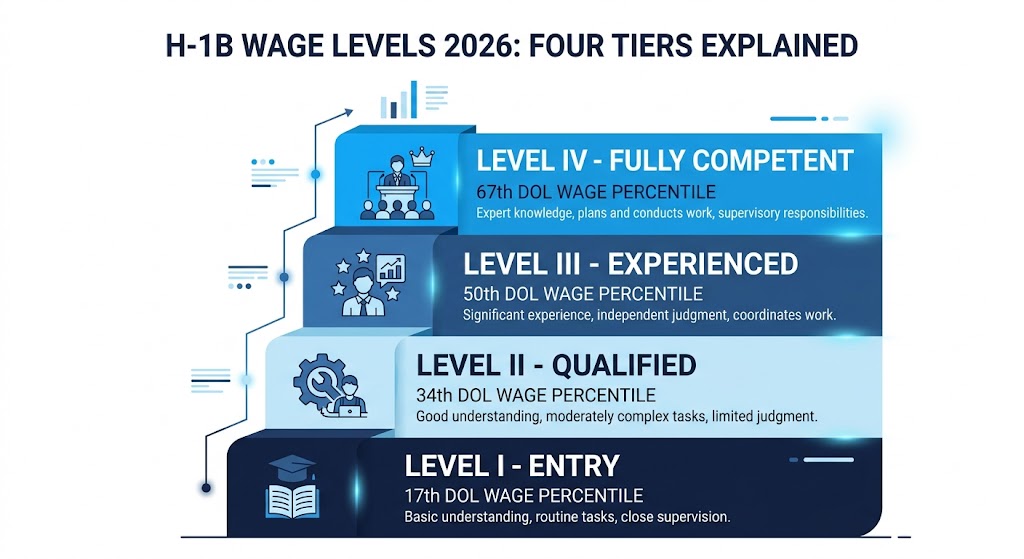
The DOL’s Prevailing Wage Determination Policy Guidance assigns workers to one of four levels based on required experience, education, job complexity, and degree of supervision. (Source: DOL OFLC Prevailing Wage Policy Guidance)
Level I — Entry Level (17th percentile) Reserved for workers with a basic understanding of the occupation performing routine tasks under close supervision. In practice, for a software developer role in Austin, TX in 2026, this floor sits around $78,000–$85,000 annually. 83% of U.S. workers in the same occupation earn more than this.
Level II — Qualified (34th percentile) Workers with a solid understanding of the occupation who perform moderately complex tasks with limited supervision. For the same Austin software developer role, this means roughly $95,000–$105,000. This is where most experienced H-1B workers in non-supervisory roles should realistically be classified.
Level III — Experienced (50th percentile) Workers with significant experience who exercise independent judgment and require minimal supervision. The prevailing wage here for an Austin software developer runs approximately $115,000–$125,000. This is the median — half of all U.S. workers in this role earn less, half earn more.
Level IV — Fully Competent (67th percentile) Senior workers with expert knowledge, often with management or supervisory responsibilities. The Austin prevailing wage at this level runs approximately $135,000–$150,000.
Verify your exact numbers using your SOC code and city at flag.dol.gov/wage-data/wage-search — wages update every July.
The critical thing to understand: your employer chooses your wage level, not the government. DOL doesn’t audit level assignments unless a complaint is filed. That gap between “who decides” and “who verifies” is where most H-1B wage problems originate — which is exactly what the 2026 proposed rule is designed to address. (Source: Economic Policy Institute)
The 2026 DOL Proposed Rule — The Biggest Change in Two Decades
On March 26, 2026, the U.S. Department of Labor published a Notice of Proposed Rulemaking that would substantially overhaul how prevailing wages are calculated for H-1B, H-1B1, E-3, and PERM programs. This is the most significant proposed change to H-1B wage requirements in over twenty years. (Source: Boundless)
The stated motivation: a September 2025 Presidential Proclamation declared that the H-1B program “has been deliberately exploited to replace, rather than supplement, U.S. workers with lower-paid, lower-skilled labor.” The proposed rule is the DOL’s direct response. (Source: Duane Morris Immigration Law Blog)
H-1B Wage Rule Reform
What Would Actually Change:
Before & After
Proposed percentile shifts by wage level — and their real-world impact
Entry-level floor roughly doubles in many markets — a significant upward shift that raises the baseline for new H-1B entrants.
from 17th → 34th
Significant increase for most qualified workers — crosses the median, making this the new center of gravity for the H-1B workforce.
from 34th → ~52nd
Above-median floor for experienced workers — jumps well into the upper tier, anchoring mid-career H-1B holders firmly above average.
from 50th → ~70th
Top-tier floor approaches the 90th percentile — practically eliminates wage undercutting at the senior level, pushing costs to near-elite territory.
from 67th → 88th
Percentile spectrum — all four levels at a glance
* Percentile estimates based on proposed DOL wage rule reform. Actual implementation may vary.
Based on DOL’s own analysis of wage data from FY 2020–2024, the proposed adjustments would increase the average certified wage by approximately $14,000 per year per worker. (Source: DOL NPRM Federal Register)
For Rohan’s situation specifically: under the proposed rule, the Level I floor in Austin for software developers would jump from approximately $82,000 to roughly $95,000 — which means his employer’s current $82,000 offer would no longer be compliant even at Level I once the rule takes effect.
What the rule will and won’t affect:
The new wage floors, if finalized, apply only to LCAs filed on or after the effective date. Existing approved LCAs, active H-1B petitions, and previously certified PERM wage determinations are not affected retroactively. H-1B cap petitions for FY 2027, with filing deadlines of June 30, 2026, are also expected to remain unaffected since their LCAs would have been filed before any effective date. (Source: DOL NPRM Federal Register)
The rule is still in its public comment period. The earliest realistic implementation date is summer 2026, though legal challenges are possible and could delay or alter the final rule. (Source: DiRaimondo & Schroeder LLP)
For workers currently evaluating offers or preparing for extensions, the H-1B new rules 2026 guide covers the broader regulatory changes alongside this wage proposal.
DOL OFLC Data · July 2025 – June 2026
Salary by City: There Is No Single National Minimum
Your H-1B wage floor depends entirely on your occupation, your city, and your assigned level
Software Developer
📍 San Francisco, CAWage Range
$130K – $210K
Software Developer
📍 Austin, TXWage Range
$82K – $138K
Data Analyst
📍 New York, NYWage Range
$85K – $148K
Mechanical Engineer
📍 Chicago, ILWage Range
$72K – $126K
Financial Analyst
📍 Houston, TXWage Range
$68K – $118K
⚡ Highest vs. Lowest — Level I Entry Floor
Software Developer
San Francisco, CA
L1 floor
$130,000
↑ Highest in dataset
Software Developer
Austin, TX
Same role · L1 floor
$82,000
↓ $48K less than SF
Financial Analyst
Houston, TX
L1 floor
$68,000
↓ Lowest in dataset
Any Role · L4 ceiling
San Francisco, CA
Max L4 floor
$210,000
↑ Top of all levels
Source: DOL OFLC Prevailing Wage Data · Wage year July 2025–June 2026. Figures are approximate minimums, not guaranteed salaries.
These figures are estimates based on current OEWS data. Always verify at flag.dol.gov using your specific SOC code and metropolitan area.
One more thing on remote work: the prevailing wage is tied to your worksite location, not your employer’s headquarters. If your employer amends your LCA to reflect a lower-cost city after you start working remotely from there, your wage floor decreases accordingly. (Source: DOL OFLC Policy Guidance)
These numbers explain exactly why understanding your wage level matters — a $10,000–$20,000 gap between levels is real money that compounds across years of employment, including into your green card timeline. The H-1B to green card timeline guide covers how wage levels factor into PERM labor certification during that process.
What Reddit Actually Shows: Three Patterns That Keep Appearing
Online H-1B communities document wage issues more honestly than most official resources. Three patterns appear repeatedly:
Pattern 1 — The misclassification trap. An engineer with four years of experience, leading architecture decisions on production systems, discovers their LCA was filed at Level I (“entry level, routine tasks under close supervision”). Their actual daily work is independent and senior-level. The employer chose Level I to minimize the wage floor. This is Rohan’s exact situation, and it appears in r/immigration and r/h1b constantly.
Pattern 2 — The bench pay violation. Workers at IT staffing companies report being told their salary pauses during “bench time” between client placements. This is a direct violation: an employer must pay the full LCA wage from the moment the H-1B is approved and active, including periods with no active project. The DOL Wage and Hour Division treats this as a straight wage theft violation. (Source: DOL Fact Sheet 62G)
Pattern 3 — The staffing company Level I scheme. H-1B workers hired through staffing firms report LCAs filed at Level I wages of $65,000–$70,000 for cities where the market rate for the same work runs $110,000+. Technically compliant at Level I. Effectively exploitative. One worker on r/h1b described the realization: “I didn’t even know what an LCA was for my first three years. I assumed my pay was fair. It wasn’t.”
The thread-level reality across all three patterns is the same: most workers don’t file complaints, because the employer controls the visa. That dynamic is precisely what the proposed 2026 wage increase targets — by making the floor high enough that there’s less space between the legal minimum and market rate. (Source: Economic Policy Institute)
The Wage-Weighted Lottery: Salary Now Affects Selection Odds
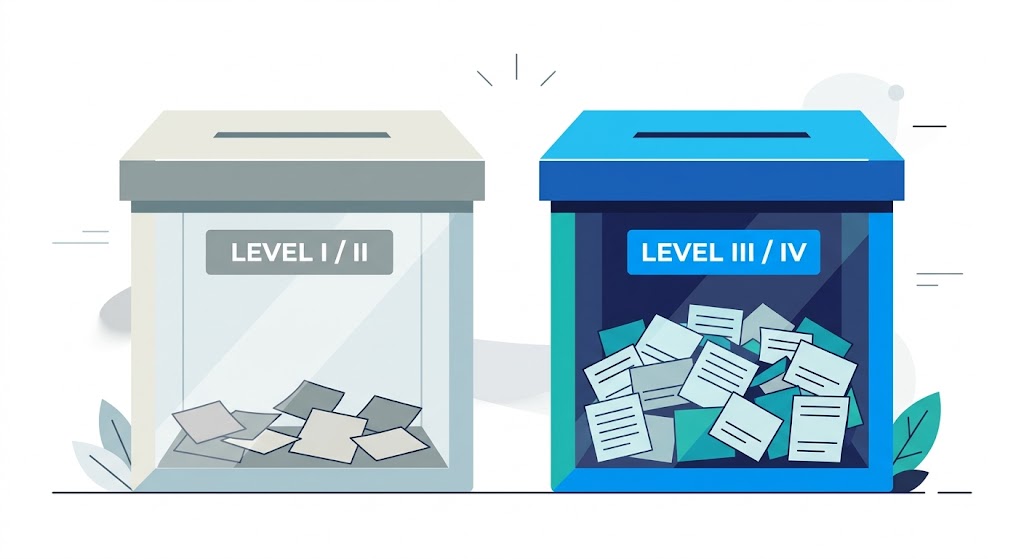
Starting with the FY 2027 cap season, your wage level does more than determine compliance. It determines how your registration is weighted in the lottery.
Higher wage level registrations receive more favorable selection odds. DHS estimates this change will produce $502 million in first-year wage increases, shifting compensation from Level I toward higher-level positions. (Source: DHS NPRM analysis)
Strict consistency requirements apply: if your employer registers you at Level III to improve lottery odds, they cannot refile at Level I after selection. USCIS may deny petitions showing wage level reductions between registration and petition stages. (Source: Envoy Global)
This changes the negotiation dynamic in a concrete way. Employers motivated to win the lottery now have a direct financial incentive to offer you a higher level — not just to be compliant, but to compete. If you’re currently on OPT evaluating offers, this is worth factoring into which companies you target. The H-1B sponsorship and salary negotiation guide covers how to use this as leverage in the offer conversation.
What a Fair, Compliant H-1B Offer Actually Looks Like
Most red-flag lists tell you what to avoid. Here’s the positive benchmark:
- Wage level matches actual duties. If you’re making independent decisions, leading architecture, or mentoring others, you should be Level II minimum — likely Level III. A Level I offer is appropriate only for genuinely entry-level work with close supervision.
- Base salary independently meets the prevailing wage. The LCA wage is satisfied by your guaranteed base — no portion of it depends on a bonus, commission, or equity grant that might not materialize.
- The LCA is available to you before you sign. A compliant, confident employer will share your LCA proactively. If HR is evasive about it, treat that as useful information.
If You’re Being Underpaid: What to Do and How Long It Takes
If you believe your employer is paying below the LCA wage, or that your classification doesn’t match your actual work, here is a realistic path forward.
Step 1 — Get your LCA. Ask HR for a copy. They are legally required to provide it. Look at Section F: your wage level, the offered wage, and the wage database year. Then check the current prevailing wage for your SOC code and city at flag.dol.gov. If the offered wage is below the current prevailing wage for your stated level, that’s a compliance violation.
Step 2 — Raise it with your employer first. Before filing anything externally, ask HR directly. Some mismatches are administrative errors — wrong SOC code, outdated wage data, a level that wasn’t updated when your role changed. Some employers correct this quietly when asked.
Step 3 — File a complaint with the DOL Wage and Hour Division. If internal escalation doesn’t resolve it, file Form WH-4 with the WHD. There is no filing fee. Filing takes approximately 30–60 minutes if you have your LCA, pay stubs, and employment contract ready. Submit by fax, mail, or in person to your nearest WHD office. (Source: DOL WH-4 Instructions)
WHD Complaint Process · Realistic Expectations
What Happens After You File
A realistic, stage-by-stage breakdown of what the WHD actually does — and when
Stage 01 · Receipt
WHD contacts you to confirm receipt
You'll receive official acknowledgment from the Wage and Hour Division confirming your complaint is in the system. This is also your window to answer initial questions and clarify any details in your filing.
Stage 02 · Initial Review
WHD decides whether to open a formal investigation
Investigators assess whether your complaint presents "reasonable cause" — meaning the facts as described could constitute a wage violation. Not every complaint advances here; this is the first gate.
Stage 03 · Active Investigation
WHD reviews LCA documents, payroll records, and interviews parties
If the case moves forward, investigators request your employer's Labor Condition Application, pay stubs, timesheets, and related records. Both you and your employer may be interviewed separately. This is the most evidence-intensive phase.
Stage 04 · Resolution
Most straightforward wage investigations reach resolution
Clear-cut cases — where pay records show an obvious shortfall against the prevailing wage — tend to settle within this window. Resolution can mean back wages recovered, civil penalties levied against the employer, or a finding of no violation.
Stage 05 · Complex / Appeals
Multi-worker cases, disputed classifications, or employer appeals
Cases involving multiple affected workers, contested job classifications, or employers who formally appeal WHD findings can extend significantly. Legal proceedings, administrative hearings, and back-and-forth document requests all add time.
⏱ Timeline at a glance
2
Business days to first contact
10
Days to investigation decision
3–6
Months for typical resolution
2+
Years for complex appeals
* Timelines are estimates based on WHD general practice. Individual cases vary. For complex situations, consult a licensed immigration or employment attorney.
If a violation is confirmed, WHD can order your employer to pay all back wages owed. Willful violators can be fined up to $35,000 per violation and may lose the right to sponsor H-1B workers in the future. (Source: DOL Fact Sheet 62G; eCFR Title 20, Part 655, Subpart I)
Retaliation against workers who file complaints is illegal. If your employer threatens you with firing or references your visa status as leverage, document it immediately and notify your WHD investigator. USCIS treats retaliation-based job loss as a potential “extraordinary circumstance,” which can allow you to address your immigration status even if employment ends. (Source: VisaVerge / DOL WHD)
The harder reality is that most H-1B workers don’t file formal complaints — the employer controls the sponsorship, and that’s a real constraint. Many workers choose to negotiate quietly or begin a job search instead. Both are legitimate responses. Knowing your rights is the baseline either way.
If your situation involves potential misclassification and you’re unsure whether your case warrants legal counsel, the H-1B visa lawyer guide walks through when hiring an immigration attorney is genuinely worth it and what it typically costs.
How to Check Your Prevailing Wage Right Now
You don’t need a lawyer for this. It takes about ten minutes.
Official DOL Tool: Go to flag.dol.gov/wage-data/wage-search. Select your occupation using the Standard Occupational Classification (SOC) code. Choose your Metropolitan Statistical Area. The system returns all four wage levels for the current wage year.
Checking your employer’s history: The DOL’s LCA disclosure data is public. Sites like h1bdata.info let you search by employer name and see wages certified for specific roles in specific cities. If your employer routinely certifies Level I for roles that are clearly experienced positions, that’s a pattern worth knowing before you accept an offer.
Reading your own LCA: Request a copy from HR. Section F shows your wage level, the offered wage, and the database year used for the prevailing wage determination. Compare what’s stated there against the current DOL data. If your employer used an older wage year, the current prevailing wage may have increased since your LCA was filed.
This is connected to your H-1B extension: when your employer renews your petition, they file a new LCA with updated wage data. If prevailing wages in your city have risen significantly since your original filing — which they have in most major metros — your employer is required to meet the new floor at extension. The H-1B extension guide covers what employers must re-certify at the renewal stage.
What to Do Before Accepting Any H-1B Offer
This section is worth reading slowly before you sign anything.
Check your prevailing wage first. Ten minutes at flag.dol.gov before any negotiation tells you the floor. That number shifts your entire conversation.
Ask your employer what level they’re filing you at. Any experienced H-1B employer will answer this without hesitation. Evasiveness is information.
Don’t accept a lower level just to secure sponsorship. It creates problems during petition review, and if your level doesn’t match your actual duties, it’s a classification issue that could surface during an extension or a PERM filing. (Source: Reddy Neumann Brown PC)
Check what they’ve paid previous H-1B workers. LCA data is public — use h1bdata.info to see what the employer certified for your role in your city.
Factor in the lottery implications. A Level III or IV offer improves your selection odds under the wage-weighted lottery system. If an employer offers you a lower level than your experience warrants, you’re losing both compensation and selection probability.
Understanding the full H-1B eligibility and requirements picture before you accept an offer gives you context that most candidates don’t have going into those conversations. And if you’re evaluating which employers sponsor most reliably, the H-1B sponsors list for 2026 shows which companies certify the highest volumes and what wage ranges they typically file.

FAQs
Ask HR for a copy of your LCA. They are legally required to provide it. Section F shows your wage level, the offered wage, and the wage database year. Compare that against current DOL data at flag.dol.gov.
Wage levels are supposed to reflect actual job duties, not job titles. Employers have significant discretion in how they classify roles, and DOL doesn’t audit LCAs at submission. If your classification clearly doesn’t match your work, that’s a misclassification issue. An immigration attorney can assess whether it rises to a reportable violation. This is exactly the type of case the 2026 proposed rule is designed to reduce.
Not yet finalized. The proposed rule entered a 60-day public comment period after March 27, 2026. After comments close, DOL reviews, may revise, and issues a final rule. The earliest realistic implementation is summer 2026. Legal challenges are possible. Existing approved LCAs and petitions are not affected retroactively.
No. Once your H-1B is active, your employer must pay the full LCA wage continuously — including periods with no active client placement. Bench pay violations are among the most common H-1B wage issues, particularly at IT staffing companies, and are directly reportable to the DOL Wage and Hour Division.
Yes, if your PERM hasn’t been filed yet. The proposed rule applies broadly to employers pursuing PERM labor certification for EB-2 and EB-3 green cards. If the rule finalizes before your PERM is filed, the new wage floors apply. Already-approved PERMs are unaffected. (Source: DOL NPRM Federal Register)
A salary increase from a wage correction has tax implications. The best tax software for H-1B holders guide covers how to handle mid-year income changes, amended returns, and the difference between resident and non-resident alien filing in these situations.
How This Ends for Rohan
After finding the discrepancy in his LCA, Rohan didn’t immediately file a complaint. He started by looking up the current prevailing wage for his SOC code in Austin at Level II: $99,200 for the current wage year. He was being paid $82,000 — $17,000 below what he should have been receiving if correctly classified.
He requested a meeting with HR and brought his LCA printout alongside a description of his actual daily responsibilities — the architecture reviews, the independent production deployments, the absence of any supervisor reviewing his code. HR reviewed the documentation and, two weeks later, reclassified him to Level II with a salary correction to $99,500 effective the following pay period. No formal complaint was filed. No lawyers were involved.
Not every situation resolves this cleanly. Rohan’s employer was a mid-sized firm that didn’t want a DOL investigation, and his documentation was solid. But the outcome started with one step that most H-1B workers skip entirely: reading the LCA.
If you’re on H-1B right now and haven’t checked your wage level against the current DOL data for your role and city — that ten-minute check is worth doing today.
Disclaimer: This article is for general informational purposes only and does not constitute legal, financial, or immigration advice. Wage figures and proposed rules cited reflect information available as of March 2026 — always verify current prevailing wages at flag.dol.gov and consult a licensed immigration attorney for your specific situation.