

The H1B Visa Supreme Court Fight Nobody Expected
Let’s be honest — nobody who filed H1B paperwork in early 2025 expected to spend 2026 watching federal courtrooms more closely than their inbox.
Yet here we are.
What started as a September 2025 presidential proclamation — a single document slapping a $100,000 fee on new H1B petitions — has snowballed into one of the most consequential immigration legal battles in recent memory. Federal judges, appeals courts, and eventually, most legal analysts expect, the U.S. Supreme Court will all have a say in where this ends.
And real people are caught in the middle.
On Reddit’s r/immigration, a user named u/sdashy30 shared a thread in January 2026 that went viral in immigration circles. After waiting over 15 months for an H1B approval from a FAANG company, they watched their job offer get rescinded — the employer citing “immigration uncertainty and risk around the $100K fee.” The comments filled quickly with similar stories: people on OPT extensions holding their breath, companies quietly freezing international hiring, and immigration attorneys fielding more panicked calls than ever.
This isn’t abstract policy anymore. It’s someone’s career on hold. It’s a family’s plans postponed.
So let’s walk through exactly what’s happening — the proclamation, the court battles, what the DC Circuit said in February 2026, where the Supreme Court enters the picture, and what you actually need to do right now.
What Happened: A Timeline of the H1B Supreme Court Fight in 2026
Before diving into the legal weeds, here’s the fast version of everything that’s happened:
September 19, 2025 — President Trump signs a Presidential Proclamation under Section 212(f) of the Immigration and Nationality Act (INA). The proclamation requires employers to pay a $100,000 fee for every new H1B petition filed after September 21, 2025. The stated reason: stopping “wage-dumping” and abuse of the H1B system.
October 2025 — The U.S. Chamber of Commerce and the Association of American Universities (AAU) file suit in D.C. federal court, arguing the fee exceeds presidential authority and bypasses Congress. Eighteen Democratic state attorneys general file a separate lawsuit.
December 23, 2025 — U.S. District Judge Beryl Howell (Obama appointee) upholds the fee. She rules that Congress gave the president “exceedingly broad language” under the INA to restrict alien entry, and that Trump’s proclamation falls within that authority.
December 29, 2025 — The Chamber files a notice of appeal with the U.S. Court of Appeals for the D.C. Circuit.
January 5-6, 2026 — The D.C. Circuit agrees to fast-track the case, setting an expedited briefing schedule with oral arguments in February 2026 — weeks before the FY2027 H1B lottery registration window in March.
February 24, 2026 — Oral arguments before the D.C. Circuit. The key question: is the $100,000 charge a fee, a tax, or a restriction on entry? Judge Gregory Katsas (Trump appointee) presses the Chamber’s attorneys on whether the size of the charge matters. D.C. Circuit Judge Michelle Childs asks the DOJ attorney point-blank: “What are you calling this? Is it a fee? Is it a tax? Is it a penalty?” DOJ’s response: “The label doesn’t really matter.”
February 27, 2026 — A government attorney reveals only about 70 employers had actually paid the $100,000 fee since September 2025. That number would become important in the tax-vs-fee legal debate.
March 2026 — FY2027 H1B cap registration runs from March 4 to March 19, 2026, under a new Weighted Selection Process. The fee remains in effect but is under active legal challenge.
April–May 2026 (expected) — Legal analysts and observers widely expect a preliminary injunction decision from a federal court — one that could temporarily block the $100K fee while appeals continue.
Sources: Bloomberg Law, Global Immigration Blog (Jackson Lewis), The Hill
Understanding the $100,000 H1B Fee: What It Actually Is
The fee was introduced through a Presidential Proclamation — not through Congress, not through USCIS rulemaking. That origin is the entire crux of the legal fight.
Here’s what the fee does in practical terms:
- It applies to new H1B petitions filed on or after September 21, 2025
- It is paid by the employer, not the worker
- It does not apply to H1B renewals, extensions, or employer transfers for workers already inside the U.S.
- Workers already on H1B status are not affected — they can still travel and work
- Workers changing status inside the U.S. (e.g., from F-1/OPT to H1B) may be exempt if they don’t leave the country while the petition is pending
- Cap-exempt employers (universities, nonprofit research institutions) may still need to pay on certain new petitions
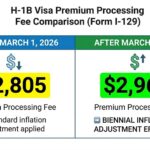
The financial math is brutal for small and mid-sized businesses. Before the proclamation, the total government cost to file an H1B petition was roughly $1,070. With the $100,000 fee added on top of existing fraud-prevention fees, training surcharges, and optional premium processing, the total government cost now exceeds $110,000 per worker.
For more detail on what filing costs looked like before all of this, see our breakdown of H1B visa fees in 2026.
The Legal Question at the Heart of It All
This case isn’t really about immigration. It’s about separation of powers.
The Chamber of Commerce and its co-plaintiffs make two core arguments:
1. The president exceeded his authority (“ultra vires”).
Yes, Section 212(f) of the INA gives the president broad power to restrict alien entry. But does “restrict entry” include imposing a six-figure fee? The Chamber says no — that’s revenue-raising, and revenue-raising requires Congress.
2. The APA was violated.
DHS and the State Department implemented the proclamation without notice-and-comment rulemaking under the Administrative Procedure Act. The Chamber argues that agencies can’t just skip that process even when they’re implementing a presidential directive.
Judge Howell rejected both arguments in December 2025. But the D.C. Circuit judges didn’t seem entirely satisfied either way during February’s oral arguments.
Here’s what made the February 2026 hearing especially significant: the U.S. Supreme Court had just struck down Trump’s global tariff regime in Learning Resources, Inc. v. Trump, holding that only Congress can impose revenue-raising measures. The Chamber immediately pointed to that ruling to argue that a $100,000 fee — collected by the government, not tied to actual administrative costs — is functionally a tax, not a presidential entry restriction.
DOJ’s counter-argument: only 70 employers paid the fee total, which means it wasn’t actually raising meaningful revenue. It was a deterrent — a restriction. Under a 2012 Supreme Court precedent from the Affordable Care Act case, a charge is only a “tax” if it passes a functional standards test. DOJ argued this fee doesn’t meet that bar.
The DC Circuit panel heard those arguments. A decision is pending as of this writing in April 2026.
Source: Bloomberg Law, February 24, 2026
Who Pays? Who’s Exempt? Breaking Down the Rules
This is where a lot of people get confused, so let’s be direct about it.
You (or your employer) must pay the $100K fee if:
- You are a new H1B worker being hired from outside the U.S.
- Your employer files a new H1B cap petition after September 21, 2025
- You were selected in the FY2027 H1B lottery and are applying via consular processing from abroad
You are likely exempt if:
- You already hold H1B status and are renewing or extending
- You are transferring to a new employer within the U.S. (portability)
- You are changing status from F-1/OPT to H1B inside the U.S. without leaving
- Your employer qualifies as cap-exempt (university, nonprofit, government research facility)
- DHS grants a national interest exception — available through [email protected]
The national interest exception exists on paper, but it requires employers to demonstrate that the worker’s presence is nationally important, no American worker is available, and the worker doesn’t pose a security risk. In practice, these exceptions have been narrowly granted.
For workers already navigating status changes — especially those on OPT wondering if H1B is still viable — our guide on the OPT to H1B visa transition breaks down your options under the current rules.
Real People, Real Impact: What Reddit and the Community Are Saying
Legal arguments are one thing. But reading through r/immigration and r/Layoffs in early 2026, the human cost of this policy is impossible to ignore.
u/sdashy30 (r/immigration, January 2026):
“I was waiting for I-140 approval. The approval was followed by this $100k mandate. In Jan 2026, after waiting ~15 months total, the company rescinded the offer, citing immigration uncertainty and risk around the $100k fee. This has been incredibly tough — career-wise, financially, and mentally.”
The replies were telling. Multiple users reported that their FAANG employers had gone radio silent on new H1B filings. Others noted that companies weren’t even communicating clearly about whether they’d pay the fee or not — just freezing decisions until courts ruled.
On r/TrueReddit, a thread analyzing the H1B fee debate drew hundreds of comments. One user with healthcare experience pointed out that rural hospitals — which rely heavily on H1B physicians — would be disproportionately hurt. Another user in tech noted: “The biggest loser here isn’t the big tech company that can absorb $100K. It’s the startup that was going to hire their first international engineer.”
On Facebook, Reuters posted about the D.C. Circuit fast-tracking the case, and the comment sections split predictably — some users cheering the policy as protection for American workers, others pointing to the loss of talented professionals who simply moved to Canada or the U.K. instead.
The pattern emerging from these conversations: the fee isn’t slowing down the largest tech companies much. They’ve mostly paused international hiring for new graduates but can absorb the cost when needed. It’s the mid-size employers — healthcare systems, mid-size software firms, research labs — who are most impacted. And it’s early-career international talent, particularly Indian and Chinese nationals with long green card backlogs, who find themselves in an especially precarious position.
If your H1B has been cancelled or your job offer revoked, our guide on what to do when your H1B is cancelled or revoked walks through your immediate options and protections.

The New H1B Lottery: Weighted Selection Is Now Live
While courts were fighting over the $100,000 fee, DHS quietly pushed through another massive change: the FY2027 H1B lottery now uses a Weighted Selection Process instead of the old random lottery.
This went into effect on February 27, 2026, just in time for the March 4–19, 2026 registration window.
Here’s what changed:
The old system was essentially a random draw. Submit a registration, get a random chance. The problem (according to the Trump administration) was that employers gamed it by submitting dozens of registrations for the same worker or flooding the pool with low-wage positions.
The new weighted system prioritizes applicants based on the prevailing wage level of the offered position. Higher wage = better selection odds. Lower wage = still in the lottery, but with lower probability.
USCIS Director Matthew Tragesser said in a statement: “The existing random selection process of H-1B registrations was exploited and abused by U.S. employers who were primarily seeking to import foreign workers at lower wages than they would pay American workers.”
Critics argue this creates a “pay-to-play” system that prices out early-career professionals and small employers. Supporters say it rewards genuine high-skill hiring over lottery manipulation.
Either way, if you’re preparing for the FY2028 lottery, the strategy has completely changed. For a detailed breakdown of the new H1B lottery rules, including how wage levels affect your selection odds, that’s a must-read.
If you’re already on H1B and wondering whether your employer qualifies for cap-exemption under these new rules, see our guide on H1B cap exemption.
Where the Supreme Court Comes In
The Supreme Court hasn’t directly ruled on the $100,000 H1B fee yet. But its fingerprints are all over this fight.
Two Supreme Court precedents are driving the legal debate:
1. Trump v. Hawaii (2018)
The Court ruled that Section 212(f) of the INA gives the president “exceedingly broad” discretionary power to restrict alien entry. The Trump administration points to this ruling to argue that a $100,000 fee is simply a restriction on entry, well within that authority. Judge Howell relied heavily on this precedent in her December 2025 decision upholding the fee.
2. Learning Resources, Inc. v. Trump (2026)
This is the game-changer. Just weeks before the D.C. Circuit oral arguments in February 2026, the Supreme Court struck down Trump’s global tariff regime, holding that only Congress can impose revenue-raising measures. The Chamber immediately cited this ruling, arguing that a $100,000 fee collected by the government is functionally a tax — not a presidential entry restriction — and therefore requires Congressional authorization.
The D.C. Circuit panel in February 2026 pressed both sides hard on this exact question. The case is now pending at the D.C. Circuit level, with analysts expecting a ruling by mid-2026. If the D.C. Circuit rules against the administration, the government will almost certainly appeal to the Supreme Court.
Legal analysts quoted by VisaHQ expect the case to reach the Supreme Court by late 2026 or 2027.
There’s also a wildcard: a preliminary injunction could arrive before then. As Day1CPT.org reported in March 2026, the Supreme Court’s tariff ruling gave new momentum to the plaintiffs. A judge in the Northern District of California — where a separate lawsuit is pending — could issue a preliminary injunction as early as April or May 2026, temporarily blocking the fee while litigation continues.
That wouldn’t be a final ruling. But it would be enormous news for employers currently sitting on frozen hiring decisions.
What Employers Should Do Right Now
If you’re a U.S. employer who relies on H1B workers — whether a large tech company, a hospital network, or a startup — the playbook has changed.
1. Map your upcoming H1B needs by category.
Separate workers already in H1B status (not affected) from new hires you’d bring from abroad (potentially subject to the fee). The cost difference is enormous, and you need to know your exposure.
2. Explore exemptions aggressively.
The national interest exception exists. Healthcare employers in particular may have a real case. Document the unavailability of American workers, the worker’s unique qualifications, and why the national interest applies. Submit to [email protected] with full supporting evidence before filing.
3. Consider cap-exempt routes where possible.
Can you place the worker with a university, nonprofit, or government research facility partner? Cap-exempt positions aren’t subject to the lottery or the fee in the same way. If you haven’t explored H1B cap exemption eligibility, now is the time.
4. Consider premium processing timing strategically.
If you do file, premium processing remains available and can significantly accelerate USCIS adjudication. For current H1B premium processing timelines and whether it’s worth the cost, we have a detailed breakdown.
5. Watch the courts in real time.
If a preliminary injunction drops in April or May 2026, the rules could change fast. Have your immigration attorney ready to move quickly — companies that already have petitions prepped can file within days of an injunction.
What H1B Workers Should Do Right Now
If you’re an H1B worker — current or aspiring — here’s where things stand for you personally.
If you’re already on H1B status: You’re largely insulated from the $100,000 fee for now. Renewals and extensions within the U.S. don’t trigger it. Transferring employers inside the U.S. is also generally exempt. Stay current on the rules around H1B transfers and changing employers — portability protections still apply.
If you’re on OPT waiting for H1B: This is the hardest position right now. Your employer may be hesitating on sponsorship because of the fee. Understand that if your change of status goes through inside the U.S. without you leaving, the $100K fee likely doesn’t apply. Our OPT-to-H1B guide walks through exactly how that transition works in the current environment.
If your offer was rescinded: You’re not alone, and you’re not out of options. Understand your 60-day grace period, consider cap-exempt employers, and look at whether your I-140 (if already filed) can be preserved. Our resource on H1B cancellation covers the immediate steps.
If you’re already on H1B and thinking about the green card: The courts fighting over H1B fees don’t directly affect your green card timeline, but they’re part of a broader shift in how the administration views employment-based immigration. For Indian nationals especially, our H1B to green card timeline and cost guide remains highly relevant as you plan.
If you need to talk to an attorney: Given how fast things are moving, this is genuinely a time to get professional advice rather than rely solely on online forums. Our guide on finding an H1B immigration lawyer explains what to look for and what questions to ask.

H1B Visa Stamping in 2026: Another Layer of Complexity
Even if you’re not affected by the $100K fee directly, there’s a separate issue that’s added stress for H1B workers in 2026: visa stamping.
The State Department has expanded its “Online Presence Review” for additional nonimmigrant visa categories, effective March 30, 2026. This means consular officers are now reviewing applicants’ social media activity more extensively before issuing visas.
For Indian professionals going home to stamp their H1B or attending visa appointments in third countries, the process has gotten longer and more unpredictable. Our updated H1B visa stamping guide for 2026 covers the current interview waiver (Dropbox) eligibility criteria and what documents you need to prepare.
H4 EAD: How This Affects H1B Spouses
H1B holders aren’t the only ones watching these developments. H4 EAD holders — typically spouses of H1B workers — have their own concerns.
The broader immigration enforcement environment under the Trump administration has raised questions about H4 EAD renewals and whether that program could face executive action. As of April 2026, H4 EAD remains intact, but the uncertainty has pushed many H4 EAD holders to monitor court developments closely.
For spouses navigating work authorization in 2026, our updated resource on H4 EAD work authorization has current information on timelines and renewal processes.
The Bigger Picture: What This Means for U.S. Immigration Policy
Step back from the legal details for a moment and think about what this case is really about.
For decades, the H1B visa program has been a cornerstone of how the U.S. attracts specialized talent — engineers, doctors, researchers, software developers. The program has also been criticized for enabling wage suppression, visa fraud, and systematic displacement of American workers. Both critiques have merit.
What the current administration is attempting — with the $100,000 fee and the weighted lottery — is a sharp pivot. Instead of reforming H1B through Congress (which has tried and failed to pass comprehensive immigration reform for 20+ years), the executive branch is using its Section 212(f) proclamation powers to reshape the program unilaterally.
The courts are now deciding whether that’s legal.
If the D.C. Circuit or eventually the Supreme Court upholds the fee, it will confirm that the executive branch has sweeping power to restructure visa programs through proclamation — without Congress. That’s a precedent that extends well beyond H1B.
If the courts strike it down, Congress will be back in the driver’s seat — and the years-long deadlock on immigration reform will continue.
Neither outcome is simple. Neither resolves the underlying tension between employer demand for global talent and genuine concerns about American worker wages.
For a full look at all the H1B visa new rules in 2026, including changes beyond just the fee, our comprehensive update covers the full picture.
Frequently Asked Questions
A: Not yet as of April 2026. The case is currently at the D.C. Circuit (appeals court) level. Legal analysts expect it could reach the Supreme Court by late 2026 or 2027, depending on how the D.C. Circuit rules.
A: No. As of April 2026, the fee is still in effect. The D.C. Circuit heard oral arguments in February 2026, and a decision is pending. A preliminary injunction from a California district court could temporarily block it before then.
No. H1B renewals and extensions within the U.S. are explicitly exempt from the $100,000 fee. Only new petitions for workers being brought from outside the U.S. are subject to it.
If a court issues a preliminary injunction, employers who participated in the March 2026 lottery would no longer need to pay the $100,000 when filing cap petitions. The lottery results themselves would still stand.
Cap-exempt employers (universities, nonprofits, qualifying government research facilities) are not subject to the H1B cap or the lottery at all. The weighted selection process only affects cap-subject employers and petitions.
The $100K fee and the lottery changes don’t directly affect H4 EAD status. However, if your spouse’s H1B situation changes, that could affect your derivative status. See our H4 EAD guide for details.
Final Thoughts: An Honest Take on Where This Is Headed
Here’s what I genuinely think, having followed this through multiple court filings and hearings.
The $100,000 fee is probably going to face serious legal trouble — the Supreme Court’s tariff ruling created real constitutional pressure on the administration’s position. Whether that translates into an injunction this spring, a D.C. Circuit reversal, or an eventual Supreme Court decision, I can’t say. Courts are unpredictable.
What I’m more confident about: the direction of H1B policy isn’t reversing. The weighted lottery is real. The administration’s intent to restrict lower-wage H1B hiring is real. Even if this specific fee gets struck down, employers and workers should expect H1B requirements to be more stringent in 2026 and beyond — higher salary thresholds, stricter specialty occupation definitions, and more intensive scrutiny at every stage.
The era of treating the H1B as a cheap labor pipeline — which is what critics of the program have always said it became — is probably over regardless of how the courts rule.
For workers building a life in America on H1B, that means being more intentional than ever: understanding your rights, planning your green card timeline, knowing your grace periods, and building financial stability that can weather policy uncertainty. Our full breakdown of H1B visa requirements in 2026 is a good place to anchor your planning.
And if you’re watching these court developments and starting to think more seriously about long-term financial planning in the U.S. — opening bank accounts, building credit, understanding how to invest on an H1B — that’s smart. Start at our U.S. immigration finance guide for resources built specifically for immigrants navigating American financial life.
The courts will keep moving. So should you.
This article is for informational purposes only and does not constitute legal advice. Immigration law changes rapidly — always consult a qualified immigration attorney for advice specific to your situation.