


There’s a very specific kind of panic that hits when your debit card gets declined somewhere unexpected.
Not the low-balance embarrassment. Something colder. You pull up your banking app to check what’s going on, and instead of a balance screen, you see something you weren’t prepared for: Account Restricted. Access Temporarily Limited.
Your money is right there. You can read the exact number. But you cannot move a single dollar of it.
If that’s where you are right now, I want you to slow down. I’ve worked through enough of these situations to tell you this: in the majority of cases, a frozen bank account in the USA is procedural, not permanent. It feels catastrophic. It usually isn’t. What determines whether this resolves in 10 days or 90 days is almost entirely how you respond in the next 48 hours.
This guide covers everything — the real legal mechanics behind bank freezes, what federal law actually guarantees you, the right way to talk to your bank, state-specific rules that can change your outcome, and exactly what actions make things significantly worse. No filler. No robotic checklists. Just what actually matters.
What “Frozen” Actually Means — and What It Doesn’t
A frozen bank account does not mean the bank took your money. That’s the first thing to understand.
What it means is that they’ve blocked your access to it while something is being reviewed. The money is still yours. The account still exists. Internally, banks call this a “compliance hold,” an “account restriction,” or a “risk review.” Whatever they’re calling it, the practical effect looks like this:
- Your debit card is declined at every point of sale
- Online bill payments and transfers are blocked
- ATM withdrawals fail
- Checks you’ve already written may bounce
What surprises most people — and this matters depending on when your next paycheck or benefit payment is due — is that incoming deposits frequently still post during a freeze. Your employer’s direct deposit, a government benefit payment, an ACH transfer from another account — in many cases these will credit to your account balance. You just can’t touch the money yet.
Whether you can access those incoming deposits depends entirely on the type of freeze and your bank’s internal policy. It’s worth asking directly when you call.
The Six Reasons Banks Freeze Accounts in the USA
This is where most articles on this topic fail completely. They list reasons without explaining what each one means for your situation. The type of freeze determines everything: the timeline, the documentation you need, whether you can resolve it yourself, and whether you need outside help.
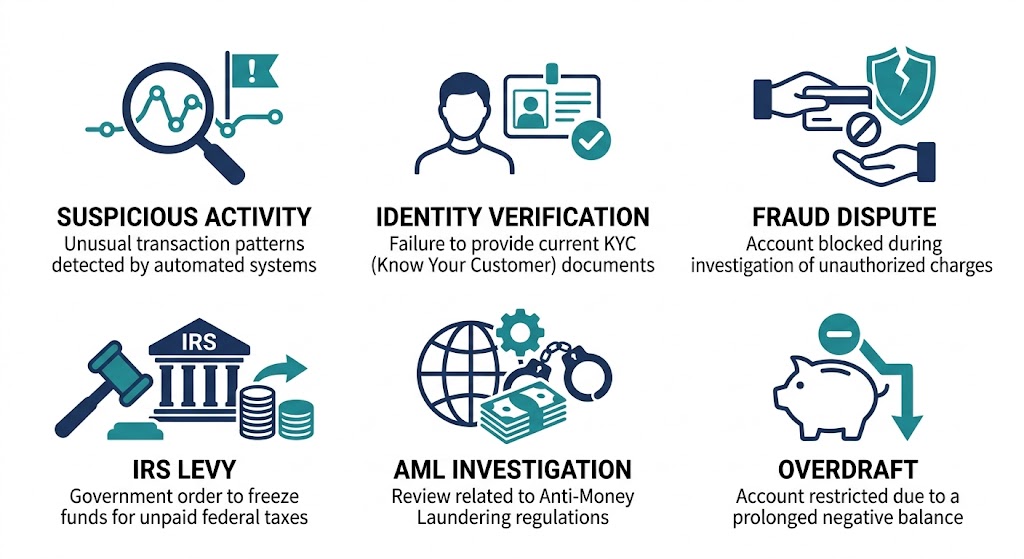
Reason 1: Suspicious or Unusual Transaction Activity
This is the most common cause, and statistically, the most likely reason you’re reading this right now.
U.S. banks operate under the Bank Secrecy Act (BSA) and are legally required to monitor accounts for behavior that deviates from established patterns. The initial monitoring is automated — an algorithm flags your account, and a human may not review it for hours. You find out when your card stops working.
Common triggers include:
- A deposit significantly larger than your account’s historical pattern. A freelancer who normally deposits $3,000 a month suddenly receiving a $17,000 project payment is a textbook trigger.
- Rapid transfers to new recipients in a short period
- International wire activity on an account that has never had it before
- Multiple deposits just under $10,000. Banks are specifically trained to flag this pattern under 31 U.S.C. § 5324, a federal anti-structuring statute, even when the deposits are entirely legitimate.
- Sudden geographic changes — your card used in a state or country where it’s never been used before
The most important thing to understand here: banks monitor behavioral patterns, not intent. You don’t need to do anything illegal. You just need to do something that doesn’t match your own history. Freelancers, immigrants receiving family transfers, and small business owners with irregular income hit this trigger constantly.
Typical resolution time if you respond with documentation promptly: 7 to 21 days.
Reason 2: Identity Verification Failure (KYC)
Know Your Customer (KYC) regulations, required by the Financial Crimes Enforcement Network (FinCEN), obligate banks to verify your identity when you open an account — and to periodically re-verify it afterward. If your identification documents have expired, your address doesn’t match their records, or your Social Security Number or ITIN doesn’t reconcile with what they have on file, the account gets restricted until you clear the verification.
Online-only banks and neobanks — Chime, Varo, Current, Dave — tend to be more aggressive about this than traditional banks, largely because they have no branches where a human can look at your ID in person.
Specific triggers:
- Expired driver’s license or passport on file with the bank
- Address change you didn’t report
- Name discrepancy (common with marriage name changes, international name formats, or spelling variations)
- SSN or ITIN mismatch with IRS records
If you opened your U.S. bank account recently and used limited documentation, that’s often the root cause here. Understanding the full requirements for opening a bank account in the USA from the start — including exactly which documents different banks accept — prevents a large share of identity-triggered freezes.
Typical resolution time: 3 to 10 days once correct documentation is submitted.
Reason 3: Disputed or Fraudulent Transaction Review
If you report a transaction as unauthorized — or if the bank’s own fraud detection flags one — the bank may freeze the entire account, not just the individual transaction, while they investigate.
This feels counterintuitive. You’re the victim. Your account still gets restricted. The reason is that banks freeze accounts during fraud investigations to prevent further unauthorized activity from occurring while the review is open.
Regulation E (12 CFR Part 1005), the federal rule governing electronic fund transfers, requires banks to investigate disputed transactions within 5 to 10 business days and to provide provisional credit — temporary restoration of the disputed funds — in most cases. The bank can reverse that provisional credit if the investigation concludes the transaction was valid, but you’re entitled to it during the investigation period.
One thing most people never ask: during an active Regulation E investigation, you can request that the bank restore access to the non-disputed portion of your account while the specific transaction is being reviewed. Many banks will do this. It’s not automatic. You have to ask.
Typical resolution time: 10 to 45 days.
Reason 4: Government Levies and Court-Ordered Freezes
Everything in the previous three categories involves your bank making a judgment call with some discretion involved. This category is categorically different. Here, the bank has zero discretion. A legal order has been issued and they must comply.
IRS Tax Levy
Under IRC § 6331, the IRS has authority to levy — seize — funds directly from your bank account when you have unpaid federal taxes and haven’t responded to their collection notices. Before doing this, the IRS is legally required to send a series of notices including a “Final Notice of Intent to Levy” (Letter 1058 or Notice CP504).
Once the levy is served to the bank, there’s a mandatory 21-day waiting period before the bank turns the money over. This window is real and legally required. During those 21 days, you can still stop the levy by paying the debt in full, entering an installment agreement, requesting an Offer in Compromise, or filing for a Collection Due Process (CDP) hearing.
If you’re in that 21-day window right now, the Taxpayer Advocate Service is the fastest path to intervention: irs.gov/advocate | 1-877-777-4778.
State Tax Levies
State tax agencies have similar levy authority. California’s Franchise Tax Board, New York’s Department of Taxation and Finance, the Texas Comptroller — most states can levy bank accounts administratively without going through civil court.
Court Judgment Garnishment
If a creditor sued you in civil court and won a judgment, they can obtain a writ of garnishment and serve it to your bank. The bank is then legally required to freeze your account. Important distinction: a debt collector cannot freeze your bank account before winning a court judgment. If anyone is threatening to freeze your account without mentioning a prior lawsuit and judgment, that’s a potential Fair Debt Collection Practices Act (FDCPA) violation — and you can report it.
Child Support Orders
State child support enforcement agencies can freeze bank accounts through an administrative process in most states, without a separate court hearing.
Typical resolution time: 21-day minimum for IRS levies; indefinite for court judgments until the underlying debt is satisfied.
Reason 5: Anti-Money Laundering (AML) Investigation
Banks are required under the Bank Secrecy Act to file Suspicious Activity Reports (SARs) with FinCEN when transactions appear to involve possible money laundering, fraud, or financial crime. During an AML review, your account is frozen. And — by law — the bank cannot tell you that a SAR has been filed.
This is the “tipping off” prohibition under 31 U.S.C. § 5318(g)(2). The representative you speak with may genuinely not be able to explain what’s happening — not because they’re being difficult, but because federal law prohibits them from disclosing it. If you’re receiving vague, circular answers that don’t point to any specific documentation request, and the freeze has lasted more than 30 days, an AML-related review may be what you’re dealing with.
In some cases, law enforcement is involved in parallel. In most cases involving ordinary civilians, it’s a compliance review that eventually resolves without law enforcement action. But the timeline is longer and the process is less transparent than other freeze types.
Typical resolution time: 30 to 90 days. Can extend further if law enforcement is actively involved.
Reason 6: Overdrawn Balance or Unpaid Bank Fees
If your account has been negative for an extended period and you haven’t addressed it, the bank may restrict outgoing transactions to protect themselves from further losses. This is less of a formal compliance freeze in the regulatory sense and more of a collections hold.
Resolution: Contact the bank directly. Get the exact amount owed. Pay it, or negotiate a payment arrangement. Ask calmly about fee waivers — many banks will reduce or eliminate fees if you approach the conversation professionally and have been a customer for some time.

Most people walk into a conversation with their bank assuming they have no leverage. That assumption is wrong. Here’s what you’re actually entitled to.
The CFPB Complaint — The Most Underused Tool in Consumer Banking
The Consumer Financial Protection Bureau (CFPB) accepts complaints from anyone about their bank’s handling of account freezes, including failure to communicate the reason for a hold, refusal to accept documentation, and excessive hold durations. Filing a complaint at consumerfinance.gov/complaint is free, takes about 10 minutes, and triggers a formal response requirement: banks must respond to CFPB complaints within 15 days.
Most consumers don’t know this exists. The ones who do know it get faster responses. Banks take CFPB complaints seriously because the Bureau has enforcement authority and because complaint data is publicly reported.
Right to Internal Escalation
You have the right to escalate past frontline customer service to someone with actual authority. Ask explicitly for:
- The compliance department
- A bank manager or branch manager (for traditional banks with branches)
- A customer advocate or ombudsman
Chase, Bank of America, and Wells Fargo each have internal customer advocate offices with more authority than general customer service. These exist. Bank staff don’t volunteer the information. Ask for them by name.
Right to Provisional Credit Under Regulation E
For disputed transactions, Regulation E entitles you to provisional credit within 5 to 10 business days of filing a dispute for most account types. The bank can reverse it if the investigation concludes the transaction was legitimate, but you’re entitled to it during the investigation.
Right to Claim Exempt Funds
If your account is frozen due to a court judgment or government levy, specific categories of funds are legally exempt from seizure under federal law:
| Fund Type | Federal Exemption |
|---|---|
| Social Security benefits | Fully exempt — 2 months of direct-deposited benefits protected |
| Veterans’ benefits | Fully exempt |
| Supplemental Security Income (SSI) | Fully exempt |
| Federal student aid disbursements | Fully exempt |
| Child support payments received | Partially exempt |
| Workers’ compensation | Varies by state |
| Unemployment benefits | Varies by state |
If any of these fund types are in your frozen account, you can file a claim of exemption with the court (for judgment garnishments) or pursue IRS hardship relief provisions (for tax levies). A bank that continues to hold properly claimed exempt funds is in violation of federal law.
Right to the Taxpayer Advocate Service
If an IRS levy is involved and you’re facing genuine financial hardship — can’t pay rent, can’t buy food, can’t cover medical expenses — the Taxpayer Advocate Service can intervene in your case outside the normal IRS process. This service is free. It exists specifically for situations like this. irs.gov/advocate
Step-by-Step: What to Actually Do Right Now
Step 1: Verify Through Official Channels Only
Log into your bank through the official app you already have installed, or type the bank’s URL directly into your browser. Do not click any link in an email or text message, even if it appears to be from your bank.
In your account dashboard or secure message center, look for:
- Any restriction notice or compliance alert
- A request for documentation
- A case or reference number
Write down the exact language of any notice. That wording tells you which category you’re dealing with and often what documentation is needed.
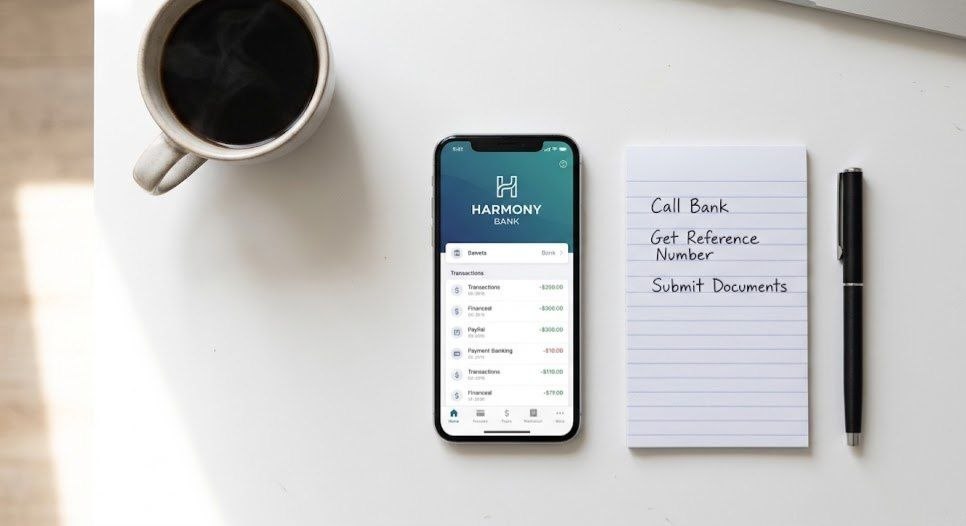
Step 2: Call the Bank — With a Strategy
Use the phone number on the back of your debit card or on the official bank website. When you reach someone, lead with questions rather than frustration.
Ask these specifically:
- “Can you tell me what type of restriction this is — compliance review, identity verification, or a legal hold?”
- “What specific documentation do I need to provide to have this resolved?”
- “What is the current estimated timeline for review completion?”
- “Does your institution have a hardship access policy for essential expenses while a compliance review is active?”
That last question matters more than most people realize. Many banks have internal policies that allow limited withdrawals for rent, utilities, and basic necessities during a compliance review. This isn’t advertised. But asking directly and mentioning hardship often unlocks it.
Document everything: the date, time, representative’s name, and the case or reference number they give you. This documentation matters if you need to escalate later.
Step 3: Determine the Type of Freeze
After speaking with the bank, you should be able to categorize your situation:
Compliance or Verification Freeze: The bank needs documentation from you. This is almost always resolvable without legal help if you respond promptly and completely.
Legal or Government Hold: A court order, IRS levy, or state agency hold. The bank is following a legal directive. You need to resolve the underlying issue — a tax debt, a court judgment — not just send documents to the bank.
Vague Answers, No Specific Documentation Request: If the bank can’t explain why the account is frozen and isn’t asking for anything specific, this may be an AML-related SAR review. Continue submitting anything they ask for through official channels. Wait for the review cycle to complete. File a CFPB complaint if there’s no progress after 30 days.
Step 4: Submit Documentation — All of It, at Once
The single biggest mistake people make is submitting incomplete documentation. Every incomplete submission resets the review timeline at many institutions.
For compliance or activity reviews, banks typically request:
- Government-issued ID — current, not expired (driver’s license, passport, or state ID)
- Proof of address dated within 60 days — utility bill, lease agreement, or statement from another financial institution
- Source-of-funds documentation for large deposits: contracts, invoices, payment confirmation emails, gift letters, inheritance paperwork, settlement agreements, or real estate closing documents
- A brief written explanation of any flagged transactions, in plain conversational language
For identity verification specifically:
- Updated, unexpired government ID
- Social Security card if there’s an SSN discrepancy
- Legal name change documentation if a name mismatch exists
Submit everything in a single submission. Use PDF format for digital uploads. Label each document clearly. Verify file sizes are within the bank’s upload limits before submitting.
Step 5: Follow Up — Then Escalate When Warranted
After submitting documentation, follow up every 5 business days. Ask for a current status update and a revised estimated resolution date.
If 30 days pass with no resolution despite complete documentation submission:
- File a CFPB complaint at consumerfinance.gov/complaint
- For IRS matters: contact the Taxpayer Advocate Service at irs.gov/advocate or call 1-877-777-4778
- For court judgments: consult a consumer law attorney in your state, many of whom offer free initial consultations
- For state-level disputes: contact your state Attorney General’s consumer protection division
How Long Can a Bank Legally Freeze Your Account?
This is one of the most searched questions about bank freezes in the U.S. The honest answer: there’s no single federal law that caps the duration for all freeze types. What the law actually says varies by category.
Compliance and activity reviews: No statutory maximum. Banks are required to act in “good faith” and resolve within a “reasonable” time. In practice, most banks target 30 days to avoid regulatory scrutiny and CFPB complaints.
Regulation E fraud disputes: Banks must complete investigations within 45 days for standard accounts, or 90 days for new accounts or international transactions. Provisional credit must be issued within 5 to 10 business days.
IRS tax levies: The 21-day waiting period begins when the levy is served to the bank. After that, the bank can and must turn the funds over. The account freeze continues until the underlying tax debt is resolved.
Court judgment garnishments: State-specific. Most states require the bank to respond to a writ within 10 to 30 days.
| Freeze Type | Typical Duration | Legal Limit |
|---|---|---|
| Compliance / Activity Review | 7–30 days | No federal cap |
| KYC Identity Verification | 3–10 days | No federal cap |
| Fraud Dispute (Regulation E) | 10–45 days | 45–90 days statutory |
| IRS Tax Levy | 21+ days | Until tax debt resolved |
| Court Judgment Garnishment | 10–30 days | Until judgment satisfied |
| AML Investigation | 30–90 days | No cap; law enforcement may be involved |
If your freeze is running past these typical ranges with no new documentation requests and no updates from the bank, escalation is appropriate.
How Major U.S. Banks Handle Freezes: Chase, BofA, Wells Fargo, and Online Banks
Generic advice has limits. Here’s what specific institutions actually do.
Chase Bank Chase’s automated fraud system frequently sends a text or in-app alert before restricting an account — though not always, and not for compliance-triggered holds. Their dedicated fraud and account services line (1-800-935-9935) is a separate number from general customer service and reaches staff with more authority over account holds. Compliance documentation requests typically come through the in-app secure message center, and Chase generally works toward 30-day resolution windows.
Bank of America BofA operates an online document submission portal for compliance reviews that substantially speeds up processing compared to mailing physical documents. Their fraud investigations team operates separately from retail banking and may ask for a recorded statement about specific disputed transactions.
Wells Fargo Wells Fargo has an internal customer advocacy office called the Office of the Customer (1-800-869-3557). This team carries more authority than frontline customer service and can directly expedite compliance reviews. If general customer service isn’t producing results after two or three contacts, ask to be transferred to the Office of the Customer by name.
Chime, Varo, Current, and Neobanks Online-only banks process all documentation through the app and email — no branches means slower handling in practice. Chime has received a significant volume of CFPB complaints about holds lasting 90 days or longer. If you bank with an online-only institution and see no progress by day 20, filing a CFPB complaint earlier than you would with a traditional bank tends to accelerate the process more reliably.
Credit Unions Credit unions are regulated by the National Credit Union Administration (NCUA) rather than the OCC or FDIC. They’re member-owned and generally more flexible than commercial banks in working with members during compliance reviews. If you’ve been a member for years, that relationship history actually carries weight here. Credit unions are also more likely to grant limited access to funds during a review without you having to fight for it.
State-Specific Rules That Can Change Your Outcome Significantly
Federal law sets the floor. Several states have added significant protections on top of it.
California Under California Code of Civil Procedure § 704.080, the first $1,788 in a bank account (adjusted periodically for inflation) is exempt from creditor levy. California also requires creditors to wait 10 days after serving a levy before the bank can release the funds — longer than the federal baseline.
New York New York’s Exempt Income Protection Act (EIPA) automatically protects a “baseline exemption amount” — currently $4,500 for most accounts — from any restraint order or levy. Banks in New York are required to apply this exemption automatically when they receive a restraining notice. You don’t have to file anything to claim it.
Texas Texas exempts wages from bank account garnishment by most creditors, with exceptions only for the IRS and child support agencies. This protection is codified in Texas Property Code § 42.001. Texas is consistently one of the most debtor-protective states in the country.
Florida Florida exempts wages from bank account garnishment for heads of household when those wages were deposited within the past six months. This is a significant protection that applies to a large share of Florida households.
Illinois Illinois protects $4,000 in bank accounts from wage garnishment, with additional exemptions for minimum wage earners.
If you believe your frozen account contains wages, benefits, or other funds that are exempt under your state’s law, your state Attorney General’s website is the starting point for understanding your specific protections. A consumer law attorney in your state can act quickly if clearly exempt funds are being held.
Business Accounts vs. Personal Accounts: The Rules Are Different
If your business account is frozen rather than a personal account, you’re operating under different legal terrain.
Business accounts carry fewer consumer protections. Regulation E, the CFPB’s consumer complaint process, and most other federal consumer protection mechanisms apply specifically to accounts used for personal, family, or household purposes. Business accounts are generally outside their scope.
This means provisional credit during dispute investigations isn’t automatic, and the bank has more discretion overall. That’s the bad news.
The good news: business accounts often come with dedicated relationship managers or business banking lines that carry more internal authority than general customer service. If your bank has assigned you a business relationship manager, contact them directly before going through general customer service. They can escalate within the bank faster.
Documentation typically required for a business account freeze:
- Business registration documents (Articles of Incorporation, LLC Operating Agreement, DBA filing)
- IRS EIN confirmation letter (CP 575 or 147C)
- Recent business tax returns
- Invoices and contracts that explain large or unusual deposits
- Business bank statements from a secondary account, if available
If you’re a new immigrant who has recently started a business in the U.S. and doesn’t yet have an established financial footprint, the path to stable banking runs through the same fundamentals as personal banking. Understanding how to build your credit score in the USA from the beginning creates the kind of documented financial history that makes banks less likely to flag your account activity as anomalous.
Joint Accounts: Who Gets Frozen When Only One Person Has the Problem
Joint bank accounts create complicated outcomes when a freeze is triggered.
If one account holder triggers a compliance review: The entire joint account is frozen, regardless of whose funds are in it or which person’s activity triggered the flag.
If a court judgment is against only one holder: In most states, a creditor can still freeze the entire joint account. The non-debtor holder must then file a claim with the court proving that some or all of the funds belong to them. This takes time and often requires legal help.
For IRS levies: The IRS can levy a joint account even when only one person owes the tax debt. The non-debtor spouse’s recourse is typically an “injured spouse” claim filed with the IRS — a process that takes months to resolve.
Practical takeaway: if you share a bank account with someone who has significant IRS debt, outstanding court judgments, or other serious financial legal exposure, maintaining separate accounts in addition to any joint account is standard financial planning — not an overreaction.
Immigrants and Visa Holders: Additional Considerations

Bank freezes affect immigrants at a disproportionately higher rate than long-term domestic account holders, and the reasons are structural rather than personal.
Automated compliance systems flag activity that deviates from established patterns. For immigrants, routine financial behavior — receiving international transfers from family abroad, irregular income tied to project-based work, ITIN usage instead of SSN, large deposits tied to relocation or home-country asset liquidation — looks unusual to a system calibrated for domestic pattern norms.
This isn’t targeted enforcement. It’s pattern mismatch. But the practical result is the same: a freeze, often with minimal explanation.
If you’re on an H-1B visa navigating the U.S. financial system, you’re already managing complexity across multiple systems simultaneously. The complete H-1B to Green Card timeline and cost guide covers the immigration side. On the banking side, a few specific practices change your risk profile:
Provide complete documentation from day one. When you open a bank account, provide every document the bank will accept — passport, visa, I-94 record, ITIN or SSN, proof of address. Over-document at opening rather than scrambling to provide it during a freeze.
Communicate large incoming transfers in advance. If you’re expecting a significant international transfer — from a home-country asset sale, from family, from a foreign employer — call your bank first. Some banks have a process for pre-clearing expected large deposits. Even if yours doesn’t, creating a prior record of the expected transaction helps.
Separate international and domestic activity where possible. If you’re regularly sending or receiving international transfers, a bank account specifically managed for that purpose — with documented patterns — is better than mixing international activity with your primary daily spending account.
Build your U.S. financial history consciously. Consistent, documented financial behavior reduces compliance risk over time. Understanding how credit scores work in the USA is one part of building that footprint — but so is account history, address consistency, and keeping your tax filings current.
If you’re an H-1B holder and your bank freeze is tied to identity verification, it may take longer because of documentation complexity around non-SSN identification. Be patient with the process and follow up on a schedule.
What Not to Do — These Mistakes Extend the Freeze

Opening multiple new accounts immediately Banks share data through systems like ChexSystems and Early Warning Services. Opening new accounts at other institutions while an existing account is under compliance review can flag those new accounts as well. Some people end up dealing with two frozen accounts. If you need emergency funds access, ask your existing bank about hardship access first before opening anywhere new.
Moving funds through a third party Asking a friend or family member to receive money transfers on your behalf while your account is frozen can appear to a compliance team like structured evasion. This can escalate a compliance hold into a formal AML investigation, which has a much longer timeline and far less transparency.
Ignoring the bank’s documentation requests Every day you don’t respond to a documentation request is another day the freeze continues. Banks don’t follow up repeatedly. After 60 to 90 days of no response, many banks close the account entirely and mail you a check for the balance — minus fees. Some report the closed account to ChexSystems, which can make opening bank accounts at other institutions difficult for up to five years.
Being aggressive with bank representatives The customer service representative on the phone did not make the decision to freeze your account. They’re documenting every interaction and passing notes to a compliance team. Being hostile does nothing except create a paper trail of difficult behavior. Calm, precise, professionally worded conversations produce better outcomes.
Posting publicly about an active freeze on social media If any law enforcement component is involved — even tangentially — public posts about an ongoing compliance or AML freeze can create additional complications. Keep the situation private until it’s fully resolved.
When to Involve a Lawyer — Honest Guidance
You almost certainly don’t need a lawyer if:
- The freeze is a compliance or KYC review
- You have the documentation the bank is requesting
- The bank is communicating with you clearly
- The freeze is less than 30 days old and progressing toward resolution
You should seriously consider legal consultation if:
- A court judgment was entered against you that you weren’t aware of
- The IRS has levied your account and you have significant back taxes or multiple years of unfiled returns
- You believe exempt funds (Social Security, veterans’ benefits, unemployment) are being held and the bank won’t release them
- The freeze has lasted more than 90 days with no resolution despite complete documentation submission
- The bank closed your account rather than just freezing it
- You’ve been contacted by law enforcement in connection with the freeze
For IRS matters, the Taxpayer Advocate Service — a free government service — can intervene in hardship situations faster than the standard IRS process: irs.gov/advocate
For non-IRS legal help, your state bar association has a referral service specifically for consumer finance and debtor’s rights attorneys. Many offer free 30-minute initial consultations.
How to Prevent This from Happening Again

Keep your account information current. Update your address, phone number, and ID documents with your bank whenever they change. Don’t let identification documents expire without updating them. Banks run periodic re-verification cycles. Stale information is one of the most preventable causes of freezes.
Communicate large deposits before they arrive. If you’re expecting a significant incoming transfer — from a home sale, an inheritance, a business deal, a legal settlement — call your bank proactively. Create a record of the expected transaction before it arrives. Some banks have a formal pre-clearance process for large deposits. Even those that don’t will note your call in the account file.
Separate business and personal finances completely. This single change eliminates the most common trigger for compliance freezes among self-employed people and small business owners. Running business income through a personal checking account creates the exact pattern inconsistency that automated systems flag.
Document unusual transactions for at least three years. Contracts, invoices, gift letters, sale agreements, payment records. If something you did today gets flagged in 18 months, you’ll want to be able to explain it clearly and completely.
Build consistent behavioral patterns. Banks flag unexpected activity, not large amounts per se. A freelancer who has always had irregular income and receives a $22,000 project payment is less likely to be flagged than someone with two years of perfectly consistent $2,000 monthly deposits who suddenly receives the same amount. History and consistency are your actual protection.
If you’re building your U.S. financial history from the ground up — as a recent graduate, new immigrant, or someone rebuilding after financial difficulty — the connection between credit history and banking stability is direct. Understanding how the U.S. credit score system works and how to build it from the beginning are both part of creating the kind of documented financial presence that makes banks less likely to flag your activity as anomalous.
Frequently Asked Questions
Yes. Under U.S. banking regulations, a bank can legally restrict your account without advance notice, particularly for fraud prevention, compliance reviews, or AML investigations. For government levies, the IRS or state agency is supposed to have notified you through their own process before instructing the bank — but the bank itself won’t call you before executing the freeze.
No. Checking and savings accounts are not reported to Experian, Equifax, or TransUnion. A freeze doesn’t affect your credit score. However, if the freeze causes you to miss loan payments or credit card payments, those missed payments will appear on your credit report. If you’re actively working on your credit while navigating a freeze, knowing which factors actually move your credit score helps you protect what you’ve built.
Often yes. Incoming ACH deposits — payroll, benefits, transfers — frequently post to a frozen account even when outgoing activity is blocked. Whether you can access those deposits depends on the freeze type and your bank’s specific policy. Ask directly when you call.
The freeze continues. After 60 to 90 days of no response, many banks close the account entirely and mail you a check. Some report the closure to ChexSystems, which can make opening new bank accounts difficult at most major institutions for up to five years.
No. A debt collector cannot freeze your bank account without first filing a civil lawsuit and winning a court judgment against you. Threatening to freeze an account without mentioning a prior lawsuit and judgment is a potential FDCPA violation you can report to the FTC at reportfraud.ftc.gov.
This happens more than most people expect. The IRS has specific relief options including “innocent spouse relief” and “injured spouse” claims. The Taxpayer Advocate Service handles these and can intervene in hardship cases faster than standard IRS channels.
Your consumer rights under U.S. federal law don’t depend on citizenship or immigration status. However, KYC verification for visa holders often takes longer because of the additional complexity of non-SSN identification and foreign documentation. If your freeze is identity-related, expect a longer timeline and communicate proactively about what documentation you can provide. The H-1B visa requirements and documentation guide is useful context for understanding what a bank will and won’t accept as valid identification.
File a CFPB complaint immediately at consumerfinance.gov/complaint. Then contact your state Attorney General’s consumer protection office. If you believe the freeze is connected to an IRS issue, contact the Taxpayer Advocate Service. If you suspect a court judgment you weren’t aware of, consult a consumer law attorney.
Final Word — From Charles William
A frozen bank account is not personal. I know it feels that way — especially when bills are due and your card is declining everywhere you try to use it. But in the vast majority of cases, this is a procedural hold triggered by an automated system doing exactly what regulators designed it to do.
The difference between a freeze that resolves in 10 days and one that drags to 90 is almost never about the freeze itself. It’s about how organized and how responsive you are in the first 48 hours after discovering it.
Know what type of freeze you’re dealing with. Respond completely with documentation the first time. Follow up on a schedule. File a CFPB complaint if the bank goes quiet after 30 days. Use the Taxpayer Advocate Service if the IRS is involved. Talk to a lawyer if a court judgment you didn’t know about is behind this.
The most productive thing you can do in the next 30 minutes: call your bank, ask the specific questions laid out in this guide, request a case number, and write down everything they tell you. That conversation sets the entire trajectory of what comes next.
Disclaimer:This article is for general educational purposes and does not constitute legal or financial advice. Banking policies, state laws, and federal regulations may change. For legal matters — including court judgments, IRS levies, or law enforcement involvement — consult a licensed attorney or the Taxpayer Advocate Service.