


The Moment Everything Changes
There’s a specific kind of quiet that follows a layoff meeting.
You walk out of that conference room — or you close that Zoom window — and for about ten seconds, nothing feels real. Then your phone buzzes. Your badge stops working. And your mind immediately goes to the things that actually matter: your family, your mortgage, your kids’ school district, your spouse’s visa tied to yours.
Within an hour, someone says it. A colleague. A group chat. A well-meaning friend who went through this two years ago.
“Don’t worry. You have 60 days.”
Four words. Technically accurate. And quietly responsible for more immigration violations than almost any other misunderstanding in the H-1B system.
Not because the 60 days don’t exist — they do. The problem is what people hear when they’re told that. They hear: you’re safe for two months. They hear: you have time. They hear: breathe, figure it out, the clock is gentle.
None of that is what the rule actually says. And the gap between the popular understanding of the H-1B grace period and its legal reality — especially in 2025, when enforcement has shifted significantly — is where immigration records get damaged and futures get complicated in ways that take years to undo.
This article covers everything. The real deadline. What actually protects your status and what doesn’t. What changed in 2025 that most articles haven’t caught up to yet. And what you should actually be doing right now, in the first two weeks — not the last three days.

What the 60-Day Grace Period Actually Says (Read the Exact Word)
Most people who quote this rule have never actually read it. So let’s start there.
When an H-1B worker’s employment ends — voluntarily or not — the Department of Homeland Security may authorize a grace period of up to 60 consecutive calendar days, or until the I-94 expiration date, whichever comes first.
(Source: 8 CFR § 214.1(l)(2) — https://www.ecfr.gov/current/title-8/chapter-I/subchapter-B/part-214/section-214.1)
That word — may — is doing enormous legal work in that sentence. Not “will.” Not “shall.” Not “must.” May. As in: the agency has discretion. As in: it is not guaranteed. As in: it can be shortened or refused based on individual circumstances.
During the grace period, your status is technically considered maintained. You can remain in the United States lawfully. What you cannot do under any circumstance is work — not for a new employer, not on a freelance contract, not through a business you incorporated last week. Work authorization ends the moment your H-1B employment ends. It doesn’t return until a new USCIS petition receipt notice is physically in your hands.
Your dependents are on the same clock. If your spouse holds H-4 status, if your children are on H-4 — they are running the same countdown in parallel. If you hit day 61 without anything filed, every person in your household is affected simultaneously. This isn’t a secondary concern. It’s a parallel emergency.
This provision covers more than just H-1B holders. Workers in E-1, E-2, E-3, L-1, O-1, and TN classifications — and their dependents — fall under the same grace period framework under the same regulation.
The Clock Starts Earlier Than You Think It Does
Here’s the first serious mistake, and it catches even people who consider themselves well-informed about immigration rules.
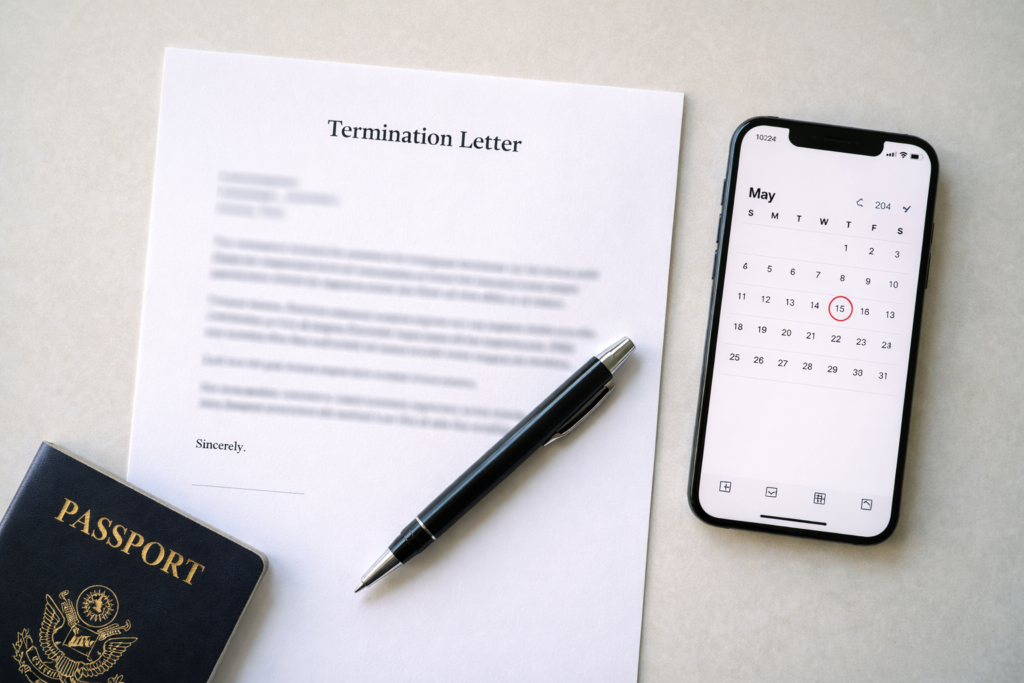
The 60-day window begins the day after your last official day of employment — as determined by your employer’s payroll and HR records. Not the day the termination notice hit your inbox. Not the day your building access was cut. Not the day you received your severance letter.
When severance is involved, this distinction becomes genuinely critical.
Picture two engineers laid off from the same company on the same date. The first receives an immediate termination with a lump-sum check. His employment ends that afternoon. His grace period starts the next morning. The second is placed on a 30-day notice period — still on payroll, still receiving health coverage, still technically an active employee in the company’s HR system. Her grace period doesn’t start until that 30 days ends.
Same company. Same layoff announcement. Completely different start dates.
(Source: https://bashyamglobal.com/blog/the-60-day-grace-period/)
The very first thing you do after a layoff — before updating your LinkedIn, before calling your recruiter, before anything — is get your official separation date confirmed in writing from HR. That date is the legal foundation of every calculation that follows.
If you’re not sure what your existing H-1B approval documents show or where to find the key dates on your I-797 notice, this guide on what your H-1B visa number is and where to find it walks through exactly what you’re looking at when you pull those documents out.
The I-94 Detail That Quietly Shortens Your Deadline
This is the part that catches people completely off guard, and it’s the most preventable mistake in the entire grace period conversation.
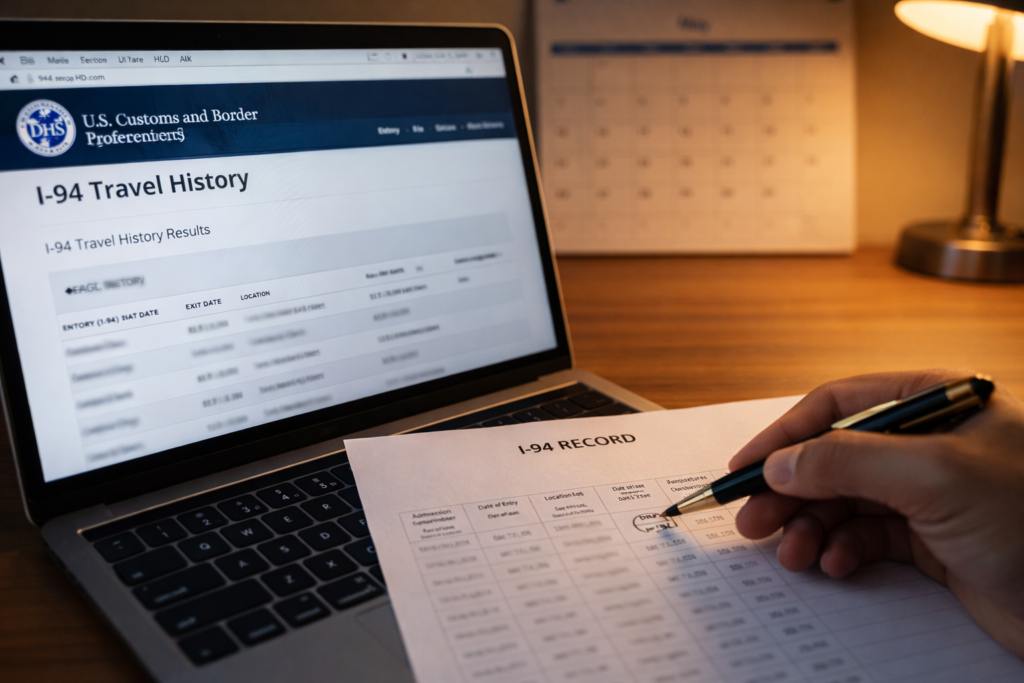
The grace period ends at whichever date comes first: 60 calendar days from your separation date, or the expiration date recorded on your I-94.
Your I-94 is the electronic record of your authorized period of stay in the United States. You can pull it up right now at https://i94.cbp.dhs.gov. Many H-1B holders — especially those who recently went through an extension or renewal — have I-94 dates that run close to their petition validity period. But some don’t. Some people have I-94 expiration dates that fall 30, 35, or 40 days from their layoff date.
If your I-94 expires in 38 days, your real deadline is day 38. Not day 60.
That’s not a technicality. That’s the rule as written. And it causes genuine, lasting harm to people who spend their first two weeks quietly job hunting without ever looking at their I-94.
Stop. Check your I-94 at cbp.dhs.gov before you read another word of this article. That date is your actual starting point — not the 60-day number that circulates in every group chat.
What Actually Protects Your Status — And What People Falsely Believe Does
This is the section where most of the real confusion lives. People hear that something is “pending” and assume they’re covered. The type of filing is everything.
What Does Protect You
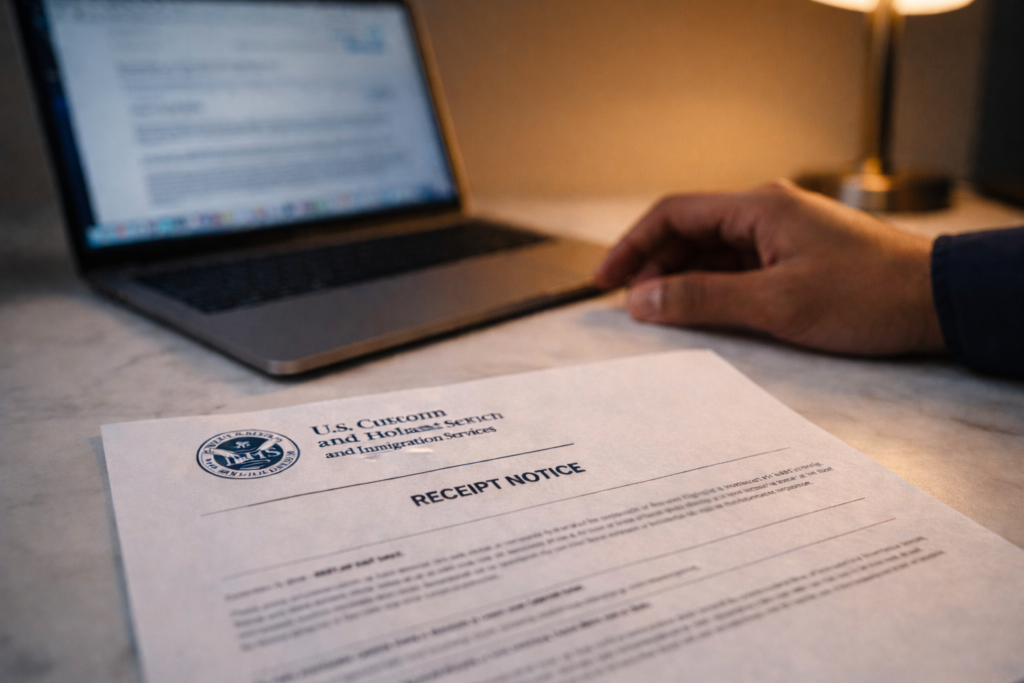
An H-1B transfer petition (Form I-129) filed with a new employer within the grace period. Once USCIS receives the petition and issues a receipt notice, your status is maintained through the entire adjudication — even if the 60-day window closes before a decision comes. The receipt notice is the document that matters. Before you have it, you have nothing.
A change of status application filed within the grace period. This covers changes to B-1/B-2 visitor status, F-1 student status, or H-4 dependent status. The critical legal point: the filing date establishes your protection, not the approval date. File before day 60, get approved three months later — you’re legally covered throughout that wait.
An adjustment of status filing if an immigrant petition is already approvable and a visa number is immediately available to you.
What Does NOT Protect You
A pending PERM labor certification. Full stop. PERM is a Department of Labor process — a labor market test initiated by your employer. It is not a USCIS petition. It has zero effect on your nonimmigrant status. Your 60-day clock runs completely independently of wherever your PERM stands.
An approved I-140 petition. Genuinely valuable for priority date purposes. Potentially portable to a new employer under AC-21 rules. But standing alone during a grace period, it provides no status protection.
Ongoing severance payments. Money is not employment. The legal relationship ended. Payments arriving afterward don’t extend it.
A job offer letter. An offer is a promise between two people. It has no legal standing with USCIS until a petition is actually filed.
(Source: https://www.kamalalaw.com/layoffs-and-h1b-60-day-grace-period-rule.html)
One thing that relieves a lot of people: an H-1B transfer to a new employer does not require re-entering the lottery. Your existing H-1B approval travels with you. If you’re curious how the current lottery system works or what the new cost rules look like for new petitions, this breakdown of H-1B lottery new rules and selection costs covers the full picture. And if your prospective employer is a university, nonprofit, or government research organization, they may qualify for cap exemption entirely — meaning the transfer process is even more straightforward. Here’s what H-1B cap exemption qualification actually requires.
The Receipt Notice: When You Can Actually Start Working Again
You landed an offer. The employer wants you to start Monday. So when exactly can you legally walk through that door?
Not at the offer. Not when the LCA is submitted. Not when the petition is mailed. The answer is specific: when the H-1B transfer petition has been filed with USCIS and you physically have the receipt notice. That’s the document. That’s the moment.
Here’s the realistic timeline from termination to first legal day of work:
Step 1 — Labor Condition Application (7–10 business days) Before anything can be filed with USCIS, the employer must obtain a certified LCA from the Department of Labor. This step cannot be meaningfully accelerated. Standard processing runs 7 to 10 business days. It’s the piece of the timeline most people forget to factor in.
Step 2 — I-129 Petition Preparation and Filing Once the LCA is certified, the employer assembles and submits Form I-129 with supporting documentation. A well-prepared employer with immigration counsel moves quickly here — a disorganized one does not.
Step 3 — Receipt Notice Arrives USCIS issues a receipt notice, typically within a few business days of receiving a properly assembled petition. This notice is your authorization to begin work.
From your last day at the old job to a receipt notice at the new one: minimum 2 to 3 weeks under smooth conditions. Which means if you were laid off today and received a job offer tomorrow, you’re still looking at 15 to 20 days before you can legally start.
Premium processing — currently $2,805 — is worth the conversation with your new employer. It doesn’t speed up the LCA step, but it guarantees a USCIS decision on the petition within 15 business days. When you’re on day 40 of a 60-day window, that certainty has real value.
The 2025 Shift: Why This Window Is More Fragile Than It Used to Be
Everything described above about the grace period has been true for years. What follows is specific to right now — 2025 — and it meaningfully changes the urgency calculation.
In February 2025, USCIS issued an internal policy memo removing categorical exemptions from immigration enforcement. Before this memo, officers generally understood the grace period as a protected window where people sorted out their status without interference. That informal understanding no longer applies uniformly across the agency.
Since that memo took effect, H-1B holders have been documented receiving Notices to Appear — NTAs, which are summonses to immigration court — while still inside their grace period. The enforcement logic being applied treats the discretionary grace period as exactly what the regulation says it is: discretionary. Something the agency can choose not to honor on a case-by-case basis.
There are credible reports of these NTAs being generated through automated AI-assisted systems, which introduces the possibility of errors reaching people whose circumstances would not, under careful human review, warrant enforcement action at all. The volume of notices has increased regardless of individual merit.
The USCIS guidance page that previously explained options for nonimmigrant workers following termination of employment was quietly archived in early 2025. The underlying regulations haven’t changed. But the public-facing commitment to explaining those options — and the informal protection that came with it — has been withdrawn.
(Source: https://www.uscis.gov/archive/options-for-nonimmigrant-workers-following-termination-of-employment-0)
What this means practically: acting in the first two weeks — not the last ten days — is more important right now than at any point in recent memory. The grace period still exists as a legal provision. The assumption that you’ll be left undisturbed for the full 60 days while you figure things out is the assumption that has become unreliable.

Your Real Options After an H-1B Layoff (Honestly Ranked)
You have more legitimate paths available than most people realize in that first week. Here’s an honest look at each one.
Option 1: H-1B Transfer to a New Employer
The most traveled path, and for good reason. Your existing H-1B approval transfers to a new sponsoring employer without a new lottery. The employer files the LCA, then the I-129, you get the receipt notice, you start work. The petition must be filed within the grace period — which, accounting for LCA time, means you need to start this process well before day 50.
If you’re evaluating potential employers and want to understand which ones have clean H-1B sponsorship records, the USCIS H-1B employer data hub is a public tool worth checking before accepting an offer.
Option 2: Change of Status to H-4
If your spouse currently holds H-1B status and is actively employed, you can file to convert to H-4 dependent status. If their employer also has an approved I-140 on file, you may eventually qualify for H-4 EAD — but that authorization takes several months to process. There will be a gap in your work authorization. Go into this option with eyes open about that gap and plan financially for it.
Option 3: Change of Status to B-1/B-2 Visitor
Filing a change of status to visitor classification before the grace period ends places you in authorized stay for the duration of the pending application. You cannot work. But you can remain in the U.S. legally, continue interviewing, and avoid accumulating unlawful presence while the job search continues.
This is a bridge. A useful one. Not a solution.
Option 4: Change of Status to F-1 Student
Genuine enrollment in an academic program is a legitimate path to maintained status. It requires actual enrollment, tuition payment, and engagement with a school’s international student services office. It is not a paperwork workaround. If you’re genuinely interested in advancing your education while the job market stabilizes, this option has real merit. If you’re looking for a shortcut, it isn’t one.
Option 5: Self-Sponsored Green Card — EB-1A or EB-2 NIW
For people who have built significant careers — patents, peer-reviewed publications, industry recognition, work that can credibly be framed as nationally beneficial — self-sponsored green card categories exist that don’t require employer sponsorship.
EB-1A is for individuals with extraordinary ability. EB-2 NIW is for those whose work serves a national interest that outweighs the normal labor market test requirement. Neither resolves an immediate 60-day crisis on its own. But combined with a concurrent I-485 filing strategy, they can create a path to an Employment Authorization Document that changes the entire equation. If your credentials are genuinely strong, this conversation with an immigration attorney is worth having even if it doesn’t become your primary plan.
Option 6: Voluntary Departure
Leaving the U.S. before the grace period expires is a legitimate strategic choice that deserves more consideration than it usually gets. Departing voluntarily means you accumulate zero unlawful presence. Your H-1B approval stays on record.
If you find a new employer while abroad and they file a transfer petition, you can re-enter the United States using your existing visa stamp and the new I-797 approval notice. No new lottery. No new cap. Provided the prior approval hasn’t expired, this path is clean.
When considering re-entry, understanding what your visa stamp needs to show and what the consular stamping process looks like is important. This 2026 guide to H-1B visa stamping for Indian professionals walks through what that process looks like at a consulate. And if you’re unsure what the visa number on your existing stamp actually means, this explanation of the visa number on the H-1B stamp clarifies what you’re looking at.
Comparison Table: H-1B Grace Period Options at a Glance
| Option | Work Authorized? | When to File | Maintains Status? | Best Suited For |
|---|---|---|---|---|
| H-1B Transfer | Yes — from receipt notice date | Within grace period; allow 2–3 weeks for LCA | Yes, through full adjudication | Anyone with a confirmed job offer from a sponsoring employer |
| H-4 Change of Status | Only after H-4 EAD approval — months later | File within grace period | Yes | Spouses of currently employed H-1B holders with valid status |
| B-1/B-2 Visitor Status | No work permitted in this status | File before grace period ends | Yes, while application is pending | Those actively job hunting without an offer yet |
| F-1 Student Status | CPT/OPT only with school authorization | File before grace period ends | Yes | Those genuinely enrolling in an academic degree program |
| EB-1A / EB-2 NIW | Via concurrent I-485 EAD filing | Months of case preparation required | Potentially, with correct concurrent strategy | Mid-to-senior professionals with strong independent credentials |
| Voluntary Departure | Not applicable — you leave the country | Depart before grace period expires | Preserves clean record; enables future re-entry | Those returning home to continue job search with new employer abroad |
What Happens When the Clock Actually Runs Out
This part doesn’t get said plainly enough in most articles. Here it is.
If the grace period closes — whether at 60 days or your I-94 expiration, whichever came first — without a petition filed or a departure from the country, you begin accumulating unlawful presence from that date forward.
The thresholds that create lasting consequences:
- Over 180 days of unlawful presence — triggers a 3-year bar on re-entering the United States
- Over 365 days of unlawful presence — triggers a 10-year bar
These are not administrative flags. They are not things an attorney can contest with the right letter. They are statutory bars written into immigration law. They attach permanently to your immigration record and surface at every future U.S. visa application, every green card interview, every consular appointment — for years. Sometimes for a decade.
The clock accumulates without any notification. No letter arrives. No automated email. No warning at all. You don’t know you’ve crossed a threshold until you’re sitting at a consular window in another country and the officer pulls up your record.
(Source: https://www.uscis.gov/archive/options-for-nonimmigrant-workers-following-termination-of-employment-0)

Four Real Scenarios That Show Exactly How This Goes Wrong
These aren’t constructed hypotheticals. They reflect patterns that surface repeatedly in immigration attorney offices and community discussions across the U.S.
The engineer who miscounted. A software engineer laid off in March assumed his I-94 and his 60-day window ended on the same date. He’d been through two H-1B extensions and assumed everything aligned. It didn’t. His I-94 expired 22 days before day 60 of what he believed was his grace period. His real deadline was mid-April. He discovered this on day 50, hired an attorney on an emergency basis, and filed just barely in time — only because a colleague asked him specifically about his I-94 date and prompted him to look.
The architect who trusted her PERM. A senior professional was deep in the employment-based green card process when her employer announced layoffs. She had a PERM labor certification actively pending with the Department of Labor and assumed that ongoing process protected her immigration status. It did not. PERM is a DOL labor market test — not a USCIS petition — and it has zero bearing on nonimmigrant status during a grace period. Her 60-day clock ran completely independently. She lost critical weeks before an attorney corrected her understanding.
The manager who made a strategic exit. A product manager approaching day 55 with no strong job offer evaluated two paths honestly: file a B-2 change of status and continue searching in the U.S., or return home and search from there. He chose to leave before the grace period expired. Six weeks later, he had an offer. The employer filed a transfer petition. He re-entered on his existing visa stamp with the new I-797. No unlawful presence. No bars. Clean record. Leaving wasn’t defeat — it was the right call given his specific situation.
The designer whose start date didn’t match her filing date. A UX professional received an offer 40 days into her grace period. The official start date on the offer letter was set for three weeks after day 60. Her attorney filed the transfer petition on day 44. The receipt notice arrived. Status maintained through the adjudication. She didn’t start working until after the grace period closed — and that was completely legal, because the grace period deadline applies to when a petition is filed, not when employment begins.
What You Should Do in the First 30 Days (Week by Week)
Weeks 1–2: Get Your Foundation Right
- Confirm your official separation date in writing from HR — not a verbal confirmation, an email or letter
- Check your I-94 expiration at i94.cbp.dhs.gov — this is your actual legal deadline
- Pull together every key immigration document: all I-797 approval notices, last three months of pay stubs, passport bio page, I-94 printout, any LCA copies accessible to you
- Contact an immigration attorney — many offer flat-fee consultations for exactly this situation. Do not make major decisions based solely on forums, WhatsApp groups, or articles including this one
During this period, also take stock of your financial situation. A layoff creates income uncertainty, and if your U.S. credit history is thin, this is the moment that becomes visible. Understanding how to build credit as an H-1B visa holder and which first credit cards make sense for immigrants in the U.S. can help you maintain stability during the gap. If you haven’t yet set up a proper U.S. banking structure, this guide on opening a bank account in the USA covers the full process.
Weeks 2–3: Move on the Immigration Front
- If you have a job offer, push the prospective employer to begin the LCA filing process immediately — every day the LCA sits in a queue is a day you cannot recover
- If no offer is confirmed, seriously evaluate whether a B-2 change of status is the right bridge to file before the grace period closes
- If you had a pending PERM or an approved I-140 with a priority date, speak with your attorney specifically about AC-21 portability — your priority date may be protectable even with a new employer if the conditions are met
Weeks 3–4: Push to Close
- Discuss premium processing with your new employer — the $2,805 fee eliminates the uncertainty of a standard processing timeline when days are genuinely scarce
- Do not travel internationally for any reason unless an immigration attorney has reviewed your visa stamp situation and specifically cleared the trip
- Confirm that your dependents — spouse and children on H-4 — are included in whatever petition gets filed. Their status resolution is tied directly to yours
If you’re also looking at your longer-term financial picture — retirement accounts, investment structures — a layoff is actually a useful time to review those. Resources on U.S. credit score fundamentals for immigrants and index fund comparisons like SPY vs VOO can help you make grounded decisions during an uncertain period. And if credit card debt has built up during the job search, these honest guides on paying off credit card debt fast and the most effective payoff strategies are worth working through.

Frequently Asked Questions
No — and this specific misunderstanding causes more unnecessary anxiety and false confidence than almost anything else. Severance money and employment status are legally separate things. If your employer terminates you immediately and pays severance as a lump sum, your clock starts that same day. If you’re kept on active payroll for a 30 or 60-day notice period — still on HR systems, still receiving benefits — your clock starts when that payroll period formally ends. The dollar amount of severance is completely irrelevant. The employment relationship is what the regulation looks at.
No. Work authorization ends the moment your H-1B employment ends. It doesn’t resume until USCIS issues a receipt notice for the new transfer petition. Working even one day before that receipt arrives is a status violation — the kind that gets recorded and surfaces in future immigration proceedings. The receipt notice is the specific document that restores authorization. Not the offer letter. Not the LCA approval. The receipt notice.
Then your real deadline is your I-94 expiration date, not day 60. The regulation is explicit: whichever comes first. This is not a technicality that can be argued around. If your I-94 expires in 32 days, you have 32 days. Check your I-94 right now at cbp.dhs.gov if you haven’t already — this is the single most overlooked detail in every grace period conversation.
A PERM labor certification that hasn’t been approved generally belongs to your former employer and doesn’t transfer. An approved I-140, however, may carry a portable priority date to a new employer under AC-21 portability rules — provided you’ve held H-1B status for at least 180 days and the new position falls in the same or a similar occupational category. This analysis has enough individual variables that it genuinely requires an attorney’s assessment. Forum answers on this specific question are frequently incomplete.
It applies to both. The regulation covers any cessation of employment — voluntary resignation and involuntary termination trigger identical grace period rules under the same discretionary framework. The reason for leaving doesn’t change the clock or the protections.

The Bottom Line
The 60-day grace period is a real legal provision that has helped thousands of skilled workers in the United States navigate an experience that can feel completely destabilizing. A layoff is not a moral failing. It doesn’t diminish your value, your contributions, or your right to the future you’ve been building here.
But the protection is conditional, discretionary, frequently shorter than people assume, and enforced more aggressively in 2025 than at any point in the past decade. The people who come through this cleanly share one consistent trait: they treated day one as the emergency it is. They checked their I-94 within 48 hours. They got their separation date confirmed in writing. They talked to an immigration attorney in week one, not week six. They pushed their new employer to start the LCA the day an offer was made. They understood that day 60 is not a finish line with buffer on the other side — it is a hard edge with permanent consequences if you cross it without a filing in place.
Know your actual deadline. Move in the first 30 days. Keep your documents organized before you need them urgently.
Disclaimer
The information in this article is intended for general educational purposes only and reflects publicly available immigration guidance and regulatory sources as of 2025. It does not constitute legal advice and should not be relied upon as a substitute for consultation with a qualified, licensed immigration attorney. U.S. immigration law is complex, changes frequently, and outcomes vary significantly based on individual circumstances including visa history, I-94 dates, employer actions, and current USCIS policy. Always consult a licensed immigration attorney for guidance specific to your personal situation before making any immigration-related decisions.