

Quick note before we start: This article is for informational purposes only and does not constitute legal advice. Immigration law is complex and fact-specific — always consult a licensed immigration attorney for decisions affecting your status. Official USCIS information is available at uscis.gov.
There’s a specific kind of stress that comes with H-1B extension season. It’s not panic. It’s more like a low hum — a background anxiety that runs through every big decision you try to make. Should you sign a new lease? Book a flight home? Accept that job offer?
You don’t know, because you don’t know when your case will move.
If you’ve been waiting months on a pending extension, that hum is familiar. And if you’re just starting this process, it’s worth knowing upfront: H-1B extensions in 2026 are slower, more scrutinized, and more expensive than they used to be. But they’re still very manageable if you understand what you’re actually dealing with.
This guide walks through the whole thing — the timelines, the fees, the 240-day rule, what happens if you travel, what happens if you get an RFE, and what your options look like if you’re approaching the six-year cap.

What You’re Actually Extending (It’s Not the Visa Stamp)
This trips people up more than anything else, so let’s get it out of the way first.
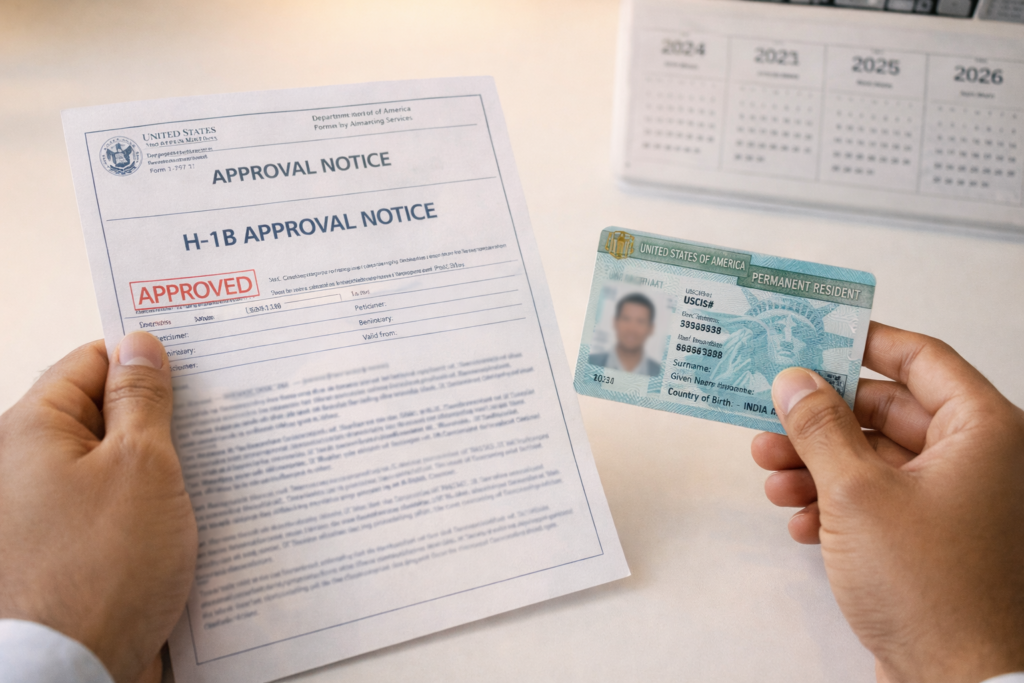
Your H-1B visa stamp — the one in your passport — and your H-1B status are two different things. When you file an extension, you’re extending your status, which is tied to your I-94 record and your I-797 approval notice. The stamp in your passport can expire, and you can still be in perfectly valid H-1B status inside the U.S.
The confusion causes real problems mostly when people travel. More on that later.
The standard H-1B structure is two periods of three years each, for a six-year total. Your employer files the first three-year petition, you work, and then — usually sometime in year two or three — they file the extension for the next three years. That’s the baseline. Most of what’s stressful right now is the timing of that process, not the concept.
If you’re past six years, or approaching it, there are separate pathways that keep you in valid status. We’ll get to those.
Who Can Actually Extend — Including the People With More Options Than They Know
Most H-1B workers can extend within the six-year cap as long as three things are true: the employer still wants to sponsor them, the job still qualifies as a specialty occupation, and status has been maintained continuously.
Beyond the six-year limit is where it gets more interesting. Under the American Competitiveness in the 21st Century Act (AC21) — the federal law that governs these extensions — you can go past six years if either of the following applies:
- A PERM labor certification was filed at least 365 days before your six-year cap date and is still pending or approved. In this case, you’re eligible for one-year extensions indefinitely until a decision is reached.
- An I-140 immigrant petition has been approved, regardless of whether a visa number is currently available. This unlocks three-year extensions, which is a much better position to be in.
The 365-day trigger on the PERM side is not a guideline — it’s a hard threshold. If the filing was 364 days before your cap date, you don’t qualify. This is exactly the kind of thing that benefits enormously from proactive planning with a competent immigration attorney.
One more category worth mentioning: some employers are entirely exempt from the H-1B cap. If you work for or are considering a move to a nonprofit research organization, a university, or a government research facility, the cap — and the lottery — may not apply at all.
For a full breakdown of who qualifies for cap exemption and how that filing works differently, see: H-1B Cap Exemption: Who Qualifies and How to Apply
How Long Is H-1B Extension Processing Actually Taking in 2026?
Let’s be direct about this, because the official USCIS numbers and the real-world experience are telling very different stories right now.
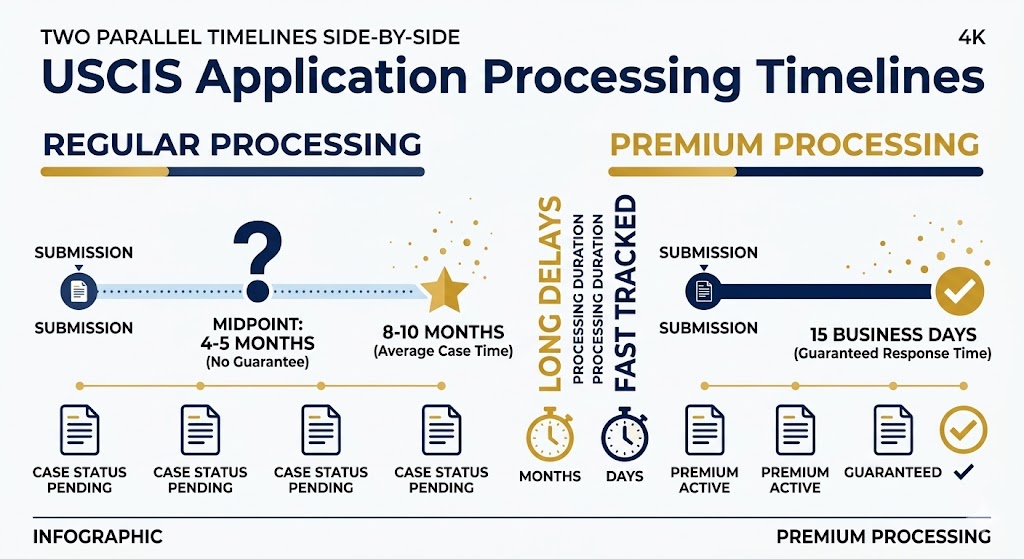
USCIS publishes estimated processing times on their case processing times page, and those figures hover around 7–8 months for standard processing. In practice, filings from spring 2025 were coming back approved in December 2025 and January 2026 at the Texas Service Center — meaning the actual gap was closer to 8–10 months for many people.
That’s not normal, and it’s not just a volume problem. RFE rates have climbed under the current administration compared to 2021–2023 levels, which means more cases are getting paused mid-process for additional evidence requests. When that happens, the 15-business-day premium processing clock stops — and restarts only after the response is submitted and accepted.
Real-world data from 2025–2026 filings:
- Receipt date April 24, 2025 → Approval January 14, 2026 (nearly 9 months)
- Receipt date May 15, 2025 → Approval February 4, 2026
- Receipt date June 5, 2025 → Still pending as of late February 2026
Premium processing, on the other hand, is performing closer to its advertised window. Most straightforward cases filed in January–February 2026 came back within 10–15 business days. The practical reality: if your expiration is more than six months away and your case is clean, standard processing can work. If you’re within four months of expiration, or you have any complexity in your case, premium processing is worth the cost.
The Full Fee Picture — Including the $100,000 One Everyone’s Confused About
H-1B extension fees are not a single number. They’re a stack of mandatory components, and the total shifts based on employer size and petition type. Here’s what’s actually in play for most extensions:
| Fee Component | Standard Employers (26+ FTE) | Small Employers (<25 FTE) |
|---|---|---|
| Base I-129 Filing Fee | $730 | $730 |
| ACWIA Training Fee | $1,500 | $750 |
| Fraud Prevention & Detection | $500 | $500 |
| Asylum Program Fee | $600 | $300 |
| Premium Processing (optional) | $2,965 | $2,965 |
| Estimated Total (no premium) | ~$3,330 | ~$2,280 |
| Estimated Total (with premium) | ~$6,295 | ~$5,245 |
Now about the $100,000 fee. This has caused enormous confusion, and understandably so.
In September 2025, a Presidential Proclamation introduced a $100,000 payment requirement tied to certain new H-1B petitions. Here’s what most articles don’t explain clearly: this fee primarily affects new H-1B petitions involving consular processing for beneficiaries currently outside the United States. It is not a standard fee applied to routine extensions for workers who are already inside the U.S. and maintaining valid H-1B status.
If your employer is extending your existing H-1B and you’ve been working here continuously in valid status, this fee almost certainly does not apply to you. But “almost certainly” is doing real work in that sentence — if there’s any ambiguity in your case, get a formal opinion from an immigration attorney before filing.
By law, employers cannot pass most mandatory H-1B fees to the employee. The ACWIA training fee, the fraud prevention fee, and the base filing fee are employer obligations.
The Document Checklist — and the Specific Things That Get People RFEs
Filing an H-1B extension means submitting Form I-129 (Petition for a Nonimmigrant Worker) along with a supporting package. The standard components include:
- Form I-129 with the H supplement
- A certified Labor Condition Application (LCA) from the Department of Labor
- An employer support letter detailing job duties, salary, and qualification requirements
- Evidence of the worker’s educational credentials and relevant experience
- Prior H-1B approval notices (I-797)
- Current I-94 records showing lawful status
- Payroll documentation or tax records demonstrating continuous employment
The items that trigger RFEs most often in 2026 are not the obvious missing documents. They’re the subtle documentation gaps:
Job description precision. A generic description like “software engineer performing development tasks” is not what USCIS wants to see. They’re looking for specific duties that map clearly to a specialty occupation definition — not job titles that could apply to someone without a bachelor’s degree.
Wage level mismatches. If the LCA lists a wage level that doesn’t match the actual complexity and requirements of the role, it’s a red flag. USCIS cross-references these, and an inaccurate prevailing wage level is one of the most common denial triggers right now.
Gaps in status evidence. If there’s even a short period where payroll records or employment documentation is unclear, expect the case to get flagged. Continuity of employment is central to the extension argument.
The 240-Day Rule: Read This Carefully Before You Assume You Can Keep Working
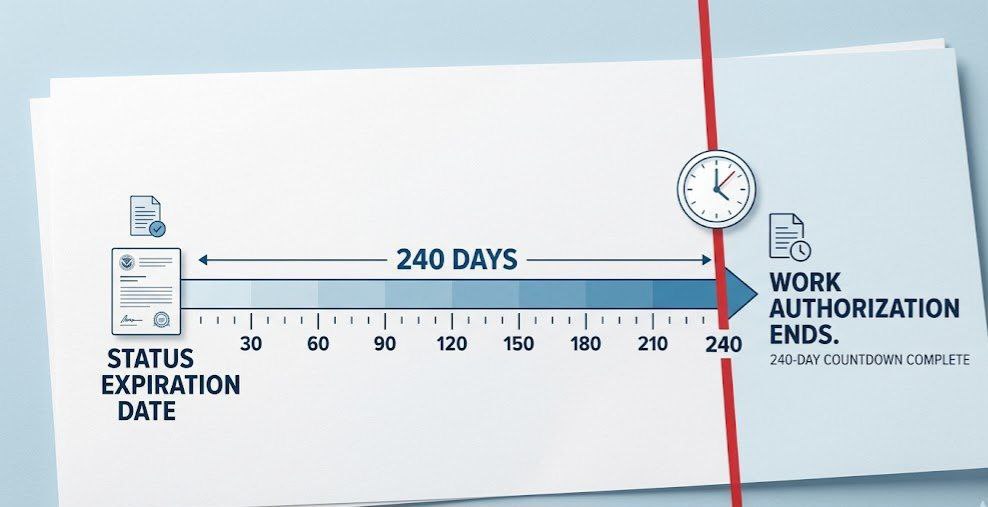
If your employer files an extension petition before your current status expires, you’re allowed to continue working for up to 240 days after that expiration date while you wait for a decision.
That sounds straightforward. Here’s where people go wrong:
The 240-day clock starts on your status expiration date — the date your I-94 or current I-797 runs out. Not the date you filed. Not the receipt date. The expiration date.
Here’s a real-world illustration: a worker’s status expired on September 30, 2025. The extension was filed in April 2025. The approval didn’t come until January 2026 — roughly 270 days after filing, but only about 107 days after the status expiration. That worker was fine. Had the approval come in June 2026, at 270 days post-expiration, they would have been out of authorized work status for 30 days by the time approval landed.
The other thing that trips people: once you’ve hit the 240-day limit, you must stop working. The pending petition doesn’t extend it further. And if you’ve worked a single day past that limit, it creates a status violation that can affect future applications.
The H-1B visa number on your documents ties directly to your petition record, which is where all of this tracks. If you’re unsure where to find that number or what it means: H-1B Visa Number: What It Is and Where to Find It
Can You Travel While Your H-1B Extension Is Pending?
Short answer: it’s complicated, and the risk level has gone up under the current administration’s enforcement posture.
The longer answer has two parts.
Your visa stamp vs. your petition status. You can re-enter the U.S. on a valid H-1B visa stamp even if it expires the day after you land — technically, entry is permitted as long as the stamp is valid at the time you board. But if both your stamp and your I-797 are expiring or expired, you have much less flexibility. Border officers have discretion in these situations.
The pending petition problem. If you have an extension petition pending and you depart the U.S. before it’s approved, current guidance suggests that a change-of-status petition may be considered abandoned. This matters most if your original petition involved a change of status rather than consular processing. The practical advice from immigration attorneys in 2026: do not travel internationally while an extension is pending unless you have explicit legal guidance that it’s safe in your specific situation.
If you do need to travel after approval, you’ll likely need a new visa stamp at a U.S. consulate abroad before re-entering. The I-797 approval notice is not a travel document.
For a full guide on what the stamping process looks like in 2026: H-1B Visa Stamping 2026 Guide
If you’re specifically navigating this as an Indian professional: H-1B Visa Stamping 2026 – Guide for Indian Professionals
And if you want to understand exactly where your visa number appears on your stamp: Visa Number on H-1B Stamp: What It Means and Where to Find It
What Happens If You Get an RFE or a Denial
An RFE — Request for Evidence — is not a denial. It’s USCIS saying: “We need more information before we can decide.” The bad news is it pauses your premium processing clock. The good news is it gives you a window to strengthen the petition.
A strong RFE response is specific, organized, and directly addresses each point raised. Generic supplemental letters or simply resending the same documents rarely work. The most common RFE responses that succeed involve updated job duty descriptions with more specificity, additional evidence of the employer-employee relationship, or expert opinion letters supporting the specialty occupation classification.
A denial is more serious. USCIS will provide written reasoning, and the petitioner has options:
- Motion to Reopen (MTR): Used when new facts or evidence exist that weren’t available at time of filing
- Motion to Reconsider (MTRec): Used when you believe USCIS misapplied the law to the existing record
- Refiling: In some cases, a new petition addressing the denial grounds is the cleaner path
If the denial stands and no viable path exists, the worker enters a grace period. This is where understanding your options quickly becomes essential. The 60-day grace period after job loss is a related but distinct protection — if you lose your job or your extension is denied, that clock matters enormously.
For a full explanation of the 60-day grace period and what it means for your options: H-1B 60-Day Grace Period After Layoff
Beyond Six Years: Using the Green Card Process to Stay Legal
If you’re approaching the end of your second three-year period, the extension question and the green card question become the same question.
The AC21 provisions that unlock post-cap extensions require either an approved I-140 or a PERM application that was filed at least 365 days before your cap-out date. This means the time to start the permanent residency process is not when you’re at month 68 of your H-1B — it’s somewhere around month 30 to 36.
Here’s why the I-140 path is significantly better if you can get there: once your I-140 is approved, you’re eligible for three-year extension increments. That’s a lot more breathing room than one year at a time while waiting on PERM.
The per-country backlog reality — particularly for workers from high-demand countries — means that an approved I-140 may not result in an available visa number for years. But that approved I-140 still protects your status, preserves your priority date, and keeps you authorized to work. It’s arguably the most important document in a long-term H-1B career.
For context on how the lottery process works and what the initial pathway into the H-1B system looks like: H-1B Lottery: New Rules, Costs, and Selection Process
Life on H-1B: The Financial Side Most Articles Skip
Here’s something the immigration guides rarely touch on — when your status is uncertain, your financial life gets uncertain too. Credit applications, mortgage approvals, bank accounts, investment accounts — many of these are affected by visa status in ways that aren’t obvious until you’re in the middle of it.
If you’re on H-1B and building your financial foundation in the U.S., a few resources worth bookmarking:
- Opening a U.S. bank account as a visa holder: How to Open a Bank Account in the USA
- Building credit history in the U.S. on an H-1B: H-1B Visa and Credit Cards: How to Build Credit in the USA
- Understanding your credit score as an immigrant: Credit Score in the USA: A Complete Guide
These aren’t immigration topics, technically. But they’re things people on H-1B need to navigate, and the sooner you start, the better position you’re in regardless of what happens with any individual petition.
Regular vs. Premium Processing: Comparison at a Glance
| Feature | Regular Processing | Premium Processing |
|---|---|---|
| Response Guarantee | None | 15 business days |
| Current Real Timeline (2026) | 8–10+ months | 10–15 business days (typical) |
| Additional Cost | $0 | ~$2,965 |
| Best For | Cases filed 6+ months early, no urgency | Approaching expiration, job changes, travel planned |
| RFE Impact | Adds months to timeline | Pauses 15-day clock; restarts after response |
| Can Be Upgraded Later? | Yes, by filing I-907 | N/A |
| Clock Start Date | Receipt date | Date I-907 is received |
| Service Centers | Texas, Nebraska, California, Vermont | Same |
Frequently Asked Questions
Up to six months before your current status expires. Filing at the six-month mark is strongly recommended — not optional — given current processing times.
No. It’s entirely petition-based. USCIS adjudicates extensions through document review, not in-person interviews.
You’ll need a valid H-1B visa stamp to re-enter. The I-797 approval notice alone is not sufficient for border entry. You’ll have to schedule a consular appointment for a new stamp before returning.
Yes, if you’re using H-1B portability under AC21. If you’ve been in H-1B status for at least 180 days and the new job is in the same or a similar occupational classification, a transfer can be filed while the extension is pending. The new employer starts that process separately.
The $215 electronic registration fee is for the initial H-1B cap lottery — the annual selection process for new H-1B numbers. It does not apply to extensions. This fee was significantly increased from the previous $10 amount starting in recent cycles.
Your employer’s attorney will receive the I-797 approval notice. Make sure you receive a copy. Review the dates on it carefully — your new I-94 validity date should match your I-797. If they don’t match, flag it immediately. Also check whether your dependent family members’ petitions have been handled concurrently.
The 15-business-day clock is paused when USCIS issues an RFE. Once you submit a response, USCIS has an additional 15 business days from receipt of that response to issue a decision.
Generally, no. Federal regulations prohibit employers from requiring H-1B workers to pay the ACWIA training fee, fraud prevention fee, or base filing fee. Premium processing is a gray area — courts have been inconsistent, but many attorneys advise employers to absorb this cost as well. If your employer is pressuring you to pay these fees, consult with an immigration attorney.
Disclaimer
The information in this article is provided for general educational purposes only. It does not constitute legal advice and does not create an attorney-client relationship. H-1B immigration law is subject to change, and individual circumstances vary significantly. Always consult a licensed U.S. immigration attorney before making decisions about your immigration status. USCIS fee amounts, processing times, and policy guidance referenced here are accurate as of early 2026 but should be independently verified at uscis.gov before filing.